
Do Mexicans Have Middle Names? Mexican Naming Customs Explained
Summary
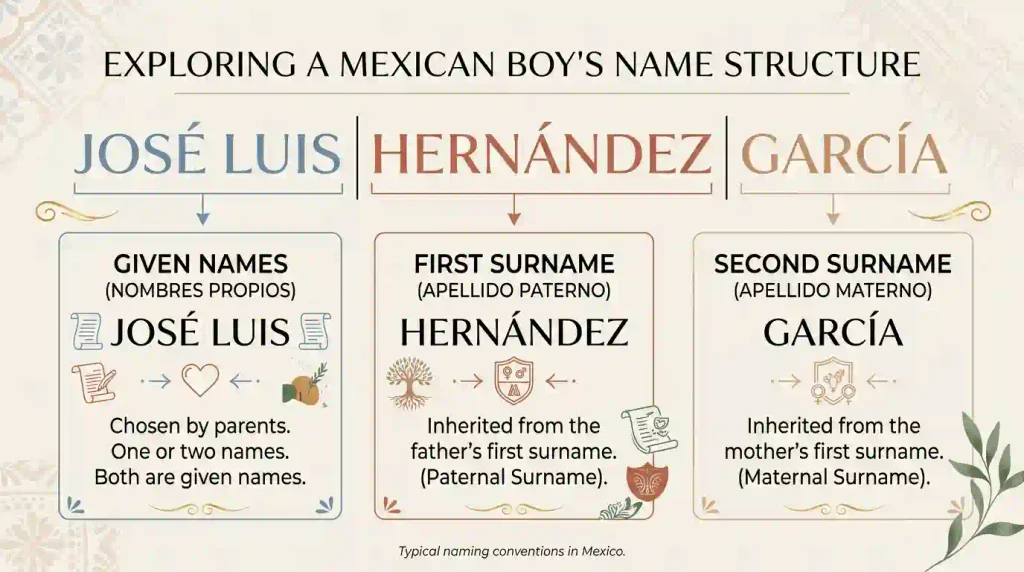
Do Mexicans have middle names? Sometimes, but Mexican names do not always fit the American idea of a first name, middle name, and last name. A person in Mexico may have one or more given names followed by two apellidos, traditionally representing family names from the father and mother. For example, in José Luis Hernández García, José Luis may be the person’s given names, while Hernández and García are two surnames—not a middle name and last name. This distinction becomes especially important when Mexican names are entered on U.S. forms, where a second given name may be treated as a middle name and one of the two surnames may accidentally be dropped. Mexican naming conventions also reflect Spanish history, Catholic traditions, saints’ names, grandparents’ names, marriage customs, and family identity. If you’re researching do Mexicans have middle names, choosing a Mexican-inspired boy name, or tracing family records, understanding given names, compound names, and the two-surname system will help you read Mexican names correctly.
Table of Contents
- Do Mexicans Have Middle Names? The Short Answer
- How Mexican Names Are Structured
- Are Two Given Names the Same as a First and Middle Name?
- How Mexican Surnames Are Used
- How Mexican Naming Customs Developed
- How Mexican Names Are Recorded in the United States
- How Naming Patterns Can Help With Mexican Family History
- What Happens When a Parent’s Surname Is Not Recorded?
- Examples of How to Read a Mexican Full Name
- Frequently Asked Questions About Mexican Middle Names
- Final Thoughts
Do Mexicans Have Middle Names? The Short Answer
Mexicans can have what English speakers would call middle names, but the traditional Mexican naming system does not depend on a separate middle-name category.
The most important distinction is between given names and apellidos, or surnames.
Consider this example:
José Luis Hernández García
An American reader might instinctively interpret the name as:
- José = first name
- Luis = middle name
- Hernández = middle or first last name
- García = last name
That can be misleading.
A more culturally appropriate interpretation would normally be:
- José Luis = given name or given names
- Hernández = first surname
- García = second surname
Luis may function somewhat like a middle name when the same person interacts with U.S. institutions, but within Mexican naming conventions it can simply be the person’s second given name or part of a compound given name.
This distinction becomes easier to understand after learning what is a middle name. The American middle-name system is only one way cultures organize personal names.
Mexican names traditionally use a two-surname system, although modern civil-registry laws and court decisions mean surname order should not be treated as an unchangeable father-first rule in every situation or every Mexican state.
The key principle is:
The second surname in a Mexican name is usually not a middle name.
It is another family surname.
That is the most important answer to remember.
How Mexican Names Are Structured
Mexican naming conventions make more sense when the full name is divided into two broad sections:
Personal names + family names
For example:
Juan Carlos Martínez López
can be understood as:
Given name(s): Juan Carlos
Apellidos: Martínez López
Mexican official records often separate these components rather than forcing the name into the American first-middle-last model.
If you’re studying naming traditions more broadly, understanding what is a name helps reveal why names can identify not only an individual but also family relationships, heritage, religion, language, and ancestry.
Given Names and Compound First Names
A Mexican child may receive one given name or multiple given names.
Common examples might include:
- José
- Carlos
- Alejandro
- Diego
- Santiago
- José Luis
- Juan Carlos
- Miguel Ángel
- Luis Alberto
- José Antonio
- Juan Pablo
- Carlos Eduardo
- Francisco Javier
Names such as José Luis and Juan Carlos are especially important when discussing Mexican middle names.
José Luis may consist of two personal names, but the person may experience them as a familiar combination rather than as an American-style first name and middle name.
Similarly:
Juan Carlos Ramírez Torres
does not necessarily mean:
First name: Juan
Middle name: Carlos
Last name: Ramírez Torres
Instead, his official name may effectively contain:
Nombre(s): Juan Carlos
Primer apellido: Ramírez
Segundo apellido: Torres
Both Juan and Carlos belong to the personal-name section.
The distinction matters when researching why do we have middle names, because the reasons cultures add additional personal names differ widely.
A second given name can honor relatives, saints, godparents, family traditions, or simply reflect the parents’ preferences.
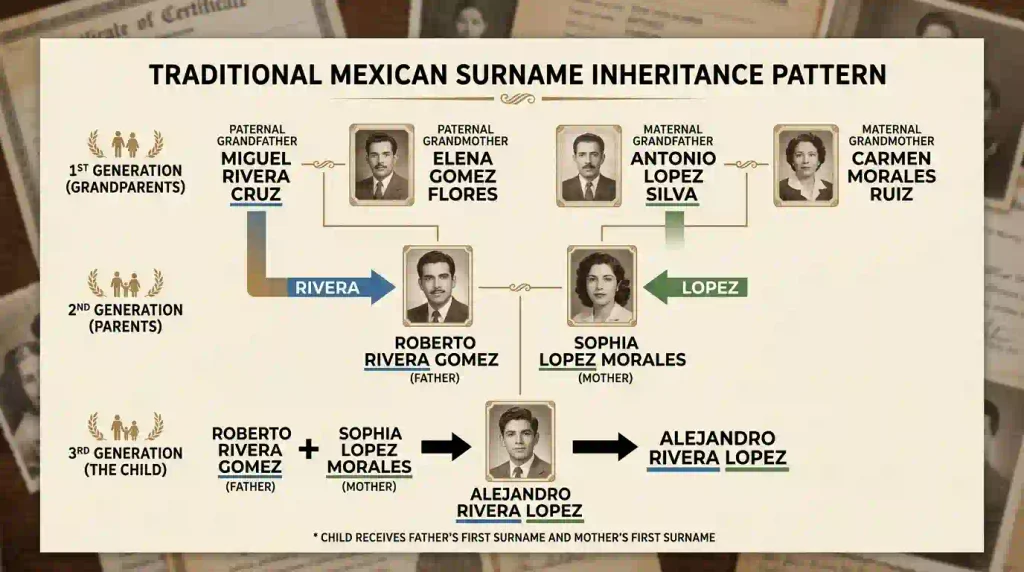
The Two Apellidos: Paternal and Maternal Surnames
The traditional Mexican naming pattern uses two apellidos.
Historically, the most familiar arrangement has been:
Father’s first surname + mother’s first surname
Suppose the father is:
Carlos Hernández Ruiz
and the mother is:
Elena García López
A child could traditionally be named:
Mateo Hernández García
Here:
- Mateo = given name
- Hernández = surname inherited from the father
- García = surname inherited from the mother
This makes both parental family lines visible in the child’s full name.
The first surname has traditionally been called the apellido paterno, while the second has traditionally been called the apellido materno.
You may also see more neutral modern terminology:
- primer apellido = first surname
- segundo apellido = second surname
That distinction is increasingly useful because Mexican law and court decisions have recognized that parents can have rights regarding the order of their children’s surnames. Rules can also differ among Mexico’s states.
Therefore, the traditional father-first structure remains extremely important for understanding Mexican records and naming customs, but it should not be treated as the only legally possible order in every modern case.
This is also why questions like what cultures have middle names cannot be answered by simply counting how many words appear in someone’s name.
Two additional words might represent two surnames rather than middle names.
What “Apellido” Means
The Spanish word apellido means surname or family name.
Its plural form is apellidos.
So when a Mexican form asks for:
Primer apellido
it is asking for the first surname.
When it asks for:
Segundo apellido
it is asking for the second surname.
The term does not mean middle name.
This is an essential distinction for English speakers.
Imagine someone named:
Daniel Alejandro Mendoza Cruz
The structure could be:
Nombre(s): Daniel Alejandro
Primer apellido: Mendoza
Segundo apellido: Cruz
Alejandro belongs with the nombre(s), while Mendoza and Cruz belong with the apellidos.
Simply placing all four names into an American first-middle-last pattern can change the meaning of the original name.
What Appears on a Mexican Birth Certificate?
A Mexican birth certificate, or acta de nacimiento, provides one of the clearest ways to understand the naming structure.
Mexico’s civil registry typically distinguishes the person’s given name or names from the surnames.
Official Mexican birth-record systems use fields such as:
- Nombre(s)
- Primer Apellido
- Segundo Apellido
- Sex
- Date of birth
- Place of birth
- Registration information
- Parentage information
The Mexican government’s official information about certified birth certificates likewise uses the structure nombre(s), primer apellido, segundo apellido when identifying a registered person.
Nombre(s), Primer Apellido, and Segundo Apellido
The key word here is nombre(s).
The plural marker shows that the given-name field can contain more than one personal name.
For example:
Nombre(s): Miguel Ángel
Primer Apellido: Rodríguez
Segundo Apellido: Sánchez
Miguel Ángel is not automatically split into first name Miguel and middle name Ángel in the Mexican record.
Both can appear under Nombre(s).
This is one of the strongest reasons you should not assume that Mexican naming conventions match American naming conventions.
For parents choosing names today, this also provides useful inspiration. A family can create a meaningful combination by pairing names based on sound, family heritage, or religious significance.
Our guide on how to choose a baby name can help if you’re deciding between one given name and a two-name combination.
Are Two Given Names the Same as a First and Middle Name?
Not necessarily.
From an American perspective, two given names often look like a first name and middle name.
From a Mexican perspective, both can belong to the nombre(s) portion of the person’s official identity.
The distinction depends on cultural context and how the person and government documents use the name.
How Compound Names Work as a Single Given Name
Some combinations are so familiar that they often function together in everyday life.
Examples include:
- José Luis
- José Antonio
- José Manuel
- Juan Carlos
- Juan Pablo
- Miguel Ángel
- Luis Miguel
- Luis Alberto
- Carlos Alberto
- Francisco Javier
A man named José Luis may regularly be called José Luis rather than simply José.
In that sense, the combination behaves more like a compound personal name.
Compound names can be especially significant in Spanish-speaking Catholic communities because names such as José and María have long been combined with additional names.
For example, José may appear as part of combinations such as:
José Antonio
José Manuel
José Miguel
José Francisco
The second element helps distinguish the individual while maintaining the traditional or religious first element.
Parents exploring Boy Names can use this approach when seeking combinations that honor both family traditions and individual identity.
Why Someone May Go By the Second Part of a Given Name
A person with two given names does not always use the first one socially.
Consider:
José Fernando Castillo Reyes
Friends and relatives may call him:
Fernando
instead of José.
This does not necessarily mean Fernando is merely a middle name.
His official nombre(s) may still be José Fernando.
There are several reasons someone might prefer the second name:
- many relatives share the same first name
- the first name is religious or ceremonial
- the family has always used the second name
- the second name provides easier identification
- personal preference changes over time
A person may therefore have one official given-name combination and a somewhat different everyday name.
This can create confusion in school, immigration, banking, genealogy, and international travel records.
It also illustrates why what is in a name meaning involves more than literal etymology. How a family uses a name can be just as important as its dictionary meaning.
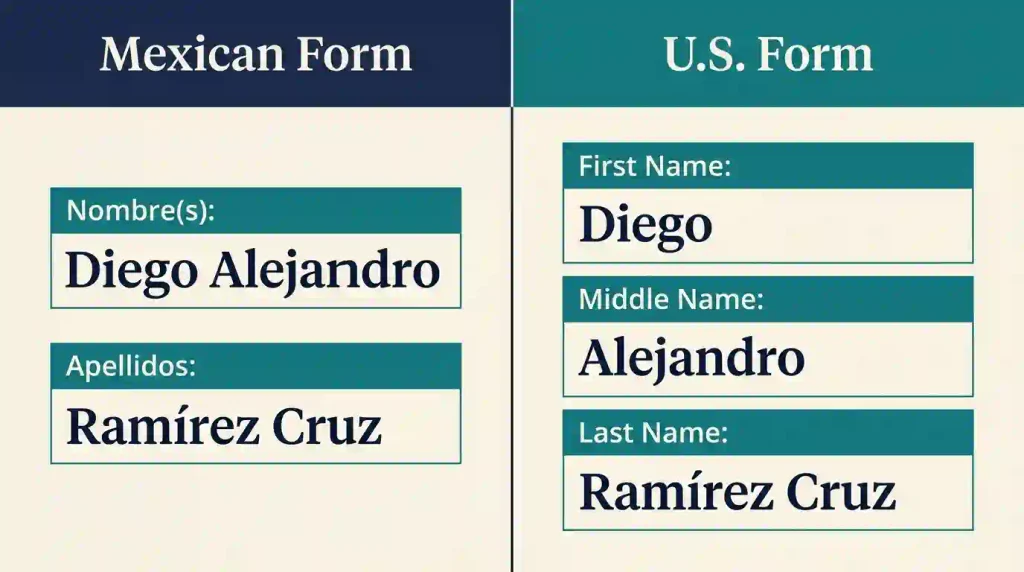
When a Given Name May Be Treated as a Middle Name in the United States
The situation often changes when someone moves to or is registered in the United States.
U.S. databases commonly request:
First Name
Middle Name
Last Name
Suppose a Mexican passport or birth record identifies:
Nombre(s): Diego Alejandro
Primer Apellido: Ramírez
Segundo Apellido: Cruz
A U.S. system may reformat that information as:
First Name: Diego
Middle Name: Alejandro
Last Name: Ramírez Cruz
Alejandro may therefore become a practical middle name in the U.S. record, even though it originated as the second of two given names.
That administrative conversion does not change the cultural origin of the name.
It simply adapts it to another system.
Our guide to middle names in the US explains why American forms place so much emphasis on the first-middle-last structure.
Questions about Mexican names are therefore similar to—but still culturally different from—questions such as do Indians have middle names or do Greeks have middle names.
Each naming system has to be understood on its own terms.
How Mexican Surnames Are Used
The two-surname system is one of the defining characteristics of Mexican and broader Spanish naming customs.
However, having two surnames does not mean both are always spoken in ordinary conversation.
Which Surname Is Usually Used When Addressing Someone?
Traditionally, the first apellido is the surname most commonly used when shortening a person’s full name.
For example:
Alejandro Martínez López
may commonly be referred to as:
Alejandro Martínez
rather than Alejandro López.
Likewise:
Dr. Carlos Hernández García
might ordinarily be addressed as:
Dr. Hernández
The second apellido still belongs to his complete family name. It has simply been omitted in the shorter everyday form.
This is why Americans sometimes mistakenly conclude that the second surname is less official.
It may still appear on:
- birth certificates
- passports
- CURP records
- school records
- civil registry documents
- marriage records
- legal documents
- genealogical records
The person’s everyday name and full legal name therefore do not always contain the same number of words.
How Marriage Can Affect a Woman’s Surname
Another major difference between Mexican and traditional American customs involves marriage.
A Mexican woman does not automatically replace her birth surnames with her husband’s surname simply because she marries.
Her birth name remains important in Mexican official identity systems.
Historically and socially, some married women have used their husband’s surname with de.
For example:
María López García de Hernández
could traditionally convey the idea of María López García being married to a Hernández.
However, this social convention should not be confused with assuming that every Mexican woman’s legal surnames automatically change at marriage.
Modern Mexican passports are fundamentally tied to the person’s legal identity and birth surnames, while a spouse’s surname may be handled separately depending on the document and circumstances.
This distinction is useful if you encounter “de” inside a Spanish name and wonder whether it functions as a de middle name. In many cases, de is a linguistic or marital name element rather than a middle name.
It is also a good example of why are names gendered: historical naming traditions can reflect marriage, family relationships, grammar, religion, and social expectations.
How Mexican Naming Customs Developed
Mexican names reflect centuries of history.
The modern system combines Spanish linguistic traditions, Catholic influences, family customs, civil-registration practices, and regional differences.
Spanish Influences on the Two-Surname Tradition
Mexico inherited much of its naming framework from Spanish naming customs.
The two-surname tradition helps represent both parental family lines.
Traditionally, a child commonly received one family surname associated with the father and another associated with the mother.
Consider three generations.
Grandfather: Roberto Mendoza Vargas
Grandmother: Elena Torres Castillo
Their son might be:
Carlos Mendoza Torres
Carlos later has a child with:
Ana Rodríguez Flores
Their child might traditionally be:
Mateo Mendoza Rodríguez
Notice how the family names move from one generation to the next.
Mateo’s two surnames connect him to both parents, while earlier surnames remain discoverable by looking at previous generations.
This structure can be extremely useful in family history research.
It also explains why losing the second apellido from a foreign record can remove valuable genealogical information.
How Family and Religious Traditions Influence Given Names
Family traditions can influence given names just as strongly as surnames.
A boy might be named after:
- his father
- paternal grandfather
- maternal grandfather
- godfather
- another respected relative
- Catholic saint
- biblical figure
Grandparents’ names remain especially meaningful in many families.
Catholic history has also strongly influenced Mexican given names.
Traditional boys’ names may include:
- José
- Juan
- Miguel
- Gabriel
- Rafael
- Francisco
- Antonio
- Jesús
- Ángel
- Santiago
Many of these names have biblical or religious associations.
Saints’ names can be chosen because a child is born near a saint’s feast day, because the family has a particular devotion, or because the saint’s name has been used for generations.
Historically, a baptismal name recorded in church or parish records might also become important when researching older families.
That does not mean every modern Mexican baby is named according to Catholic tradition. Contemporary parents choose from international names, modern Spanish names, indigenous names, biblical names, family names, and countless other sources.
For parents trying to balance family heritage with a name that sounds good today, how to pick a middle name offers strategies that can also be applied to choosing a second given name.
How Mexican Names Are Recorded in the United States
Problems often begin when a naming system designed around two surnames enters a database designed around one surname.
Mexican-American families, immigrants, students, employees, travelers, and dual citizens frequently encounter this issue.
How to Enter Given Names and Two Surnames on U.S. Forms
There is no single answer that applies to every U.S. form.
The safest principle is:
Follow the instructions for that specific form and match the identity document the form tells you to use.
For example, a U.S. visa application may instruct applicants to enter all surnames exactly as they appear in their passport.
Suppose a passport identifies:
Given names: Juan Carlos
Surnames: Mendoza García
A form asking for all family names may require:
Surname/Family Name: Mendoza García
Given Names: Juan Carlos
Another system may provide:
First Name
Middle Name
Last Name
and require a different formatting convention.
Never assume that:
- the second given name must always go in “middle name”
- the second surname belongs in “middle name”
- only the first surname should be entered
- a hyphen should be added automatically
Instead, read the instructions and use the same spelling and order as the document requested by the agency.
This is particularly important with government records.
Why a Mexican Name May Be Shortened or Reformatted in U.S. Records
Consider:
Carlos Eduardo Hernández Morales
Different systems could potentially display this as:
Carlos E. Hernández Morales
Carlos Eduardo Hernández
Carlos Hernández
Carlos E. Hernandez-Morales
or another variation.
Some variations arise from:
- limited database fields
- character limits
- accent marks being removed
- second surnames being omitted
- second given names being treated as middle names
- two surnames being hyphenated
- users entering their own names differently
- clerks misunderstanding Spanish naming customs
Hyphenation deserves special attention.
Mexican surnames do not need to be hyphenated simply because there are two of them.
Hernández Morales
and
Hernández-Morales
are not automatically interchangeable spellings.
A hyphen should not be invented just to make a database recognize two words as one surname unless the relevant official process requires or establishes that form.
Keeping Names Consistent Across Official Documents
Consistency matters far more than trying to make every name resemble an American name.
When dealing with official records, compare:
- Mexican birth certificate
- Mexican passport
- U.S. immigration documents
- Social Security records
- state identification
- driver’s license
- school records
- banking records
- employment records
If your passport shows two surnames, dropping one in another official system may eventually cause discrepancies.
The same applies to two given names.
A person officially named José Antonio should not casually switch among José Antonio, José A., Antonio, and José without considering how each government or financial institution records identity.
For everyday social use, shortened names are normally much less important.
For official identity, consistency is valuable.
This issue is not unique to Spanish names. Readers researching is bin a middle name encounter the same broader problem: a naming element from one culture can be incorrectly forced into the “middle name” field of another culture.
How Naming Patterns Can Help With Mexican Family History
The structure of Mexican names can be extremely valuable to genealogists.
A full name may reveal clues about both sides of a family.
Using Given Names and Surnames to Trace Family Relationships
Imagine finding an old record for:
Manuel García Hernández
You later discover a marriage record for:
Pedro García López
and
Rosa Hernández Martínez
The surname structure provides a clue that Manuel could be their child.
Why?
Because:
Pedro’s first surname = García
Rosa’s first surname = Hernández
Manuel’s surnames = García Hernández
That pattern does not prove the relationship by itself, but it can help identify which records deserve further investigation.
You can then confirm the relationship using:
- Mexican birth certificates
- civil registry records
- marriage records
- death certificates
- census records
- parish records
- baptism records
- immigration records
Given names can provide additional clues.
A grandfather named Francisco Javier may have several descendants named Francisco, Javier, or Francisco Javier.
Relatives may repeat saints’ names or grandparents’ names across generations.
Understanding these patterns makes Mexican family history research much more efficient.
Why Names May Appear Differently in Historical Records
Historical records require caution.
A person may appear differently across:
- civil registry documents
- baptism records
- parish records
- immigration manifests
- U.S. census records
- marriage records
- death certificates
For example:
Francisco Javier Rodríguez Martínez
could appear elsewhere as:
Francisco Rodríguez
Javier Rodríguez
Francisco J. Rodríguez
Francisco Rodríguez Martínez
Francisco Rodriguez Martinez
Accent marks may disappear.
Second surnames may be omitted.
Given names may be shortened.
A familiar everyday name may replace the complete baptismal or legal name.
Clerks may reverse surnames or misunderstand which element belongs in which field.
International migration creates additional possibilities.
A second apellido may be mistaken for a middle name and then disappear from later generations of records.
This is why genealogists should compare relationships, dates, places, parents, and siblings rather than rejecting a record simply because the name formatting is slightly different.
The same principle applies to name pronunciation: spelling, pronunciation, transliteration, and administrative formatting are separate aspects of a person’s identity.
What Happens When a Parent’s Surname Is Not Recorded?
Not every Mexican family record fits the idealized two-parent, two-surname example.
A person’s record may contain only one surname, or the surname structure may differ because of the circumstances surrounding registration.
Situations can include:
- only one parent being legally recorded
- a parent not recognizing parentage at registration
- a foreign parent having only one surname
- incomplete historical records
- legal changes to parentage
- adoption
- variations in state civil-registry rules
Mexican government systems already recognize that some individuals may not have a segundo apellido.
For example, the CURP system accounts for cases in which a person has no second surname rather than pretending that another name exists.
When a foreign parent has only one surname, Mexican consular registration forms can likewise leave the second-surname field empty.
In some registration situations where only the mother’s filiation is established, a child’s surnames may derive from the mother’s family surnames according to the applicable civil-registry rules.
The important principle is:
Never invent a second apellido simply because a form contains a box for one.
Use the person’s legally recorded name.
Because Mexico has state-level civil registries and family law can depend on jurisdiction and circumstances, anyone dealing with a real legal registration issue should follow the instructions of the relevant Registro Civil or Mexican consulate.
Examples of How to Read a Mexican Full Name
Examples make the distinction between middle names and Mexican surnames much clearer.
Example 1: One Given Name and Two Surnames
Diego Ramírez Torres
Given name: Diego
First apellido: Ramírez
Second apellido: Torres
Diego does not have an obvious second given name.
Torres is not his middle name.
Example 2: Two Given Names and Two Surnames
José Luis Hernández García
Given names: José Luis
First apellido: Hernández
Second apellido: García
In Mexico, Luis can belong to the nombre(s) field.
In some U.S. systems, it may be treated as a middle name.
Example 3: Compound Given Name
Juan Carlos Mendoza Rodríguez
Given name: Juan Carlos
First apellido: Mendoza
Second apellido: Rodríguez
Juan Carlos may be used together in everyday life.
Carlos should not automatically be interpreted as a conventional American middle name.
Example 4: Person Uses the Second Given Name
José Fernando Castillo Reyes
Legal given names: José Fernando
Everyday name: Fernando
First apellido: Castillo
Second apellido: Reyes
Someone who knows him socially may think his name is Fernando Castillo even though his official name contains four elements.
Example 5: Traditional Surname Inheritance
Father:
Miguel Ortega Sánchez
Mother:
Lucía Vargas López
Child:
Mateo Ortega Vargas
The traditional pattern gives Mateo the father’s first surname, Ortega, and the mother’s first surname, Vargas.
Modern rules may permit different ordering choices depending on the jurisdiction and registration circumstances.
Example 6: Mexican Name on an American Form
Original name:
Andrés Felipe Moreno Cruz
A U.S. database might represent it as:
First name: Andrés
Middle name: Felipe
Last name: Moreno Cruz
This does not mean Felipe originated as an American-style middle name. It may simply be the person’s second given name.
Example 7: Married Woman
Birth name:
Elena Martínez López
She marries:
Carlos Hernández Ruiz
Her Mexican legal identity does not automatically become Elena Hernández simply because of marriage.
A social or marital reference involving the husband’s surname may appear in some contexts, but her birth surnames remain important for official identity.
Mexican Names Compared With Other Naming Cultures
Mexican naming conventions become easier to understand when compared with other systems.
In the United States, one personal name often appears between the first and last name.
In Greece, a parental identifier can sometimes be mistaken for a middle name, which is why the question do Greeks have middle names requires cultural context.
In South Asian naming systems, surnames, fathers’ names, caste names, regional customs, and multiple personal names can interact in different ways, as explained in our guide to do Indians have middle names.
Arabic names create yet another structure, where lineage elements should not automatically be classified as middle names.
French naming traditions are different again; our guide to middle names in French explores how additional given names function there.
The broader lesson is simple:
A name’s position does not always reveal its purpose.
Before calling something a middle name, determine whether it is:
- a second given name
- compound given name
- paternal surname
- maternal surname
- lineage name
- surname particle
- patronymic
- religious name
- another culturally specific identifier
Frequently Asked Questions About Mexican Middle Names
Do Mexicans have middle names?
Yes, Mexicans can have multiple given names, although the second given name is not always understood exactly like an American middle name.
Do Mexicans normally have two last names?
Traditionally, Mexican names commonly include two surnames representing two family lines.
Is the second surname a middle name in Mexico?
No, the segundo apellido is a surname, not a middle name.
What does apellido mean?
Apellido means surname or family name.
What does primer apellido mean?
Primer apellido means first surname.
What does segundo apellido mean?
Segundo apellido means second surname.
What does nombre(s) mean on a Mexican form?
Nombre(s) refers to a person’s given name or given names.
Can a Mexican person have two given names?
Yes, names such as José Luis, Juan Carlos, and Miguel Ángel are common examples.
Is José Luis one name or a first and middle name?
It can function as a two-part or compound given name rather than necessarily following the American first-middle pattern.
Why do Mexicans have two surnames?
The traditional system reflects family connections through both parental lines.
Does the father’s surname always come first in Mexico?
It is the traditional pattern, but modern surname-order rules can vary and parents’ naming rights have been recognized by Mexican courts.
Which Mexican surname is usually used socially?
Traditionally, the first apellido is most often used when shortening the full name.
Does a Mexican woman lose her surnames after marriage?
No, marriage does not automatically erase her birth surnames from her Mexican legal identity.
What does “de” mean in a married Mexican woman’s name?
Historically, “de” could connect a married woman socially with her husband’s surname, but it is not a conventional middle name.
Can a Mexican surname contain a space?
Yes, surnames and surname particles can contain multiple words.
Should two Mexican surnames be hyphenated in the United States?
Not automatically; follow the spelling and formatting on the relevant legal identity document and form instructions.
Can the second apellido be omitted?
It may be omitted socially, but official records should follow the person’s legally documented name.
What happens if someone has no second surname?
Official systems can accommodate people who legally have only one surname.
Can a Mexican second given name become a middle name in America?
Yes, U.S. systems may record a second given name in the middle-name field.
Should I put my second Mexican surname in the middle-name box?
Usually you should not assume that; follow the form’s instructions and the surname information on your official document.
Are Mexican birth certificates issued with separate surname fields?
Modern records commonly distinguish nombre(s), primer apellido, and segundo apellido.
Are Mexican names useful for genealogy?
Yes, two surnames can provide valuable clues linking individuals to both parental family lines.
Do baptismal records help with Mexican genealogy?
Yes, historical parish and baptismal records can provide names, parents, godparents, and other family information.
Why do Mexican names sometimes look different in U.S. records?
U.S. databases may omit a surname, treat a second given name as a middle name, remove accents, or reformat the surname.
Can someone have two middle names?
Depending on the legal system, yes; see our guide explaining can you have two middle names.
Are Mexican naming customs the same everywhere in Latin America?
No, many countries share Spanish naming traditions, but laws and everyday practices vary by country and region.
Final Thoughts
So, do Mexicans have middle names? They can, but understanding Mexican names requires looking beyond the American first-middle-last model. A Mexican person may have one or more given names followed by two apellidos, and a second given name can sometimes become a middle name when the name is reformatted in the United States. The second apellido, however, is a family surname—not a middle name.
Understanding this structure helps parents choose culturally meaningful names, prevents mistakes on international forms, and makes Mexican genealogical records much easier to follow.
If you’re exploring names for a baby boy or want to understand how different cultures build personal names, browse our Naming Guides for more cultural naming traditions, meanings, and practical naming advice.