
How to Pick a Middle Name: Meaning, Flow, and Practical Tips
Choosing your son’s first name can feel like the biggest naming decision—until you try to find a middle name that fits. You may want to honor a grandfather, preserve your heritage, or use a favorite name that did not make the first-name shortlist. Learning how to pick a middle name becomes easier when you give that choice a clear purpose and test the complete combination. Start with the first name and surname, then compare a few possibilities for sound, meaning, spelling, and initials. A short middle name might bring balance, while a longer one might add a rhythm you love. However, no syllable formula can decide what matters most to your family. This guide focuses on boy names, with practical examples, family naming advice, and a comparison worksheet to help you narrow your options. You will also discover how to handle honor-name disagreements, check combinations across languages, and avoid common mistakes. The goal is a middle name you appreciate—one that sounds comfortable and adds something meaningful to your son’s full name.
Table of Contents
- Understand What a Middle Name Can Do
- Decide Your Middle-Name Priorities Before Browsing
- Find Middle-Name Ideas and Build a Shortlist
- Choose a Middle Name That Flows With the Full Name
- Honor Someone Through a Middle Name
- Handle Family Expectations and Honor-Name Disagreements
- Choose a Middle Name With Meaning
- Explore Middle-Name Ideas by Style and Length
- Choose a Middle Name for Different Family Situations
- Decide Whether to Use No Middle Name, One, or Two
- Test Your Shortlisted Middle Names in Everyday Use
- Avoid Common Mistakes When Picking a Middle Name
- Compare Your Finalists With a Middle-Name Worksheet
- Try Your Preferred Middle Name Before Finalizing It
- Make Your Final Middle-Name Decision
- Frequently Asked Questions
- Final Thoughts
Understand What a Middle Name Can Do
Before browsing suggestions, consider the middle name’s role. It usually sits between the first name and surname in the naming structure many U.S. families use.
If you are wondering what is a middle name, understanding its purpose gives you a useful starting point. It can carry a family story, improve the full name’s sound, or provide another name your child may use.
Preserve Family Connections and Cultural Heritage
A middle name can connect your son with grandparents, godparents, or earlier generations. It may also preserve a name from a language your family speaks.
You can explore why do we have middle names to understand how this naming position can serve different purposes. For your own choice, decide which connection you want to carry forward.
Add Meaning and Personal Significance
Some parents choose a name because it represents a value, place, or memory. Others simply love a name they have known for years.
Personal significance does not require an impressive origin story. A name connected with a meaningful friendship or family experience can matter just as much as an ancient name with a widely quoted definition.
Improve the Rhythm of the Full Name
A middle name changes how the complete combination sounds. Leo Alexander Brooks has a different rhythm from Leo James Brooks.
Neither is automatically better. The longer middle creates movement, while the shorter option keeps the combination compact. Say both aloud and notice which feels more natural in your own pronunciation.
Provide an Alternative Name Your Child Could Use
Your son may eventually prefer his middle name for everyday or professional use. Choosing one you genuinely like gives him another option.
For example, a child named William Ellis might later prefer Ellis. You cannot predict his preference, but you can avoid treating the middle position as a place for a name nobody particularly wants.
Decide Your Middle-Name Priorities Before Browsing
If you are asking how to choose a middle name, begin with priorities rather than a huge list. Otherwise, every attractive suggestion can pull you in a different direction.
Choose one main purpose and one or two supporting preferences.
Choose the Main Purpose of the Middle Name
Decide whether family connection, sound, cultural significance, or personal appeal matters most.
An honor name may remain your favorite even when another option sounds smoother. Conversely, if your goal is rhythm, you can compare several names without needing a family link. Defining the purpose makes the decision clearer.
Consider Family Naming Traditions
Your family may repeat a middle name, pass down a grandparent’s name, or use names beginning with the same letter.
Ask what the tradition means before deciding whether to continue it. You can respect your relatives while choosing a different approach. For broader context, explore middle names in the US.
Decide Whether to Match or Contrast the First Name’s Style
Matching styles can feel cohesive: Henry Thomas combines two established choices. Contrast can also work: River James pairs a nature-inspired first name with a traditional middle.
Try both approaches. If you are exploring gender-neutral options, our guide to why are names gendered can help you think beyond fixed labels.
Find Middle-Name Ideas and Build a Shortlist
Once your purpose is clear, collect a manageable selection. You might begin with ten possibilities and reduce them to three or four serious candidates.
Browse Boy Names for ideas, then compare each favorite with the first name and surname.
Brainstorm Names You Already Like
Look at your original first-name list. A name you loved but did not choose may work beautifully in the middle.
Also consider names from books, family records, or places connected with your life. If you are still choosing the first name, begin with how to choose a baby name before finalizing the whole combination.
Explore Names From Your Cultural Background
Family stories and records can reveal names you might otherwise miss. Ask relatives about spelling, pronunciation, and the people behind those names.
Exploring what cultures have middle names can also clarify differences between naming systems. Avoid assuming that every name between a first name and surname serves the same function.
Use a Middle Name Matcher or Name Generator
A middle name matcher can produce combinations based on length, style, or origin. A baby name generator may introduce options beyond your usual preferences.
Use these tools for discovery. Their suggestions cannot know your family associations or preferred pronunciation unless you provide that context. A generated score should never outweigh a name’s meaning to you.
Use AI Suggestions as a Starting Point
AI-generated name suggestions can help with focused requests, such as “suggest traditional boy middle names for Leo with a three-syllable surname.”
However, verify any claims about name meaning or cultural usage. Ask for different styles rather than one supposedly perfect answer. You should evaluate the results yourself, just as you would with any naming list.
Choose a Middle Name That Flows With the Full Name
Learning how to pick a middle name that flows means listening to the entire combination. Syllables matter, but emphasis and sound transitions matter too.
Keep the first name and surname fixed while trying different middles.
Experiment With Different Syllable Counts
Syllable contrast can help you discover a rhythm you enjoy. A short first name may pair well with a longer middle, while a long first name may suit a compact middle.
Try Finn Alexander and Sebastian Dean as sound experiments. These patterns are useful options, not rules that every name must follow.
Listen to Stressed Syllables and Overall Rhythm
Names with the same syllable count can sound different because their emphasis falls in different places.
Say each combination naturally and tap the stressed beats. Notice whether the rhythm feels crowded, abrupt, or comfortable. Avoid changing your normal pronunciation simply to make a naming formula work.
Check Vowel and Consonant Transitions
Pay attention to where one name ends and the next begins. Leo Owen may blend together differently from Leo Thomas.
Repeated consonant sounds can also create a pause or require extra articulation. Some families enjoy these transitions. The question is whether you like the combination when spoken, rather than whether it breaks a supposed sound rule.
Explore Alliteration Without Making the Name Awkward
Alliteration repeats an initial sound, as in Benjamin Blake. It can make a combination memorable or pleasing.
However, test it with the surname too. Repeating the same sound across every name may feel playful, formal, or excessive depending on the combination. Your own reaction matters more than a blanket rule against matching initials.
Avoid Choppy Joins, Unwanted Rhymes, and Repeated Sounds
Read the full name at an ordinary speaking speed. Listen for accidental phrases, difficult joins, and rhymes you did not intend.
You do not need to remove every repeated sound. Focus on combinations that repeatedly make you stumble or create an association you dislike. A lyrical pattern can be appealing when you choose it intentionally.
Compare Examples of Smooth Name Combinations
The examples below illustrate possible patterns. Their flow may vary with accent and pronunciation, so use them as starting points.
| Boy name combination | Pattern to explore | What to listen for |
| Leo Alexander Brooks | Short first, longer middle, short surname | Whether the longer middle adds comfortable movement |
| Sebastian Dean Miller | Longer first, short middle | Whether Dean provides a clear transition |
| Henry Thomas Reed | Similar first and middle lengths | Whether the natural stresses feel balanced |
| Finn Nathaniel Carter | Short first, longer middle | Whether the complete name remains easy to say |
| Elias James Bennett | Longer first, compact middle | Whether the sound boundaries stay clear |

Honor Someone Through a Middle Name
Honor names can give your child a connection with someone important. The connection may be direct or adapted.
Discuss what would make the tribute meaningful before deciding that the exact name is your only option.
Use a Loved One’s Exact Name
Using the exact name creates a straightforward tribute. Henry Robert might honor a grandfather named Robert without making Robert the everyday first name.
Make sure you appreciate the name itself as well as the person. Your son will have his own relationship with it, separate from your family’s memories.
Consider a Related Form, Shared Initial, or Meaning
A shortened form, linguistic variant, or shared initial can preserve a connection while fitting your preferences.
For example, a family honoring William might consider Liam. A shared initial is a more indirect tribute and should be described honestly. Names beginning with the same letter do not necessarily share an origin or meaning.
Preserve a Maiden Name or Family Surname
A maiden name or maternal surname can occupy the middle position when it fits the naming structure you want.
This can preserve a family connection that would otherwise be less visible. Check the complete combination carefully, particularly if the middle surname sounds similar to the final surname or makes the name difficult to distinguish.
Balance Family Significance With Sound and Personal Preference
An emotionally important name does not have to produce a flawless rhythm. Sound is one consideration among several.
If the exact name bothers you, discuss alternatives rather than forcing yourself to accept it. Our wider exploration of what is a name can help you think about identity beyond a naming formula.
Handle Family Expectations and Honor-Name Disagreements
Naming discussions can become difficult when several relatives hope to be honored. Decide how much influence family expectations should have before making promises.
Decide Between Names From Different Sides of the Family
Compare the significance of each option without turning the choice into a measure of affection.
You might use one honor name, consider two middle names, or find a different meaningful connection. Avoid promising that future children will resolve the balance, since family plans can change. Choose a solution you can explain kindly and support now.
Set Boundaries Around Naming Pressure
A clear response can protect the decision: “We appreciate your suggestions, and we are choosing the combination that feels right for our family.”
You can listen without committing. If naming pressure continues, share less of the shortlist. Family connection should add meaning to your son’s name rather than make the process an obligation.
Reach a Decision Both Parents Can Support
Each parent can privately rank the finalists, then compare preferences. Discuss the reasons behind a strong objection or favorite.
Aim for an agreement both people can support. If you are choosing alone, a trusted person can provide practical feedback without taking over the decision. Caregiver preferences deserve discussion, but they do not replace the parent’s judgment.
Choose a Middle Name With Meaning
A meaningful middle name can express something you value without needing to predict your son’s personality.
Research its origin carefully, especially when meaning is the main reason you like it.
Connect the First and Middle Names Through Their Meanings
You might enjoy names with complementary associations, such as a nature-inspired first name and a middle name linked with a family story.
However, two name definitions do not automatically combine into an established phrase. Keep the distinction clear. Our guide to what is in a name meaning can support a more thoughtful approach.
Consider Religious, Symbolic, or Desired Personal Qualities
Biblical names such as Daniel, Samuel, and Nathaniel may appeal through faith or family practice. Virtue names and symbolic choices can express hopes or values.
Give your son room to interpret that meaning himself. A name associated with courage does not require him to behave a particular way, and a religious name should not become a fixed expectation about his future.
Explore Middle-Name Ideas by Style and Length
If you are wondering how to come up with a middle name, explore several styles beside your chosen first name.
The following ideas emphasize boys’ names while preserving the broader categories in this guide.
Classic One-Syllable Middle Names
James, John, George, Hugh, and Paul offer compact options with established histories. Dean, Cole, and Reed provide other short combinations to test.
A one-syllable middle can create a useful contrast, but it will not suit every surname. Say the complete name before deciding that a familiar short choice automatically flows.
Longer Middle Names for Short First Names
Alexander, Benjamin, Nathaniel, Theodore, and Sebastian offer more length and movement.
Try combinations such as Jude Alexander or Finn Theodore. Then add the surname. What sounds appealing as a two-name pair may feel different as a full name, especially when the surname is also long.
Nature-Inspired and Meaningful Middle Names
River, Reed, Rowan, and Heath offer nature-related possibilities. A place name may also work when it connects with a meaningful family experience.
Choose a connection you appreciate rather than selecting a word only because it feels distinctive. Research names with multiple origins instead of assuming every interpretation is equally established.
Familiar Middle Names for Boys
William, James, Thomas, Michael, and Joseph are recognizable choices to explore. They may also appear in your family records.
If you are learning how to pick a middle name for a boy, begin with combinations you enjoy saying. Familiarity can be convenient, but it does not make a name better than a less familiar heritage choice.
Familiar Middle Names for Girls
Rose, Jane, Marie, Elizabeth, and Grace provide familiar comparison points for families naming children of different genders.
These examples also show how short and long middle names can serve similar purposes. Your son’s choice does not need to follow a sibling’s exact style, though you may enjoy a shared family connection.
Distinguish First-Name Popularity Rankings From Middle-Name Usage
The Social Security Administration’s baby-name data is based on the first-name field of Social Security card applications. It should not be treated as a national ranking of middle names.
Describe suggestions as familiar or established unless you have reliable middle-name-specific evidence. A frequently suggested middle name and a measured popularity leader are different claims.
Choose a Middle Name for Different Family Situations
The best combination depends partly on your surname, family languages, and existing children.
Adapt the process to those circumstances instead of relying only on a general rhythm rule.
Pair a Middle Name With a Hyphenated or Double Surname
A two-part surname creates additional sound transitions. Try compact and longer options before assuming only a short middle will work.
For example, compare Leo James Carter-Reed with Leo Alexander Carter-Reed. Listen to the entire sequence, then consider how it looks in writing. Length is a practical concern, but your preferences still matter.
Test the Full Name Across Your Family’s Languages
Ask speakers of each family language to say the complete combination naturally. Different pronunciations may be acceptable or even meaningful to you.
Articles exploring do Mexicans have middle names and do Indians have middle names can introduce naming-structure questions. Use them as context rather than assuming every family follows one national pattern.
Consider Meaningful Spellings and Different Pronunciations
A spelling may preserve an important linguistic connection even when some people need guidance. Our name pronunciation guide can help you prepare a clear explanation.
Also distinguish middle names from other naming elements. Resources discussing is bin a middle name and de middle name encourage you to investigate context before labeling unfamiliar elements.
Choose Shared or Different Middle Names for Siblings
A shared middle name can continue a tradition. Different middle names can give each child an individual family connection.
Neither approach is automatically fairer. Consider the meaning of each choice and whether you appreciate it independently. Related guides such as do Greeks have middle names and middle names in French can support further cultural exploration.
Balance Matching Themes and Individual Identity for Twins
For twins, test each full name separately as well as together. Matching initials or similar rhythms may appeal, but they can also create confusion.
You can choose a subtle connection, such as two family honor names, without creating a matched set. Each child’s name should remain a choice you like on its own.
Decide Whether to Use No Middle Name, One, or Two
Your naming structure should reflect your preferences and applicable registration requirements.
Avoid adding another name simply because you feel every available position needs to be filled.
Consider What Each Additional Name Contributes
One middle name may satisfy your main goal. A second may preserve another family connection or include a favorite you value.
Ask what each addition contributes. If it has little significance and makes the combination less appealing, reconsider it. A shorter full name can be a deliberate choice rather than an unfinished one.
Test the Rhythm of a Two-Middle-Name Combination
Say all four parts together, then test the shorter forms you expect to use. Two compact middle names may sound very different from two long ones.
If you are considering this structure, read can you have two middle names. Keep the focus on your complete combination rather than assuming an extra name always improves balance.
Check Full-Name Length, Forms, and Registration Requirements
Before submitting a birth certificate application, verify the naming requirements where the birth will be registered. Ask about name length, spaces, accents, and punctuation if relevant.
Do not assume every U.S. state or form handles names identically. Review the spelling and order of all names carefully, especially when you are using a compound surname or multiple middle names.
Test Your Shortlisted Middle Names in Everyday Use
Practical tests help you identify concerns before making the decision. They should make the process clearer, not turn every name into an impossible challenge.
Say the First, Middle, and Last Name Aloud
Speak the complete combination in a normal introduction. Repeat it without giving every name an artificial pause.
Notice whether you enjoy saying it and whether each part remains clear. You can also make an audio recording and listen later, which may reveal patterns you miss while concentrating on speaking.
Try the Full Name at Normal and Faster Speaking Speeds
Names are sometimes spoken quickly, so test that version too. Listen for a repeated stumble or disappearing sound.
Do not treat one imperfect attempt as a failure. Practice can make an unfamiliar combination easier. The useful concern is a difficulty that persists and genuinely bothers you.
Test the Middle Name With Likely First-Name Nicknames
Benjamin James and Ben James may create different impressions. Theodore Cole also sounds different when shortened to Theo Cole.
Check nickname compatibility if you expect to use both names together. You can encourage a preferred nickname, but your son may eventually choose another, so consider the common options.
Imagine Formal Introductions and Casual Use
Picture the name on a school record, in a professional introduction, and during an ordinary family conversation.
Some families regularly use double names, which makes daily flow especially relevant. Others use the middle name mainly on documents. The role you expect it to play should guide how much attention each test receives.
Check Initials and Monograms
Write the initials in ordinary name order. If you plan to use a traditional monogram, check that arrangement separately.
Review the actual letters rather than mentally calculating them. A new middle name can change a combination you previously considered harmless. Also check whether siblings would share initials if that matters to your family.
Consider Nicknames Formed From Initials
Initials may create another everyday option, such as AJ or JT. Decide whether you like that possibility.
You do not have to plan an initial-based nickname, but noticing one can help. Your son may appreciate the flexibility, or your family may naturally begin using it.
Avoid Unfortunate Acronyms and Letter Combinations
Look for clear words or common abbreviations you would rather avoid. Keep the exercise proportionate.
Almost any letters can be connected with something if you search long enough. Focus on obvious combinations instead of inventing remote reasons to reject a name. Teasing cannot be prevented through initials alone.
Ask a Trusted Person for Practical Feedback
Ask specific questions: “How would you pronounce this?” or “Do you hear an unintended phrase?”
These questions produce more useful feedback than asking everyone whether they like the name. Choose someone who respects your preferences and understands that their role is to notice practical issues, not select the winner.
Avoid Common Mistakes When Picking a Middle Name
A middle name should support your naming goals without creating a new problem or replacing a first name you love.
Letting an Unwanted Middle Name Dictate the First Name
If you feel obligated to use a family name, avoid letting it eliminate every first name you enjoy.
Consider a related form, a different family connection, or a less polished rhythm. A meaningful combination can still work without following an idealized pattern.
Using Both Favorite First Names Without Considering Future Children
If you and your partner agree on only two names, consider whether you want to use both now.
You may happily decide to do so. Simply make it a conscious choice rather than discovering later that you would have preferred to save one. Future family plans are uncertain, so this is a preference rather than a rule.
Expecting a Middle Name to Fix a First-and-Last-Name Problem
Most everyday introductions omit the middle name. If the first name and surname create an unwanted phrase or difficult sound, inserting another name will not consistently solve it.
Test the everyday combination independently. Choose a first name that works with the surname, then let the middle contribute something additional.
Treating the Middle Name as a Consolation Prize for One Parent
Dividing naming rights can seem convenient, but the first and middle names may not have equal everyday visibility.
If you use this arrangement, discuss it openly. Both parents should understand and accept the complete name, rather than one person receiving a choice they regard as less important.
Compare Your Finalists With a Middle-Name Worksheet
A worksheet makes comparison easier by keeping the same questions visible for each candidate.
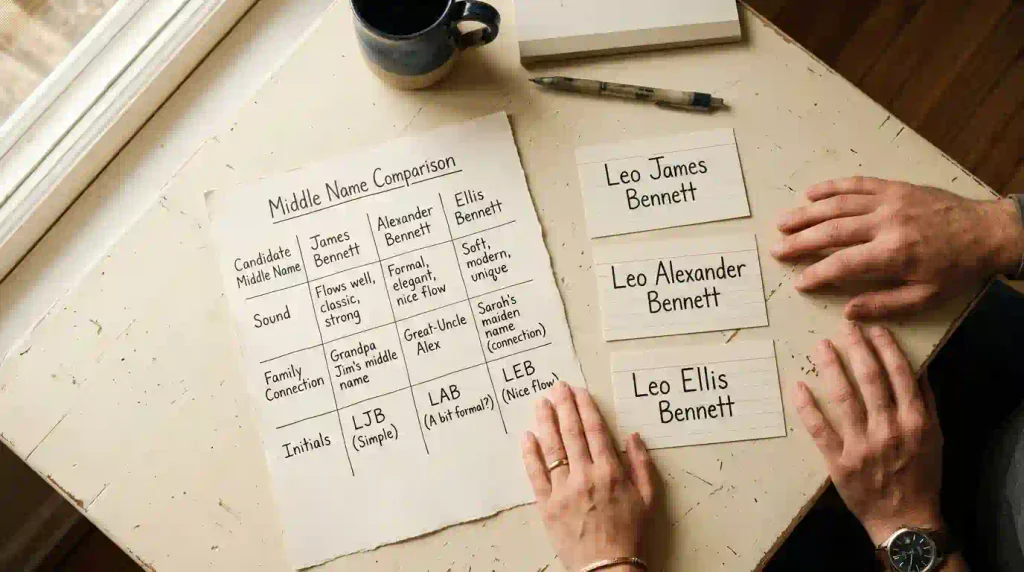
The example below is fictional. Replace its observations with your own surname, family connections, and preferences.
| Consideration | Leo James Bennett | Leo Alexander Bennett | Leo Ellis Bennett |
| Main appeal | Compact, established style | Fuller rhythm | Soft sound and personal appeal |
| Family connection | Possible honor name | Depends on family history | Depends on family history |
| Sound check | Test the James–Bennett transition | Test the complete length | Test the Leo–Ellis transition |
| Initials | LJB | LAB | LEB |
| Question to resolve | Does the short middle feel right? | Is the longer combination comfortable? | Is the pronunciation clear in daily use? |
Evaluate Each Combination Against Your Naming Priorities
Compare the finalists with the purpose you chose at the beginning. If family meaning is central, give it appropriate weight.
A candidate should not receive extra credit only because it is newly discovered. Apply the same questions to every combination so your comparison stays consistent.
Separate Practical Checks From Personal Preferences
An initial combination is observable. “Feels too formal” is a personal impression.
Record both, but distinguish them. Two parents can reasonably hear different qualities in the same name. Clear labels help you discuss preferences without treating one person’s taste as a factual error.
Record the Advantages and Concerns for Each Combination
Write one main advantage and one unresolved concern beside each finalist.
For example, “honors grandfather; common nickname disliked by one parent.” This makes the real trade-off visible. A numerical score can support discussion, but it should not decide how much a meaningful connection matters.
Keep Your Preferred First Name Central to the Comparison
Keep the first name and surname fixed while comparing middles. Otherwise, the process may expand into a new search.
If the first name genuinely needs reconsideration, address that separately. More guidance is available in our Naming Guides, but additional reading should help resolve a question rather than endlessly multiply options.
Try Your Preferred Middle Name Before Finalizing It
A short trial period can help you experience the name beyond a list. It does not guarantee certainty, but it may clarify a specific concern.
Use and Write the Complete Name for Several Days
Say the full name in conversation and write it by hand. Try introducing your son in an imagined everyday situation.
Notice whether the name becomes comfortable as it grows familiar. If you are choosing together, give both parents time to use it rather than evaluating only one person’s reaction.
Revisit Specific Concerns Before Registration
Before submitting paperwork, return to any remaining issue. Is the concern about pronunciation, an unwanted association, or genuine disagreement?
Resolve concrete questions where possible. A name becoming less novel is different from discovering a problem you consistently dislike. Check the final spelling and name order once the choice is settled.
Make Your Final Middle-Name Decision
At some point, you need to choose between several reasonable options. Another attractive name existing does not make your decision wrong.
Balance Practical Checks With Personal Judgment
The best way to learn how to pick a middle name is to combine practical checks with your own priorities.
Sound, spelling, initials, and meaning deserve attention. Yet no matcher or formula can measure your family’s connection accurately. Use the checks to identify concerns, then decide which trade-offs you accept.
Choose a Middle Name You Genuinely Appreciate
Choose a name you enjoy saying and feel comfortable explaining. That explanation might involve family history, cultural heritage, or simple personal preference.
Your son will develop his own relationship with the name. Give him a thoughtful choice without expecting it to determine his personality, interests, or future.
Frequently Asked Questions
How Can I Choose a Middle Name for Myself as an Adult?
Choose a name that fits your identity, test it with your full name, and verify the applicable process if you want a legal change.
How Do You Pick a Middle Name That Flows?
Test the full combination aloud and compare syllable lengths, natural emphasis, and sound transitions.
How Are Middle Names Chosen?
Families choose them for personal appeal, family connections, cultural heritage, meaning, or full-name rhythm.
Does a Middle Name Have to Be Shorter Than the First Name?
No; both short and long middle names can work when the complete combination feels comfortable.
What Should My Middle Name Be?
Choose one that reflects your preferences or meaningful connections and works with the name you already use.
Can a Quiz Find the Perfect Middle Name?
A quiz can suggest ideas, but it cannot replace your personal judgment or practical checks.
How Do You Get a Middle Name if You Do Not Have One?
You can choose one personally, but official use requires checking the legal name-change process that applies to you.
Can I Use a Family Surname as a Middle Name?
Yes, it can preserve a family connection; check the full combination and applicable registration requirements.
How Can I Find Someone Else’s Middle Name?
Ask them directly and respect their choice if they prefer not to share it.
Is It Okay to Choose a Middle Name Simply Because I Like It?
Yes; personal enjoyment is a valid reason even without an honor-name or cultural connection.
Final Thoughts
Learning how to pick a middle name starts with deciding what you want it to contribute. Your son’s middle name might preserve a family connection, reflect your heritage, add a rhythm you enjoy, or keep a favorite name available for the future. Test the complete combination aloud, review spelling and initials, and compare a few finalists against your actual priorities. Give meaningful choices room to matter even when another option sounds slightly smoother. Then choose a name you genuinely appreciate and feel comfortable using. Ready to narrow your list? Browse Boy Names, select three middle-name candidates, and complete the comparison worksheet. A clear purpose and a few practical checks can turn an overwhelming search into a thoughtful decision.