
Middle Names in the United States: History, Purpose, and Customs
Summary
Middle names in the US are common, but they are neither legally required nor used by every American. In the familiar U.S. naming pattern—first name, middle name, last name—the middle name usually acts as an additional given name between a person’s primary given name and family name. Parents may use it to honor grandparents, preserve a mother’s maiden name, recognize a religious figure, distinguish relatives who share the same first and last names, or simply create a name combination they love. Middle names were much less common among many early Americans than they are today, becoming increasingly widespread during the 19th century as American society, population, immigration, and family naming traditions changed. Modern Americans may have one middle name, several middle names, only a middle initial, or no middle name at all. If you’re wondering what is middle name in USA naming, or why do Americans have middle names, the answer lies in a mixture of history, family heritage, identity, culture, and personal choice.
Table of Contents
- Why Do People Have Middle Names?
- How Middle Names Emerged and Became Common in the United States
- Why Some People in the United States Have No Middle Name
- Middle Name, Middle Initial, or Additional Given Name: What’s the Difference?
- How Do U.S. Forms and Records Handle Middle Names?
- How Do Family and Cultural Traditions Shape Middle Names in the United States?
- What Middle Names Can Reveal in Genealogy
- Can You Add or Change a Middle Name in the United States?
- Frequently Asked Questions About Middle Names
- Final Thoughts
Why Do People Have Middle Names?
There is no single reason Americans have middle names.
For some families, a middle name is an opportunity to honor a grandparent. For others, it preserves a family surname that might otherwise disappear. Religious families may select a saint’s name or another religious name. Some parents simply want a first and middle combination that sounds attractive.
This flexibility is one reason the American middle name has become such a familiar part of modern United States naming practices.
If you’re starting with the basics, understanding what is a middle name helps distinguish the middle name from the first name, surname, compound given name, and other culturally specific name elements.
How Middle Names Lighten the First Name’s Load
A useful way to think about a middle name is that it can lighten the first name’s load.
Without a middle name, parents may feel that one name must accomplish everything:
- sound attractive
- honor a relative
- preserve family heritage
- carry religious meaning
- work with the surname
- satisfy both sides of the family
- give the child an individual identity
Adding a middle name creates another place to carry meaning.
Imagine parents who love the boy name Ethan but also want to honor a grandfather named William.
Instead of choosing between them, they can use:
Ethan William Parker
Ethan becomes the everyday first name, while William preserves the family connection.
Another family might love a modern first name but want a traditional family middle name:
Mason Thomas Reed
Others may reverse the idea by choosing a traditional first name and a more distinctive middle:
Benjamin Atlas Carter
This flexibility is one reason parents often spend almost as much time deciding how to pick a middle name as they do choosing the baby’s first name.
Honoring Family Members, Loved Ones, and Religious Figures
One of the strongest American family naming traditions is using a middle name to honor someone.
A boy’s middle name might come from:
- his father
- grandfather
- great-grandfather
- uncle
- godparent
- family friend
- respected historical figure
- religious leader
- saint
For example:
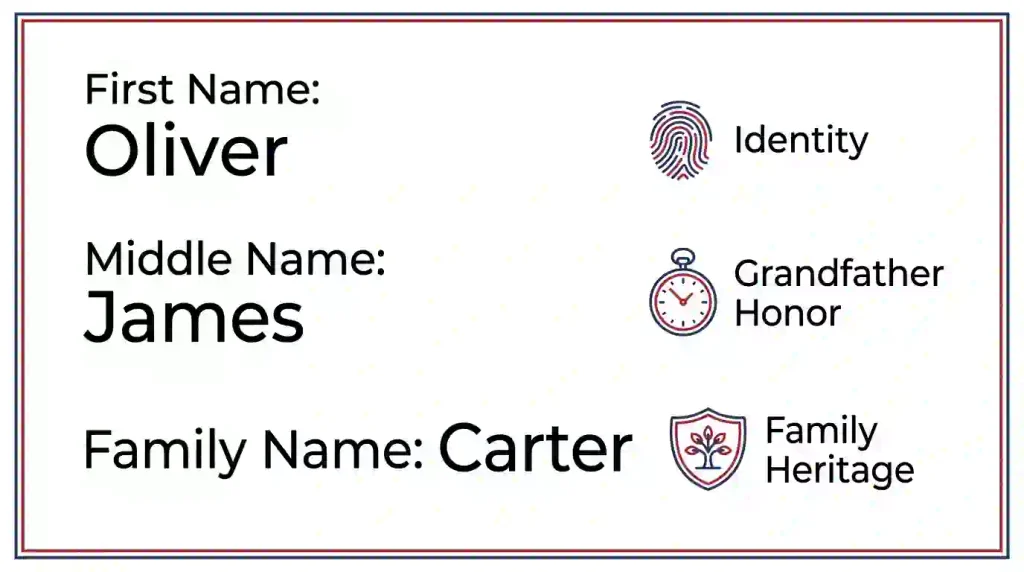
Oliver James Wilson
might honor a grandfather named James.
Another child could be:
Henry Sullivan Brooks
where Sullivan is the mother’s maiden surname.
Using a mother’s maiden name as a child’s middle name has long been a recognizable American practice, particularly when families want to preserve connections to both sides of a child’s lineage.
Middle names can therefore serve as miniature pieces of family history.
What seems like an ordinary middle name may actually preserve the surname of a maternal grandmother, great-grandfather, or another branch of the family.
Religious traditions can influence middle names too.
Catholic families may choose a saint’s name, while other Christian families might use a biblical or baptismal name.
This illustrates the broader idea explored in what is in a name meaning: a name’s significance may come from family relationships and personal history rather than only its dictionary meaning.
Distinguishing People With Similar Names
Middle names also help distinguish people who would otherwise have identical names.
Suppose a family includes:
William Carter
and his son
William Carter
A middle name creates more distinction:
William Henry Carter
William James Carter
Middle initials can provide the same benefit.
Two men named Robert Johnson might be distinguished as:
Robert A. Johnson
and
Robert M. Johnson
This became increasingly useful as the U.S. population grew and as communities, businesses, military organizations, schools, and government agencies maintained larger sets of records.
A middle name does not make someone’s identity unique by itself, but it provides another identifying element.
The National Archives even describes a middle name as an additional personal name that can help distinguish people when identifying individuals in records.
How Middle Names Emerged and Became Common in the United States
Middle names may feel deeply established in American culture today, but they were not always standard.
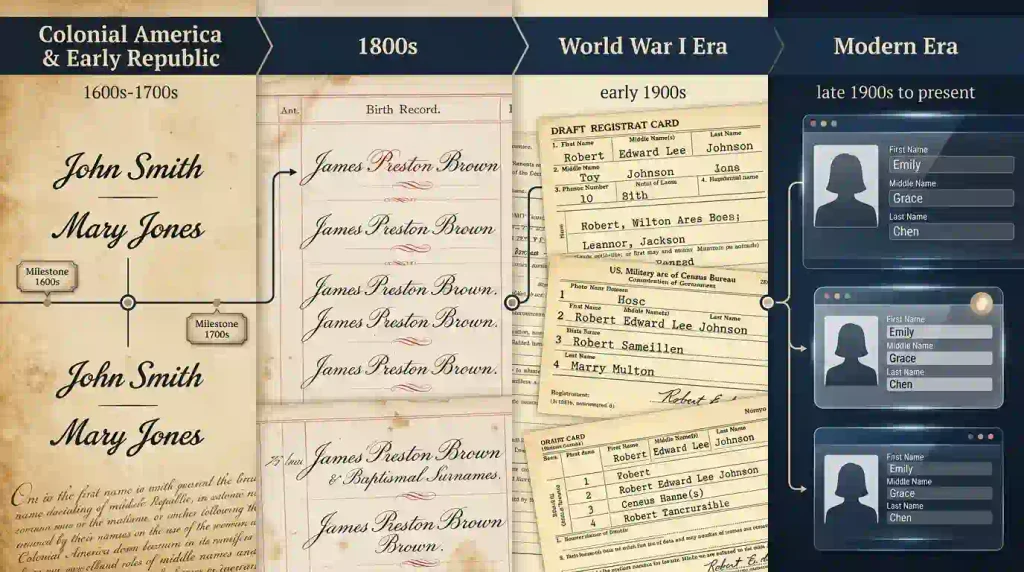
Many early Americans had only:
Given name + surname
The widespread American expectation of:
First name + middle name + surname
developed gradually.
The Origins of Middle Names
The history of middle names is more complicated than a single straight line from one ancient culture to modern America.
The Roman naming system is sometimes mentioned when discussing multi-part personal names.
Roman citizens could have elements known as the:
- praenomen
- nomen
- cognomen
However, it would be misleading to say that the modern American middle name simply descended directly from the Roman cognomen.
The social functions of Roman names were different.
The more relevant development for modern European naming involved the gradual adoption of multiple given names in medieval and early modern Europe.
In parts of medieval Italy and among European nobility, additional personal names became more visible. Religious traditions also encouraged people to honor saints and other figures through personal names.
Over time, different European cultures developed their own approaches to multiple given names.
Those traditions eventually reached North America through immigration and settlement.
For parents interested in the broader comparison, our guide to what cultures have middle names shows why the American system is only one of many ways people organize personal names.
Middle Names in Early America
Middle names were uncommon among many English-descended colonists.
Well-known early American figures illustrate the pattern:
George Washington
Thomas Jefferson
Benjamin Franklin
James Madison
These familiar names contain no middle name.
Even Meriwether Lewis and William Clark, whose expedition took place in the early 1800s, lived during an era when many Americans still lacked middle names.
The National Park Service’s history of early American middle names notes how unusual middle names were among Americans of the Revolutionary generation and how rapidly the custom expanded afterward.
That said, colonial America was culturally diverse.
Not everyone followed English naming practices.
Dutch, German, French, Spanish, and other immigrant groups brought naming traditions that could involve multiple personal names.
German immigrants are a particularly useful example.
Traditional German naming patterns sometimes gave children a religious or spiritual first name followed by another given name used more regularly. When those families settled in America, their names did not necessarily fit the simpler English colonial pattern.
So it is safer to say:
Middle names were uncommon among many early Anglo-Americans—not that every early American lacked one.
How Middle Names Became Commonplace
During the late 1700s and especially the 1800s, middle-name usage expanded.
Families increasingly used additional names to:
- honor relatives
- preserve surnames
- recognize prominent individuals
- express religious traditions
- distinguish people with similar names
- maintain connections between family branches
One famous early example is John Quincy Adams, born in 1767.
His middle name, Quincy, came from his maternal family line and illustrates how a family surname could become a personal middle name.
That pattern remains familiar today.
A mother’s maiden name such as:
Harrison
might become:
Samuel Harrison Cole
A grandmother’s surname such as:
Bennett
could become:
Lucas Bennett Hayes
This practice contributes to family name preservation, allowing a surname to survive even when it is not passed down as the child’s main family name.
As middle-name adoption spread through the 19th century, having a middle name gradually shifted from something comparatively unusual to something many Americans considered normal.
By the early 20th century, middle names and middle initials were established enough to appear regularly in administrative and military records.
World War I-era enlistment records are often noted in discussions of the growing administrative recognition of the middle name.
How Middle Name Trends Changed Across U.S. Generations
The purpose of middle names has changed along with their popularity.
Earlier middle names often reflected:
Family heritage
Examples:
- mother’s maiden name
- grandmother’s surname
- grandfather’s first name
Religious naming also remained influential.
Later generations increasingly used middle names for a mixture of:
- family honor
- sound and rhythm
- personal taste
- cultural identity
- creativity
- balance with the first name
Modern parents may intentionally choose a conservative middle name behind an adventurous first name.
For example:
Atlas James Morgan
Or they may do the opposite:
William Phoenix Carter
This lets the child have both a conventional and distinctive option.
Some parents also give children more than one middle name:
Alexander James Theodore Collins
Others eliminate the middle name entirely.
American naming customs are therefore increasingly flexible rather than moving toward one universal pattern.
Parents browsing Boy Names today are choosing within a much broader naming environment than families did two centuries ago.
What Historical Records Can—and Cannot—Tell Us About Those Trends
Historical records are incredibly useful—but they require caution.
A census, military record, church register, birth certificate, marriage record, newspaper notice, or immigration record might:
- show the person’s full middle name
- show only a middle initial
- omit the middle name
- use a nickname
- contain a spelling error
- record an adopted name
- show a name the person began using later
Therefore:
A record without a middle name does not always prove that the person never had one.
The reverse is equally important.
A middle name found on a much later document does not automatically prove that the person received it at birth.
Someone could have experienced middle-name adoption later in life.
Genealogists should look for several independent records before drawing conclusions about a person’s birth name.
Why Some People in the United States Have No Middle Name
Despite how familiar middle names are, Americans do not have to have one.
A person’s name can simply be:
Ethan Carter
with:
First name: Ethan
Middle name: none
Surname: Carter
Reasons someone might have no middle name include:
- family tradition
- cultural background
- parents preferring a shorter name
- religious practice
- immigration naming conventions
- personal choice
- legal name change
The United States includes families originating from naming traditions all over the world, many of which do not use middle names in the American sense.
For example, understanding do Mexicans have middle names requires recognizing the Spanish two-surname system.
Similarly, the answer to do Indians have middle names varies greatly by region, language, religion, and family convention.
Our guide explaining do Greeks have middle names shows another example in which parental identifiers and second given names can be confused with Western middle names.
Why the Assumption That Everyone Has a Middle Name Persists
Middle names became so common in the U.S. that the first-middle-last format began to feel standard.
Schools, databases, forms, employee systems, and computer software reinforced this expectation.
People became accustomed to seeing:
First | Middle | Last
But a field appearing on a form does not mean everyone legally has a value for it.
Many modern forms recognize this by labeling the field:
Middle Name — if applicable
or:
Middle Initial — optional
Americans can therefore have:
- no middle name
- one middle name
- multiple middle names
- only an initial used publicly
- a compound given name
- culturally specific additional names
The American naming system is common, not universal.
Middle Name, Middle Initial, or Additional Given Name: What’s the Difference?
These terms overlap, but they are not always identical.
Middle Name
A middle name is normally a personal name appearing between the first name and surname.
Example:
Noah Benjamin Wilson
Benjamin is the middle name.
Middle Initial
A middle initial is an abbreviated representation of a middle name.
For:
Noah Benjamin Wilson
the abbreviated form could be:
Noah B. Wilson
However, not every middle initial necessarily tells an outside observer what the full name is.
Records should be checked rather than guessing.
Additional Given Name
An additional given name is a broader term.
A person can have multiple given names that another administrative system later divides into first and middle names.
This is especially important when working with multicultural names.
Something appearing in the middle position may instead be:
- a second given name
- patronymic
- family surname
- lineage marker
- religious name
For example, asking is bin a middle name shows why position alone does not determine a name element’s function.
When a Middle Initial Stands in for a Full Middle Name
Americans frequently use a middle initial rather than spelling out the full middle name.
Examples include:
John F. Kennedy
George W. Bush
The initial makes the full name shorter while retaining an identifying element.
Middle initials are particularly common in:
- professional names
- academic publications
- government records
- author names
- business directories
- legal documents
Someone may use the full middle name on a birth certificate but only the middle initial professionally.
That does not mean the person’s name changed.
It is simply a shortened presentation.
How to Tell a Compound First Name From a Separate Middle Name
Compound first names complicate the picture.
Consider:
John Paul Carter
Is Paul a middle name?
Possibly.
But if the family intentionally uses John Paul together as the child’s given name, the structure could function differently.
Names such as:
- John Paul
- Billy Ray
- Mary Anne
- Mary Jane
can sometimes operate as compound given names.
Legal documentation and family usage provide the best clues.
This distinction is especially useful when researching why are names gendered, because combinations, naming traditions, and expectations can vary by gender and cultural background.
How Do U.S. Forms and Records Handle Middle Names?
There is no single rule governing every U.S. form.
Federal agencies, state governments, schools, employers, banks, airlines, hospitals, and private companies can format names differently.
Some forms request:
Middle Name
Others request:
Middle Initial
Others say:
Middle Name, if applicable
And some do not ask for a middle name at all.
Interestingly, the Social Security Administration’s internal definition of a legal name for Social Security number purposes focuses on the first name and surname, rather than treating the middle name as part of that specific legal-name definition.
That demonstrates why Americans should never assume every government system treats middle names identically.
What to Enter When a Form Asks for a Middle Name and You Don’t Have One
If you have no middle name, do not invent one.
Depending on the instructions, you may:
- leave the field blank
- select “No Middle Name”
- enter a permitted notation such as N/A if explicitly requested
Never automatically enter “N/A,” “NMN,” or another abbreviation unless the specific form allows or instructs you to do so.
The safest approach is always:
Follow the instructions on that form.
For passports, immigration documents, government applications, and financial records, your entries should also match the identity documents the agency asks you to use.
Why a Middle Name May Appear on One Record but Not Another
Suppose someone is legally named:
Alexander James Miller
His documents might show:
Birth certificate: Alexander James Miller
School record: Alexander J. Miller
Bank account: Alexander Miller
Professional profile: Alex J. Miller
Those variations do not automatically mean there are four different legal identities.
Different databases store different amounts of name information.
This is particularly important for genealogists.
A missing middle name may reflect recording practice, not a real name change.
How Do Family and Cultural Traditions Shape Middle Names in the United States?
American naming customs reflect centuries of immigration.
Families with English, Irish, Scottish, German, Italian, French, Spanish, Greek, South Asian, Arabic, African, Latin American, and many other backgrounds have contributed their own naming practices.
The result is enormous variety.
Using a Relative’s Name or Family Surname as a Middle Name
One of the strongest American traditions remains honoring relatives.
A boy named:
Owen Matthew Clark
may carry his father’s name Matthew.
Another:
Caleb Harrison Ford
may carry his mother’s maiden name Harrison.
Using surnames as middle names can preserve:
- maternal ancestry
- grandparents’ family names
- important family branches
- names at risk of disappearing
This is particularly useful when parents want the child’s primary surname to follow one family line while still representing the other.
For parents making these decisions, how to choose a baby name can help balance family significance, pronunciation, initials, and overall flow.
How Middle-Name Customs Differ Across Families and Cultural Backgrounds
Not every family uses middle names the same way.
One family might give every son the father’s first name as a middle name.
Another might alternate grandfathers’ names.
A Catholic family might choose a saint’s name.
Another family may use the mother’s maiden surname.
Immigrant families may adapt elements from another naming system into the American middle-name position.
This cultural adaptation can create confusion.
For example, French naming traditions frequently involve multiple given names. Learn more in our guide to middle names in French.
Spanish names can include surname particles, while a phrase such as de middle name may actually involve a surname element rather than a middle name.
Pronunciation can matter as much as spelling when combining names, so checking name pronunciation is useful when choosing a middle name from a language you do not regularly speak.

What Middle Names Can Reveal in Genealogy
Middle names can be valuable clues in genealogy because they frequently preserve family relationships.
A middle name might represent:
- mother’s maiden surname
- grandmother’s maiden surname
- grandfather’s name
- uncle’s name
- godparent’s name
- family friend’s surname
- religious figure
- prominent historical person
Suppose you’re researching:
Charles Whitmore Davis
and discover that his maternal grandmother was:
Elizabeth Whitmore
That middle name may provide a strong clue connecting the two family lines.
How Middle Names Help With Genealogy Research
When researching family history, compare middle names across:
- birth records
- census records
- marriage certificates
- death records
- military records
- immigration files
- church records
- cemetery records
- newspapers
- wills and probate files
A repeated middle name may reveal a naming tradition.
For example:
Thomas Everett Green
has a son:
James Everett Green
whose son becomes:
Michael Everett Green
Everett may be an inherited family name.
The U.S. National Archives recommends genealogists look broadly at names, dates, places, and relationships because names alone are rarely enough to prove identity.
Why a Middle Name in a Later Record May Not Be a Birth Name
Genealogists should be especially cautious when a middle name suddenly appears later in someone’s life.
Imagine an ancestor recorded at birth as:
Samuel Turner
but appearing at age 50 as:
Samuel Edward Turner
Possible explanations include:
- Edward was omitted from the early record
- the record keeper used only first and last names
- Samuel adopted Edward later
- Edward was a confirmation or religious name
- the later document contains an error
- two people have been mistakenly combined
A later record should therefore not automatically rewrite an earlier identity.
The same applies to initials.
A record showing:
Samuel E. Turner
does not prove the middle name was Edward unless another source confirms it.
Genealogy works best by accumulating evidence rather than making assumptions from a single document.
Can You Add or Change a Middle Name in the United States?
Yes.
People in the United States can generally change, add, or remove a middle name, but the exact legal process depends on the reason for the change and the jurisdiction.
Someone might want to:
- add a family middle name
- remove an unwanted middle name
- change its spelling
- adopt a maiden surname as a middle name
- add a religious name
- simplify multiple given names
- take a name used socially for years
Why the Process Can Depend on Where You Live
Name-change law is largely handled at the state level.
A name might be changed through:
- marriage
- divorce
- adoption
- court order
- another legally recognized process
Court requirements can vary by state and sometimes by county.
A person seeking an independent legal name change may need to:
- file a petition
- provide identification
- pay court fees
- complete required notices
- attend a hearing
- obtain a certified court order
Not every jurisdiction follows identical steps.
For that reason, someone changing a middle name should check the rules of the state and local court where they live.
Which Personal Records May Need Updating After a Name Change
Changing the name legally is only part of the process.
Records that may need updating include:
- Social Security record
- driver’s license
- state ID
- passport
- voter registration
- employer payroll records
- bank accounts
- insurance records
- property documents
- tax records
- school or university records
- professional licenses
Consistency matters.
If someone’s new legal name is:
Daniel Marcus Bennett
but older databases still list:
Daniel Michael Bennett
identity verification can become more complicated.
Keep certified copies of the document establishing the name change and follow each agency’s individual process.
Frequently Asked Questions About Middle Names
What is middle name in USA naming?
A middle name is usually an additional personal or given name placed between a person’s first name and surname.
Why do Americans have middle names?
Americans use middle names for family honor, heritage, religion, identification, tradition, or simply because parents like the name combination.
Does every American have a middle name?
No, having a middle name is common but not universal.
Is a middle name legally required in the United States?
No, Americans are not generally required to have a middle name.
Can someone have no middle name?
Yes, a person’s name can legally consist of only a first name and surname.
Can someone have more than one middle name?
Yes, multiple middle names are possible; see can you have two middle names for a detailed explanation.
Can a middle name be used as a first name?
Yes, many people choose to go socially or professionally by their middle name instead of their first name.
Is a middle initial the same as a middle name?
A middle initial usually represents a middle name, although records should be checked before assuming what the full name is.
Can I use only my middle initial?
Yes, people commonly use a middle initial in professional and everyday contexts.
Can a surname become a middle name?
Yes, family surnames—including a mother’s maiden name—are frequently used as middle names.
Can my mother’s maiden name be my middle name?
Yes, preserving a mother’s maiden surname as a middle name is a long-standing American naming practice.
Can a child have the mother’s surname as a middle name?
Yes, parents frequently use a maternal family surname as a child’s middle name.
Is a second given name always a middle name?
No, some cultures and families treat multiple given names differently from the typical American first-middle structure.
Is a compound first name the same as a first and middle name?
Not always; names such as John Paul may function together as one compound given name.
Did early Americans commonly have middle names?
Many early Anglo-Americans did not; middle names became much more common during the 19th century.
Did George Washington have a middle name?
No, George Washington did not have a middle name.
Did Thomas Jefferson have a middle name?
No, Thomas Jefferson did not have a middle name.
Why did middle names become popular in America?
Family honor, surname preservation, religious customs, European naming traditions, population growth, and greater administrative use all contributed.
Can you legally add a middle name?
Yes, but the procedure can depend on your state and the reason for the name change.
Can you remove your middle name?
Yes, a middle name can generally be legally removed through the appropriate name-change process.
Does Social Security require a middle name?
No; Social Security does not require everyone to have a middle name.
What should I write if I don’t have a middle name?
Follow the specific form’s instructions and leave the field blank when permitted rather than inventing a middle name.
Can immigrants use their second given name as a U.S. middle name?
Sometimes, but official formatting should follow the rules of the agency and the person’s supporting identity documents.
Are middle names mainly an American tradition?
No, many cultures use additional given names, but their structure and purpose can differ significantly.
Final Thoughts
Middle names in the US have evolved from a relatively uncommon feature among many early Americans into one of the most familiar parts of modern American naming customs. Today, a middle name might honor a grandfather, preserve a mother’s maiden name, recognize a saint, distinguish people with similar names, or simply complete a combination parents love. Yet there is no rule saying every American must have one—some people have none, while others have multiple middle names.
For parents choosing a baby boy’s name, the middle position offers valuable freedom: your first name can express personal style while the middle name carries family history, tradition, or deeper meaning.
Explore our Naming Guides for more advice on building meaningful names and understanding naming traditions around the world.