Is “De” a Middle Name? Meaning, Naming Traditions, and Correct Usage
Searching for “de middle name” can lead to a surprisingly important question: does that small word belong to someone’s given name, middle name, or surname? In many French, Spanish, and Dutch names, de is a surname particle, but its meaning and position vary across languages and families. It can also appear within a compound given name or within a complete maternal surname used as a middle name. That means you cannot classify it simply by counting the words in a person’s name. Whether you are choosing a boy’s name, exploring family history, or completing a U.S. form, the safest approach starts with the full name and its established use. This guide explains the differences through clear examples, practical form guidance, and the naming traditions behind familiar particles such as de, del, du, and van. You will also learn why “de” does not automatically prove noble ancestry—and how to preserve a family name without accidentally changing its structure.
Table of Contents
- Quick Answer: Is “De” a Middle Name?
- Understanding “De” in a Personal Name
- How to Identify Where “De” Belongs in Your Name
- Examples of “De” in Different Name Structures
- “De” vs. “De La,” “Del,” and Similar Name Elements
- Entering Names With “De” on U.S. Forms
- Can Parents Choose “De” as a Standalone Middle Name?
- Does “De” Indicate Nobility?
- “De” and Related Prefixes in Dutch Surnames
- “De,” “Du,” and “Des” in French Names
- “De” in Spanish Names and Naming Traditions
- “De” in Filipino Surnames
- How to Research a Name Containing “De”
- Common Mistakes When Interpreting “De” in Names
- Frequently Asked Questions About “De” in Names
- Key Takeaways
- Sources and Further Reading
- Final Thoughts
Quick Answer: Is “De” a Middle Name?
Usually, “de” is a connecting element within a surname rather than a separate middle name. However, its role depends on the complete name, naming convention, and documented family usage.
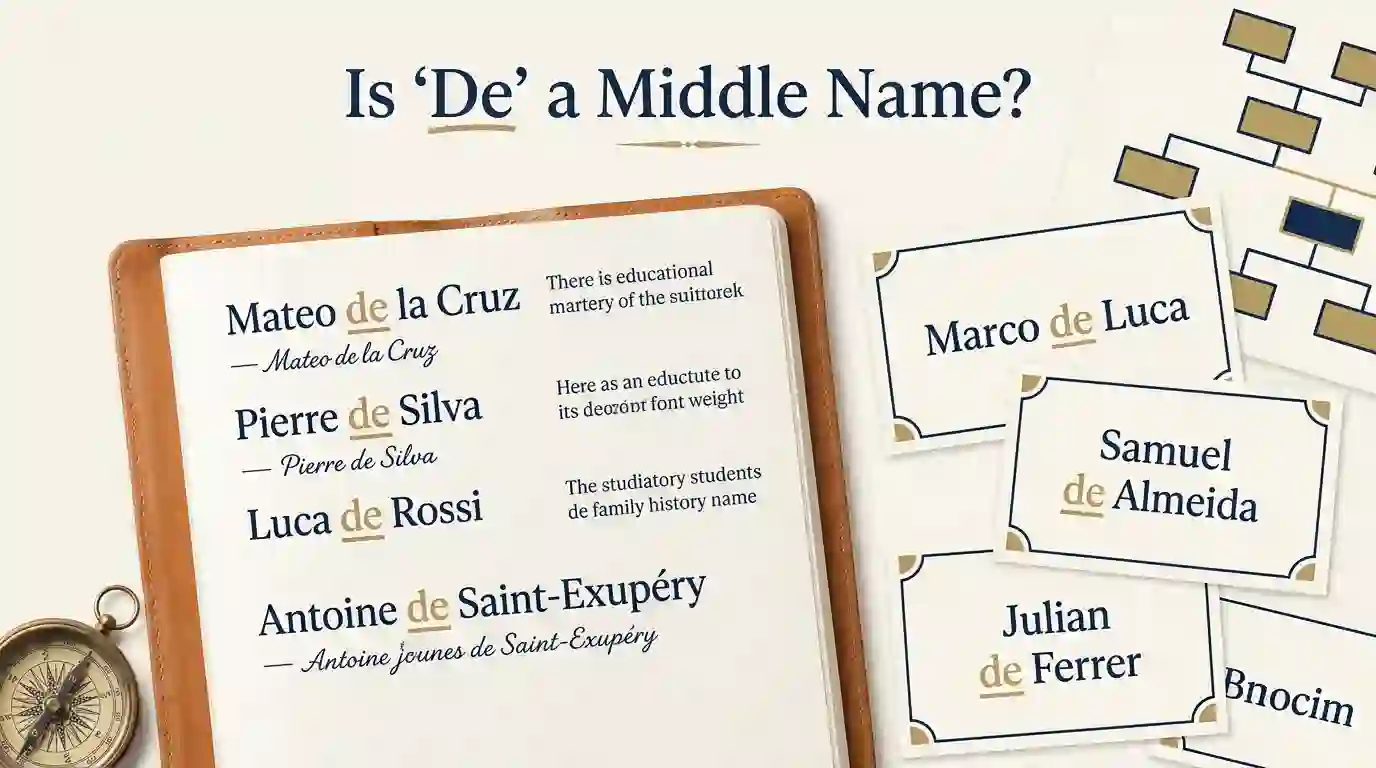
In Lucas de Vries, for example, de Vries can be the complete surname. The word de does not become a middle name because it appears between Lucas and Vries.
A different person might have a compound given name containing de. Another might use an entire surname containing de as a middle name.
If you need a basic definition before exploring these differences, our guide to what is a middle name explains the usual English-language structure.
Understanding “De” in a Personal Name
Why Position Alone Does Not Make “De” a Middle Name
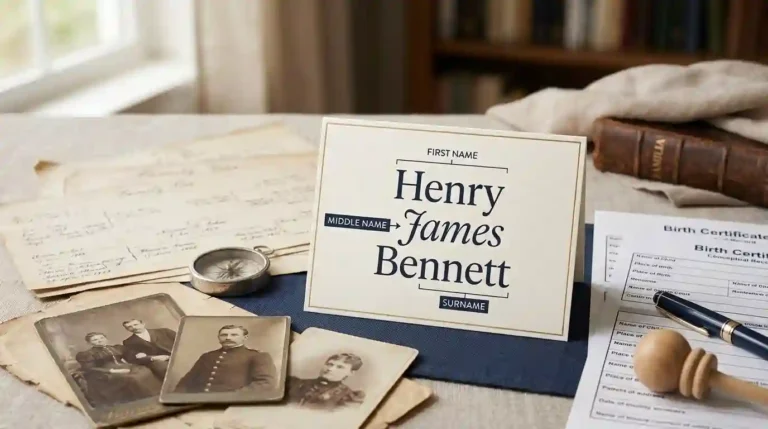
A full name can contain several words without having a middle name.
For instance, a two-word given name followed by a three-word surname contains five words. Those words do not necessarily represent five separate naming fields.
Think about function first: which words identify the person individually, and which words belong to the inherited surname?
What Is a Surname Particle?
A surname particle is a small connecting element associated with a family name. It often originates as a preposition or definite article.
French de commonly means “of” or “from.” Dutch de means “the.” Both can appear in surnames, but they have different grammatical origins.
Understanding what is a name helps explain why even a short connecting word can carry identity and family meaning.
How Surname Particles Differ From Descent Prefixes
A surname particle may describe location or connection. A descent prefix identifies ancestry more directly.
Irish O’, Gaelic Mac, and Anglo-Norman Fitz developed as descent markers. They are not interchangeable with de.
The related question is bin a middle name illustrates why relationship words should be interpreted within their own naming traditions.
How Particles Connect Names to Places, Land, and Family Origins
Many particles originally connected a person with a village, estate, landscape feature, or place of residence.
A place-name surname may refer to a settlement. A topographic surname may describe a river, wood, hill, or valley.
These meanings provide historical clues. They do not, by themselves, identify the exact ancestor who first used the name.
How to Identify Where “De” Belongs in Your Name
Examine the Complete Name and Its Naming Tradition
Start with the full name, including spaces, accents, and hyphens.
Then identify the relevant language and family convention. French naming conventions, Dutch naming conventions, and Spanish naming conventions can assign different meanings to similar-looking words.
Our overview of what cultures have middle names provides useful context for these structural differences.
Confirm Family Usage and Check Existing Records
Ask the person or family how the name is divided. Compare that explanation with a birth record, passport, or other relevant identity document.
A document is useful evidence, but a previous entry may contain an error. If documents disagree, contact the organization responsible for the record rather than guessing.
Recognize “De” Within a Compound Given Name
In a name such as Juan de Dios, the words can form a compound given name. The connecting word belongs inside that given-name expression.
English speakers may expect everything after the first word to be a middle name. That expectation can misrepresent names from other traditions.
Recognize “De” as Part of a Surname
If the established surname is de la Cruz, keep its components together when identifying the family name.
Do not assign de la to the middle-name field merely because Cruz is the final word.
The same principle applies to many multiword surnames containing van, von, da, or di.
Recognize a Maternal Surname Used as a Middle Name
In common Filipino naming patterns, a person’s middle name is the mother’s maiden surname.
If that surname is de la Cruz, the complete expression may occupy the middle-name position. Here, de remains a particle within the surname-derived middle name.
It is the whole maternal surname, rather than the particle alone, that performs the middle-name function.
Examples of “De” in Different Name Structures
An Annotated Table of Given Names, Middle Names, and Surnames
The examples below are illustrative. Their classifications assume the family uses the names as described.
| Illustrative full name | Given name | Middle name | Surname | Role of “de” |
| Lucas de Vries | Lucas | None specified | de Vries | Particle within the surname |
| Juan de Dios García | Juan de Dios | None specified | García | Connecting word within a compound given name |
| Mateo de la Cruz Santos | Mateo | de la Cruz | Santos | Particle within a maternal surname used as a middle name |
| Oliver De Bennett | Oliver | De | Bennett | Deliberately chosen standalone middle name |
Why Similar-Looking Names May Have Different Structures
Two names with the same number of words can follow different conventions.
Even identical spelling does not guarantee identical classification. A family may preserve an inherited surname, while another deliberately chooses the same spelling as a given name.
That distinction matters when considering can you have two middle names: multiple words may form one name rather than two separate middle names.
“De” vs. “De La,” “Del,” and Similar Name Elements
Compare Meanings, Languages, and Naming Functions
Similar particles can have different meanings or grammatical structures.
| Element | Language or tradition | Basic meaning or origin |
| de | French, Spanish, Portuguese | Commonly “of” or “from” |
| de | Dutch | “The” |
| de la | French, Spanish | Commonly “of the” or “from the,” with a feminine article |
| del | Spanish | Contraction of de + el |
| du | French | Contraction of de + le |
| des | French | In these surname expressions, contraction of de + les |
| d’ | French | Elided form of de |
| van | Dutch | “Of” or “from” |
| von | German | “Of” or “from” |
| da, dos | Portuguese | Forms combining a preposition and article |
| di, della | Italian | Connecting forms commonly associated with “of” and “of the” |
Portuguese surnames, Italian surnames, and German surnames need their own contextual interpretation. A shared English translation does not make their naming rules identical.
Why One Language’s Naming Rules Do Not Apply to Every Name
A French capitalization convention should not automatically govern a Dutch-American surname.
Migration, surname fusion, and family preference can establish spellings that differ from the original language’s convention.
Preserve the person’s name spelling. Do not “correct” it solely because a different spelling looks more traditional.
Entering Names With “De” on U.S. Forms
Follow the Form’s Instructions and Relevant Identity Document
U.S. organizations use different systems for names. A passport application, payroll record, school enrollment form, and airline booking may have different instructions.
Use the document and naming information requested by that organization. Guidance for one agency should not be treated as a universal rule.
Our guide to middle names in the us explains the familiar American naming framework.
Determine the Appropriate First-, Middle-, and Last-Name Fields
Identify the complete given name and surname before entering individual words.
If de Vries is the surname, ordinarily keep those words in the last-name field unless the form provides a separate prefix field or specific instructions.
A form’s layout cannot reliably tell you where a culturally unfamiliar name should be divided.
Handle Spaces, Character Limits, and Unsupported Name Formats
If a form rejects spaces or cannot accommodate the complete name, check its help guidance or contact support.
Avoid inventing a new shortened surname. An approved technical accommodation may be necessary, but it should come from the organization’s instructions.
Keep a record of any guidance you receive.
Avoid Dropping or Separating a Surname Particle
Removing de, moving it into a middle-name field, or joining words can create a mismatch with existing records.
The Social Security Administration’s name-entry guidance for employers specifically advises clarification when a person has apparent compound or multiple surnames.
The practical lesson is simple: confirm the name’s structure before entering it.
Resolve Inconsistent Name Entries Across Records
First determine whether the difference is a display convention, an abbreviation, or an actual record error.
Then ask the relevant organization about its correction process and required evidence.
Correcting an incorrectly divided surname is not necessarily the same as choosing a new legal name.
Can Parents Choose “De” as a Standalone Middle Name?
Distinguish a Deliberate Naming Choice From an Inherited Particle
Parents may consider De as a chosen middle name, subject to the applicable registration rules.
That choice gives the spelling a different function from de within an inherited surname. It does not automatically give a child aristocratic status or a particular cultural background.
For a broader starting point, read how to choose a baby name.
Consider Family Meaning, Pronunciation, and Name Flow
Say the full name aloud. Consider whether people will understand De as a separate name or assume it belongs to the surname.
If honoring a family surname, using the complete surname may preserve the connection more clearly than selecting its particle alone.
Our guide on how to pick a middle name explores sound, meaning, and family connections.
Understand the Difference Between “De” and “Dee”
De and Dee are different spellings. They may also have different intended pronunciations.
Do not assume that a chosen middle name De must be pronounced like a French or Dutch particle. The family’s intended pronunciation matters.
For practical help sharing it, visit our name pronunciation guide.
Does “De” Indicate Nobility?
Why Surname Particles Became Associated With Aristocracy
European aristocracy often used names connected with estates, castles, and territorial holdings.
Because prominent families appeared frequently in historical records, particles became associated with noble ancestry.
The term nobiliary particle describes this association in relevant contexts. It does not classify every surname particle as noble.
When a Particle Actually Indicated Social Status
In particular periods and regions, a particle could accompany recognized rank, land ownership, or membership in a noble house.
Supporting evidence might include a noble register, land record, title, or documented relationship with an estate.
The surname needs to be interpreted alongside that evidence.
Why “De” Alone Cannot Establish Noble Ancestry
A person could have a name meaning “from the village” without owning the village or holding a title.
Likewise, a coat of arms associated with one historical individual does not belong automatically to everyone sharing the surname.
Surname etymology explains a name’s formation. Genealogical evidence establishes family descent.
How Particles Disappeared, Merged, or Changed Position
Clerks, migration, anglicization, and changing administrative practices affected surname spelling.
A particle might remain separate, join the following word, or disappear from an archival index.
Track these variations when researching family lineage, but do not assume that similar forms always represent the same family.
“De” and Related Prefixes in Dutch Surnames
What “De” Means in Dutch Names
Dutch de is a definite article meaning “the.”
It can appear before a profession or description. For example, de Boer means “the farmer.”
Its origin differs from French and Spanish de, even though the spelling matches.
What “Van” Means and Why It Is Common
Dutch van commonly means “of” or “from.”
Many surnames containing it refer to a town, farm, region, or landscape feature associated with an ancestor.
Its frequency makes it a familiar feature of Dutch surnames.
Understanding “Van de,” “Van den,” and “Van der”
These combinations commonly preserve expressions meaning “from the” or “of the.”
The forms den and der reflect older grammatical case patterns.
Their survival in surnames does not mean modern speakers use those forms in every comparable everyday expression.
Less Common Dutch Surname Prefixes
Other forms include te, ter, ten, and in ’t.
They may refer to being at or in a particular place. Their meaning depends on the complete expression and historical usage.
A prefix should be researched together with the remaining surname.
Dutch Surnames Meaning “Son Of”
Names ending in forms such as -sen may originate as patronymic surnames.
A patronymic surname developed from a parent’s given name. Once it became hereditary, it no longer changed to reflect each new generation’s father.
This illustrates one historical answer to why do we have middle names: naming elements can preserve relationships, although different cultures place them differently.
Does “Van” Indicate Dutch Nobility?
Van alone does not establish Dutch noble ancestry.
Its ordinary locational meaning explains many surnames. Applying assumptions about German von to Dutch van can produce misleading conclusions.
Research the family’s records instead of interpreting the prefix as a title.
Napoleon’s Surname Registration and the “Joke Names” Myth
Napoleonic-era registration in 1811 helped formalize surnames for people who did not already use stable hereditary names.
However, many Dutch families had hereditary surnames long before then.
The popular claim that unusual surnames were generally invented as a joke or protest oversimplifies their history.
Capitalizing and Alphabetizing Dutch Surname Prefixes
In Netherlands usage, a prefix is commonly lowercase after a given name: Lucas de Vries.
When the surname stands alone, capitalization may change: De Vries. Dutch indexing commonly sorts by the main surname element.
Belgian and overseas family conventions can differ, so preserve the established spelling and follow the relevant indexing system.
“De,” “Du,” and “Des” in French Names
How French Given Names and Surnames Are Structured
French names may contain several given names as well as a surname.
Those additional given names do not necessarily have the same everyday function as an American middle name.
Our guide to middle names in french explores that distinction.
The Meanings and Grammatical Uses of “De,” “Du,” and “Des”
French de commonly means “of” or “from.”
Du and des combine that preposition with definite articles. The form d’ reflects elision.
These grammatical elements can survive in family names long after the original descriptive phrase became hereditary.
Understanding “Le,” “La,” and Articles Joined to Surnames
Le and la mean “the.”
They can appear separately or become joined to another word through surname fusion. Leblanc, for example, incorporates an article and a descriptive element.
Spacing is part of the established surname, not an optional decoration.
Why Hereditary French Surnames Developed Early
The growth of communities and administrative records increased the need to distinguish people sharing a given name.
Additional descriptions gradually became hereditary surnames during the medieval period.
The process varied by region and social setting rather than occurring on one universal date.
Four Main Origins of French Surnames
Surnames Derived From Given Names
Names such as Martin developed from personal names used by earlier generations.
These names may preserve a patronymic origin without a visible “son of” prefix.
Occupational Surnames
An occupational surname identifies a trade or role.
Forms such as Lefèvre and Lefebvre are associated with the smith’s occupation.
Surnames Derived From Places and Landscapes
Dubois relates to woods, while Duval relates to a valley.
Such names often describe residence or origin rather than noble rank.
Surnames Derived From Nicknames and Personal Traits
A descriptive surname can refer to size, coloring, appearance, or a perceived characteristic.
Petit means “small,” while Legrand is associated with being tall or large.
Common French Surnames and Their Meanings
Martin, Bernard, Dubois, Petit, and Laurent are familiar French surnames.
Their origins differ: some derive from given names, while others describe places or personal traits.
A shared surname meaning does not demonstrate a shared ancestor.
Regional Dialects, Surname Endings, and Geographic Clues
Regional dialect and language shaped French surname forms.
Breton, Occitan, Germanic, and other influences may provide geographic clues through vocabulary or a regional surname suffix.
These patterns suggest research directions rather than proving a family’s exact birthplace.
Norman Surnames and Their Adoption Into English
Some Norman surnames entered England after the Norman Conquest of 1066.
Names such as Neville and Sinclair reflect this history.
A surname can therefore have a French origin while belonging to an English family tradition for many centuries.
Spelling Variations, Missing Accents, and French-Canadian Dit Names
A diacritic may disappear in overseas documents or databases. Search accented and unaccented forms.
A dit name is an additional identifying name introduced by dit, meaning “called.”
Different branches may adopt different parts, so investigate both the original surname and the dit name.
Accents and Endings in French Given Names
Accents and spelling endings can influence pronunciation and distinguish established forms.
When choosing a French-inspired boy’s name, check the full name rather than assuming every similar ending follows the same rule.
Family usage remains important when a name crosses languages.
Hyphenated Given Names and Double Surnames
A hyphenated given name such as Jean-Luc differs structurally from a hyphenated surname.
Double surnames may preserve both parents’ family names.
Punctuation helps show structure, but the person’s documented naming arrangement remains decisive.
French Naming Restrictions and the 1993 Changes
France’s 1993 reform broadened parental choice beyond the earlier restrictive framework.
Choice still operates within rules intended to protect the child’s interests.
For current registration decisions, parents should consult the responsible authority rather than rely on a historical overview.
Using French Naming Patterns for Fictional Characters
Choose a character’s period, region, and family background before adding a particle.
Avoid giving every upper-class character de or treating every name without it as working-class.
Authentic naming requires context, not simply a decorative prefix.
“De” in Spanish Names and Naming Traditions
How Spanish Surnames Originated
Spanish surnames developed through several overlapping patterns.
Surnames Derived From Places
A place-name surname may identify an ancestor’s town, region, or geographical connection.
Some expressions include de to indicate that relationship.
Occupational Surnames
Names could also originate from a trade, job, or social role.
An occupational origin does not imply that later generations followed the same occupation.
Surnames Describing Appearance or Personality
A descriptive surname may preserve an old nickname based on a physical feature or perceived trait.
The description belongs to the name’s history, not necessarily to its present bearer.
Patronymic and Matronymic Surnames
Patronymic surnames derive from a father’s name; matronymic surnames derive from a mother’s name.
Do not confuse these historical origins with the modern practice of inheriting a paternal surname and maternal surname.
Keeping a Parent’s Name Unchanged
Some surnames developed from a given name without an obvious added ending.
The resulting hereditary surname may look like an additional first name.
Adding a Descent Suffix
Many Spanish patronymic surnames contain historical endings such as -ez.
Fernández and González are familiar examples, although individual surname histories require careful research.
Surnames Assigned to Foundlings
Institutions sometimes assigned surnames to children whose parents were unknown.
Some names reflected religious or institutional circumstances. They should be interpreted sensitively and with supporting records.
How Spanish Surname Conventions Changed Over Time
Sixteenth-Century Uses of “Y” and “De”
Historical names may contain y, meaning “and,” or de, commonly meaning “of” or “from.”
Their use depended on family practice, description, and period. Neither element should automatically be classified as a middle name.
The Eighteenth-Century Development of Two-Surname Naming
Two-surname usage became more established over time, but its development was gradual.
Treat the eighteenth century as part of that history rather than a universal starting point for every Spanish-speaking family.
Modern Legislation and Surname-Order Choices
Modern surname-order rules differ across countries and have changed over time.
Do not assume Spain’s rules apply identically throughout Latin America.
For a related cultural discussion, see do mexicans have middle names.
How Compound Spanish Surnames Are Formed
A compound surname may include a particle, several words, or a hyphen.
It is important to distinguish one compound surname from two separately inherited surnames.
Word count alone cannot make that distinction.
Everyday Names Versus Legal Names
A person may use one surname socially while retaining a longer legal name.
A married name may also differ from a maiden name or birth surname, depending on local tradition and personal choice.
Use the requested legal name for official records and the person’s preferred name in ordinary interaction.
Gender and Compound Forms in Spanish Given Names
Spanish given names include gendered given names and some gender-neutral names.
Endings can offer clues, but exceptions exist. A compound given name may also cross the assumptions English speakers make about individual words.
Our guide to why are names gendered explores the cultural background.
Catholic Saints and Given Names
Saints’ names have influenced Spanish naming traditions.
A baptismal name may contain more elements than the name used in everyday or civil records.
Given Names Associated With Mary
A Marian name refers to Mary or a devotional title associated with her.
Such elements can appear in compound names, including some names used by boys.
Their religious and cultural context explains the structure.
Alphabetizing and Indexing Spanish Names With Particles
Archives may index a name under its main surname element or preserve the particle in the searchable form.
Search the complete surname and plausible indexed variants.
For formal writing, consult the relevant style guide; The Chicago Manual of Style recognizes that national usage and personal preference matter.
“De” in Filipino Surnames
Understanding the Surname “De Lima”
De Lima should be considered as a complete surname when that is the person’s established family name.
The particle is not automatically a middle name.
Common Filipino naming patterns also make it possible for such a surname to appear in the maternal middle-name position.
Handling “De La,” “Dela,” “De Los,” and “Delos”
Filipino surnames may preserve separate words or use joined forms.
Do not casually replace de la with Dela, or reverse the change. The family’s established spelling may distinguish the documented name.
Historical variants are useful for research but are not permission to alter a living person’s name.
How Naming Traditions Affect Surname Filing and Alphabetization
A local registry, library, or database may apply its own filing rules.
Follow that system when searching, while preserving the full name in your notes.
Where initials are required, ask how a multiword middle name should be represented rather than inventing an abbreviation.
How to Research a Name Containing “De”
Identify the Naming Language and Family Tradition
Determine the relevant language, earliest known locality, and family’s established usage.
Onomastics studies names and their origins. Genealogy investigates the people and relationships behind a particular family line.
Both approaches help, but they answer different questions.
Trace Historical Spellings and Changes in Particle Placement
Search versions with and without the particle, along with joined and separate forms.
Record each spelling variation with its date and source.
Changes may reflect clerical practice, migration, or a genuine name change.
Use Naming Conventions to Interpret Genealogical Records
Compare a birth record, marriage record, parish register, and other church record wherever available.
Look for relationships, occupations, addresses, and dates. These details are more useful for identifying people than surname resemblance alone.
A matching name without matching context is weak evidence.
What a Surname Can and Cannot Reveal About Ancestry
A surname can suggest linguistic origins and historical naming patterns.
It cannot prove nationality, a single family founder, or noble ancestry on its own.
The question what is in a name meaning becomes more useful when meaning is separated from documented descent.
Can DNA Testing Help Investigate a French Surname Line?
DNA testing may support biological relationships between people.
Y-DNA can sometimes help investigate a paternal surname line, but it does not establish the meaning of a surname.
A genetic result also cannot prove noble status simply because the name contains de.

Common Mistakes When Interpreting “De” in Names
Confusing a Name’s Cultural Structure With Its Form-Field Placement
A computer system may store a name in an unfamiliar field without changing its cultural function.
Likewise, an English three-field form does not mean every culture divides names into first, middle, and last names.
Compare the traditions discussed in do indians have middle names and do greeks have middle names.
Overlooking Spaces, Joined Spellings, and Complete Surnames
Name spacing and surname capitalization deserve attention.
De la Cruz, Delacruz, and other forms may appear in different records, but they should not automatically be treated as interchangeable for official purposes.
Copy the established spelling and investigate discrepancies.
Generalizing From One Person’s Name to Every Family
One person’s surname order, pronunciation, or capitalization does not establish a universal rule.
An inherited convention can differ from a deliberate parental choice or an anglicized family spelling.
Ask the person, consult the appropriate record, and keep the full naming context in view.
Frequently Asked Questions About “De” in Names
Should I Include “De” When Writing My Last Name?
Yes, when it belongs to your established surname, preserve it unless a specific form gives different instructions.
Does “De” Count Toward My Middle Initial?
Only if it belongs to your actual middle name; follow the organization’s instructions for multiword names.
Can “De” Be Part of Both a Given Name and a Surname?
Yes, it can serve different functions within different complete names.
What Is the Most Common Surname in France?
Martin is widely recognized as France’s most common surname, although rankings depend on the dataset.
Are Norman Surnames French or English?
They may have Norman French origins and centuries of established use within English families.
Is De a Middle Name When It Appears Between Two Names?
Its position alone is insufficient; it may belong to a compound given name or surname.
What Should I Do if My Documents Divide “De” Differently?
Ask the responsible organizations whether the difference reflects their formatting rules or requires a record correction.
Key Takeaways
The central de middle name question is about naming function rather than word position.
In many names, de belongs to a surname. In others, it appears within a compound given name or a complete maternal surname used as a middle name.
Its meaning varies by language, and its presence does not prove nobility. For forms, preserve the complete name and follow the relevant organization’s instructions.
Sources and Further Reading
Academic and Historical References
Useful reference works include The Oxford Dictionary of Family Names in Britain and Ireland, A Dictionary of English Surnames, and The Chicago Manual of Style.
These resources support surname interpretation and editorial treatment. Family-specific conclusions still require original records.
Additional Naming and Genealogy Resources
For U.S. name-entry questions, the Social Security Administration provides guidance on compound and multiple surnames. Dutch Genealogy offers practical explanations of Dutch prefixes, indexing, and surname registration. French government guidance explains current parental naming choices. ssa.gov
Explore our Naming Guides for related explanations. You can also bookmark this de middle name guide when discussing family naming choices.
Final Thoughts
A small word can carry a large part of a family’s identity. Before deciding that de is a middle name, look at the complete name, its language, and the way the family uses it. That approach helps you preserve a surname, recognize a compound given name, and avoid unnecessary mistakes on forms. For parents choosing a boy’s name, the same principle applies: understand the meaning before selecting the spelling. A deliberate middle name can be meaningful, but an inherited particle deserves its full family context. Say the complete name aloud, confirm its structure, and record the preferred spelling clearly. Explore Boy Names to find names that connect personal style with family heritage—and choose a name you can explain with confidence.