
Do Indians Have Middle Names? Naming Traditions and Regional Differences
Summary
Do Indians have middle names? Some do, but there is no single naming pattern across India. A name between a person’s given name and surname might be an additional personal name, a father’s name, a religious name, or part of a compound given name. Other Indian names contain only a given name and surname, use initials, or have no inherited family surname at all. These differences reflect regional languages, community traditions, family history, and personal preferences. For parents choosing a boy’s name, understanding these patterns can make the decision more meaningful. You might honor a relative, preserve a heritage name, or choose a simple structure that suits your family. This guide explains how Indian naming conventions work, why a middle word does not always mean a middle name, and how names can appear differently in everyday life and official records. You will also find practical examples, respectful greeting suggestions, and ideas for choosing a middle name for an Indian-American boy without overlooking your family’s own traditions.
Table of Contents
- Quick Answer: Do Indians Have Middle Names?
- Understanding Middle Names in India
- History and Development of Indian Naming Traditions
- Regional Differences in Indian Name Structures
- Religious and Community Influences on Indian Names
- What Indian Middle Names Represent
- Meanings and Origins of Indian Names
- Indian Surnames and Their Functions
- Indian Name Structures Explained With Examples
- How to Identify the Middle Name in an Indian Full Name
- Language, Script, and Transliteration
- Gender, Marriage, and Name Changes
- Contemporary Indian Naming Trends
- Indian Names in Legal and Official Records
- Indian Names on US Forms and Documents
- Addressing People With Indian Names
- Choosing a Middle Name for an Indian-American Boy
- Indian Names in Library Catalogues and Author Records
- Frequently Asked Questions
- Final Thoughts
- Sources and Further Reading
Quick Answer: Do Indians Have Middle Names?
Yes, some Indian people have middle names. However, middle names are neither universal nor used in the same way across all Indian families.
A boy might receive an extra given name chosen by his parents. Another might carry his father’s personal name between his own name and the family surname. Someone else might use a parental initial before the given name.
The crucial distinction is position versus function. A word can appear in the middle of a full name without functioning as an English-style middle name.
For a basic comparison, our guide to what is a middle name explains the familiar first–middle–last structure. Indian naming conventions often require a broader understanding.
Understanding Middle Names in India
Given Names, Middle Names, Surnames, and Initials
A given name identifies the individual. A family name, or surname, may connect that person to an inherited family identity. “First name” and “last name” are common form labels, but they can mislead when names follow a different order.
A middle name may be an additional given name or another component recorded in that field. Initials can abbreviate personal names, parental names, family identifiers, or place names.
Understanding what is a name helps explain why these components carry social meaning beyond their position on a form.
Why India Has No Single Naming Convention
India includes many languages, religions, communities, and regional naming traditions. Tamil names, Bengali names, Marathi names, and Punjabi names can follow different structures.
Even within one community, families may choose different arrangements. Migration, intercommunity marriage, personal beliefs, and administrative requirements can influence those choices.
Therefore, an Indian naming system is better understood as a collection of overlapping practices than a fixed national formula.
A Compound Given Name Is Not Always a First and Middle Name
A compound given name contains more than one element that together form the person’s personal name.
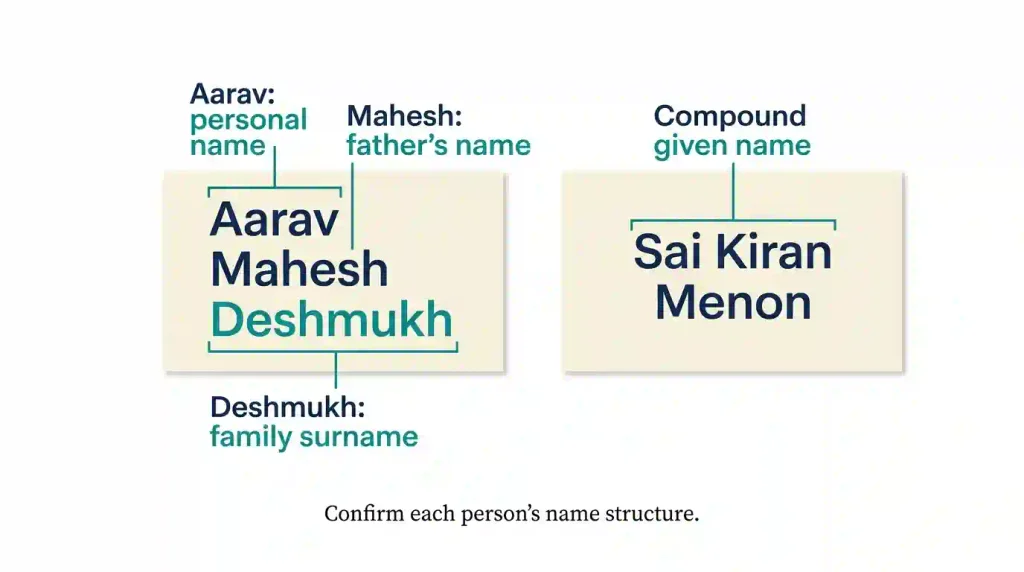
For example, a family might treat “Sai Kiran” as one complete given name. Another family may use similar words as separate given names. Spaces alone cannot settle the question.
Likewise, asking can you have two middle names is different from asking whether a multiword Indian given name contains any middle name at all.
History and Development of Indian Naming Traditions
Ancient and Classical Indian Names
Ancient and classical Indian names drew on several languages and cultural traditions. Names could refer to deities, virtues, natural features, ancestry, or philosophical ideas.
Historical figures sometimes became known through a single personal name, an epithet, a title, or a combination of identifiers. Applying a modern first–middle–surname structure to every ancient name can distort its meaning.
Historical Uses of Additional Names
Additional names could identify a parent, lineage, teacher, place, occupation, or religious association. Their functions varied across periods and communities.
A lineage identifier did not necessarily operate like today’s inherited surname. Similarly, a title appearing after a personal name was not automatically a middle name.
How Traditional Naming Practices Have Changed
School records, employment systems, migration, and identity documents have encouraged more standardized name presentation.
Some families preserve their traditional structure. Others expand initials, adopt an inherited surname, or choose a separate middle name for their children.
These changes explain why relatives from different generations may use different name orders while sharing the same family background.
Regional Differences in Indian Name Structures
Northern India: Given Names, Optional Middle Names, and Surnames
Many north Indian names follow a given-name-plus-surname pattern. Some include an additional component such as Kumar, Chandra, or Singh.
However, these elements do not always perform the same function. Kumar may form part of a personal name in one family and serve as a surname in another.
A boy with two name components may have no middle name. A boy with three components may have a compound given name rather than a separate middle name.
Western India: Parental Names Between Given Names and Surnames
Some western Indian naming traditions place a parent’s personal name between the child’s given name and inherited surname.
This arrangement can resemble a Western middle-name structure. Its cultural purpose, however, may be to identify parentage.
Gujarati Naming Influences
Some Gujarati families use a given name, father’s name, and family surname. Others use only a given name and surname.
Parental names may appear in full official records while remaining absent from everyday introductions. Gujarati names also vary by religion, community, and family preference.
Naming Patterns in Maharashtra
A familiar Marathi naming pattern combines the individual’s given name, father’s given name, and surname.
For a fictional example, “Aarav Mahesh Deshmukh” could identify Aarav as the individual, Mahesh as his father, and Deshmukh as the family surname. This interpretation applies only if that family confirms the arrangement.
Southern India: Different Name Orders and Family Connections
South Indian names include several distinct systems. Tamil, Telugu, Malayalam, and Kannada names should not be treated as one uniform pattern.
Some names use parental initials. Others include inherited family names, house names, village names, or personal names in different orders.
Kannada naming practices, for example, can include combinations of place, parental, family, and given-name elements.
Tamil Initials and Parental Names
Some Tamil names place a father’s initial before the individual’s given name. In “R. Karthik,” the R might represent a father named Ravi.
However, initials can represent other components too. Expanding R as Ravi without confirmation would be a guess.
A parental initial is not automatically a middle initial simply because a Western form provides that field.
Telugu Family Names and Name Order
Many Telugu names place an inherited family name before the given name. The family name may also appear as an initial.
When someone uses a different order internationally, the underlying name components can remain the same. Their position changes to fit a particular setting.
Malayalam Names and Family or House Names
Malayalam names may include a house name, family name, parental name, personal name, or religious component.
The arrangement varies among families and communities in Kerala. A name appearing first may identify a house or family rather than the person’s given name.
Rajasthani Naming Influences
Rajasthani names reflect diverse linguistic, religious, and community backgrounds. Some include inherited surnames or components associated with lineage and historical titles.
Singh appears in some names, but its presence does not establish one universal Rajasthani structure. Individual family practice remains the best guide.
Bengali Home Names and Formal Names
Some Bengali families distinguish between a familiar home name and a formal name.
A boy might use a short, affectionate name with relatives and a different name at school or work. These are different forms of address rather than necessarily separate components of one full name.
How Daknam and Bhalonam Differ From Middle Names
A daknam is commonly understood as a familiar or pet name. A bhalonam is the formal or “good” name.
Neither automatically functions as a middle name. The relationship concerns context of use, rather than placement between a first name and surname.
Indian Naming Practices Outside India
The Indian diaspora includes families whose naming traditions have developed in the United States, Britain, the Caribbean, Africa, and elsewhere.
Some retain parental initials or traditional name orders. Others use a heritage given name, an additional middle name, and an inherited surname.
Comparisons with what cultures have middle names help show that migration can create flexible naming practices.

Religious and Community Influences on Indian Names
Hindu Naming Patterns and Their Exceptions
Hindu names may reference deities, virtues, literature, philosophy, nature, or family history.
However, Hindu families do not share one naming structure. Some use inherited surnames, some include parental names, and others avoid community or caste identifiers.
A Sanskrit-derived name also does not prove that its bearer follows a particular religion.
Sikh Naming Traditions
Sikh naming traditions commonly include Singh or Kaur. Many Sikh given names can be used across genders.
Some people use Singh or Kaur as their final name component. Others retain another family surname, placing Singh or Kaur between the given name and surname.
The Meaning and Use of Singh
Singh means “lion.” It has an important place in Sikh naming, but non-Sikh people also use it.
Depending on the person’s name structure, Singh may function as a final name, an additional component, or a recorded middle name.
How Singh and Kaur Differ
Kaur is traditionally associated with Sikh women and is commonly explained as meaning “princess.”
Singh and Kaur express community identity and ideals of equality. Their appearance in middle-name or surname fields depends on personal usage and document conventions.
Muslim Naming Traditions in India
Indian Muslim names may draw on Arabic, Persian, Urdu, and regional languages. Names can contain multiple personal components or inherited family identifiers.
Muhammad, Ahmed, Ali, and other elements may have different roles in different families. Their position alone does not reveal whether they are first names, middle names, or surnames.
For another example of a name component whose function matters, see is bin a middle name. Arabic naming structures should not be assumed to describe every Indian Muslim name.
Other Religious and Community Naming Practices
Christian names in India can combine baptismal or devotional given names with parental names, inherited surnames, or local family identifiers.
Jain, Buddhist, Parsi, Jewish, Indigenous, and other communities also maintain varied practices. Religion intersects with language and regional identity rather than replacing them.
Hindu Naming Traditions in Bali
Bali belongs to Indonesia, so Balinese naming conventions should not be presented as Indian regional customs.
Some Balinese names include birth-order or status-related components. Although Hindu traditions provide a connection, Balinese names follow their own local cultural systems.
Avoid Inferring Religion or Caste From a Name Alone
Names can suggest a historical association without proving a person’s present identity.
Families may share surnames across communities, change names, or choose names outside traditional expectations. Respect the identity a person communicates rather than assigning one from spelling.
What Indian Middle Names Represent
A Father’s Name and Family Lineage
In some families, a father’s name connects a child’s personal identity with family lineage.
This parental component differs from an inherited surname because it may change in each generation. A boy carries his father’s name, while his own child may later carry his.
Patronymics and Matronymics
A patronymic identifies a person through the father’s name. A matronymic uses the mother’s name.
Some Indian families follow long-established parental naming practices. Others deliberately choose a mother’s name or names from both parents. These choices need not follow a single regional formula.
Family Connections and Cultural Identity
An additional name can honor a grandparent, preserve an ancestral name, or reflect a family’s language.
For an Indian-American boy, a heritage middle name may maintain a connection with relatives while allowing another name for everyday use.
Religious Meaning and Personal Significance
A middle component may express devotion, a valued quality, or a meaningful family story.
The question why do we have middle names often leads back to these personal purposes. Cultural tradition matters, but so does the reason a family chooses a particular name.
Distinguishing People With Similar Names
Additional components can help distinguish people who share a given name and surname.
Nevertheless, a name alone is not a unique identifier. Schools, employers, and institutions may also need dates of birth, identification numbers, or other relevant information.
Meanings and Origins of Indian Names
How Language and Cultural Background Shape Meaning
Indian names draw on Sanskrit, Tamil, Telugu, Kannada, Malayalam, Bengali, Marathi, Gujarati, Punjabi, Urdu, and many other languages.
A spelling may have more than one proposed origin. Therefore, parents should confirm the meaning in the relevant language rather than relying on a short baby-name listing.
Exploring what is in a name meaning can help connect linguistic meaning with family significance.
Understanding Das in Personal Names
Das is associated with a meaning such as “servant” or “devotee” in names derived from Sanskrit traditions.
It appears as a surname or name component in several communities. Its use does not automatically identify a middle name, religion, or caste.
Understanding Kumar as a Name Component
Kumar is related to Sanskrit kumāra, associated with a boy, youth, or prince.
It can appear within a compound personal name, as an additional given name, or as a surname. In “Amit Kumar,” Kumar’s role depends on how the person and family use the name.
Astrology and the Namkaran Naming Ceremony
Some Hindu families choose a name during a namkaran naming ceremony. Depending on family practice, astrological considerations may influence its opening sound.
Other parents prioritize meaning, relatives, pronunciation, or personal preference. Astrology is one possible influence, not a requirement for Indian names.
Indian Surnames and Their Functions
Family Names, Community Identifiers, and Caste Associations
Some Indian surnames preserve an inherited family identity. Others have historical associations with communities, places, titles, or caste.
Those associations do not provide a dependable description of every bearer. The same surname can appear across different backgrounds and regions.
Surnames Derived From Occupations
Some surnames developed from occupations or social roles. Others relate to administration, trade, scholarship, or agricultural life.
A surname’s historical origin does not establish a person’s current occupation or social position.
Common Indian Surnames
Examples encountered across Indian communities include Sharma, Patel, Gupta, Shah, Singh, Das, Rao, and others.
These examples do not form a nationwide frequency ranking. Their distribution and meaning vary, and some can also function as titles or other name components.
Caste-Neutral Names and Changing Preferences
Some parents avoid identifiers they associate with caste. They may choose a parental name, a neutral surname, or a personal name without an inherited surname.
However, no name guarantees that others will perceive it as caste-neutral. The family’s intention and the wider social interpretation may differ.
Indian Name Structures Explained With Examples
Annotated Examples of Given Names, Middle Names, and Surnames
If you are asking, “What is a middle name example in India?”, a fictional name such as “Arjun Dev Sharma” can illustrate the structure. Arjun could be the first given name, Dev a separate middle name, and Sharma the surname.
However, that interpretation is valid only when the family treats Dev as a separate middle name.
The following examples illustrate possible structures rather than rules for every similar name.
| Fictional name | Possible interpretation | Important distinction |
| Arjun Dev Sharma | Arjun: given name; Dev: middle name; Sharma: surname | Dev is a middle name only if used that way |
| Aarav Mahesh Deshmukh | Aarav: personal name; Mahesh: father’s name; Deshmukh: surname | The middle component identifies parentage |
| R. Karthik | R.: parental initial; Karthik: given name | Confirm what R represents |
| Rao Aditya | Rao: family name; Aditya: given name, in this fictional family | A family name can precede the given name |
| Sai Kiran Menon | Sai Kiran: compound given name; Menon: surname | Kiran is not necessarily a middle name |
| Aman Singh Gill | Aman: given name; Singh: additional component; Gill: surname | Document labels may vary |
| Arul | Single personal name | A mononym has no separate middle name or surname |
Examples of Parental Names and Expanded Initials
Suppose a family confirms that R. Karthik means “Ravi Karthik,” with Ravi identifying Karthik’s father.
Expanding the initial preserves the parental connection. It does not automatically turn Ravi into a hereditary family name or an English-style middle name.
Similarly, “Aarav Mahesh Deshmukh” may contain a parental name that is recorded in a middle-name field for administrative convenience.
Examples of Compound Given Names and Names Without Surnames
A family may consider “Sai Kiran” a complete given name. Another person may use a single name, such as Arul, without a family surname.
These structures deserve accurate representation. Adding a surname or dividing a compound given name simply to fit a familiar pattern can change the person’s intended identity.
How to Identify the Middle Name in an Indian Full Name
Ask How the Person Uses Each Name Component
The most reliable question is: “Which part is your given name, and how do you use the other parts?”
This lets the person explain the structure without forcing an assumption. Their preferred everyday name may differ from the complete name shown in official documents.
Confirm the Family’s Naming Tradition
Ask whether a component refers to a parent, family, house, place, or additional personal name.
For parents choosing a boy’s name, discussing this with relatives can uncover important family history. It can also prevent disagreements about what a proposed middle name represents.
Compare Existing Records Without Assuming Every Middle Word Is a Middle Name
A birth certificate, passport, and school record may present the same name differently.
Compare the labels as well as the spelling and order. If records conflict, seek clarification from the relevant institution rather than deciding that every second word must be a middle name.
Language, Script, and Transliteration
How Indian Writing Systems Affect Name Presentation
Indian names appear in writing systems including Devanagari, Bengali, Gurmukhi, Gujarati, Tamil, Telugu, Kannada, Malayalam, and Perso-Arabic scripts.
When names move into English-language records, spacing and spelling may change. The English presentation does not always reveal the original linguistic structure.
Transliteration and Spelling Variations
Transliteration represents a name from one writing system in another. Different conventions can produce different English spellings.
A family may consistently prefer one spelling even when alternatives exist. For everyday communication, learning the person’s name pronunciation is more useful than guessing from unfamiliar letters.
Preserving Name Components When Expanding Initials
Expand initials only after confirming their full forms and intended roles.
Preserve the spelling the person uses. A letter representing a village, house, or parent should not be replaced with an invented surname.
For document use, follow the relevant institution’s instructions about expansion and supporting records.
Gender, Marriage, and Name Changes
Gender Associations in Indian Given Names
Some Indian given names have strong gender associations. Others are used across genders, and usage can vary by language or community.
Many Sikh given names illustrate this flexibility. Parents exploring why are names gendered can consider both cultural expectations and their own preferences.
How Marriage Can Affect Surnames and Other Name Components
Some people adopt a spouse’s surname after marriage. Others retain their birth surname, combine surnames, or change another component.
In certain family traditions, a spouse’s personal name may replace a parental component. This is a variable practice, not a requirement for all Indian women.
Differences Between Birth Names and Official Names
A birth name, married name, professional name, and everyday name can differ.
Official records may require evidence connecting earlier and later names. A familiar home name or shortened professional name does not necessarily replace the complete name used for identification.
Contemporary Indian Naming Trends
Renewed Interest in Sanskrit Names
Some parents favor Sanskrit-derived names because of their meanings, literary associations, or spiritual significance.
However, interest in Sanskrit names should not obscure the rich naming traditions of other Indian languages. A Tamil, Punjabi, Bengali, or Malayalam name can preserve an equally meaningful heritage.
Combining Traditional Meanings With Modern Preferences
Parents may seek a name that carries a traditional meaning while feeling comfortable in contemporary life.
Shorter spellings, familiar sounds, and easy everyday use can influence the choice. The best arrangement balances these preferences with accurate meaning and family relevance.
International Influences and Diaspora Adaptations
Diaspora parents sometimes combine a heritage given name with an English-language middle name, or reverse that arrangement.
Others preserve a traditional name order. Comparing middle names in French with Indian structures highlights how additional given names can serve different cultural purposes.
Recent Boy-Name Choices
Parents considering a contemporary style may explore names such as Aarav, Arjun, Ishaan, Kabir, and Vihaan.
These are examples to investigate, not a verified ranking of the newest or most popular names. Their meanings and associations should be checked individually.
Recent Girl-Name Choices
Names such as Aanya, Diya, Mira, and Ananya offer examples of choices parents may consider.
For a website focused on boys, these comparisons are useful because sibling names can share a language, meaning, or family connection without following identical gender patterns.
Indian Names in Legal and Official Records
Given Names Compared With Complete Legal Names
A complete legal name can contain more than a given name and surname. Depending on the record, additional given names or parental components may appear within the given-name field.
Consequently, a document without a separate middle-name box does not necessarily omit an additional personal name.
Recording Middle Names, Parental Names, and Initials
Different institutions can use different field structures and rules for initials.
Treat each application’s instructions as authoritative for that application. Avoid expanding, dropping, or relocating a component solely because another form handled it differently.
Why Consistent Name Records Matter
Consistent spelling and name presentation can make it easier to connect school records, identity documents, travel bookings, and financial accounts.
Where differences already exist, ask the relevant organization how to document or correct them. A naming explanation helps establish meaning, but it does not replace an institution’s verification process.
Indian Names on US Forms and Documents
Understanding First-, Middle-, and Last-Name Fields
Many US forms assume a first name, optional middle name, and family surname. Indian names may fit those fields easily, or require clarification.
Our guide to middle names in the US explains the familiar structure. However, the correct treatment of an Indian name still depends on the specific form.
Completing Forms When You Have No Middle Name
If you have no middle name, leave an optional middle-name field blank unless the instructions require another response.
Do not invent a middle name. Likewise, avoid entering “N/A” or “None” unless instructed, because a system might store that text as an actual name component.
Handling Multiple Given Names or No Family Surname
A person with multiple given names may need to preserve them together in a particular field. Someone without a family surname may encounter a mandatory surname box.
There is no universal workaround suitable for every US agency, airline, school, or financial institution.
What to Do When a Form Does Not Fit Your Name
Contact the issuing organization and explain your name as it appears on the relevant identification document.
Describe which components are given names, parental names, or family identifiers. Ask for the organization’s specific procedure before submitting information that changes the structure.
Follow the Issuing Organization’s Instructions Before Rearranging Names
Do not assume that instructions for one application apply to another.
The safest practical approach is to follow the particular organization’s rules while preserving accurate links to your existing records. Keep any written guidance you receive for future reference.
Addressing People With Indian Names
Choosing the Appropriate Name for a Greeting
Use the name the person uses in introductions, email signatures, or stated preferences.
An initial or first-position word may not be their given name. If you know someone introduces himself as Karthik, “Hello Karthik” is usually more appropriate than guessing from an expanded formal name.
Honorifics and Titles in Professional Emails
Use a professional title such as Dr. when it is confirmed and appropriate.
Mr., Ms., and other honorifics require more care when gender or surname structure is uncertain. A neutral greeting with the person’s full name can avoid unnecessary assumptions.
What to Write When Name Structure or Gender Is Unclear
“Hello” followed by the person’s displayed full name is a practical option.
You can also ask, “How would you prefer to be addressed?” This respects the person’s usage while avoiding guesses about gender, marital status, or family name.
Practical Greeting Examples
| Situation | Suitable greeting | Reason |
| The person introduces himself as Arjun | Hello Arjun | Uses the stated everyday name |
| An email signature reads R. Karthik | Hello R. Karthik | Preserves the displayed form |
| The preferred name is Karthik | Hello Karthik | Follows the person’s preference |
| A confirmed professional name is Dr. Meera Rao | Dear Dr. Rao | Uses the verified title and surname |
| Name structure is unclear | Hello Aman Singh Gill | Avoids assigning a surname or title |
Choosing a Middle Name for an Indian-American Boy
Decide What Purpose the Middle Name Should Serve
Start with the reason for adding a middle name. Do you want to honor a relative, preserve a heritage language, express a meaningful quality, or create another name your son can use?
Our guide on how to pick a middle name can help turn that purpose into a manageable shortlist.
Consider a Parental Name or an Honor Name
A parent’s or grandparent’s name can create a direct family connection.
Decide whether you intend the component as a traditional parental identifier or a separate honor name. The same word can serve either purpose, but clarity helps when explaining the complete name later.
Choose a Heritage Given Name
A heritage middle name can preserve a connection with the family’s language, literature, or religious tradition.
For example, parents might consider Dev, Arjun, or Kiran after checking their meanings and cultural fit. An English-language first name does not require an Indian middle name, but the combination may suit some families.
Consider Whether No Middle Name Fits Your Family’s Preferences
A boy does not need a middle name to have a meaningful identity.
Some families prefer a given name and surname. Others use a traditional structure without a separate middle-name component. Choose what fits your family rather than adding a name simply because a form includes a box.
Check Pronunciation, Full-Name Flow, and Initials
Say the complete name aloud in the languages your family uses. Consider how relatives, teachers, and the child himself may pronounce it.
Check the initials and the way adjacent names sound together. These practical details belong alongside meaning when considering how to choose a baby name.
Agree on the Complete Name Before Registration
Confirm the spelling, spacing, order, and intended role of each component before registration.
Discuss whether an ancestral or parental name should appear in full. Agreement at this stage helps the family use the same complete name consistently as the child grows.

Indian Names in Library Catalogues and Author Records
Why Indian Names Can Be Difficult to Catalogue
Library catalogues need a consistent way to identify authors and group their works.
Indian names can challenge systems that assume every author has a surname in the final position. Initials, compound personal names, pen names, and varying name orders add complexity.
This is a specialist cataloguing issue rather than a reason to change an author’s name.
Selecting Entry Elements Across Regional Naming Systems
An entry element is the name component used to organize an author’s catalogue heading.
Cataloguers consider established usage, reference information, and the relevant cataloguing standard. Simply moving the final word to the beginning can produce an inaccurate heading.
Different Approaches for Ancient and Modern Authors
An ancient author known by one name may require a different treatment from a modern author with an established surname.
Dates, titles, or other identifying information may distinguish authors who share names. The goal is reliable identification and retrieval, rather than forcing every name into one structure.
Ranganathan’s Classified Catalogue Code Guidelines
S. R. Ranganathan’s Classified Catalogue Code is an important contribution to Indian library science.
Its treatment of name headings belongs within a broader cataloguing framework. When applying it, consult the relevant edition and rule rather than assuming that one simplified formula covers every Indian author.
Modern institutions may follow other standards or established authority records.
Worked Author-Name Examples
The following examples illustrate familiar surname-based catalogue arrangements. They do not establish a universal rule for Indian names.
Arundhati Roy
A surname-first heading commonly presents this name as “Roy, Arundhati.”
Arundhati is the given name in this arrangement. Roy is the surname, and the familiar published name contains no separate middle name.
V. S. Naipaul
A familiar catalogue presentation is “Naipaul, V. S.”
The initials represent Vidiadhar Surajprasad. Naipaul was a Trinidad-born writer of Indian ancestry, so this example belongs to the wider Indian diaspora rather than a claim about citizenship.
Anita Desai
“Desai, Anita” illustrates an established surname-first arrangement.
The example shows why cataloguing order and everyday name order can differ without changing the underlying name components.
Vikram Seth
“Seth, Vikram” similarly places the surname first for catalogue organization.
The published name does not contain a separate middle component. Its two-word structure is straightforward, but many other Indian author names require additional investigation.
Frequently Asked Questions
Does Every Indian Person Have a Middle Name?
No; Indian names may include a middle name, parental component, initials, or no middle name at all.
Is a Father’s Name Always Used as a Middle Name?
No; some families include a father’s name, while others use different structures or no parental component.
Are South Indian Initials Middle Names?
Not necessarily; they may abbreviate a parent’s name, family identifier, house name, or place name.
Can Singh or Kaur Be a Middle Name or Surname?
Yes; either can appear in a middle-name or surname position depending on personal usage and records.
Can an Indian Name Have No Family Surname?
Yes; some people use a single name or a structure without an inherited family surname.
Final Thoughts
Do Indians have middle names? Some do, but the most useful answer depends on the person’s family tradition and how each component functions. An additional word might be a separate given name, a parental name, a religious component, or part of a compound personal name. Initials and name order add further variety. For parents choosing a boy’s name, this flexibility offers room to honor relatives, preserve a heritage language, and create a name with lasting personal meaning. Start with your family’s priorities, confirm the meaning and pronunciation, and agree on the complete structure before registration. Explore more Boy Names and our Naming Guides to build a thoughtful shortlist that suits your son and your family’s story.
Sources and Further Reading
The International Federation of Library Associations and Institutions provides an authoritative Names of Persons resource, including an India reference dated 1996. It is useful for historical naming and cataloguing context; it is not a source of current application instructions.
For related reading, do Greeks have middle names explores another naming tradition. The guide to do Mexicans have middle names helps distinguish additional given names from surname structures, while de middle name examines the role of name particles.
This guide to do Indians have middle names brings those questions back to India’s varied regional and family practices.