Middle Names in French: Naming Traditions, Meanings, and Boy Name Ideas
Summary
Middle names in French naming work differently from the familiar American first, middle, and last name pattern. French families can register several given names, and those additional names may honor grandparents, preserve family heritage, reflect religious traditions, or simply give a child more options. However, Jean-Pierre is not automatically the same arrangement as Jean, Pierre, and a person’s everyday name does not always match the first name listed on a birth certificate. These small differences matter when you choose a boy’s name, interpret family records, or complete an international form. This guide explains the French system in clear English, then connects those rules to practical naming decisions. You will discover how a prénom usuel works, what French name rankings actually measure, and how to compare traditional, modern, royal, and French-Canadian choices. You will also find boys’ name tables with careful meaning notes and approximate pronunciation guides. Whether you want to honor a French grandfather or pair an English first name with a French middle name, the aim is a name your family understands and your child can comfortably use.
Table of Contents
- Do French People Have Middle Names?
- Understanding the Structure of French Names
- What Is a Prénom Usuel in France?
- One Compound Name or Two Separate Given Names?
- How to Say “Middle Name” in French
- The History of French Naming Traditions
- French Name Registration and Official Records
- Using Multiple French Given Names on U.S. Forms
- French-Origin Names vs. Names Commonly Used in France
- How Reliable Are French Middle-Name Popularity Lists?
- Choosing a French Middle Name
- Choosing a French Middle Name for a French-American Boy
- French Middle-Name Ideas by Style and Origin
- French Middle Names for Boys
- French Middle-Name Combinations Explained
- Why Does Marie Appear in Some French Boys’ Names?
- French Middle Names for Girls
- Gender-Neutral French Middle Names
- French Surnames and Name Particles
- French Middle Names in Genealogy
- French-Canadian and Acadian Naming Traditions
- Frequently Asked Questions About Middle Names in French
- Final Thoughts on Middle Names in French
Do French People Have Middle Names?
Yes, many French people have additional given names that English speakers would call middle names. However, French naming conventions do not organize them into a separate legal middle-name category. A person can have one prénom or several prénoms. The surname belongs to a different part of the name.
That distinction answers the main search question without suggesting that every French person follows the same custom. Some parents choose one given name. Others choose two, three, or more. Having several names does not mean that the person introduces themselves with all of them.
Multiple French Given Names vs. English-Style Middle Names
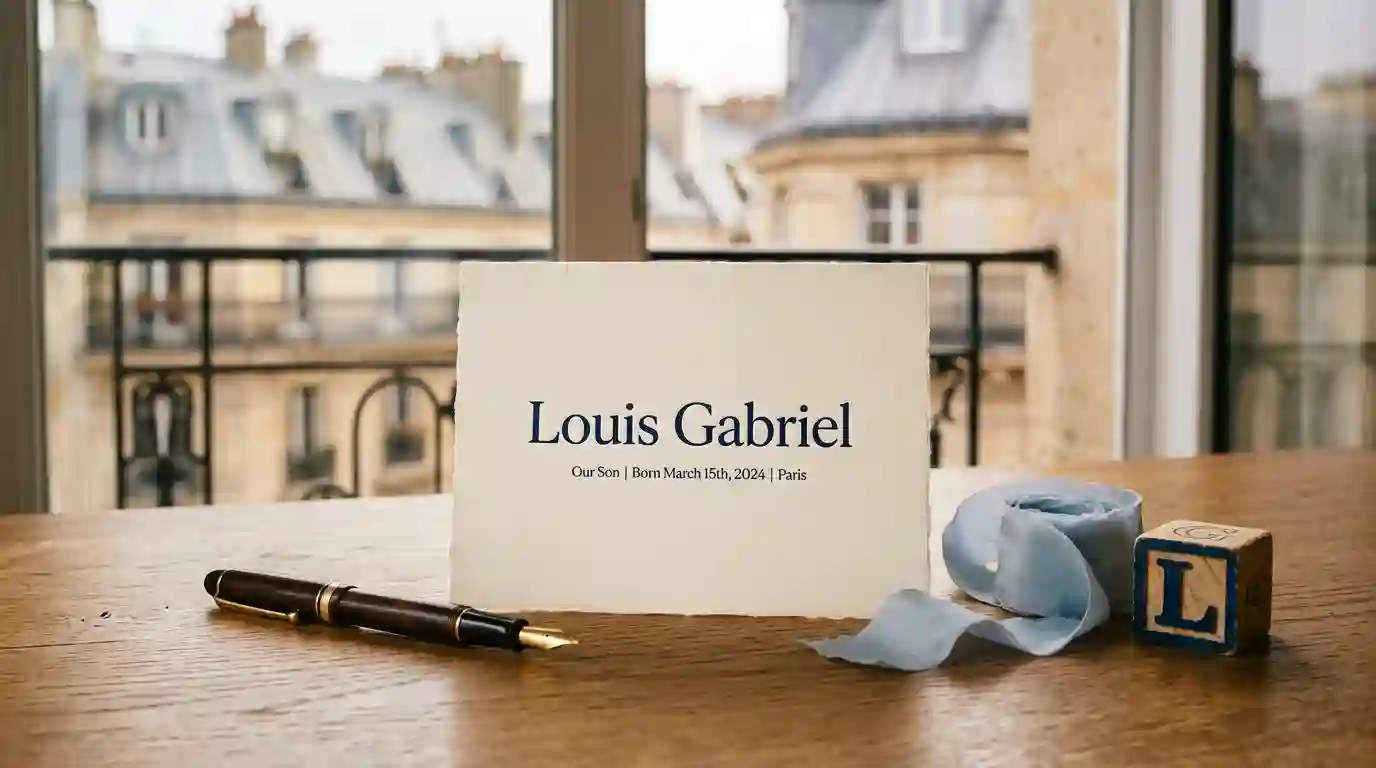
Imagine a boy registered as Louis, Gabriel, André Martin. Louis, Gabriel, and André are given names. Martin is his surname. In an American conversation, Gabriel and André might be described as his middle names. In French administrative language, they are additional prénoms.
The difference is partly vocabulary, but it also affects everyday usage. English speakers often assume that the first given name is the person’s ordinary name. France allows any registered given name to function as the usual name. Therefore, the position of a name does not fully explain its role.
If you are comparing the two systems, start with what is a middle name. The familiar English definition is useful, provided you do not treat it as a universal naming structure.
How Additional Given Names Express Family and Cultural Identity
Additional names give parents room to connect generations. A child’s first name might be a contemporary favorite, while another preserves his grandfather’s name. A third might recognize a relative on the other side of the family.
For example, Arthur, René, Michel could combine an independent first-name choice with two family honor names. However, you cannot work out that family story from the spelling alone. René could honor a relative, reflect a religious association, or simply appeal to the parents.
The strongest heritage choice often comes from an actual relationship. A name that belonged to a beloved ancestor can carry more meaning than a name selected only because a website describes it as elegant or fashionable.
French Naming Practices Compared With English-Speaking Countries
French and English-speaking families both use names to express belonging, memory, and personal taste. The main difference concerns the terminology and administrative structure surrounding those names. An American middle-name field may combine names that a French record lists individually.
English-speaking countries also differ from one another, and families within the same country do not share a single practice. Treat comparisons as practical explanations, rather than rigid cultural rules. Our guide to middle names in the us explores the American side in more detail.
If your family crosses several cultures, the question is not which country does naming correctly. It is how each system represents the child’s identity and how you can preserve that identity across records.
Understanding the Structure of French Names
Understanding the labels makes a long French name much easier to read. You need to separate given names, surnames, names used socially, and names used for particular professional purposes. Those categories can overlap in everyday conversation without becoming legally interchangeable.
Given Names vs. Family Names
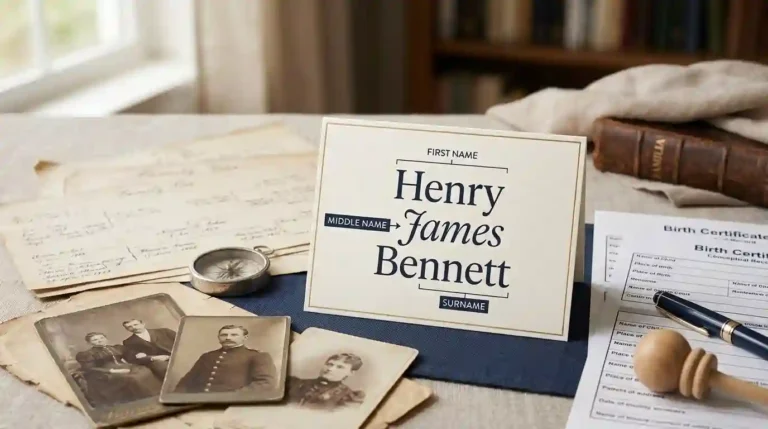
A prénom is a given name. A nom de famille is a family name or surname. In Louis Gabriel Martin, Louis and Gabriel may be given names, while Martin is the family name. However, an unpunctuated example cannot establish every detail of registration.
Some words can function as either a given name or a surname. Martin is a useful example because French families use it in both positions. The relevant field on the document provides stronger evidence than whether a word looks like a familiar first name.
For a broader introduction to identity and naming categories, what is a name explains why names work as more than simple labels.
How Several Given Names Fit Into a Full French Name
A full civil name can contain several given names followed by one or more surname elements. On some forms, the surname appears first or in capital letters. That formatting does not turn the first surname element into a given name.
Think of the name as two separate groups: the registered prénoms and the registered nom de famille. Within the given-name group, one item may itself be compound. Jean-Paul, Louis is two registered given names if Jean-Paul forms the first item and Louis forms the second.
Consequently, counting spaces is unreliable. You need to know the recorded boundaries between names. That becomes particularly important when a database asks you to separate first and middle names.
Birth Names vs. Names Used Socially or Professionally
Nom de naissance refers to the birth surname. Nom d’usage describes a surname used in an authorized everyday capacity, such as a spouse’s surname in an applicable situation. Neither expression means an additional given name.
A pseudonym is another category. A writer’s nom de plume might be entirely different from the name on a birth certificate. Similarly, an actor can work under a professional name without that professional name becoming a registered prénom.
When reading a biography, do not assume that every unfamiliar word in the person’s name is a middle name. First identify whether the source is discussing civil identity, a surname used socially, a stage name, or a nickname.
Why Middle Initials Are Less Common in French Usage
American readers often expect a format such as Louis G. Martin. French everyday usage more commonly centers on the usual given name and surname. Other given names may remain visible mainly in formal records.
This is a general difference in presentation, not a rule forbidding initials. French writers, researchers, or businesses may use initials for practical reasons. Bibliographic systems can also shorten names in ways that do not reflect the person’s own naming habits.
For parents, the useful lesson is simple: a French additional name does not need to function as a public middle initial. Its value may be family meaning, an alternative everyday name, or continuity with previous generations.
What Is a Prénom Usuel in France?
A prénom usuel is the given name someone ordinarily uses. It helps explain why a French person’s everyday introduction may not begin with the first name written in their civil record.
Can Someone Use Their Second or Third Given Name?
French rules allow a registered given name to serve as the usual name regardless of its position. Thus, someone registered as Paul, Antoine, Louis can use Antoine in ordinary life. Antoine is already part of that person’s registered identity.
For a family choosing several names, this offers a useful perspective. An additional name can be more than a hidden tribute. The child might later prefer it. Choose names you would be comfortable hearing used independently, even if your original plan centers on the first one.
Everyday Name Choice vs. Official Name Order
Choosing a usual name and changing the official order are different matters. A person may introduce themselves as Antoine while a document continues to display Paul, Antoine, Louis in its registered sequence.
If a process requests all legal given names, the everyday preference does not automatically override that instruction. If it asks for a preferred name, the usual name may be appropriate. Always read the field label and the institution’s guidance.
This distinction also prevents a common misunderstanding in genealogy. An ancestor appearing under different given names in separate records may be one person using different parts of an established name, rather than two unrelated individuals.
One Compound Name or Two Separate Given Names?
A compound given name, or prénom composé, combines elements that function together as one name. Jean-Pierre and Jean-Luc are familiar boys’ examples. However, spaces and hyphens must be interpreted alongside the registration details.
Jean-Pierre vs. Jean Pierre vs. Jean, Pierre
Jean-Pierre clearly signals a compound name in ordinary writing. Jean, Pierre signals two separate given names when used to reproduce the civil-record distinction. Jean Pierre, without punctuation, requires more care.
A compound name can be written with a space. Therefore, Jean Pierre might represent a compound name or an incomplete display of two given names. You cannot settle the question from typography alone.
That matters when naming a baby. If you intend Jean-Pierre to be one first name, make that intention clear during registration. If you intend Jean as one name and Pierre as another, make the separation equally clear.
How Hyphens, Spaces, and Commas Affect Interpretation
Hyphens often make a compound name easy to recognize. Commas in French birth registration distinguish separate given names. Spaces are less decisive because they can appear inside a compound name and between names in ordinary prose.
For an English-speaking family, pronunciation can help communicate the intended structure, but it does not replace the official record. Saying Jean-Pierre together explains how you call the child. The birth entry establishes how the name was registered.
When a school or travel system omits punctuation, keep your original documents available. A simplified display does not necessarily mean the registered name itself has changed.
Why Registration Details Matter More Than Appearance
Online biographies, family trees, and social profiles frequently omit commas. Some also remove accents or hyphens to fit software restrictions. Those shortened displays can hide important distinctions.
Before treating Pierre as a middle name in Jean Pierre Martin, check the underlying record. A compound Jean Pierre should not be divided casually just because an American form expects separate fields.
Our guide to can you have two middle names can help with the English-language side of multiple names. For French examples, remember that the number of registered items and the number of written words may differ.

How to Say “Middle Name” in French
There is no single French expression that perfectly matches every English use of “middle name.” The best wording depends on whether you mean the second name specifically, any additional names, or a field on a translated form.
French Expressions for Additional Given Names
Deuxième prénom means second given name. Troisième prénom means third given name. Prénoms supplémentaires can describe additional given names more generally. Autres prénoms is another practical expression when asking about other registered names.
Prénom composé means compound given name, so it should not be used as a general translation of middle name. Nom de famille means surname. Keeping those terms distinct prevents misunderstandings in both conversation and paperwork.
If an English form asks for one middle name but the person has several additional prénoms, explain the actual arrangement rather than forcing a misleading one-word translation.
Choosing the Appropriate Term for the Context
In a casual conversation, asking about a deuxième prénom is often natural if you specifically want to know the second registered given name. On a form, prénoms may ask for all given names together.
For a bilingual family discussing a proposed name, say whether you mean an additional prénom or a compound first name. “We want Jean as the first name and Louis as another given name” communicates more clearly than saying the baby will have a double name.
French speakers may understand the English middle-name concept, but shared understanding improves when you describe the name’s role and position.
The Origins of French Naming Vocabulary
Prénom combines the idea of coming before with nom, meaning name. Its modern function is to identify the given-name category, even when a document prints the surname first.
Nom de famille literally means family name. Usuel relates to customary or ordinary use. Together, prénom usuel describes the given name used habitually. These expressions explain different functions rather than different levels of importance.
Etymology can clarify a term, but it does not replace present-day usage. A translation should explain what the word means in the actual conversation, especially when French and American administrative categories do not line up neatly.
Example Sentences About Middle Names
“As-tu un deuxième prénom ?” means “Do you have a second given name?” “Mon deuxième prénom est Louis” means “My second given name is Louis.” Both sentences fit an informal conversation.
For several names, “J’ai trois prénoms” means “I have three given names.” To explain an everyday preference, “Mon prénom usuel est Gabriel” means “My usual given name is Gabriel.”
If the distinction concerns a compound name, “Jean-Pierre est un prénom composé” means “Jean-Pierre is a compound given name.” That sentence tells the listener that the elements belong together.
A Sample Conversation About Additional Given Names
Camille asks, “Comment s’appelle votre fils ?” meaning “What is your son’s name?” His father replies, “Il s’appelle Arthur. Ses autres prénoms sont Louis et René,” meaning “His name is Arthur. His other given names are Louis and René.”
Camille then asks, “Ce sont des prénoms de famille ?” meaning “Are those family names?” In this context, she means names chosen from the family, not necessarily surnames. The father can clarify, “Oui, ce sont les prénoms de ses grands-pères,” meaning “Yes, they are his grandfathers’ given names.”
That short exchange shows why context matters. Family honor names and family surnames are different ideas, even when everyday wording sounds similar.
The History of French Naming Traditions
French additional given names developed within religious, family, regional, and administrative traditions. Those influences help explain older records, but they should not be treated as requirements for modern parents.
Religious Influences and Names From the Calendar of Saints
Roman Catholic naming traditions influenced many French families. Saints’ names connected children with religious figures, feast days, and baptismal practices. Jean, Pierre, Paul, and Joseph belong to a familiar historical Christian naming vocabulary.
However, a religious association does not tell you why an individual child received a name. Joseph might reflect devotion, a grandfather, or both. Nor does having a saints’ name establish someone’s present-day religion.
When selecting a boy’s honor name, consider whether the religious connection feels meaningful to your family. You can appreciate a name’s history without adopting every tradition associated with it.
Honoring Grandparents, Godparents, and Other Relatives
Additional given names have offered a way to recognize relatives and godparents while leaving parents free to choose the everyday name. This can create a family chain in which the same name appears across several generations.
For example, a grandfather called François might inspire the additional name François in a grandson otherwise called Hugo. The relationship matters more than whether François currently feels fashionable.
If you wonder why do we have middle names, family remembrance is one important answer. French examples show how that purpose can operate within a system that calls all these items given names.
The Naming Restrictions Introduced in 1803
The law of 11 Germinal, Year XI, corresponding to April 1, 1803, restricted the naming choices registrars could accept. It referred to names from calendars and names associated with figures of ancient history.
Describing it simply as a ban on every non-French name misses the wording and later interpretation. Likewise, describing it as only a saints’ list oversimplifies its historical scope. Administration and interpretation evolved over the long period in which the law applied.
For today’s parents, the point is historical. Older French name pools partly reflect legal constraints as well as taste, religion, and family custom.
The Expansion of Naming Freedom in 1993
The 1993 reform replaced the older restrictive framework with much broader parental choice. That freedom did not remove protection for the child’s interests or the safeguards concerning another person’s surname.
Modern discussions sometimes say French parents can choose absolutely anything. That wording is too broad. A registrar can flag a concerning choice, and the relevant authorities can review it.
The reform helps explain the wider range of names visible in contemporary France. It also means that a name need not come from an old religious calendar to fit a modern French family.
How French Naming Preferences Have Changed Over Time
Naming preferences change through generational cycles, migration, media, family memory, and changing sounds. A name that feels old-fashioned to parents may feel fresh to their children. International names can become familiar without becoming French in linguistic origin.
Additional given names can preserve older preferences even when first names change. A boy called Noé today might have Bernard as an additional name because his family values that connection.
Therefore, studying first-name trends alone cannot reveal every name a generation receives. Family honor names may remain important without appearing prominently in ordinary introductions or first-name rankings.
French Name Registration and Official Records
Civil registration establishes the names recorded for a child. It is especially important when you want several given names, a compound name, or a spelling containing accents.
The Civil Registry and Registration of Given Names
French birth registration belongs to the état civil system. Families deal with the relevant civil registry, often through the mairie. The birth entry records the given names and surname as separate identity information.
Before registering, write the intended arrangement clearly. A discussion about “two names” can mean one compound prénom or two separate prénoms. Ask the registrar to confirm the distinction and check the completed spelling.
A careful first entry is useful for the child’s later records. It reduces the chance that a family must explain whether an omitted hyphen, space, or accent was intentional.
Legal Requirements for Choosing a Child’s Names
Parents have broad naming freedom, with safeguards concerning the child’s interests and protected surname rights. French registration also has rules about permitted writing conventions, so international spellings can raise practical questions.
For the official explanation, consult the French government’s guidance on choosing a child’s given names. It is the most useful starting point when the choice affects registration in France.
A naming website can help compare meanings and styles. The registrar’s guidance is the right place to confirm whether a specific proposed spelling and structure can be entered in the relevant record.
How Additional Given Names Appear on Identity Documents
Identity cards and passports draw on civil identity information, but layouts and machine-readable displays can simplify how names appear. Accents or punctuation may look different in different parts of a document.
When checking an identity document, compare it with the underlying registered information. Do not assume a shortened digital display has deleted a name from the civil record. Equally, do not dismiss a genuine spelling error as a harmless formatting choice.
For international travel, read the booking provider’s instructions about matching identity documents. The correct way to enter several prénoms depends on the system and the document used.
Adding or Changing Registered Given Names
Adding, removing, or rearranging registered given names is a formal change, distinct from choosing a usual name already present in the record. France provides a given-name change procedure that considers a legitimate interest.
A correction of a clerical mistake may follow a different route from a substantive name change. For example, repairing an accidentally omitted mark is not necessarily the same request as adopting an entirely new prénom.
Before applying, identify the actual issue: everyday preference, incorrect transcription, name order, or a new name. That distinction helps you seek the appropriate current instructions and supporting documents.
Using Multiple French Given Names on U.S. Forms
An American form can make a French name look more complicated than it is. The challenge often comes from the database’s fields, rather than from the name itself.
When a Form Offers Only First, Middle, and Last Name Fields
Read the instructions before translating the structure. Some systems define first name as the first given name and middle name as the remaining given names. Others request a complete given-name field or a particular passport format.
For Louis, Gabriel, André Martin, one system might accept Louis in the first-name field and Gabriel André in the middle-name field. That is an illustration, not a universal rule.
If the form does not explain its requirements, ask the issuing institution. Guessing can create avoidable inconsistencies, especially when the record will connect with identity verification or international documents.
Handling Several Additional Given Names
A single middle-name field may allow several words. If it does, preserving all required additional given names together may be straightforward. However, character limits and punctuation rules vary.
Do not invent abbreviations merely because the box appears short. Check whether the system expects full names, permits initials, or supplies an overflow process. A second additional name may be meaningful to the family and important to matching records.
Keep a private reference of the exact registered spelling. It helps you distinguish genuine omissions from display limitations when different systems present the same identity differently.
Checking Instructions Before Splitting a Compound Name
If Jean-Pierre is one registered given name, putting Jean in one field and Pierre in another can misrepresent that structure. The same concern applies to a compound name written with a space.
Start from the source document and the form’s instructions. If the software rejects a hyphen, ask about its accepted transcription. The institution may have a standard process for punctuation that you should follow consistently.
Do not make a permanent naming decision around one awkward form. A temporary software limitation does not define the child’s cultural identity or the meaning of the registered name.
Keeping Connected Records Consistent
Consistency helps institutions connect records, but consistency does not require forcing every display to look identical. One database may omit accents while another preserves them. What matters is using authorized formats and documenting the relationship between them.
Review names when setting up school, medical, financial, and travel records. Correct a real error early, before it spreads into linked systems. For important documents, request the institution’s own correction procedure.
International naming comparisons can also help explain why form fields are imperfect. Our articles on do mexicans have middle names and do indians have middle names explore other structures that do not always fit a simple American template.
French-Origin Names vs. Names Commonly Used in France
A name can be widely used in France without originating in the French language. This distinction matters when you want a genuine family connection or an accurate description of a name’s history.
Does Popularity in France Make a Name French?
Popularity describes use in a place and time. It does not establish etymology. Gabriel has Hebrew roots, while Louis is a French form developed from a Germanic name. Both belong comfortably in discussions of French naming.
Similarly, a name associated with another language can become familiar in French-speaking communities. That familiarity does not erase its earlier history.
When someone asks for a French middle name, clarify the goal. They might want a name of French linguistic formation, a conventional French form, a name currently used in France, or a name from their own French family.
Distinguishing Linguistic Origin, French Forms, and Local Usage
Three separate questions make research clearer. Where did the name originate? What form does French use? In which communities is that form familiar?
Jean is the French form corresponding to John and ultimately derives from a Hebrew name. Guillaume corresponds to William and has Germanic roots. Étienne corresponds to Stephen and comes through Greek and later language development.
These histories do not make the French forms less French in use. They simply show why “French name” is a cultural and linguistic description, rather than a guarantee that every root is native to French.
Choosing Between French Heritage and Contemporary French Usage
For heritage, begin with real family names. For contemporary style, look at recent first-name data and listen to how names are used today. For a recognizable French form, compare options such as Henri, Luc, and Julien.
You can combine these goals. A boy’s everyday first name might fit his present community, while an additional name preserves the spelling used by his French grandfather.
The broader question of what is in a name meaning is useful here. A name’s value may come from a relationship, language connection, or personal story as much as from its root translation.
How Reliable Are French Middle-Name Popularity Lists?
A list headed “Most Popular French Middle Names” may be a set of attractive recommendations rather than a measured ranking. Before using popularity as a deciding factor, find out what was actually counted.
First-Name Rankings vs. Additional Given-Name Usage
INSEE’s French given-name statistics are based on the first given name recorded at birth. They do not provide a national ranking of every second or third prénom. That difference is essential when evaluating a middle-name claim.
The U.S. Social Security Administration’s baby-name tables also concern first names rather than a complete national middle-name ranking. Therefore, comparing those two sources can illuminate first-name trends across countries, but not prove which middle names families prefer.
An additional name might be common because it honors older relatives. First-name data alone cannot measure that hidden use.
Popular Names vs. Editorial Recommendations
This article’s name tables offer editorial recommendations. They group names by style, familiarity, and practical usefulness for families. They do not claim to rank France’s most frequently registered additional given names.
Terms such as elegant, sweet, distinctive, and traditional describe a style judgment. Even “easy for English speakers” depends on the speakers involved. A family familiar with French may find Guillaume easier than another family does.
Use recommendations to build possibilities, then use actual family preferences, reliable origins, and spoken examples to make the final decision.
Checking What a Naming Dataset Actually Measures
Look for the dataset’s country, year range, naming position, spelling policy, and population coverage. A table of births in one year differs from a count of living people. Regional results differ from national totals.
Check whether accented and unaccented forms are combined. Check whether rare names are suppressed or grouped. If the page does not explain these choices, avoid presenting its figures as precise evidence.
The best popularity statement is specific: a particular spelling ranked in a particular first-name dataset for a particular year. Broad claims about French middle names require additional evidence.
Choosing a French Middle Name
The best choice connects meaning, sound, spelling, and family identity. You do not need a complicated system, but you do need to consider how the complete name works beyond a beautiful list.
Understanding the Name’s Meaning and Origin
Name meanings often summarize old word elements rather than describe a modern personality. Louis is traditionally linked with famous battle or warrior elements. That does not mean every Louis carries a literal warrior identity.
Some origins are uncertain. Arthur and several Celtic-derived names have competing explanations. A responsible guide marks that uncertainty instead of choosing the prettiest interpretation and calling it fact.
For an honor name, the family meaning can be more decisive than the dictionary meaning. René may matter because it belonged to a kind grandfather, regardless of its traditional association with being reborn.
Honoring Family Connections and French Heritage
Ask relatives about the names they actually used. A birth record may contain several prénoms, while a grandfather was known by only one of them. That everyday name might be the most meaningful tribute.
You can preserve an original spelling, use a related French form, or select a name that shares an important association. Explain the choice honestly. Henri can honor Henry through a related form, but the spelling is not identical.
If both sides of the family deserve recognition, two additional names may offer room. However, include each name because it adds value, rather than because you feel obliged to use every suggestion.
Checking Pronunciation for French and English Speakers
French pronunciation contains sounds that English approximations cannot reproduce perfectly. Nasal vowels, the French r, and the vowel in Luc or Jules need particular care.
Listen to complete names, not isolated syllables alone. French generally gives phrase-level prominence rather than the strong fixed word stress English speakers may expect. A written guide such as loo-E is only an approximate listening aid.
Our name pronunciation guide can help you organize that comparison. Ask relatives or fluent speakers to say the name naturally before you commit to its spelling.
Deciding Whether to Preserve Accent Marks
Accents are part of standard spellings such as André, Émile, and Théo. Preserving them can support the French form and guide readers. However, registration and software support depend on jurisdiction and institution.
Do not assume that an American state, a school system, and a French civil record accept identical character sets. Confirm the local rules before registration and ask how the name will appear in connected records.
If your family chooses an unaccented form, understand the practical and cultural tradeoff. The name can still preserve an important relationship, but the written form may differ from standard French spelling.
Questions to Ask Before Making Your Final Choice
Can you explain why the name belongs in your child’s story? Do you like hearing it beside the first name and surname? Would you be comfortable if your son later chose it as his everyday name?
Also consider whether the spelling has a clear plan across the languages your family uses. Decide how you will respond to different reasonable pronunciations. A name can work beautifully without sounding identical in every language.
If the shortlist feels crowded, our guide to how to pick a middle name offers a useful way to compare meaning and flow without chasing a supposedly perfect answer.
Choosing a French Middle Name for a French-American Boy
A French-American boy’s name can connect two communities without requiring every element to be translated. Start with the family’s actual languages and relationships, then evaluate how the combination works.
Balancing Family Heritage and Everyday Use
An English first name with a French additional name is one option. A French first name with a familiar English additional name is another. Neither arrangement automatically preserves heritage better.
James Étienne, for example, combines a familiar English first name with a distinctly French form. Gabriel Louis may feel more shared across languages, although the pronunciation changes. The best arrangement depends on how your family intends to use it.
Choose a combination that gives your child a coherent story. He should be able to explain the connection without needing to defend why two cultures appear in one name.
Comparing French and English Versions of a Family Name
Some pairs make the connection obvious: Henri and Henry, Charles and Charles, or Louis and Louis. Others look more different, such as Guillaume and William, Étienne and Stephen, or Jacques and James.
A related form can honor a relative while fitting the family’s preferred language. Still, ask whether the honoree values the original spelling. Sometimes the exact name matters; sometimes the shared history matters more.
Our guide to how to choose a baby name can help keep that discussion focused on your family rather than on changing online trends.
Choosing a Name Both Sides of the Family Can Use Comfortably
Comfort does not require a single universal pronunciation. Louis may sound different in French and English, and both versions can belong in a bilingual family.
Before choosing, ask close relatives to try the whole name. You may discover a difficulty that never appeared on the page, or find that a name you considered difficult becomes familiar after hearing it once.
Avoid rejecting a meaningful name solely because it needs a brief explanation. Equally, be realistic if repeated pronunciation corrections would frustrate your household. Family comfort is a personal consideration, not a universal ranking.
Building a Shortlist With Meaning, Spelling, and Pronunciation
Keep a short comparison record for each finalist. Include the family connection, standard spelling, likely French pronunciation, likely English pronunciation, and the full combination with the surname.
Try the name in ordinary sentences: a school introduction, a birthday card, and an adult professional introduction. This helps you imagine the name across a lifetime instead of only on a nursery announcement.
For more inspiration, explore Boy Names. Then return to your strongest personal choices. A broader collection is useful for discovery, while a small final shortlist makes a decision easier.
French Middle-Name Ideas by Style and Origin
Style categories help you explore possibilities, but their boundaries overlap. Louis can be classic, royal, and easy to recognize internationally. Émile can feel literary, gentle, and traditional. A family connection may matter more than any of those descriptions.
The following groups offer a starting point for a boy’s additional name. They are recommendations rather than rankings, and a name’s placement does not limit how your family can use it.
Common and Familiar French Middle Names
Jean, Pierre, Paul, Louis, and Michel are familiar choices within French naming history. Their established use makes them useful starting points when you want a recognizable French connection.
However, familiar does not necessarily mean currently fashionable for newborns. A traditional family name may be well known because older relatives carry it, while a newer first-name trend belongs to a younger generation.
For an English first name, a concise option such as Luc or Paul can create a clear boundary. For a short first name, a longer option such as Nicolas can provide a different rhythm.
Sweet and Beautiful French Middle Names
Parents seeking a softer impression might consider Émile, Rémi, Noé, or Julien. Their vowel sounds and relatively gentle consonants can suit combinations that otherwise feel firm or abrupt.
Beauty is personal, so test the whole name aloud. A name that looks graceful in a table can feel repetitive next to a first name with similar vowels. Noah Noé, for example, repeats closely related forms and may not give the contrast a family wants.
Instead of treating sweetness as a fixed property, listen for the mood of the complete combination in both household languages.
Unique and Less Familiar French Middle Names
Amaury, Aubin, Célestin, and Florimond may feel less familiar to many American readers. That can make them appealing when you want a name with a clear French character and an interesting sound.
Less familiar is not the same as statistically rare. A name’s visibility differs across regions, generations, and social circles. Avoid promising that a choice will be unique in a future classroom.
Consider how much explanation your family is comfortable offering. An additional name can be a good place for a distinctive choice because the child does not necessarily use it in every everyday introduction.
Historical and Old French Middle Names
For a historical atmosphere, consider Raoul, Thibault, Géraud, or Enguerrand. Some connect with medieval naming traditions or older French forms of Germanic names.
“Old French” has a technical linguistic meaning as well as a casual naming-list meaning. A name used in medieval France is not automatically a word created in the Old French language. Distinguish the history of its use from the origin of its root elements.
Historical names can carry strength and family continuity, but check the modern spelling you plan to use. Older records may show forms that are no longer conventional.
Elegant and Sophisticated French Middle Names
Alexandre, Augustin, Théodore, and Étienne offer longer forms with an established place in French usage. They can complement a brief first name such as Max, Leo, or Jack.
An elegant impression comes partly from the pairing. Max Alexandre has a compact opening followed by a longer name. Alexander Alexandre repeats equivalent forms and creates a very different effect.
Choose elegance through balance rather than length alone. If the surname is already long, a shorter French name may create a more comfortable full combination.
Names Associated With French Royalty
Louis, Henri, Charles, François, Philippe, and Hugues have associations with French rulers or dynastic history. Their royal connections are historical associations, not claims about the child’s ancestry.
If you like the style but not the royal theme, the same names can still serve as family honor names or classic choices. Louis does not require an interest in monarchy.
Check which association you actually value. A familiar king’s name may be easier to explain than a rare aristocratic title, and a given name usually fits a baby-name shortlist more naturally than a borrowed title.
French-Canadian Middle Names
Jean, Joseph, René, André, and François appear within French-Canadian family traditions, alongside many other choices. Historical Catholic records may include devotional names that differ from the name a person used every day.
Modern Quebec naming has its own trends and administrative context. Do not describe contemporary French-Canadian families as if they all follow older baptismal patterns. Nor should France’s registration guidance be applied automatically to Quebec.
For a heritage choice, identify the specific relative, region, and generation. A name from your own family records is a stronger connection than a generic label saying “French-Canadian.”
French Middle Names for Boys
The tables below contain 88 distinct boys’ name choices. They include French forms, names used in France, and several regional or international options. The groups are practical browsing categories, not claims of equal linguistic origin or measured middle-name popularity.
Pronunciation spellings are approximate aids for English readers. Capital letters indicate a suggested point of emphasis for the approximation, not fixed French lexical stress. “Nasal” means the vowel should resonate through the nose without a fully pronounced final n. French r and the rounded vowel heard in Luc do not have exact English equivalents.
Recommended Boys’ Names With Meanings and Pronunciation
Begin with these established choices if meaning and recognizable French forms matter most. The origin notes summarize conventional etymologies rather than promising that every interpretation is undisputed.
| Name | Origin or traditional meaning | Approximate French pronunciation |
| Louis | French form of a Germanic name linked with fame and battle | loo-EE |
| Henri | French form of Henry; home and ruler elements | ahn-REE; first vowel nasal |
| Jean | French form of John; God is gracious | zhahn; nasal vowel |
| Pierre | French form of Peter; rock or stone | pyehr |
| Paul | Latin origin; small or humble | pohl |
| Luc | French form of Luke; traditionally from Lucania | lük; rounded French u |
| André | French form of Andrew; manly or masculine | ahn-DRAY; first vowel nasal |
| Émile | From Latin Aemilius; often associated with rivalry | ay-MEEL |
| René | French form from Latin Renatus; reborn | ruh-NAY |
| Étienne | French form of Stephen; crown or wreath | ay-TYEN |
| Guillaume | French form of William; will and helmet elements | gee-YOHM |
| François | French form of Francis; Frenchman | frahn-SWAH; first vowel nasal |
| Jacques | French form related to James and Jacob | zhahk |
| Philippe | French form of Philip; lover of horses | fee-LEEP |
| Nicolas | French form of Nicholas; victory of the people | nee-koh-LAH |
Louis and Henri offer strong heritage connections with relatively familiar spellings. Guillaume and Étienne make the French form more visible, although some English speakers will need help saying them.
Notice that Luc is not simply a name meaning “light.” It belongs to the Luke/Lucas family, traditionally connected with Lucania. Similar-looking words can encourage attractive but misleading name meanings, so check the actual etymology.
Boys’ Names Popular in France
These names include familiar choices associated with recent French first-name usage. No order or rank is implied. Confirm a specific year’s data if current popularity will influence your decision.
| Name | Origin or meaning note | Approximate French pronunciation |
| Gabriel | Hebrew origin; God is my strength | gah-bree-EL |
| Raphaël | Hebrew origin; God has healed | rah-fah-EL |
| Léo | Related to Latin leo; lion | lay-OH |
| Noah | Hebrew biblical name; commonly linked with rest | noh-AH |
| Maël | Breton origin; prince or chief | mah-EL |
| Arthur | Origin disputed; often linked with Celtic traditions | ar-TÜR; rounded French u |
| Adam | Hebrew biblical name; connected with human or earth traditions | ah-DAHM |
| Jules | French form of Julius; ultimate etymology uncertain | zhül; rounded French u |
| Hugo | Germanic origin; mind or spirit element | ü-GOH; rounded initial vowel |
| Victor | Latin origin; conqueror or victor | veek-TOR |
| Oscar | Multiple origin traditions; avoid a single certain gloss | ohs-KAR |
| Liam | Short form of William; will and helmet elements | lee-AHM |
| Sacha | Form related to Alexander; defender of people | sah-SHAH |
| Isaac | Hebrew origin; he will laugh | ee-ZAHK |
| Aaron | Hebrew biblical name; etymology uncertain | ah-ah-RON; final vowel nasal |
This group illustrates the difference between use and origin. Liam is not a French-origin name simply because French families choose it. Maël provides a regional Breton connection, while Gabriel belongs to a widely shared biblical tradition.
For a middle-name choice, the practical question is whether the name supports your family’s aim. Contemporary familiarity may be useful, but it should not replace an honest explanation of origin.
Distinctively French Boy Names
These forms often give English readers a more visible French impression. Several originated through Germanic, Greek, Latin, or regional language traditions, so “distinctively French” describes their forms or associations rather than exclusive roots.
| Name | Origin or meaning note | Approximate French pronunciation |
| Baptiste | French religious name; baptist or baptizer | bah-TEEST |
| Benoît | French form of Benedict; blessed | buh-NWAH |
| Gaspard | Related to Jasper; often interpreted as treasurer | gahs-PAR |
| Gautier | French form of Walter; rule and army elements | goh-TYAY |
| Amaury | French Germanic-derived form; root interpretation varies | ah-moh-REE |
| Aubin | From Latin Albinus; white or bright | oh-BAN; final vowel nasal |
| Célestin | From Latin Caelestinus; heavenly | say-les-TAN; final vowel nasal |
| Florent | Latin origin; flourishing | floh-RAHN; final vowel nasal |
| Florimond | Traditional elements linked with flower and protection | floh-ree-MON; final vowel nasal |
| Loïc | Breton form related to Louis | loh-EEK |
| Pierrick | Breton form related to Pierre; rock | pyeh-REEK |
| Thibault | Germanic-derived form; people and bold elements | tee-BOH |
| Raoul | French form of Ralph; counsel and wolf elements | rah-OOL |
| Géraud | Germanic-derived form; spear and rule elements | zhay-ROH |
| Enguerrand | Medieval Germanic-derived name; analysis varies | ahn-geh-RAHN; nasal vowels |
Baptiste can stand independently even though many readers know it through Jean-Baptiste. Similarly, Pierre and Pierrick are related but not interchangeable spellings. Choose the form that best reflects the intended family or linguistic connection.
Loïc deserves particular attention because the diaeresis signals separate vowel sounds. Removing the mark in a digital field may make the pronunciation less obvious to an unfamiliar reader.
French Boy Names That Are Easier for English Speakers
These spellings are recognizable or relatively straightforward for many English-speaking families. Their French pronunciations can still differ substantially from the English versions, so familiarity with the letters is only one advantage.
| Name | Origin or meaning note | Approximate French pronunciation |
| Charles | Germanic origin; traditionally free man | sharl |
| Thomas | Aramaic origin; twin | toh-MAH |
| David | Hebrew origin; beloved | dah-VEED |
| Daniel | Hebrew origin; God is my judge | dah-nee-EL |
| Samuel | Hebrew biblical name; interpretation varies | sah-mü-EL; rounded French u |
| Simon | Hebrew origin; heard or hearing | see-MON; final vowel nasal |
| Martin | From Latin Martinus; related to Mars | mar-TAN; final vowel nasal |
| Vincent | Latin origin; conquering | van-SAHN; nasal vowels |
| Maxime | French form from Latin Maximus; greatest | mak-SEEM |
| Antoine | French form of Anthony; ultimate meaning uncertain | ahn-TWAHN; nasal vowels |
| Julien | French form of Julian; belonging to Julius | zhü-LYAN; final vowel nasal |
| Olivier | French form of Oliver; origin has competing explanations | oh-lee-VYAY |
| Rémi | From Latin Remigius; associated with an oarsman | ray-MEE |
| Robin | Related to Robert; fame and bright elements | roh-BAN; final vowel nasal |
| Denis | Related to Dionysius; associated with Dionysus | duh-NEE |
Thomas looks almost identical across the two languages, but French normally does not pronounce the final s. Charles also changes from a typical English pronunciation to a French sh sound at the beginning.
If bilingual ease is your main goal, decide whether you welcome two pronunciations or want one preferred version. That choice may narrow the shortlist more effectively than counting syllables.
Boy Names Popular in Both France and the United States
This section offers cross-border choices that English and French readers may recognize. Popularity varies by year and spelling; these are shared-use candidates rather than a current joint ranking.
| Name | Origin or meaning note | Approximate French pronunciation |
| Alexandre | French form of Alexander; defender of people | ah-lek-SAHNDR; nasal vowel |
| Benjamin | Hebrew origin; traditionally son of the right hand | ban-zhah-MAN; nasal vowels |
| Nathan | Hebrew origin; he gave | nah-TAHN |
| Joseph | Hebrew origin; may he add | zhoh-ZEF |
| Lucas | Latin form associated with Lucania | lü-KAH; rounded French u |
| Ethan | Hebrew origin; firm or enduring | ay-TAHN |
| Élias | Form related to Elijah; my God is Yahweh | ay-lee-AHS |
| Théodore | Greek origin; gift of God | tay-oh-DOR |
| Augustin | Related to Augustus; venerable or exalted | oh-güs-TAN; final vowel nasal |
| Léon | Greek/Latin lion tradition | lay-ON; final vowel nasal |
| Félix | Latin origin; fortunate or happy | fay-LEEKS |
| Axel | Scandinavian form related to Absalom; father of peace | ak-SEL |
| Éric | Old Norse origin; traditional ruler interpretation | ay-REEK |
| Marc | French form of Mark; traditionally associated with Mars | mark |
Some shared-use candidates differ in their conventional local spellings. Alexandre and Alexander belong to the same name family, but they are not identical entries. Élias and Elias also raise accent and pronunciation choices.
Instead of claiming one spelling fits every country perfectly, consider what your family wants to preserve. A French spelling can be intentional even when American relatives naturally use an English pronunciation.
Additional French Boy Names to Consider
These options expand the shortlist beyond the most obvious choices. Some have literary, historical, religious, or regional associations that may suit a particular family story.
| Name | Origin or meaning note | Approximate French pronunciation |
| Adrien | From Latin Hadrianus; from Hadria | ah-dree-AN; final vowel nasal |
| Alain | Related to Alan; origin uncertain | ah-LAN; final vowel nasal |
| Armand | Germanic origin; army and man elements | ar-MAHN; final vowel nasal |
| Bernard | Germanic origin; bear and brave elements | behr-NAR |
| Claude | From Latin Claudius; traditional lameness association | klohd |
| Clément | Latin origin; merciful or gentle | klay-MAHN; final vowel nasal |
| Edmond | Germanic origin; wealth and protection elements | ed-MON; final vowel nasal |
| Emmanuel | Hebrew origin; God is with us | eh-mah-nü-EL |
| Fabien | From Roman Fabius; linked with the Latin word for bean | fah-BYAN; final vowel nasal |
| Hugues | Germanic origin; mind or spirit element | üg; rounded French u |
| Laurent | Latin origin; from Laurentum | loh-RAHN; final vowel nasal |
| Pascal | Related to Easter and ultimately Passover terminology | pahs-KAL |
| Sébastien | Greek origin; from Sebaste | say-bahs-TYAN; final vowel nasal |
| Tristan | Celtic literary name; original etymology debated | trees-TAHN; final vowel nasal |
A less fashionable additional name may be exactly right when it honors a relative. Bernard, Claude, and Alain can connect a child with an older generation without requiring the parents to choose them as everyday first names.
Also remember that a historical root meaning does not define the modern name’s worth. Families choose Claude because of people, history, and sound, not because they want the child described by an ancient root gloss.

French Middle-Name Combinations Explained
A good combination gives each name enough space to be heard. Meaning matters, but the relationship between sounds can make a meaningful choice easier or harder to use.
Short First Names With Longer French Middle Names
A short first name can leave room for a longer additional name. Jack Alexandre, Max Sébastien, and Leo Guillaume demonstrate different versions of that pattern.
However, counting written letters is less useful than listening. Guillaume has a compact spoken form despite its longer spelling. Alexandre changes its rhythm between French and English. Try the language versions your household actually uses.
A longer middle name can also carry a substantial family tribute while the everyday first name stays brief. That balance may suit parents who want heritage without a long daily introduction.
Longer First Names With Short French Middle Names
Benjamin Luc, Alexander Jean, and Theodore Paul offer a longer opening followed by a concise additional name. This can help when the surname also contains several syllables.
Short does not automatically mean easy. Jean has a nasal vowel that English speakers may approximate differently, and Luc contains a rounded vowel absent from many English accents. Consider practical pronunciation alongside rhythm.
If the family uses an English version of the French name, decide that deliberately. A clear household preference is more helpful than hoping every speaker will make the same assumption.
Checking Repeated Sounds and Name Boundaries
Repeated sounds can make a combination musical or blur its boundaries. Leo Léo repeats closely related forms. Louis Luc starts both names with a similar sound, which some families enjoy and others find too repetitive.
Say the whole name slowly, then at ordinary conversational speed. Listen for where the first name ends and the next begins. Vowel endings beside vowel beginnings can be smooth, but they may also merge.
Do not reject all repetition. Joseph Jules may feel memorable to one family. The point is to hear the effect and choose it intentionally.
Reviewing Initials and Surname Flow
Check initials in the sequence your child will use. Multiple additional names create more initials, and a monogram may rearrange them. Review the ordinary initials and any local monogram convention separately.
Next, say the full name with the actual surname. Henry Étienne Carter has a different rhythm from Henry Étienne Dubois. The same middle name can work differently beside a short, long, or compound surname.
If the surname contains a particle, include it in the test. Do not remove de, du, or another surname component simply to make the name seem shorter on a shortlist.
Annotated Examples Showing Benefits and Tradeoffs
James Étienne Martin offers a familiar English first name and a clearly French additional form. Its main tradeoff is that Étienne may need pronunciation guidance in an English-speaking setting.
Arthur Louis Bennett creates a more internationally recognizable combination. However, Louis can invite different pronunciations, so the family should decide whether both are welcome.
Max Alexandre Dubois balances a brief first name with a longer middle name. Its French and English rhythms differ, so both versions deserve a spoken test.
Benjamin Luc Moreau provides a short middle element between two longer names. The French vowel in Luc may need explanation, but the overall spelling stays compact.
These examples illustrate possibilities rather than preferred legal field arrangements. If a family registers the child in France, the exact given-name boundaries should be clear in the civil entry.
Why Does Marie Appear in Some French Boys’ Names?
Marie is usually associated with girls in contemporary French usage, yet it also appears in some masculine compound names and additional-name traditions. That pattern has historical and religious context.
Religious and Family Traditions
Marie can refer to devotion to Mary within Catholic naming traditions. A family may combine that devotional association with a masculine name, as in Jean-Marie.
Religious history does not reveal every individual family’s reason. A boy might receive such a name because a male relative already carried it. The direct family tribute and the older devotional tradition can coexist.
Avoid describing this as evidence that ordinary French gender associations do not exist. It is a particular established pattern within a broader naming system.
Marie as an Additional Given Name
Marie may appear among a boy’s additional registered given names. In that position, it does not mean that the child’s everyday name must be Marie.
If you are reading an older record, separate the name sequence from the person’s usual form. If you are choosing a new name, discuss the family meaning and how people in your community may interpret it.
For many parents, preserving a real ancestral combination is more meaningful than adding Marie solely to make a name seem French.
Marie Within a Compound Name Such as Jean-Marie
Jean-Marie functions as a masculine compound name in established French usage. Its familiar cultural role differs from choosing Marie alone as a contemporary boy’s everyday name.
If you intend Jean-Marie as one registered given name, preserve that structure in the registration and clarify it when completing international forms. Jean as a first name and Marie as another prénom represent a different arrangement.
Our guide to why are names gendered explores how language and cultural expectations shape these associations without making them identical across societies.
French Middle Names for Girls
Although this guide centers on boys’ names, a brief comparison helps families naming siblings or interpreting relatives’ records. The underlying distinction between additional and compound given names applies to girls as well.
Recommended Girls’ Names With Meanings and Pronunciation
| Name | Origin or traditional meaning | Approximate French pronunciation |
| Claire | Latin origin; clear or bright | klehr |
| Louise | Feminine form related to Louis | loo-EEZ |
| Élise | French short form related to Elizabeth; my God is an oath | ay-LEEZ |
| Margot | Form related to Marguerite; pearl | mar-GOH |
| Lucie | From Latin Lucia; related to light | lü-SEE; rounded French u |
| Céleste | Latin origin; heavenly | say-LEST |
| Juliette | French form related to Julia; ultimate root uncertain | zhü-lee-ET |
| Madeleine | French form of Magdalene; woman from Magdala | mahd-LEHN |
These names are suggestions rather than a ranking of girls’ additional given names. As with boys’ choices, compare the family connection and the spoken form before treating a style label as decisive.
Pairing French Girls’ Names With First Names and Surnames
Emma Claire offers a compact additional name. Charlotte Élise repeats some gentle consonant sounds but keeps distinct name boundaries. Ava Madeleine pairs a brief first name with a longer French form.
Use the same practical method you would for a boy. Test the full surname, preserve meaningful spelling, and distinguish a compound name from two registered given names.
Sibling names do not need identical lengths or matching initials to feel connected. A shared family story can create a stronger relationship than an artificially coordinated pattern.
Gender-Neutral French Middle Names
Some French given names are used across genders, but their associations can vary by generation, country, and spelling. A name described as neutral on an American website may lean strongly toward one gender in France.
French Names Used Across Genders
Camille, Claude, Dominique, and Alix are useful examples to investigate. Each has a history of use beyond a single gender, although the balance of use is not constant.
Sacha is another name whose associations vary across communities. Do not assume that every name derived from a shared international form has the same gender pattern in every language.
If neutrality is central to your choice, look at the relevant local data and contemporary usage. A historical example of mixed use does not necessarily predict how today’s classmates will interpret the name.
How Gender Associations Can Differ Between France and the United States
French Camille and American Camille may create different expectations for readers. Robin can also have a different gender balance depending on the country. A family moving between languages may encounter both interpretations.
That is not automatically a problem, but it should be part of the decision. Consider whether your household welcomes a name that needs occasional clarification.
For broader comparisons, what cultures have middle names helps place French additional names within a wider range of naming practices.
French Surnames and Name Particles
Surname elements often sit where an English reader expects a middle name. However, position alone does not turn a particle or family-name component into a given name.
The Four Main Types of French Surnames
A useful introductory classification groups surnames by personal-name connections, occupations, places, and descriptive nicknames. Patronymic names connect with an ancestor’s given name. Occupational names relate to work. Locational names point toward a place or landscape. Descriptive names refer to a characteristic or nickname.
These categories are research tools rather than a complete account of every surname. A particular spelling can have several possible origins, and different unrelated families may share it.
When naming a child, a surname’s background can add interest. When tracing ancestry, the meaning should guide questions rather than supply the answer by itself.
Common French Surnames and Their Meanings
Martin derives from a personal name. Boulanger relates to a baker. Dubois connects with woodland terminology. Petit means small, while Legrand conveys the great or tall one in a descriptive naming context.
Those glosses do not prove what a known ancestor did or looked like. By the time a surname became inherited, later generations could carry it without sharing the original characteristic.
For a boy’s full name, identify the surname first, then evaluate the given names beside it. Gabriel Dubois contains one given name and a surname; bois is not a hidden additional prénom.
Recognizing Articles Joined to Family Names
Le and la are French articles meaning “the.” They appear within many family names, sometimes joined to the following element and sometimes separated according to the established spelling.
L’ is an elided article before an appropriate vowel sound. Preserve the surname’s actual spelling rather than inventing a new boundary based on modern vocabulary.
Spacing can distinguish documented forms, so Legrand and Le Grand should not automatically be treated as interchangeable in a person’s records. Follow the civil identity or the historical source you are studying.
Understanding De, Du, Des, and Related Particles
De often conveys “of” or “from.” Du combines de and le, while des can combine de and les. De la and d’ appear in related grammatical structures.
Inside a personal name, their role depends on the registered or historical surname. In a name such as Charles de Gaulle, de belongs to the surname structure rather than serving as an English-style middle name.
Our de middle name guide explores that specific confusion. A similar habit of checking function also helps with the question is bin a middle name, although Arabic naming elements belong to a different linguistic system.
Why a Name Particle Does Not Automatically Indicate Nobility
A particle can appear in noble family names, but its presence does not establish noble ancestry. Names connected with places and other histories may use similar forms.
Claims about status require documentary evidence concerning the specific family. A name’s appearance is only a starting clue. Likewise, having no particle does not rule out every historical connection with nobility.
For baby naming, avoid adding a particle simply to create an aristocratic effect. If it belongs to the family’s surname, preserve it. If it does not, recognize that inventing it creates a different naming choice.
Royal Titles and Multiple Family Names
A historical person can appear under a personal name, a title, a territorial designation, or a dynastic description. Those expressions do not all function as additional given names.
Louis XVI, for example, includes a regnal number. The number identifies his place among rulers with that royal name, not a middle-name element. Similar care is needed when reading titles such as duke or baron beside a personal name.
Separate the individual’s given names from the title and family designation before borrowing inspiration. A royal association may suit a boy’s name without importing the entire historical title.
French Middle Names in Genealogy
Genealogy reveals how names worked in actual families. However, historical records may preserve only part of a person’s identity, and modern indexing can simplify what the original document shows.
Using Given Names and Surnames as Family-History Clues
Repeated given names can suggest family honor patterns, but repetition alone does not prove kinship. Jean and Marie were sufficiently widespread that unrelated people could share them.
Combine the name with dates, locations, relatives, witnesses, and occupations. A marriage record naming the parents may provide a stronger connection than a matching name in an isolated census entry.
If your goal is a heritage name for a baby boy, record the evidence behind the choice. “Named after great-grandfather André” is clearer than a broad claim that the name has belonged to the family for centuries.
Why Additional and Compound Names Matter in Historical Records
A person might appear under a full baptismal sequence in one record and a shorter everyday name in another. A compound name might lose punctuation in an index. Those changes can create apparent differences without identifying different people.
Preserve the original spelling in your transcription and add a separate normalized search version if needed. Do not quietly replace the historical form with a modern one.
An Acadian Family With Two Daughters Named Jeanne
The 1671 Acadian census includes two daughters named Jeanne in the family of Jacques Bourgeois and Jeanne Trahan. Their differing ages help distinguish them. Additional unrecorded names are a possibility, not an established explanation.
This example shows why a name match needs context. A researcher should not merge siblings merely because the same household uses the same recorded given name.
How Nicknames Developed Into Inherited Surnames
Descriptive labels could distinguish people and later become associated with descendants. Over time, some labels became inherited surnames, losing their direct relationship to the original individual’s traits or occupation.
The change was not identical in every region or family. Avoid constructing a detailed ancestral story from a surname translation alone. Historical naming involved local language, variable spelling, and social practice.
Ancestral Clues in Briard and Dufour
Briard may suggest a connection with Brie. Dufour literally points toward an oven and can suggest an occupational or locational history. Neither interpretation proves a particular ancestor’s birthplace or profession.
Use these meanings to shape a search. Then look for independent documents that establish the actual person’s location and work.
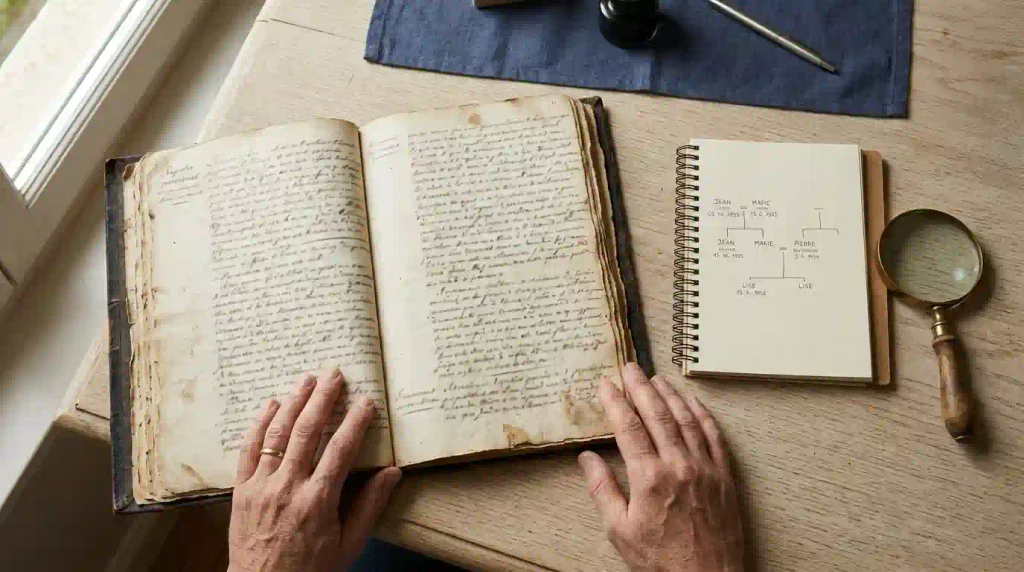
Tracing Names Through Parish Registers
Parish registers can provide baptisms, marriages, and burials, often with valuable relationships. Search the relevant locality and examine the original image when possible.
Watch for Latinized given names and spelling variation. A modern index may use a normalized form or misread handwriting. Reading nearby entries can help you recognize the writer’s letter shapes and repeated wording.
For family naming purposes, keep the ancestor’s usual name and recorded name distinct if the evidence supports both. Either may inspire a tribute, but explain which one you chose.
Why French Historical Records Can Be Difficult to Interpret
Faded ink, unfamiliar handwriting, abbreviations, language changes, and incomplete survival can complicate interpretation. A missing name may reflect a damaged document rather than an unnamed child.
Do not fill gaps with assumptions from modern forms. Historical record keepers did not always preserve the categories or punctuation a contemporary database expects.
If two interpretations remain possible, record the uncertainty. A careful unresolved note is more useful than a confident family story that rests on a guessed word.
French-Canadian and Acadian Naming Traditions
French-Canadian and Acadian histories share linguistic connections with France while developing in their own communities. Quebec and Acadia should not be treated as identical places or interchangeable legal jurisdictions.
Early French Families and Acadian Surnames
French families began settling in Acadia in the seventeenth century. Their descendants preserved and adapted names through migration, local communities, and contact with other languages.
For a modern heritage choice, begin with the actual branch of your family. A Quebec ancestor and an Acadian ancestor may offer different records, locations, and naming stories.
Choosing a boy’s additional name from a documented relative can recognize that history without implying that every French-speaking Canadian family shares the same custom.
What Are Dit Names?
A dit name is an alternative identifying name or family nickname. Dit means “called” in this naming context. Such names can help explain why a family appears under more than one surname form.
They are not an additional-prénom category. If you see a phrase containing dit in a historical record, examine whether it connects a surname with an alternative family label.
Search both forms during research. An index might preserve one and omit the other, making a family harder to find if you search only a modern inherited surname.
Julien Lor and the Alternative Name La Montagne
Julien Lor appears in Acadian research with surname variants and the alternative name La Montagne. The example illustrates why researchers search aliases as well as ordinary spellings.
La Montagne should not be reclassified as his middle name. Nor does sharing that alias automatically establish that two historical men were the same person.
How Land and Titles Influenced Family Names
Territorial labels, property associations, and titles can become part of how a historical person is identified. However, each element needs interpretation in its own context.
Before connecting two records, distinguish an inherited surname from a place designation or title. A family’s later choice of surname may preserve only one component of an earlier longer identification.
The Mius examples below demonstrate that principle. Their relevance is the structure of historical naming, rather than a recommendation to use territorial labels as a boy’s additional given name.
Marguerite Mius and the Laverdure Line
Marguerite Mius d’Entremont and Pierre Melanson were among the families associated with the founding of Grand-Pré. Laverdure appears in the Melanson family’s naming history; it should not be mistaken for Marguerite’s additional given name.
When tracing this line, distinguish birth-family identity from the surname or alternative label associated with a spouse’s family. That approach prevents a family tree from turning every shared label into a personal name.
Jacques Mius and the d’Entremont Family
Jacques Mius belongs to the historical d’Entremont family context. Jacques is the given name; the remaining elements require surname and family-history interpretation.
For a baby-name tribute, Jacques is an intelligible given-name choice. Borrowing an entire ancestral designation requires separate consideration of what the components actually represent.
Abraham Mius and the Pleinmarais Name
Historical accounts associate Abraham Mius with forms such as Plemazais or Plemarch. The outline’s Pleinmarais wording should not be assumed to be an equivalent spelling without documentary support.
This is a useful research lesson: do not silently standardize a disputed historical label. Preserve the form in the source you consult and investigate whether another spelling identifies the same person.
Phillippe Mius and Mi’kmaw Connections
The younger Philippe Mius is associated in historical accounts with a marriage connection to the Saint-Castin family. Philippe is the standard French given-name spelling; “Phillippe” should be checked against the source rather than adopted automatically.
Claims about Mi’kmaw ancestry or community connections need evidence for the specific lineage. A European-looking surname does not settle ancestry, and a name alone cannot establish Indigenous identity.
Acadian Displacement and Lost Family Names
The Acadian deportations beginning in 1755 separated families and disrupted communities. Later records can reflect migration, spelling changes, and administrative practices in new locations.
A surname that looks different may preserve the same family connection, but that possibility needs verification. Avoid assuming that all unfamiliar spellings arose from a single dramatic event.
For a child’s heritage name, the family story can honor resilience without overstating what the records establish. A carefully documented given name provides a personal connection to history.
Using DNA Research to Investigate French and Acadian Ancestry
DNA results can complement documents by identifying possible biological relationships. They cannot explain why an ancestor received a particular given name or prove the meaning of a surname.
Begin with a documented research question. Compare matches with records and keep the biological inference separate from assumptions about language, culture, or social identity.
Commercial ancestry estimates can change as databases and methods change. Do not base a child’s heritage story solely on a percentage label from one test.
Comparing Y-DNA, mtDNA, and Autosomal Testing
Y-DNA examines a direct paternal genetic line in people who carry the relevant Y chromosome. It can be useful for a surname-line question, but surnames and biological transmission do not always remain aligned.
Mitochondrial DNA examines a direct maternal line. Autosomal testing surveys inheritance across many ancestral lines and is commonly used to investigate broader cousin relationships.
These tests answer different questions. None replaces a full family tree, and none can reconstruct every ancestor simply from the present-day surname.
Cross-cultural naming research also benefits from understanding the actual naming system involved. For another example, do greeks have middle names discusses a different cultural context that should not be interpreted through French categories.
Frequently Asked Questions About Middle Names in French
Can a French Boy Have No Additional Given Names?
Yes, a French boy can have one registered given name without a second or third prénom.
Must a French Middle Name Be Religious?
No, an additional French given name can reflect family, culture, personal taste, or other permitted choices.
Can Siblings Share the Same Additional Given Name?
Yes, siblings can share an additional given name, including a name honoring the same relative.
Does a French Name Need to Be Translated for Everyday English Use?
No, families can retain the French form and decide how they want it pronounced in English.
Does Using an Additional Given Name Mean Someone Has Legally Changed Their Name?
No, using an already registered prénom as the usual name differs from formally changing registered names.
Final Thoughts on Middle Names in French
Middle names in French naming make more sense when you think in terms of registered given names, compound names, and the name someone uses every day. Those distinctions help you choose a boy’s name, preserve a family tribute, and avoid mistakes on international forms. Start with your family’s story, then compare meaning, spelling, pronunciation, and the complete name beside the surname. Treat popularity lists carefully, especially when they measure first names rather than additional prénoms. A familiar choice such as Louis can be meaningful, and a distinctive choice such as Étienne can work beautifully with preparation. Explore our Naming Guides to refine your shortlist, then choose the combination your family can explain, enjoy, and proudly pass on.