What Is a Name? Meaning, Types, and How Names Shape Identity
Summary
What is a name? A name is a word, phrase, or set of words used to identify and distinguish a person, place, object, organization, or other entity. For people, a personal name can include a given name, middle name, surname, nickname, title, or other culturally meaningful elements. But names do much more than separate one person from another. They can carry family heritage, cultural identity, language, religion, history, personal meaning, and social expectations. A boy named after his grandfather may carry a family connection, while another child may receive a nature-inspired, religious, mythological, or completely modern name because of what it represents to the parents. Naming systems also differ dramatically around the world: some cultures place the family name first, some use patronymics, and others use multiple surnames or given names. Understanding what is a name, where names come from, and why humans use them reveals how deeply naming is connected to identity, communication, family, and society.
Table of Contents
- What Is a Name?
- What Are the Different Types of Names?
- Where Do Names Come From, and What Do They Mean?
- How Do Naming Traditions and Name Structures Differ Across Cultures?
- Why Are Names Important to Identity and Society?
- How Do People Choose Names?
- Why Do People Change Their Names?
- How Are Names Used in U.S. Documents and Everyday Life?
- How Do Names Function in Literature and Media?
- How Do Names and Naming Trends Change Over Time?
- Frequently Asked Questions About Names
- Final Thoughts
What Is a Name?
A name is an identifying label used to refer to a particular person, place, animal, organization, object, product, or other entity.
If you ask what are names used for, the simplest answer is:
Names allow us to identify, distinguish, remember, and communicate about people and things.
Imagine a classroom containing 25 children but no one has a name. A teacher would have to say something like:
“Boy sitting beside the window in the second row.”
A personal name makes communication much easier:
“Daniel.”
Names therefore perform a basic practical function, but human naming systems have grown into something much richer.
A person’s name may communicate:
- individuality
- family relationships
- ancestry
- cultural background
- religion
- language
- gender association
- generation
- social identity
- personal history
This explains why questions such as why do humans have names, why do people need names, and what is the purpose of a name have answers that go beyond simple identification.
Names help organize society while giving individuals a recognizable identity.
How Names Identify and Distinguish People, Places, and Things
Humans do not name only other humans.
We give names to:
- people
- cities
- countries
- rivers
- mountains
- planets
- businesses
- products
- ships
- buildings
- pets
- fictional characters
Consider:
Amazon
Depending on context, Amazon can refer to a geographical region, a river, or a company.
Likewise:
Jordan
could refer to a country or a personal name.
Names allow language users to refer to a particular entity rather than only describing its category.
Instead of saying:
“the large city in the United States located beside Lake Michigan,”
we simply say:
Chicago.
This is the essential function behind why we name things: naming makes communication faster and more precise.
The academic study of names is generally called onomastics, or onomatology. Within that field, researchers examine personal names, place names, naming systems, historical changes, and the relationships between language and culture.
What Is a Personal Name?
A personal name is a name used to identify a human being.
Depending on the naming tradition, a personal name might include:
- given name
- middle name
- surname
- patronymic
- matronymic
- clan name
- religious name
- nickname
- title
For example:
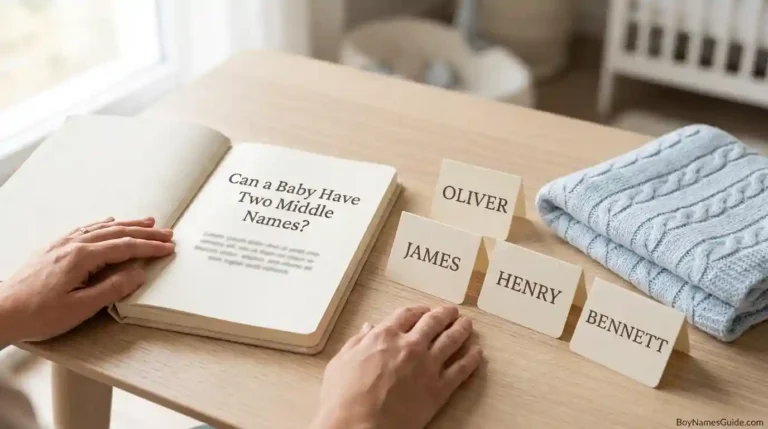
Oliver James Bennett
contains several recognizable components in a typical American format:
Given name: Oliver
Middle name: James
Surname: Bennett
If someone asks what is a person’s name, however, the answer is not necessarily limited to these three parts.
Around the world, personal names follow very different structures.
A person may have:
- one name
- two names
- several given names
- multiple surnames
- no middle name
- a father’s name
- a mother’s name
- a clan identifier
- a generation name
That is why our broader Naming Guides examine names within their cultural contexts instead of assuming every person uses the Western first-middle-last model.
What Is a Surname?
A surname is a name usually associated with family membership or inherited lineage.
Other common terms include:
- family name
- last name
Examples include:
Carter
Williams
Rodriguez
Patel
Kim
But “last name” can be misleading internationally because the family name does not always appear last.
In some naming traditions, the family name order places the surname before the individual’s given name.
Surname systems also developed from different sources.
A family name may historically relate to:
- occupation
- location
- parentage
- personal characteristic
- clan
- ancestor
For example, many surnames around the world developed from words meaning “son of” a particular person or indicating someone’s place of origin.
What Is a Title?
A title is different from a personal name.
Examples include:
- Mr.
- Mrs.
- Ms.
- Dr.
- Professor
- Sir
In:
Dr. Daniel Carter
“Dr.” is a title.
Daniel is the given name.
Carter is the surname.
Titles can communicate social role, professional qualification, marital convention, rank, or honor.
They should not automatically be considered part of the person’s birth name.

What Are the Different Types of Names?
There is no single fixed number of name types because names can be categorized according to purpose, language, culture, or what they identify.
However, several major categories are particularly useful.
Given Names, Middle Names, and Family Names
A given name is a personal name assigned to an individual, commonly at or near birth.
It is often called a first name in English-speaking countries.
Examples include:
- Liam
- Noah
- Oliver
- Theodore
- Mateo
Parents looking for a baby boy’s given name can browse our collection of Boy Names for meanings, origins, themes, and naming ideas.
A middle name is an additional personal name used between the primary given name and family name in naming systems where that structure applies.
For example:
Liam Alexander Reed
Liam = given name
Alexander = middle name
Reed = surname
If you want a deeper explanation, read what is a middle name.
Some people have more than one additional name. Our guide on can you have two middle names explains how multiple middle names work.
Nicknames, Professional Names, Place Names, and Brand Names
A nickname is an informal name used instead of or alongside a formal personal name.
For example:
Alexander → Alex
Benjamin → Ben
William → Will
Theodore → Theo
A nickname may also have little obvious connection to the formal name.
A professional name is a name someone uses publicly in a career.
Writers may use pen names.
Actors and musicians may use stage names.
Business professionals may shorten or modify their names for consistency or recognition.
A place name identifies a geographical feature or location.
Examples include:
- California
- London
- Nile
- Everest
- Sahara
Some place names eventually become personal names.
For example:
Austin, Jordan, and Hudson can all function as personal names as well as geographical references.
A brand name identifies a company, product, or service.
Brand naming has different goals from personal naming, but both depend on memorability, associations, sound, and identity.
Aliases and Online Usernames
An alias is an alternative name used by someone in addition to their primary identity.
It may be used for:
- privacy
- artistic work
- professional activities
- security
- historical reasons
Online life has created another important category: the username.
A person may have:
Legal name: Daniel Michael Carter
Preferred name: Dan Carter
Professional profile: Daniel M. Carter
Online username: DanCreates
Social media display name: Dan Carter | Designer
These are all forms of identity expression, but they do not necessarily have the same legal status.
An online username is primarily an account identifier, while a legal name connects the individual to official records.
Where Do Names Come From, and What Do They Mean?
The question how are names made has many answers because names can emerge from languages, occupations, landscapes, religions, myths, personal traits, historical figures, and family traditions.
Some names are thousands of years old.
Others are newly invented.
Common Sources of Name Meanings
Personal names commonly originate from ideas connected with:
Nature
Examples may be inspired by:
- rivers
- forests
- flowers
- animals
- sky
- stars
- seasons
These are often described as nature-inspired names.
Virtues
A virtue name may express an admired quality such as:
- Hope
- Faith
- Justice
- Grace
Religion
A religious name may come from:
- scripture
- saints
- prophets
- religious traditions
Mythology
A mythological name may come from figures in Greek, Roman, Norse, Hindu, or other mythological traditions.
Geography
A geographical name may derive from a city, country, region, mountain, river, or another meaningful place.
Family
Parents may name children after:
- grandparents
- parents
- relatives
- ancestors
The origin of a name and the reason one particular family chooses it are therefore not always the same.
How Personal Experiences Can Shape a Name’s Meaning
A dictionary or etymological source might tell you the historical roots of a name.
But the family may give that name another layer of meaning.
Imagine a boy named:
James
Historically, the name has its own linguistic origin.
But his parents may have chosen it because James was the name of a beloved grandfather.
For that child, “James” represents both its linguistic history and a specific family heritage.
This distinction helps answer questions such as what does my name mean?
A name can possess:
- an etymological meaning
- a cultural association
- a personal or family meaning
Our guide to what is in a name meaning explores these different layers in greater detail.
How Etymology Differs From Modern Associations
Etymology studies the historical origin and development of words, including names.
A name’s etymology might trace it through several older languages.
Its modern association can be completely different.
For instance, people today may associate a name with:
- a celebrity
- athlete
- fictional character
- historical figure
- friend
- relative
Those associations may become culturally powerful even when they have nothing to do with the name’s original linguistic meaning.
This distinction matters when evaluating baby-name meanings online.
A website saying a name “means bravery” may sometimes be describing a modern symbolic association rather than the actual linguistic derivation.
Why a Name’s Meaning Can Change Across Languages and Cultures
Names travel.
When people migrate, trade, intermarry, translate religious texts, and share stories, names move between languages.
During that process, a name may develop:
- new pronunciation
- new spelling
- shortened form
- translated equivalent
- different gender association
- new cultural meaning
The same spelling may even have unrelated origins in two languages.
This is why a name should not always be assigned one universal meaning.
Context matters.
How to Check Whether a Name Meaning Is Reliable
When researching a baby name, distinguish between:
Etymological meaning and symbolic interpretation.
A reliable explanation should ideally identify:
- language of origin
- older root word
- historical form
- literal meaning
- known spelling variants
- uncertainty or disputed interpretations
Be cautious when a source makes dramatic claims without explaining where the meaning came from.
A name does not automatically mean “warrior,” “king,” “moon,” or “blessing” simply because one modern naming list describes it that way.
For serious name research, checking several reputable linguistic, historical, or onomastic sources is safer than copying a meaning from a single unsourced list.
The International Council of Onomastic Sciences provides useful terminology for the academic study of names through its onomastic terminology resources.
How Do Naming Traditions and Name Structures Differ Across Cultures?
One of the most important lessons in name research is that there is no universal naming structure.
The familiar American arrangement:
First + Middle + Last
is only one system.
Examples of Naming Traditions Around the World
American families commonly use a given name, optional middle name, and surname.
Mexican naming traditions commonly include given names plus two family surnames. Our article on do Mexicans have middle names explains how this differs from the U.S. model.
Greek naming customs may include parental-name information alongside given and family names. See do Greeks have middle names for the distinction between a second given name and a parent-name identifier.
Indian naming customs vary extensively according to language, religion, region, and family practice. Our guide to do Indians have middle names explores several of those variations.
French naming traditions may involve multiple given names, which are discussed in middle names in French.
Arabic naming systems can use lineage terms unfamiliar to English speakers. For example, understanding is bin a middle name requires knowing what the element means culturally rather than simply looking at its position.
These examples show why the question what cultures have middle names cannot be answered by applying one country’s terminology worldwide.
Why the Given Name May Come Before or After the Family Name
The term “first name” can be misleading internationally.
In many English-speaking contexts:
Daniel Carter
places the given name first.
But some cultures traditionally place the family name first.
This means given name and family name are often more precise terms than “first name” and “last name.”
Name order can reflect:
- language
- social convention
- administrative practice
- historical tradition
When dealing with international names, you should not reorder them based solely on what feels familiar in English.
Patronymics, Matronymics, and Multiple Family Names
A patronymic identifies someone through the father or a paternal ancestor.
A matronymic performs a similar function through the mother.
Naming systems around the world have used both approaches.
Other systems preserve both parental family lines with multiple surnames.
This creates a fundamental lesson:
Something located between a given name and a final surname is not automatically a middle name.
Even small elements can have specific functions.
For example, something that looks like a de middle name may actually be connected with a surname structure or another linguistic convention.
How Language and Culture Influence Gender Associations in Names
Why do some names feel masculine, feminine, or gender-neutral?
Language and culture play major roles.
A name can become associated with a gender because of:
- grammatical endings
- historical usage
- famous people
- religious figures
- naming laws
- cultural expectations
In some languages, certain endings strongly correlate with grammatical or traditional gender.
Yet those associations can change when a name moves to another culture.
A historically male name in one era or location may later become a gender-neutral name or become more strongly associated with women.
Our guide on why are names gendered explains how language, history, society, and grammatical gender can influence these patterns.
Why Are Names Important to Identity and Society?
If names were purely practical labels, people would probably care much less about them.
Instead, naming a child can become one of the most significant decisions parents make before or after birth.
Why?
Because names become closely connected with personal identity.
How Names Connect People With Family and Cultural Heritage
A boy named after his grandfather carries a visible family link.
A child given a traditional cultural name may preserve language and heritage across generations.
A religious name may connect a child with a faith community.
A surname can preserve family lineage across centuries.
Names therefore act like small pieces of history carried by individuals.
They can communicate:
- where a family came from
- what language it spoke
- which religious tradition it followed
- which relatives were honored
- which cultural community it belonged to
Of course, a name does not tell us everything about a person.
Identity is much more complex.
But a name can serve as one meaningful part of that story.
The Psychological Impact of a Name
Names can become connected with self-concept, individuality, and belonging because people hear and use their own names throughout life.
A person may feel proud of a name because it connects them with:
- family
- ancestry
- culture
- faith
- someone they admire
Someone else may dislike a name because it is frequently mispronounced, mocked, or strongly associated with an identity they do not feel represents them.
The important point is not that a name determines personality or destiny.
It does not.
Claims that a person’s name automatically controls intelligence, success, character, or future should be treated cautiously.
Instead, the psychological importance of a name often comes from the experiences and social interactions connected with it.
How Names Can Affect Perception and Social Interaction
Names can produce associations in listeners.
A person may perceive a name as:
- traditional
- modern
- formal
- youthful
- familiar
- unusual
- culturally specific
Those associations are influenced by individual experience and society.
For example, a name may suddenly feel modern because several celebrities use it.
Another may feel old-fashioned because it was especially common several generations ago.
These are perceptions, not objective qualities of the person carrying the name.
It is important not to turn name associations into stereotypes.
A person’s abilities, personality, intelligence, or values cannot be reliably determined from their name.
Names in Personal and Professional Identity
People often present their names differently depending on context.
Someone legally named:
Alexander Benjamin Carter
might use:
Alex Carter with friends
Alexander B. Carter professionally
Alexander Benjamin Carter on official documents
AlexCarterDesign as an online username
The underlying person is the same.
Different name forms simply fit different settings.
A name can therefore function as part of:
- professional profile
- email address
- social media account
- artistic identity
- personal branding
- legal identity
How Do People Choose Names?
Parents choose baby names for many different reasons.
Some begin with family tradition.
Others begin with meaning.
Some simply hear a name and love how it sounds.
There is no universal formula.
Family Traditions, Cultural Influences, and Personal Preferences
Possible naming influences include:
- parents
- grandparents
- ancestors
- cultural heritage
- religion
- favorite literature
- historical figures
- nature
- travel
- family locations
- personal values
One family might choose:
Theodore James
because James is the grandfather’s name.
Another might choose:
Leo Alexander
because they simply like the combination.
Another family may intentionally select a heritage name to maintain a connection with grandparents’ language and culture.
If you’re currently naming a son, our guide on how to choose a baby name provides a practical step-by-step approach.
Considering a Name’s Meaning, Pronunciation, and Spelling
Before choosing a name, consider three major factors:
Meaning
Does the origin or family significance matter to you?
Pronunciation
Will people around the child know how to say it?
Spelling
Is the preferred spelling established, unusual, or likely to require frequent correction?
An unfamiliar spelling is not automatically bad.
Neither is an unusual pronunciation.
The goal is simply to understand the practical implications.
Our name pronunciation guide can help when comparing names from languages or cultures you do not regularly speak.
What Makes a Name Memorable?
Memorable names often have a strong combination of:
- recognizable sound
- clear rhythm
- distinctive features
- manageable pronunciation
- personal meaning
But memorable does not have to mean unusual.
Simple names such as:
Jack
Leo
Noah
are highly memorable precisely because they are short and familiar.
Longer names such as:
Alexander
Sebastian
Theodore
can be memorable because of their rhythm and history.
The best choice depends on what the family values.
Common Mistakes When Choosing or Using a Name
Some mistakes can be avoided by checking the complete name before making a final decision.
Consider:
- full initials
- first-middle-last rhythm
- likely nicknames
- pronunciation
- surname compatibility
- meaning
- spelling
- cultural context
If you’re adding another personal name, our guide on how to pick a middle name can help you test the complete combination.
Another common mistake is assuming an unfamiliar name component performs the same function as an American middle name.
Cultural research prevents many of these misunderstandings.

Why Do People Change Their Names?
Names are important, but they are not necessarily permanent.
People may change part or all of a name for personal, family, cultural, professional, or legal reasons.
Common Reasons for Name Changes
A name change may be connected with:
- marriage
- divorce
- adoption
- family circumstances
- professional identity
- religious conversion
- cultural reclamation
- personal preference
- correcting records
- gender identity affirmation
Someone may change only a surname.
Another person may change a first name.
Someone else may add or remove a middle name.
A person may also use a preferred name socially without legally changing the official name.
Personal, Cultural, and Legal Implications
Changing a name can affect both identity and paperwork.
A person’s name may appear across:
- passport
- driver’s license
- Social Security records
- financial accounts
- employment records
- educational records
- insurance
- property records
In the United States, the legal process for changing a name can vary according to state and circumstance.
Marriage, divorce, adoption, and independent court-ordered changes may follow different procedures.
A name change also carries personal implications.
Someone reclaiming a heritage name may feel closer to cultural roots.
Another person may change a name because the old one no longer represents their identity.
Names therefore exist at the intersection of personal choice, society, culture, and law.
How Are Names Used in U.S. Documents and Everyday Life?
Names do not always appear identically in every setting.
A person can have a complete legal name and still use shorter or alternative forms every day.
Legal Name, Preferred Name, and Display Name
A legal name generally refers to the name recognized for relevant official or legal purposes.
A preferred name is the name someone chooses to use in everyday interactions.
A display name is the name shown publicly in a digital platform, workplace system, or account.
Consider:
Legal or official record: Christopher Michael Harrison
Preferred name: Chris Harrison
Professional display: Christopher M. Harrison
Username: ChrisHarrisonNY
These do not necessarily represent conflicting identities.
They can simply be different presentations of the same person’s name.
Why a Person May Use Different Name Forms in Different Settings
Name usage changes with context.
Formal documents may require a complete name.
Friends may use a nickname.
A professional may include a middle initial.
A writer might use a pen name.
Social media users may use a shortened form.
Someone with a long name may omit additional given names in everyday conversation.
People may also adjust their name when moving between countries where naming systems differ.
This can explain why immigrant names sometimes appear differently across official records and everyday use.
How to Respect Someone’s Preferred Name and Pronunciation
The easiest way to respect someone’s name is to use the form and pronunciation they ask you to use.
If you’re unsure how a name is pronounced, asking politely is usually better than repeatedly guessing.
Do not assume a name should be shortened.
For example, someone named Alexander may prefer:
Alexander
rather than Alex.
Someone named William may prefer:
Will, Bill, or William.
The person carrying the name is the best source for how they want it used.
How Nicknames, Aliases, and Usernames Are Used
Different alternative names serve different purposes.
A nickname may express familiarity.
An alias is an alternative identity label.
A professional name may be used for career consistency.
A username identifies a digital account.
A social-media display name can communicate identity without matching the account username.
Modern naming has therefore expanded far beyond birth certificates.
People now manage identity across both physical and digital environments.
How Do Names Function in Literature and Media?
Writers rarely choose every character name randomly.
Names can help establish:
- time period
- location
- social background
- personality expectations
- symbolism
- family connection
How Names Can Suggest a Character’s Identity or Background
A historical novel set in medieval Europe will probably use different character names from a science-fiction story set centuries in the future.
Names can immediately suggest cultural context.
A writer may choose a name because of:
- historical accuracy
- etymology
- sound
- symbolism
- irony
- cultural association
Yet writers also sometimes deliberately challenge expectations.
A gentle character may have a name associated with strength.
A villain may have an innocent-sounding name.
This contrast can make a character more interesting.
Examples of Meaningful Names in Stories
Literature frequently uses character names symbolically.
Some character names deliberately reflect traits, occupations, origins, or themes.
Others become meaningful only because readers associate the name with the famous character.
This demonstrates an important point about naming:
Associations can change meaning.
A name with an ordinary historical origin may develop a powerful new cultural association through literature, film, television, music, or public figures.
That does not change its original etymology, but it changes how society hears the name.
How Do Names and Naming Trends Change Over Time?
Names move through cycles.
A name can be fashionable in one generation, rare in the next, and fashionable again decades later.
Several forces influence naming trends:
- celebrities
- movies
- television
- literature
- immigration
- religion
- historical events
- popular culture
- changing family values
- renewed interest in vintage names
- international naming influences
Names once seen as old-fashioned may return because parents rediscover them.
Other names may decline after becoming extremely common.
Modern parents also have access to names from many more cultures through international media, migration, travel, and the internet.
The U.S. Social Security Administration’s baby-name database shows this movement clearly: rankings can be explored across years going back to the late 19th century.
Current naming trends do not mean parents must follow popularity lists.
A highly popular name can still be the right choice if a family loves it.
Likewise, rarity does not automatically make a name better.
The most useful question is:
Does this name fit the child and the meaning, culture, sound, or family connection you want to preserve?
Frequently Asked Questions About Names
What is a name?
A name is a word or set of words used to identify and distinguish a person, place, object, organization, or other entity.
What is a personal name?
A personal name is a name used to identify an individual human being.
Why do we have names?
Names make communication and identification easier while also expressing personal, family, and cultural identity.
Why do humans have names?
Humans use names to distinguish individuals, communicate efficiently, organize social relationships, and preserve cultural and family connections.
Why do people need names?
Names provide practical identification and help connect individuals with families, communities, records, and social identities.
What is the purpose of a name?
A name identifies someone or something and can also communicate family, culture, language, religion, and personal meaning.
What are names used for?
Names are used for identification, communication, records, relationships, identity, and cultural continuity.
Why are names given to people?
People receive names so they can be individually identified and connected with family, culture, or personal traditions.
What is a given name?
A given name is a personal name assigned to an individual, often at or near birth.
What are your given names?
Your given names are the personal names assigned to you apart from your family surname.
Is a given name the same as a first name?
Often yes in English-speaking systems, but “given name” is more accurate internationally because it may not appear first.
What is a surname?
A surname is a family name that commonly connects an individual with a family or lineage.
What is a middle name?
A middle name is an additional personal name used between a primary given name and surname in naming systems that use that format.
How many types of names are there?
There is no fixed number, but major types include personal names, surnames, nicknames, titles, place names, aliases, professional names, brand names, and usernames.
What are the different types of names?
Names can include given names, middle names, surnames, nicknames, titles, aliases, place names, professional names, brand names, and usernames.
What is the study of names?
The study of names is called onomastics or onomatology.
How are names made?
Names develop from languages, family traditions, occupations, locations, religion, mythology, nature, personal traits, and newly created forms.
When did names become a thing?
Names existed before surviving written history, so there is no known date when humans first began naming one another.
What makes a name a name?
A word or expression functions as a name when it identifies a particular person, place, organization, object, or other entity.
What gives us our names?
Names may be given by parents, family members, communities, religious traditions, legal processes, or individuals themselves.
Why do people have different names?
Different languages, cultures, families, religions, histories, and personal preferences create enormous variation in names.
Why do we name things?
Naming lets us refer to specific things efficiently instead of repeatedly describing them.
Why are names important in society?
Names support communication, identification, relationships, cultural continuity, and official recordkeeping.
What is behind a name?
Behind a name may be its linguistic origin, family history, cultural association, personal meaning, or all of these together.
Can names have more than one meaning?
Yes, a name can have an etymological meaning, cultural associations, and a separate personal meaning within a family.
Does a name determine personality?
No, a name does not determine someone’s personality, intelligence, character, or destiny.
Can people change their names?
Yes, people may change names for personal, family, cultural, marital, religious, professional, or identity-related reasons.
Is a nickname a real name?
A nickname is a genuine form of name usage, although it may not be the person’s official or legal name.
Is a username a name?
A username is a digital identifier and can function as part of a person’s online identity.
Why do some names sound masculine or feminine?
Language patterns, historical use, grammatical gender, religion, and cultural expectations can create gender associations.
Can a name become gender-neutral?
Yes, gender associations can change across generations, languages, and cultures.
How should I choose a baby name?
Consider meaning, pronunciation, spelling, family significance, cultural context, initials, surname compatibility, and how the full name sounds.
Final Thoughts
So, what is a name? At its simplest, a name identifies someone or something—but human names carry much more than identification. A personal name can preserve family heritage, cultural identity, language, religion, ancestry, personal choice, and memories. Given names, middle names, surnames, nicknames, patronymics, and other naming elements also work differently across cultures, which is why names should always be understood in context.
For parents choosing a baby boy’s name, the goal is not simply to find something fashionable. Look at the name’s origin, meaning, pronunciation, family significance, cultural background, and how it works with the complete name.
Explore more Naming Guides to understand naming traditions, or browse our Boy Names collection for meaningful ideas for your child.