

Do Greeks Have Middle Names? Greek Naming Customs Explained
Summary
Do Greeks have middle names? Usually, not in exactly the same way Americans use middle names. A traditional Greek name is generally built around a given name and family name, while a parent’s name—especially the father’s given name—may also appear in official records as a patronymic or parent-name identifier. Because this parental name can sit between a person’s first name and surname when Greek names are written or adapted abroad, it is sometimes mistaken for a conventional middle name.
That does not mean Greeks can never have middle names. Modern parents may give a child a genuine second personal name, and Greek-American families may use middle names according to U.S. customs. Greek naming traditions also involve grandparents, Orthodox saints, baptismal names, gender-related surname forms, and distinctive grammatical patterns such as the genitive case.
If you are researching do Greeks have middle names, choosing a Greek-inspired baby name, or trying to understand a Greek family record, the important question is not simply whether a name appears in the middle—it is what that name represents.
Table of Contents
- Do Greeks Have Middle Names? The Short Answer
- How Greek Names Are Structured
- Greek Family Naming Traditions
- Why Greek Surnames Can Differ by Gender
- How Greek Naming Customs Vary Today
- Frequently Asked Questions About Greek Middle Names
- Sources on Greek Naming Customs
- Final Thoughts
Do Greeks Have Middle Names? The Short Answer
Traditionally, Greeks do not necessarily use middle names in the Anglo-American sense.
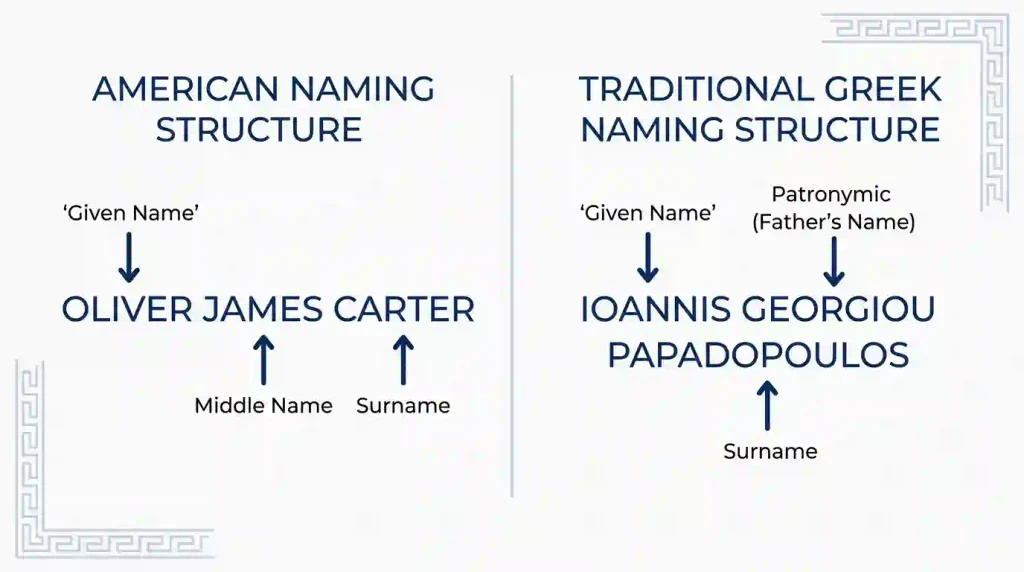
In the United States, a typical name might be:
Michael James Carter
Here:
- Michael = given name
- James = middle name
- Carter = family name
A Greek naming structure may work differently. A person’s records can contain:
- a given name
- a father’s given name or patronymic
- sometimes a mother’s name
- a family name or surname
The parent’s name is important for identification, but it should not automatically be interpreted as the person’s middle name.
This distinction matters because a Greek person’s name may appear in databases, passports, immigration records, genealogical documents, school records, or foreign forms in a way that makes the patronymic look like a middle name.
Understanding this difference becomes easier once you understand what is a middle name in the first place. A conventional middle name is normally part of a person’s own personal name. A patronymic identifies the person’s parent or family relationship.
In other words:
A Greek patronymic may occupy the “middle” position without functioning as a Western middle name.
However, contemporary Greeks can also have two given names. In that case, the second name really is a second personal name, rather than a parent’s name.
The answer therefore depends on the individual, the document, the period, and whether the name is being used in Greece or adapted to another country’s naming system.
How Greek Names Are Structured
Greek naming conventions combine language, family identity, administrative practice, and religious tradition.
Before deciding whether a particular Greek name contains a middle name, it helps to separate the different elements that might appear.
If you are new to naming terminology, our guide explaining what is a name provides a useful starting point because names can carry several different functions: personal identification, family connection, ancestry, religion, and cultural identity.
Given Name, Parent’s Name, and Family Name
The basic modern Greek personal name normally begins with a given name and ends with a family name.
For example, imagine a boy named:
Alexandros Papadopoulos
Alexandros is his given name and Papadopoulos is his surname.
Greek administrative records may additionally identify his father and mother. If his father is named Georgios and his mother is named Eleni, those parental names can be recorded independently of Alexandros’s own given name.
A fuller administrative identification might therefore contain information corresponding to:
- Given name: Alexandros
- Father’s given name: Georgios
- Mother’s given name: Eleni
- Family name: Papadopoulos
The exact formatting varies by document.
Historically and linguistically, Greek patronymic information may also use the genitive case, which expresses a relationship similar to “of” in English.
For example, a form of a father’s name meaning essentially “of Georgios” may identify whose son or daughter a person is.
This grammatical relationship is why readers occasionally encounter Greek names containing forms ending in -ou.
The -ou suffix is frequently associated with a Greek genitive or possessive form, although Greek names have many possible endings and transformations. It should never be assumed that every name ending in -ou is a middle name or patronymic.
This differs from systems such as Arabic naming structures, which is why questions such as is bin a middle name require understanding the naming tradition rather than simply judging the position of a word in the full name.
How Greek ID Cards Show a Person’s Name and Their Parents’ Names
Greek identity documents provide one of the clearest examples of why parental names should not automatically be called middle names.
On Greece’s newer identity cards, the front of the card contains core information about the holder, including the surname and given name.
The reverse side separately includes the father’s name and mother’s name.
That separation is important.
The father’s given name does not become the cardholder’s second personal name simply because it appears on the identity document. It remains information identifying the person’s parent.
Someone named:
Dimitrios Nikolaou
might therefore have additional fields listing his father and mother, but those fields do not necessarily create additional components of Dimitrios’s personal name.
The Greek Ministry of Citizen Protection describes the information shown on Greece’s modern identity cards, including the separate parental-name fields.
This distinction can also matter when examining birth records, municipal records, marriage documents, citizenship applications, and genealogical sources.
Why a Parent’s Name Can Be Mistaken for a Middle Name
The confusion often begins when a Greek name is transferred into a system designed around:
First Name | Middle Name | Last Name
Greek naming conventions do not always fit neatly into those three boxes.
Suppose an international record contains:
Nikolaos Georgiou Papadopoulos
An English-speaking reader might immediately assume:
- Nikolaos = first name
- Georgiou = middle name
- Papadopoulos = last name
But that interpretation may be incorrect.
Depending on the source document, Georgiou could represent patronymic information connected to the father’s given name rather than a personal middle name chosen for Nikolaos.
This is why genealogists and researchers need to distinguish between:
- a middle name
- a patronymic
- a parent-name identifier
- a second given name
- part of a compound surname
Position alone does not establish function.
Similar confusion happens in many naming systems around the world. Our guide to what cultures have middle names explains why the familiar American first-middle-last model should not be applied universally.
Comparisons with do Mexicans have middle names and do Indians have middle names also show how something appearing between a given name and surname can have completely different meanings depending on culture.
How an Actual Second Given Name Is Different
A true second given name is different because it belongs directly to the individual.
For example, if parents formally name a child:
Alexandros Nikolaos
both Alexandros and Nikolaos may be the child’s own personal names.
Nikolaos is not identifying the father. It is a second personal name.
This is much closer to what Americans normally think of as a middle name.
Modern families can choose more than one personal name for many reasons, including:
- honoring two relatives
- honoring a saint
- combining Greek and international traditions
- satisfying different sides of the family
- giving a child a name suitable for life abroad
- preserving a traditional Greek name alongside a modern choice
The distinction can be summarized simply:
Patronymic: tells you something about the person’s parent.
Second given name: is one of the person’s own names.
Middle name: is a positional concept commonly used in countries such as the United States.
That is also why a question such as can you have two middle names can have different answers depending on the legal and cultural naming system being discussed.
Greek Family Naming Traditions
Greek names are rarely interesting only because of their linguistic structure. They are closely tied to family continuity.
For parents browsing Boy Names, Greek naming traditions provide a useful example of how a name can represent ancestry rather than simply personal taste.
Naming Children After Grandparents
One of the best-known Greek naming customs is the grandparent naming tradition.
Traditionally, families often named children after grandparents, creating continuity between generations.
A frequently described traditional pattern is:
- the firstborn son is named after the paternal grandfather
- the firstborn daughter is named after the paternal grandmother
- later children may honor the maternal grandfather or maternal grandmother
This is a tradition rather than a universal rule.
Different families may reverse the order, honor another relative, use a saint’s name, select a completely different name, or compromise by giving a child two personal names.
Imagine a family in which the paternal grandfather is named Nikolaos.
When the couple has its first son, they may name him Nikolaos in honor of his grandfather.
If several brothers each follow the same custom, cousins within the extended family may end up sharing the same given name.
That explains why repeated names are common in some Greek families.
A child might consequently have:
- a grandfather’s formal name
- a familiar shortened form used at home
- a surname
- parent-name identifiers in administrative records
The naming pattern can look repetitive from the outside, but within the family it reinforces ancestry and continuity.
For parents deciding between heritage, meaning, pronunciation, and personal preference, our guide on how to choose a baby name explores the same balancing process in a broader context.
Naming Children After Orthodox Saints
The Greek Orthodox Church has also had a major influence on Greek personal names.
Many Greek names correspond to Orthodox saints, including familiar examples such as:
- Georgios
- Nikolaos
- Dimitrios
- Ioannis
- Konstantinos
- Andreas
- Athanasios
A child may receive a Christian or baptismal name connected with an Orthodox saint.
The saint associated with the name may become the child’s patron saint, and the saint’s feast can become the person’s name day.
For many Greek Orthodox families, the name day has traditionally been an important celebration.
A person’s name day normally corresponds to the saint’s feast day associated with his or her name.
This creates several overlapping influences:
Family tradition + Orthodox saints + baptism + cultural identity
The same name can therefore honor both a grandfather and a saint.
For example, a boy named Nikolaos after his grandfather may simultaneously carry the name of Saint Nicholas.
That dual significance helps explain why certain names remain common across generations.
A name is not simply a collection of letters. As discussed in what is in a name meaning, names can communicate family history, religion, expectations, identity, and cultural belonging.

Why Greek Surnames Can Differ by Gender
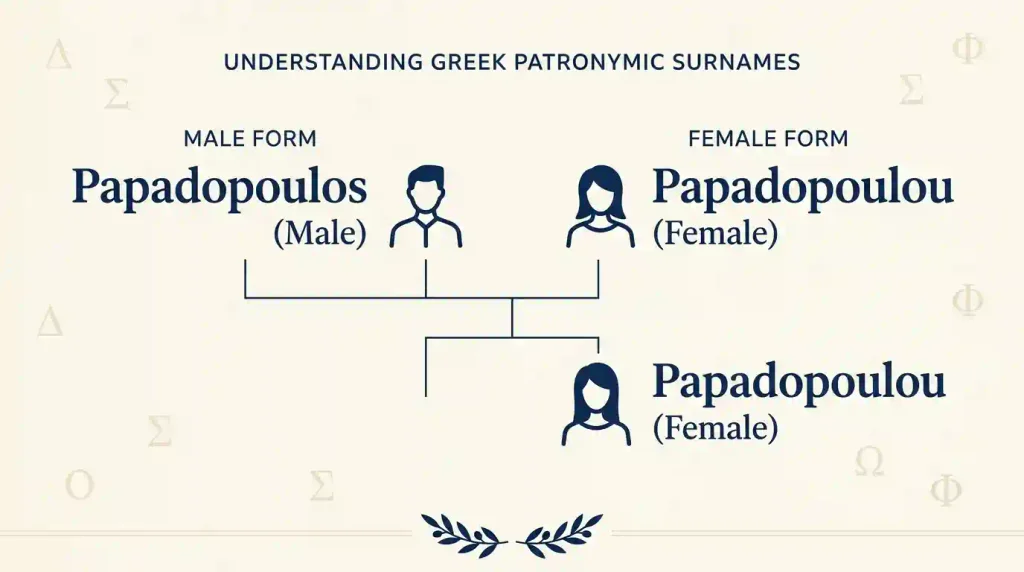
Another feature that can confuse readers unfamiliar with Greek names is that male and female surname forms may differ.
In traditional Greek morphology, a woman’s surname may appear in a grammatical form related to the corresponding male surname.
A commonly cited example is:
Papadopoulos → Papadopoulou
A man might use the surname Papadopoulos while a woman from the same family may use Papadopoulou.
The female form reflects Greek grammar and historically often represents a genitive or possessive form.
Similar transformations can occur with other surname endings.
This is not the equivalent of giving women completely unrelated family names. The forms can represent the same family surname adapted according to traditional grammatical conventions.
It is one interesting answer to the broader question of why are names gendered. Gender differences in names can come from grammar, religion, social customs, or historical naming systems.
Does a Greek Woman Take Her Husband’s Surname?
Modern Greek law adds another important distinction.
Historically, married women commonly used their husband’s surname. However, major family-law reforms introduced in 1983 changed the legal framework.
Under modern Greek law, marriage does not automatically change either spouse’s legal surname.
A woman therefore generally retains her own legal surname after marriage.
A spouse may still use the other spouse’s surname socially under certain circumstances, but marriage itself does not automatically replace the person’s legal family name.
This is the significance of the 1983 Greek surname law, particularly Law 1329/1983 and its reform of the Civil Code.
So if:
Maria Papadopoulou
marries:
Andreas Nikolaidis
you should not automatically assume that her legal name becomes Maria Nikolaidi.
Her legal surname can remain Papadopoulou.
This is especially important for genealogy because older and newer records may reflect different conventions.
What About the Surname of Children?
Parents in Greece determine the surname used for their children according to Greek family law.
A child’s surname may derive from one parent or combine the surnames of both parents, subject to legal rules.
Current Greek law also provides rules for situations in which parents have not made the required surname declaration.
That surname decision is separate from the child’s given name, baptismal name, or any parent-name identifier.
Therefore, when reading a Greek full name, do not assume every additional element is a middle name.
How Greek Naming Customs Vary Today
Greek naming conventions are traditions, not an unchangeable formula.
Modern Greek families live in Greece, the United States, Canada, Australia, the United Kingdom, Germany, and many other countries. Their naming choices can reflect both Greek heritage and the administrative systems of the countries where they live.
Parents Choosing a Second Name for a Child
A modern Greek family may decide to give its child two given names.
For example:
Leonidas Andreas
Both names may belong to the child.
Parents might choose Leonidas because they like the name and Andreas to honor the child’s grandfather.
Alternatively, one name could recognize a grandparent while the other honors an Orthodox saint.
A second given name may be especially attractive when parents need to balance different family expectations.
If the father’s parents hope the first son will receive the paternal grandfather’s name while the mother’s family wants its heritage represented as well, two names can provide a compromise.
The decision resembles the process described in our guide on how to pick a middle name: sound, meaning, heritage, initials, family significance, and everyday usability all matter.
The important point is that an authentic second personal name should not be confused with the father’s name appearing in a patronymic or administrative field.
Greek Naming Practices in Greece and Greek-American Families
The differences become especially visible in the Greek diaspora.
Greek-American families may combine Greek naming practices with U.S. conventions.
A Greek-American boy might have a name such as:
Nicholas George Papadopoulos
In the United States, George may be intentionally registered as a traditional American-style middle name.
Perhaps:
- Nicholas honors a grandfather
- George honors another relative or saint
- Papadopoulos is the family surname
In that situation, George genuinely functions as the child’s middle name.
Another Greek-American family might simplify or Anglicize the spelling of a Greek given name.
Examples could include:
- Georgios → George
- Ioannis → John
- Nikolaos → Nicholas
- Konstantinos → Constantine or Gus in informal usage
- Dimitrios → Dimitri or James in some family traditions
These are not mechanically interchangeable in every family, and personal preference matters.
The broader point is that diaspora families frequently adapt their naming customs to the language and bureaucratic requirements around them.
This is one reason middle names in the US can look different from middle-name practices in Greece.
Likewise, middle names in French reflect their own administrative and cultural history rather than simply following the American model.
Even small particles or name components must be interpreted culturally. A person researching something like a de middle name should first determine whether “de” is actually a personal name, a surname particle, or another linguistic element.
Why a Greek Parent’s Name May Appear as a Middle Name Abroad
International forms are a major source of confusion.
Many databases require three fields:
First Name
Middle Name
Last Name
What happens when an original naming system contains a patronymic rather than a Western middle name?
Sometimes the closest available field is “middle name.”
As a result, a Greek parent’s name may be entered into the middle-name field even though its original Greek function is different.
That can happen in:
- immigration records
- citizenship applications
- university systems
- airline bookings
- older genealogical databases
- employment systems
- banking records
- insurance databases
- foreign birth registrations
Once entered that way, the name can begin appearing on subsequent documents as though it were a conventional middle name.
This is an administrative adaptation, not necessarily evidence that the person’s original Greek name contained a Western-style middle name.
Transliteration Can Create Additional Confusion
Greek names also need to be converted from the Greek alphabet into the Latin alphabet for international use.
This process is called name transliteration.
For example, the Greek name Γεώργιος may appear in Latin characters as Georgios, while familiar everyday or international forms may differ.
Transliteration should not be confused with translation.
It attempts to represent characters and sounds from one writing system in another.
Because transliteration standards, historical records, and personal preferences can vary, the same Greek family may appear under slightly different spellings in different sources.
That matters greatly when researching ancestry.
A researcher should compare:
- Greek-script name
- Latin-script spelling
- father’s given name
- mother’s given name
- maiden surname
- married/social surname
- place of birth
- birth records
- dates
Our name pronunciation guide is also useful when exploring unfamiliar international names because spelling alone may not clearly communicate how a Greek name is pronounced.
How to Tell Whether a Greek “Middle” Name Is Actually a Middle Name
If you encounter a Greek name containing three or more elements, use context rather than guessing.
1. Look at the Original Document Fields
If possible, inspect the labels.
A name entered under “father’s name” is parental information, even if another database later places it in the middle-name field.
2. Check Whether the Name Is in the Genitive Form
A genitive or possessive form can provide a clue that an element functions as a patronymic.
The -ou suffix is particularly worth noticing, although it is not conclusive on its own.
3. Compare the Father’s Given Name
If the supposed middle name closely corresponds to the father’s first name, you may be looking at a patronymic.
4. Check Birth and Baptism Records
A genuine second given name may appear as one of the individual’s officially registered names.
A baptismal record can also help determine whether another Christian name was given during baptism.
5. Consider the Country Where the Record Was Created
A Greek-American record may deliberately use an American-style middle name.
A Greek municipal record may treat the same-looking element differently.
6. Never Rearrange the Name Without Evidence
Changing the order of foreign names can produce mistakes.
This is particularly important for genealogical research, legal documents, passports, and immigration applications.
Greek Names and Their Meaning for Baby-Name Research
For parents exploring Greek names for a baby boy, Greek naming history offers an important lesson: meaning does not stop at the dictionary definition of the first name.
A Greek boy’s name may communicate:
- ancestry
- respect for grandparents
- Orthodox religious heritage
- connection with a patron saint
- regional identity
- family continuity
- linguistic history
- diaspora identity
That makes Greek names particularly interesting for parents looking beyond fashionable baby-name lists.
A beautiful name can sound appealing while also carrying several generations of family history.
Explore our Naming Guides if you want to compare naming traditions across cultures before choosing a name.
Frequently Asked Questions About Greek Middle Names
Do Greeks have middle names?
Traditionally, Greeks do not always use Western-style middle names, although modern Greeks can have a second given name.
What is a Greek patronymic?
A patronymic is a name element or identifier derived from or referring to a person’s father.
Is a Greek father’s name the same as a middle name?
No; the father’s name is normally parental or patronymic information unless it has separately been given to the child as a personal name.
Do Greek IDs include the father’s name?
Yes, modern Greek identity cards include separate fields for the holder’s father and mother.
Do Greek IDs show the mother’s name?
Yes, the mother’s given name is also included separately on modern identity cards.
Why do some Greek names have three parts?
The third element may be a patronymic, second given name, compound surname, or administrative adaptation depending on the record.
What does -ou mean in Greek names?
It commonly appears in genitive forms expressing a relationship similar to “of,” although not every -ou name has the same function.
Can a Greek child have two given names?
Yes, parents may give a child more than one personal name.
Are Greek children named after grandparents?
Many families traditionally name children after grandparents, although the custom is not mandatory.
Is the first Greek son always named after his paternal grandfather?
It is a well-known traditional pattern, but modern families are free to make different choices.
Are Greek children named after saints?
Many Greek Orthodox families choose names associated with Orthodox saints.
What is a Greek name day?
A name day celebrates the feast day associated with the saint whose name a person bears.
Is a baptismal name different from a legal name?
It can be, depending on the family and registration, although many people use the same Christian name in both religious and civil life.
Do Greek women change their surname after marriage?
Marriage does not automatically change a spouse’s legal surname under modern Greek law.
Why do male and female Greek surnames look different?
Traditional Greek grammar can place female surnames in a different, often genitive, form.
Can Greek-Americans have normal American middle names?
Yes, Greek-American families commonly combine Greek heritage with American naming conventions.
Can a Greek patronymic become a middle name in the United States?
It may be entered or treated as a middle name in American systems even when its original Greek function was patronymic.
Are patronymics unique to Greece?
No; many cultures use parent-based naming elements, although their structures and meanings differ.
Should I call every name between a Greek first and last name a middle name?
No; identify whether it is a patronymic, second given name, or another name component first.
Sources on Greek Naming Customs
Reliable research into Greek names should distinguish between cultural tradition and official administrative rules.
For legal and documentary questions, particularly those involving Greek identity documents, surnames, parent names, birth records, or marriage, government and civil-registry information should carry more weight than informal naming websites.
For religious traditions, Greek Orthodox sources are valuable for understanding baptism, baptismal names, Orthodox saints, patron saints, name days, and saint’s feast days.
Genealogical records can then help show how these traditions were actually used within individual families.
Remember that naming practices also change over time. An older record may follow conventions that differ from a modern Greek identity card.
The 1983 Greek surname law, changing social expectations, migration, international marriages, and the growth of the Greek diaspora all influence how Greek names appear today.
For that reason, the safest method is always to identify each element by its function, rather than deciding what it is based only on where it appears in the name.
Final Thoughts
So, do Greeks have middle names? Sometimes—but the traditional Greek system should not automatically be interpreted through the American first-middle-last model. A Greek person’s records may contain a given name, parent-name identifier or patronymic, and family name, while a genuine second given name is also possible. Grandparent traditions, Orthodox saints, baptismal names, gender-related surname forms, and Greek-American customs make the picture even more interesting.
If you are researching a Greek name, always determine whether the apparent “middle name” is actually the person’s own name or simply identifies a parent. That one distinction prevents many genealogical and administrative mistakes.
For more cultural naming explanations, baby-name research, and practical naming advice, continue exploring Boy Names Guide and compare how names work across different languages and traditions.