
Why Do We Have Middle Names? History, Purpose, and Traditions
Summary
Why do we have middle names? Middle names developed gradually from European naming traditions and today serve several practical and personal purposes. Families may use a middle name to honor a parent, grandparent, godparent, saint, or other important person; preserve a mother’s maiden name or another family surname; distinguish relatives who share the same first and last names; or simply give a child another meaningful name. Middle names were uncommon among many early Americans but became increasingly popular during the 18th and 19th centuries as family traditions, immigration, population growth, and recordkeeping changed. By the early 20th century, they had become a familiar part of U.S. naming practice. Yet middle names are neither universal nor required. Many cultures use patronymics, multiple surnames, lineage names, or other naming structures instead. Some Americans also have no middle name, while others have two or more. Understanding the history reveals an important point: middle names are not just extra words—they can preserve family history, cultural identity, religious tradition, and personal meaning.
Table of Contents
- Why Do We Have Middle Names? The Short Answer
- What Is a Middle Name?
- How Did Middle Names Begin?
- What Purposes Do Middle Names Serve?
- How Do Middle-Name Traditions Vary Across Cultures?
- Why Do Some People and Families Choose Not to Use a Middle Name?
- How Are Middle Names Used Today?
- Are Middle Names Required on U.S. Forms?
- Are Middle Names Becoming Less Common or Changing in Use?
- What Middle Names Do Families Choose?
- How Can a Middle Name Help With Genealogy Research?
- Frequently Asked Questions About Middle Names
- Final Thoughts
Why Do We Have Middle Names? The Short Answer
The simplest answer is that middle names give families an additional place to preserve meaning.
A first name often needs to work as the name a child hears and uses every day. A surname usually connects the child with a family line. The middle position gives parents additional freedom.
For example:
Ethan James Carter
might use:
- Ethan as the everyday given name
- James to honor a grandfather
- Carter as the family surname
Another family might choose:
Oliver Harrison Reed
because Harrison was the mother’s maiden surname.
That is why questions such as what is the purpose of a middle name, why do middle names exist, or what is the point of middle names do not have one answer.
Middle names can serve:
- family
- religious
- cultural
- practical
- personal
- stylistic purposes
They can connect generations while allowing the child’s primary first name to remain an individual choice.
Our detailed guide on why do we have middle names explores this tradition as part of the broader way people build personal names.
Key Reasons Families Give Children Middle Names
Parents commonly choose middle names to:
- honor a family member
- preserve a family surname
- use a mother’s maiden name
- recognize a godparent
- honor a saint or religious figure
- distinguish children from relatives with similar names
- maintain cultural heritage
- improve the rhythm of a full name
- give the child another name option
- use a meaningful name that parents did not choose as the first name
A middle name can therefore carry emotional weight even when it is rarely spoken.
What Is a Middle Name?
A middle name is usually an additional personal or given name placed between a person’s primary given name and surname in naming systems that use that structure.
For example:
Lucas Benjamin Parker
can be divided into:
First name: Lucas
Middle name: Benjamin
Surname: Parker
If you want a deeper explanation of the terminology, our guide to what is a middle name covers examples, legal use, multiple middle names, and cultural differences.
Where a Middle Name Fits in a Person’s Full Name
The familiar American pattern is:
Given Name + Middle Name + Family Name
For example:
Noah Alexander Collins
Noah is the primary given name.
Alexander is the middle name.
Collins is the family name or surname.
Together, Noah and Alexander can be considered personal given names, although everyday English usually calls Noah the first name and Alexander the middle name.
A full personal name can contain even more parts.
Someone might have:
Alexander James Thomas Bennett
with two middle names.
Others may have no middle name at all.
Understanding what is a name helps make these distinctions clearer because personal names can include given names, surnames, patronymics, titles, and other culturally specific elements.
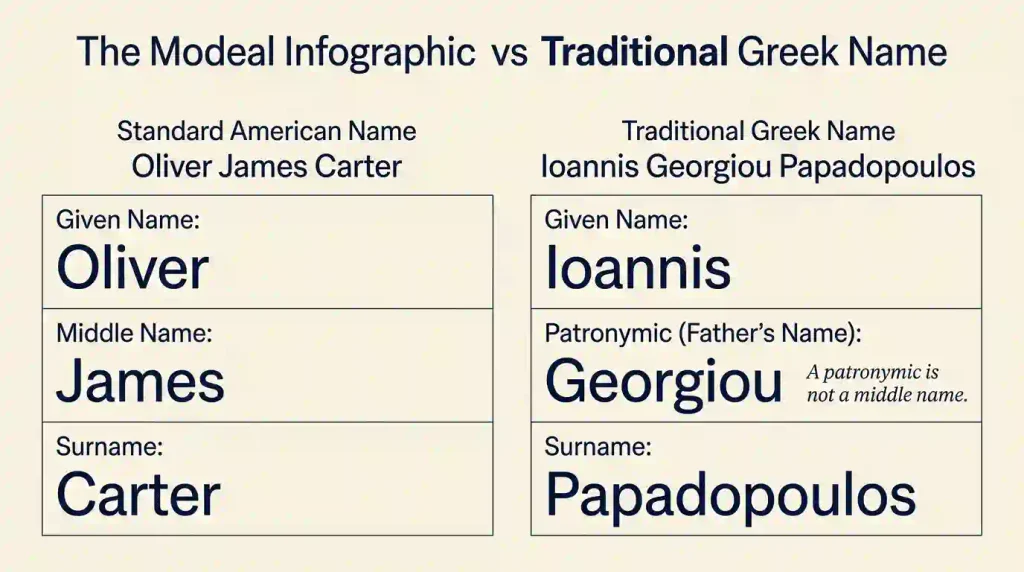
How a Middle Name Differs From a Surname or Patronymic
A middle name belongs to the person’s own set of personal names.
A surname usually identifies a family or inherited line.
A patronymic identifies someone through the person’s father or paternal ancestry.
These distinctions matter because something appearing between a first and last name is not automatically a middle name.
For example, some naming traditions include the father’s personal name as part of a larger patronymic chain.
Other cultures use two surnames.
When those structures are placed into an American-style form containing:
First | Middle | Last
one element may be incorrectly classified as a middle name.
That is why international names should be interpreted according to their original naming convention rather than simply their word order.
How Did Middle Names Begin?
There was no single moment when one person “invented” the middle name.
The history developed gradually.
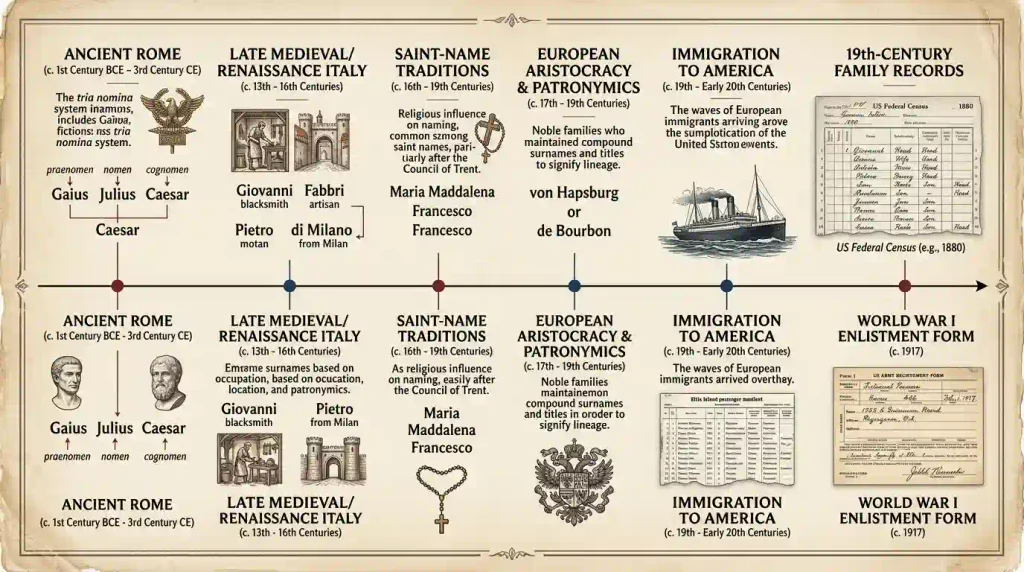
Ancient societies used multi-part names, medieval Europeans developed additional personal-name traditions, religious naming influenced families, and later social and administrative practices helped normalize middle names.
Ancient Rome’s Tria Nomina and the Limits of the Comparison
Ancient Roman naming is often mentioned when people ask where did middle names come from.
Prominent Roman men could use the Roman tria nomina:
- praenomen
- nomen
- cognomen
The praenomen was a personal name.
The nomen identified the gens or wider family group.
The cognomen could distinguish a family branch and later serve other hereditary or identifying functions.
Because Roman names contained multiple elements, they sometimes get described as the origin of modern middle names.
That comparison is useful—but limited.
The Roman nomen was not the equivalent of a modern middle name simply because it appeared in the middle.
The social purposes of the Roman naming system were different.
It is therefore more accurate to say that ancient Rome demonstrates a long history of multi-part personal naming, not that today’s middle name directly descended unchanged from the cognomen or nomen.
The Return of Middle Names in 13th-Century Italy
If you ask when did middle names start in something resembling later European practice, late-medieval Italy is especially important.
Evidence of additional given names appears in Italy by the late 13th century.
The custom became increasingly visible among socially prominent families and was well established among upper-class families in parts of Italy by the late 1400s.
These additional names were not always “middle names” in exactly the modern American administrative sense.
However, the tradition of giving one individual more than one personal name became increasingly important.
Italy therefore represents a major stage in the development of the European naming customs that later contributed to modern middle-name usage.
Saints’ Names, Baptism, and Religious Protection
Religion played a major role.
Families could give a child an additional saint’s name associated with Christian devotion.
A child might receive:
- a family name
- a saint’s name
- another personal name
Medieval and early-modern families could believe that placing a child under the patronage of a saint had spiritual value or protection.
A baptismal name could similarly connect the individual with religious tradition.
These traditions illustrate why additional names were not originally chosen merely because parents liked the sound.
Names could represent:
- devotion
- faith
- spiritual protection
- family connections
- community membership
A godparent could also influence naming choices, making the additional name a link between the child and an important religious or family relationship.
How Middle Names Spread From European Nobility to Other Social Classes
Additional given names initially appeared disproportionately among European nobility, aristocratic families, and other elite social groups.
For aristocratic families, names could preserve:
- alliances
- ancestors
- inherited family connections
- saints
- important relatives
Using several names could also reflect social status.
Over time, customs associated with elite groups spread more broadly.
The Italian aristocracy helped normalize multiple personal names within influential families before similar practices expanded to other social classes and areas of Europe.
The pattern did not develop identically everywhere.
Different countries adopted multiple given names at different speeds and for different reasons.
By the 17th century, multiple given names were more established in German-speaking areas.
That matters to U.S. history because German immigrants later carried their own naming traditions to North America.
How Immigration and Population Growth Popularized Middle Names in the United States
Many early English-speaking Americans had only:
Given Name + Surname
Famous examples include:
George Washington
Thomas Jefferson
Benjamin Franklin
Middle names were uncommon among many colonial Anglo-American families.
That gradually changed.
By the late 1700s and especially during the 1800s, middle-name use expanded.
Several factors contributed.
Immigration
Different immigration waves brought European naming traditions involving multiple given names.
German immigrant communities, for example, had naming customs that did not always match English colonial practice.
Population Growth
As population growth increased the number of people sharing similar names, another identifying name became increasingly useful.
Imagine several people named:
John Williams
Adding another personal name created distinctions such as:
John Henry Williams
John Edward Williams
John Samuel Williams
Family Heritage
Families increasingly used middle names to preserve surnames from other branches of the family.
A maternal surname might become the child’s middle name.
The history of middle names in the US shows how a once-uncommon custom became a familiar feature of American naming.
The U.S. National Park Service provides a helpful historical overview in its article about why many early Americans had no middle names.
How World War I Paperwork Made Middle Names More Standard
By the beginning of the 20th century, middle names had become common enough for government recordkeeping to reflect them explicitly.
The World War I enlistment form is frequently highlighted because it provided a dedicated space for a middle name.
That does not mean military paperwork invented or suddenly created middle names.
Instead, the form reflects how normal they had already become.
Once government, military, school, employment, banking, and other administrative systems regularly requested:
First Name | Middle Name | Last Name
the three-part pattern became even more familiar.
Administrative forms therefore helped reinforce the expectation that a typical American name included a middle element.
What Purposes Do Middle Names Serve?
If someone asks what are middle names used for, the answer depends on the family.
A middle name can perform several jobs simultaneously.
Honoring Relatives, Godparents, and Other Important People
One of the most common traditions is honoring someone.
A boy’s middle name might come from his:
- father
- grandfather
- great-grandfather
- uncle
- godparent
- close family friend
- admired ancestor
For example:
Leo Thomas Carter
may honor a grandfather named Thomas.
Parents can therefore choose a first name they personally love while preserving an honor name in the middle.
If you’re currently making that decision, how to choose a baby name can help balance family tradition with personal preference.
Preserving Family Heritage and a Mother’s Maiden Name
Middle names are especially useful for preserving family heritage.
Suppose the mother was born:
Emily Harrison
and later has a son whose family surname is Carter.
The parents might choose:
Benjamin Harrison Carter
Harrison preserves part of the maternal family lineage.
This approach can keep a mother’s maiden name visible after marriage or maintain a surname from an important branch of the family tree.
Other surnames can be used in the same way.
A child’s middle name could come from:
- maternal grandmother
- paternal grandmother
- great-grandparent
- ancestral family surname
This helps explain what is in a name meaning: sometimes a name’s most important meaning is not its dictionary definition but the family story attached to it.
Distinguishing People With Similar First and Last Names
Middle names also help with name-based identification.
Imagine a father and son named:
William Carter
Adding middle names creates:
William Thomas Carter
and:
William James Carter
A middle initial can make the distinction shorter:
William T. Carter
William J. Carter
This can help in:
- school records
- legal documents
- professional records
- genealogical research
- military records
- databases
Of course, middle names do not guarantee unique identification.
Many people can still share exactly the same full name.
But another name element improves differentiation.
Adding Personal Meaning, Individuality, or Another Name Choice
Middle names also give parents creative flexibility.
Perhaps parents love both:
Theodore
and:
James
Instead of choosing one, they can use:
Theodore James Bennett
Parents can also pair a traditional first name with a distinctive middle:
William Atlas Carter
or a modern first name with a classic middle:
Maverick James Cole
The middle name becomes another expression of personal identity and parental choice.
It may even provide a useful alternative later if the child prefers the middle name to the first.
Parents browsing Boy Names can therefore consider combinations rather than evaluating each name alone.
How Do Middle-Name Traditions Vary Across Cultures?
The familiar Western middle name is not universal.
This is one of the most important points to understand.
Why Middle Names Are Not Used in Every Culture
Some cultures historically developed other ways to organize personal and family identity.
Instead of:
First + Middle + Last
a naming tradition might use:
- multiple given names
- two surnames
- patronymics
- clan names
- generation names
- father’s name
- maternal and paternal family names
That is why what cultures have middle names requires cultural context rather than simply counting words in someone’s full name.
How Some Naming Systems Use Patronymics or Other Lineage Names
An Arabic naming system may include ancestry elements connecting an individual with a father or earlier generations.
This is why asking is bin a middle name cannot be answered by saying, “It appears in the middle, so yes.”
“Bin” can indicate “son of” within a lineage structure.
Greek naming practices also historically and administratively use parent-name information. Our guide explaining do Greeks have middle names shows why a parent’s name should not automatically be classified as a Western middle name.
A Hispanic naming convention can involve two family surnames.
In Mexican naming, the second surname is not simply a middle name. See do Mexicans have middle names for examples.
Indian naming systems vary enormously. Our guide to do Indians have middle names explains how region, religion, community, and family custom affect structure.
How Middle Names Can Reflect Family Relationships, Birth Order, or Cultural Traditions
Other naming systems create still more variety.
Vietnamese Naming Custom
Vietnamese names commonly include a family name, one or more middle elements, and a given name.
The “middle” element can perform functions that differ from an American-style second given name.
Chinese Naming Tradition
Traditional Chinese names generally place the family name first, followed by the given name.
A Western middle-name category is not required.
Some families may use generation-related characters or other traditions connecting siblings and relatives.
Japanese Naming Tradition
Japanese names conventionally consist of a family name and given name, without requiring a Western-style middle name.
Korean Naming Tradition
Korean names likewise traditionally use family and given names rather than the American three-part model.
These examples demonstrate why international forms can create confusion.
A box labeled “middle name” does not mean every culture naturally contains a corresponding element.
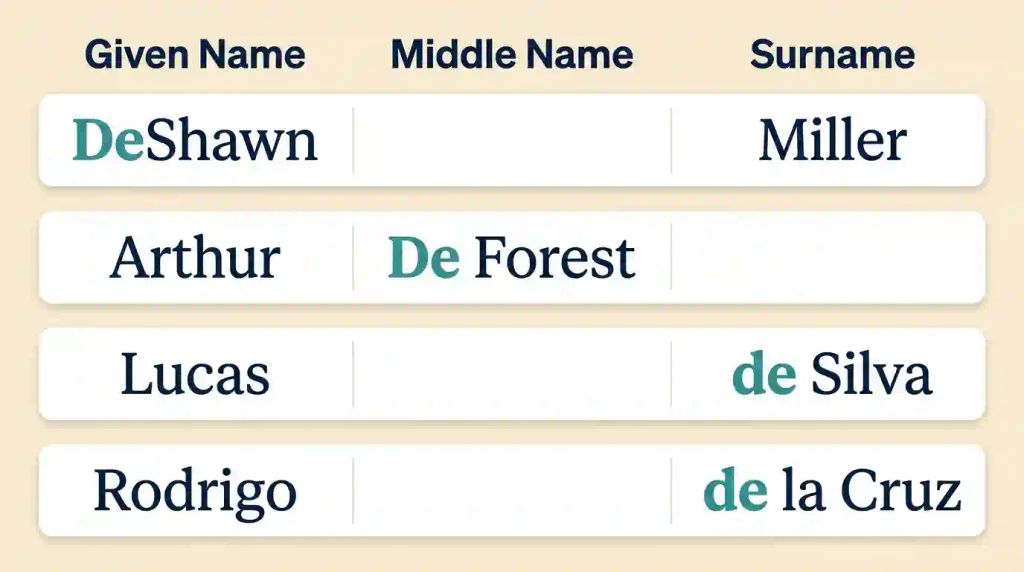
Even surname particles can be misunderstood. Something that looks like a de middle name may actually belong to a family name or another linguistic construction.
French practices are different again; middle names in French can involve several additional given names.
Why Do Some People and Families Choose Not to Use a Middle Name?
There is nothing incomplete about having no middle name.
Some parents simply prefer:
First Name + Surname
For example:
Ethan Carter
can be a complete personal name.
Personal Preferences, Family Choices, and Simplicity
Reasons families skip a middle name include:
- cultural tradition
- simplicity
- family custom
- dislike of additional names
- avoiding very long names
- parents finding one given name sufficient
Some cultures do not traditionally use middle names at all.
In other cases, the family technically uses additional given names but does not classify them as middle names.
The decision therefore depends on both personal preference and cultural naming convention.
How Are Middle Names Used Today?
Modern middle names occupy an interesting position.
They appear frequently in official records but may rarely be spoken.
Why Middle Names Appear on Forms but Are Rarely Used in Conversation
Someone named:
Daniel Michael Carter
may simply introduce himself as:
Daniel Carter
Friends may never hear “Michael.”
Yet the middle name may appear on:
- birth certificate
- passport
- driver’s license
- school records
- financial records
- professional documents
This creates a distinction between having a middle name and using it.
A middle name can be important to identity without being part of daily speech.
Why Some People Go by Their Middle Name
Other people do the opposite.
Someone legally named:
John Andrew Miller
might be known to everyone as:
Andrew Miller.
Reasons can include:
- several relatives share the first name
- family always used the middle name
- the person prefers it
- professional convenience
- avoiding confusion
Using a middle name socially does not necessarily mean the legal name has changed.
It simply reflects everyday name usage.
How Middle Initials Appear in Formal and Official Contexts
Middle initials are particularly common in professional contexts.
Examples:
Daniel M. Carter
Alexander J. Reed
Samuel T. Parker
A middle initial can:
- distinguish people
- shorten a long name
- create professional consistency
- reflect formal documentation
If pronunciation influences your choice of first or additional names, our name pronunciation guide can also help when combining names from unfamiliar languages.
Are Middle Names Required on U.S. Forms?
No universal rule requires every American to possess a middle name.
Different agencies also handle names differently.
For example, the Social Security Administration’s own administrative definition for SSN purposes focuses on the person’s first and last name rather than treating the middle name as a required component.
A birth certificate, passport application, driver’s-license form, bank form, or employment database may structure names differently.
How to Handle a Form That Asks for a Middle Name or Initial When You Have None
If you have no middle name:
Do not invent one merely because the form contains a middle-name box.
Follow the instructions for that specific form.
Depending on the system, you may be expected to:
- leave the field blank
- select “none”
- use a specified notation
Do not automatically enter:
N/A
or:
NMN
unless the form specifically instructs you to do so.
For government applications, match the supporting legal documents requested by the agency.
Are Middle Names Becoming Less Common or Changing in Use?
This question is harder to answer than it first appears.
Reliable nationwide statistics on middle names are much weaker than statistics on first names.
The Difference Between Having a Middle Name and Using It Daily
Someone may legally possess a middle name but almost never use it.
Another person may use a middle initial professionally.
Someone else may go exclusively by the middle name.
So three different things need to be separated:
- having a middle name
- recording a middle name
- actively using a middle name
These are not identical.
Modern naming also seems increasingly flexible.
Parents may choose:
- traditional honor names
- surnames as middle names
- unusual word names
- two middle names
- no middle name
That variety makes it difficult to describe one national trend.
What Available U.S. Data Can—and Cannot—Show About Middle-Name Trends
The United States has excellent public data for many first-name trends.
Middle-name information is much more fragmented.
Birth records, genealogical databases, surveys, and individual studies can provide clues, but there is no single public national middle-name ranking with the same depth as major first-name datasets.
Therefore, claims such as:
“Middle names are disappearing”
or:
“Nearly everyone has exactly one middle name”
should be treated cautiously unless the claim comes with a clearly defined dataset.
Modern diversity may be changing how middle names are used, but exact national percentages are difficult to establish confidently.
What Middle Names Do Families Choose?
Middle-name choices can range from traditional to highly distinctive.
Common and Distinctive Middle-Name Examples
Traditional choices for boys include:
- James
- Michael
- Thomas
- Alexander
- William
- Joseph
- David
- Edward
- John
- Charles
Examples:
Noah James Carter
Oliver Thomas Reed
Lucas Michael Brooks
Henry Alexander Cole
Parents can also use shorter names to balance longer first names:
Sebastian Lee Carter
Alexander James Reed
More distinctive choices might include:
- Atlas
- River
- Phoenix
- Sage
- Orion
- Everest
Examples:
William Atlas Cole
Benjamin River Hayes
James Orion Bennett
Family surnames are another strong option:
Samuel Harrison Clark
Oliver Bennett Reed
The best choice depends on:
- meaning
- family significance
- initials
- sound
- length
- surname
- personal preference
Our guide on how to pick a middle name walks through these factors step by step.
The choice can also be influenced by changing expectations about masculine and neutral names. Our guide to why are names gendered explains how those associations develop and shift.

How Can a Middle Name Help With Genealogy Research?
Middle names can provide excellent clues in genealogy research.
They often preserve family connections that would otherwise be invisible.
What a Middle Name Can Reveal About Relatives and Family History
Suppose an ancestor is named:
Thomas Whitmore Davis
You later discover that his maternal grandmother’s maiden name was:
Whitmore
That connection may explain the middle name.
Another ancestor named:
Samuel Robert Hayes
may have been named after a grandfather, Robert.
Repeated middle names across generations can reveal patterns.
Imagine:
William Everett Carter
has a son:
James Everett Carter
whose child is:
Henry Everett Carter
Everett may represent a family tradition or ancestral surname.
A middle name can therefore provide clues about:
- ancestor names
- maiden surnames
- maternal families
- godparents
- religious naming traditions
- family friendships
Why a Middle Name Alone May Not Prove Its Origin
A clue is not proof.
If someone is named:
Benjamin Franklin Carter
you cannot automatically conclude that Franklin was a relative.
The parents might instead have admired Benjamin Franklin.
Similarly, a surname-style middle name may have come from:
- family ancestry
- friend
- famous figure
- local place
- personal preference
Genealogical conclusions require supporting records.
How Missing Names, Initials, and Spelling Changes Affect Historical Searches
Historical records frequently show names inconsistently.
The same person might appear as:
William Henry Carter
in one record,
William H. Carter
in another,
and:
William Carter
elsewhere.
Older clerks could omit middle names.
Handwriting could be misread.
Spelling could vary.
A person could also begin using an additional name later.
Therefore, absence from one historical record does not prove the middle name never existed.
Likewise, a later middle name does not automatically prove it appeared at birth.
How to Trace the Story Behind Your Middle Name
If you want to discover where your own middle name came from, begin with family evidence.
Check:
- Your birth certificate.
- Parents’ and grandparents’ full names.
- Maiden surnames in the family.
- Older family trees.
- Marriage records.
- Baptismal records.
- Census and military records.
- Family Bibles or memorial records.
- Newspaper announcements.
- Ask older relatives why the name was chosen.
Then compare repeated names across generations.
You may discover that a seemingly ordinary middle name preserves a story several generations old.
Frequently Asked Questions About Middle Names
Why do we have middle names?
Middle names provide an additional place to honor relatives, preserve family heritage, express culture or religion, distinguish people, or add another personal name.
Why do people have middle names?
People have them for family, cultural, religious, practical, historical, and personal reasons.
What is the purpose of a middle name?
A middle name can honor someone, preserve ancestry, distinguish an individual, or add personal meaning to a full name.
What is the point of a middle name?
Its purpose depends on the family; it may carry heritage, identity, religious meaning, or simply complete the chosen name.
Why do middle names exist?
They developed through European multiple-name traditions and later became useful for family remembrance, identity, and recordkeeping.
Where did middle names come from?
Modern Western middle-name traditions developed gradually, with important roots in late-medieval European multiple-given-name practices.
When did middle names start?
Multiple additional given names were appearing in Italy by the late 13th century, although modern middle names developed gradually rather than being invented on one date.
Were Roman names the origin of middle names?
Roman multi-part names are an interesting comparison, but the Roman tria nomina did not function like the modern first-middle-last system.
When did middle names become common in America?
Their use expanded through the 1800s and had become highly customary by the late 19th and early 20th centuries.
Why were middle names created?
They were not created for one single reason; religion, family lineage, social tradition, identification, and personal naming customs all contributed.
Does everyone have a middle name?
No, many people and cultures do not use middle names.
Are middle names required in the United States?
No, a person does not universally need to have a middle name.
Can someone have more than one middle name?
Yes; see can you have two middle names for examples and practical considerations.
Can someone have no middle name?
Yes, having no middle name is completely valid.
Can a surname become a middle name?
Yes, family surnames and a mother’s maiden name are often used as middle names.
Why do people use their mother’s maiden name as a middle name?
It helps preserve the maternal family line in the child’s full name.
Can a person go by their middle name?
Yes, many people use their middle name socially or professionally instead of their first name.
Is a middle initial the same as a middle name?
A middle initial often abbreviates a middle name, although records should be checked before assuming what the full name is.
Is a patronymic the same as a middle name?
No, a patronymic identifies someone through a parent or ancestor and may only resemble a middle name when reformatted.
Can someone legally change their middle name?
Yes, people can generally change, add, or remove a middle name through the appropriate legal process in their jurisdiction.
Does a middle name have to honor someone?
No, parents can choose it for sound, meaning, personal preference, cultural significance, or any other permitted reason.
Are middle names used in every culture?
No, many cultures use different naming structures involving surnames, patronymics, lineage names, or multiple given names.
Why are middle names rarely used in conversation?
They usually provide additional identity or family meaning rather than serving as the person’s everyday call name.
Can middle names help genealogists?
Yes, repeated middle names and surname-style middle names can reveal valuable clues about relatives and ancestral family lines.
Final Thoughts
So, why do we have middle names? What began as part of evolving European multiple-name traditions eventually became a flexible way to preserve family history, honor relatives and saints, distinguish people, and give children another meaningful personal name. In the United States, middle names moved from relative rarity among many early Americans to a familiar naming custom during the 19th and early 20th centuries.
Yet they remain optional, and many cultures organize personal names in completely different ways. A middle name may be rarely spoken while still carrying generations of family meaning.
If you’re choosing a name for your son, explore our Naming Guides for cultural naming advice, or browse Boy Names to find combinations that balance meaning, heritage, pronunciation, and personal style.