
Is Bin a Middle Name? Meaning, Naming Traditions, and Correct Usage
Summary
Is bin a middle name? Usually, no. In Arabic and many Malay naming traditions, bin means “son of.” It connects a boy’s personal name to his father’s name rather than serving as an extra given name. For example, Adam bin Yusuf means Adam, son of Yusuf. The confusion starts because bin often sits between other words, exactly where a middle name might appear in an American name. However, a word’s position does not explain its purpose. Bin can express family lineage, belong to an established surname, or appear inside a document field whose label does not match its cultural meaning. Understanding these differences helps parents choose meaningful boy names and helps readers interpret unfamiliar names respectfully. This guide explains bin, ibn, bint, and binti through clear examples, compares patronymics with middle names, and explores Arabic and Malay naming practices. You will also learn how to approach name order, spelling, everyday introductions, and official forms without assuming that every name follows a first-middle-last pattern.
Table of Contents
- Is Bin a Middle Name? The Direct Answer
- What Does Bin Mean in a Name?
- How a Name With Bin Is Structured
- Bin vs. Middle Name vs. Surname
- Bin and Ibn: Meaning, Spelling, and Usage
- Bint and Binti: Related Naming Terms
- Bin in Arabic Naming Conventions
- Bin in Malay and Malaysian Names
- Other Patronymic Markers: a/l, a/p, s/o, d/o, and Anak
- Can Bin Be Part of a Family Name or Given Name?
- Choosing a Boy’s Name With Bin
- Using Names With Bin on Forms and Official Documents
- Pronunciation, Capitalization, and Everyday Address
- Reading Family Lineage and Genealogy
- Common Mistakes and How to Avoid Them
- Comparing Bin With Other Naming Traditions
- A Practical Name-Interpretation Checklist
- Frequently Asked Questions
- Final Thoughts
Is Bin a Middle Name? The Direct Answer
Bin Usually Identifies a Family Relationship
In the naming traditions discussed here, bin usually functions as a patronymic marker. A patronymic identifies a person through a parent’s name, commonly the father’s. Bin supplies the relationship: “son of.” The name following it identifies the father in a straightforward patronymic construction.
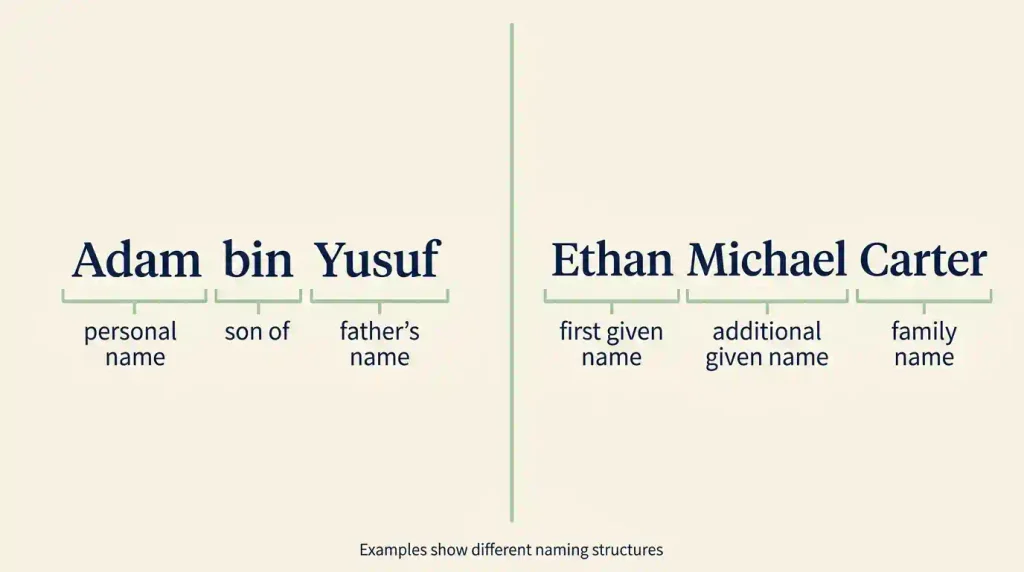
Consider the illustrative name Omar bin Hassan. Omar is the boy’s personal name. Bin means son of. Hassan is the father’s name. Calling bin Omar’s middle name would hide the information that the structure actually communicates.
This matters when you compare names across cultures. A familiar English template can help you recognize individual words, but it may assign them the wrong roles. Understanding the relationship between the words gives you a more accurate interpretation than simply counting them.
A Middle Position Does Not Create a Middle Name
In James Oliver Smith, Oliver may be an additional given name. In Omar bin Hassan, the middle word links Omar to Hassan. Both examples contain three words, yet the words perform different jobs.
The same principle applies to longer names. A name can contain multiple given names, several generations of ancestry, a family name, or a combination of these elements. Its second or third word does not automatically qualify as a middle name.
If this distinction is new to you, our guide to what is a middle name explains the common meaning of that category. Use it as a starting point, while remembering that other naming systems organize identity differently.
Administrative Labels Can Differ From Cultural Meaning
A person’s records might place bin, or a phrase containing bin, in a field labeled “middle name.” That describes how a particular system stores the name. It does not change the traditional meaning of the word.
There can therefore be two answers to the same question. Culturally, bin may be a lineage connector. Administratively, an institution may have assigned it to a particular personal identification field. When completing paperwork, the institution’s instructions and the person’s established records matter more than a general cultural diagram.
What Does Bin Mean in a Name?
The Meaning of “Son Of”
Bin belongs to a naming vocabulary associated with Arabic and also used in other languages and communities. In a patronymic construction, its practical meaning is “son of.” It introduces a relationship rather than describing the boy’s personality, hopes, or qualities.
For example, Zayd bin Ali communicates that Zayd is the son of Ali. Zayd identifies the person being named. Ali identifies the father within this example. Bin explains why those two names appear together.
This is why treating bin like a standalone baby-name choice can be misleading. A parent choosing a name such as Zayd is selecting a personal name. A parent using bin Ali is expressing a naming relationship. The two decisions belong to different parts of the full name.
Lineage, Ancestry, and Personal Identity
A patronymic can make family lineage visible. It helps place a person within a family relationship and can connect names across generations. However, one link to a father does not provide a complete family history.
A name alone cannot tell you everything about ancestry, citizenship, religion, or upbringing. Even when a naming marker has a clear traditional meaning, individuals and families may use names in ways shaped by migration, inherited records, or local practice.
Names also carry emotional meaning beyond their literal structure. A family may value a patronymic because it preserves continuity. A child may later associate it with belonging, memory, or responsibility. These personal meanings complement the grammatical meaning without replacing it.
Why Bin Is More Than a Decorative Word
Bin can sound appealing because it is short and fits smoothly between names. Nevertheless, its role is not simply to improve rhythm. Removing it, adding it, or moving it can change how readers understand the relationship expressed by the full name.
Before treating any name element as decoration, consider what is in a name meaning. A meaningful naming choice should account for what the complete phrase communicates, not only how the individual words sound.
For a boy-name website, this distinction is especially useful. Readers need to know which element they can choose as their son’s personal name and which element connects that choice to a family naming tradition.
How a Name With Bin Is Structured
The Basic Pattern
A simple illustrative pattern is personal name + bin + father’s name. This pattern explains the relationship clearly, but it is not a universal formula for every Arabic, Malay, or Muslim name.
In Adam bin Yusuf, Adam is the personal name, bin is the connector, and Yusuf is the father’s name. In Hamza bin Khalid, Hamza is the personal name and Khalid is the father’s name. These examples are teaching examples rather than instructions for name registration.
Notice that the last word is not necessarily an inherited surname. Yusuf can be Adam’s father’s personal name. The fact that it appears last does not turn it into a family name shared unchanged across generations.
Multiple Words Can Form One Personal Name
A personal name can contain more than one word. In the illustrative name Muhammad Adam bin Yusuf, Muhammad Adam may be the child’s complete personal name. Bin then introduces the father’s name, Yusuf.
Someone using an American first-middle-last template might label Muhammad the first name and Adam the middle name. That could describe how a specific record divides the words, but it should not be assumed to reflect the family’s own interpretation.
The useful question is not “How many words come before bin?” It is “Which words does this person recognize as their given or personal name?” An individual’s explanation can clarify a structure that otherwise looks ambiguous.
Longer Names Can Include Several Relationships
A name may include a longer lineage chain. In the constructed example Ali bin Hasan bin Umar, the reading is Ali, son of Hasan, who is son of Umar. Here, two occurrences of bin connect successive generations.
You might also encounter a family name after a patronymic phrase. Its presence adds another naming element rather than replacing the meaning of bin. To interpret the full sequence, you need to understand both the lineage links and the family’s actual naming practice.
This is why long names should not be shortened by guesswork. Removing an apparently extra word may remove a personal name, a relationship marker, or part of an established family name.

Bin vs. Middle Name vs. Surname
Three Different Naming Functions
A middle name is commonly an additional given name in the familiar U.S. naming pattern. A surname is commonly an inherited family name. A patronymic identifies a relationship to a parent. These functions can overlap in particular legal records, but they remain useful distinctions.
Suppose a boy is called Ethan Michael Carter. Michael may honor a relative, yet it is still an additional given name rather than a word meaning “son of.” By contrast, bin in Adam bin Yusuf explicitly signals a relationship.
This also explains why a father’s name can appear in two systems for different reasons. Michael might be chosen as an honor name because Ethan’s father is Michael. Yusuf might appear after bin because the structure directly identifies Adam’s father.
| Naming element | Usual function in the example | Illustrative example | Important distinction |
| Personal or given name | Identifies the individual | Adam in Adam bin Yusuf | It may contain more than one word. |
| Middle name | Additional given name in a first-middle-last system | Michael in Ethan Michael Carter | Its position and role depend on the naming system. |
| Bin | Expresses “son of” | bin in Adam bin Yusuf | It is a relationship marker in this construction. |
| Patronymic phrase | Identifies the person through a parent | bin Yusuf | It need not be an inherited surname. |
| Family name or surname | Identifies an established family name | Carter in Ethan Michael Carter | Actual family names can also contain historical patronymic elements. |
Why a Father’s Name Is Not Automatically a Surname
In an active patronymic system, the parental element can change from one generation to the next. If Yusuf’s son is Adam, the son may be Adam bin Yusuf. If Adam’s son is Zayd, the next generation may be Zayd bin Adam.
An inherited surname works differently. A family name may remain the same for parents and children even when the father’s personal name changes. This difference is central to understanding why the last word in a name cannot always be labeled a surname.
Our explanation of why do we have middle names explores reasons for additional given names. Those reasons can include honoring family, but honoring someone is not always the same as using a patronymic.
Bin and Ibn: Meaning, Spelling, and Usage
How Bin and Ibn Are Related
Bin and ibn are closely related forms associated with the Arabic word for son. In naming constructions, both can express “son of.” You may encounter them in contemporary personal names, historical biographies, and English-language transliterations.
The difference is not that ibn means “middle name” while bin means “surname,” or vice versa. Both can perform a lineage function. Their appearance reflects linguistic context, established usage, and how a name has been represented in another writing system.
For ordinary readers, the most useful approach is to recognize the relationship while preserving the person’s spelling. Understanding a word does not give you permission to rewrite someone’s name.
Why You Should Not Swap the Forms Casually
If a person writes their name with bin, keep bin. If their established spelling uses ibn, keep ibn. Even closely related forms can produce different record searches or fail to match a document when changed.
The same caution applies to spacing and capitalization. A spelling choice may be familiar within a family, standardized in official records, or consistently used in professional publications. Treat that established form as part of the individual’s identity.
Parents considering a new name should discuss the intended spelling before registration. A naming decision made thoughtfully at the beginning is easier to maintain than a series of informal spelling changes made later.
Recognizing Ibn in Historical Names
Historical figures such as Ibn Sina and Ibn Khaldun are often known through name forms containing ibn. These familiar examples show why an element connected with ancestry can become central to how a person is remembered.
However, a historical name may preserve an ancestor’s association rather than offer a simple modern first-middle-last division. Do not assume every widely known Ibn name identifies the immediate father in the same way as a fresh teaching example.
Historical names also circulate in shortened forms. A short version used in books may omit personal names, lineage links, or other identifiers that appear in a fuller historical record.
Bint and Binti: Related Naming Terms
What Bint Means
Bint means “daughter of” in an Arabic naming construction. It provides a useful comparison because it performs a relationship function similar to bin, while identifying a daughter rather than a son.
In the illustrative name Maryam bint Ali, Maryam is the personal name and Ali identifies the father. Bint expresses the relationship. Like bin, bint should not automatically be treated as an additional given name merely because it appears between names.
Although this article focuses on boys, knowing the related terms makes the overall naming system easier to understand. It helps parents distinguish a personal name from a gendered relationship marker.
What Binti Means
Binti is commonly encountered in Malay naming practices as a marker meaning “daughter of.” Spelling variants and abbreviations also appear in particular contexts. The appropriate form for an individual remains the one they use and the one their records establish.
Compare the teaching examples Adam bin Yusuf and Aisyah binti Yusuf. The connector changes, while each structure still relates a child’s personal name to the father’s name. This comparison concerns structure rather than a claim that every family uses these forms.
The question why are names gendered explores gender associations more broadly. Here, the gendered element is a kinship word; it is not simply a baby name associated with boys or girls.
Bin in Arabic Naming Conventions
Personal Names and Lineage Elements
Traditional Arabic naming conventions can distinguish a personal name, often called an ism, from a lineage element, often called a nasab. Bin or ibn can occur within that lineage element. This framework helps explain why a full name can carry several kinds of information.
Other elements may refer to an honorific, an epithet, or an association with a place or group. They do not all behave like Western given names and surnames. A traditional full name can therefore communicate more than the identity of one individual.
These terms are useful for interpretation, but they should not become a rigid template imposed on every modern Arab name. Contemporary naming practices and official records often use shorter or differently organized forms.
Regional and Family Differences
Arab culture includes many countries, communities, and family traditions. The Arabian Peninsula, North Africa, and other Arabic-speaking regions should not be treated as a single naming jurisdiction.
You may encounter an explicit bin or ibn marker in one name and a sequence of parental names without that connector in another. A name’s meaning depends on the actual naming practice, not on whether it looks like a textbook example.
For the same reason, “Middle Eastern names” is too broad a label to determine structure. The Middle East includes different languages and naming traditions. A regional description alone cannot tell you which word is a surname or whether a person has a middle name.
Arabic Names and Muslim Names Are Not Identical Categories
Arabic describes a language and associated cultural practices. Muslim describes a religious identity. Those categories can overlap, but they do not mean the same thing.
Muslim names appear in communities with many different languages and local traditions. Not every Muslim boy’s name includes bin, and a name should not be judged incomplete because it lacks that connector. Similarly, Arabic naming practices cannot be understood only through religion.
When choosing Islamic names, parents should distinguish the meaning of a personal name from the structure of the full name. Religious suitability, family preference, and civil registration are separate questions that may require different kinds of advice.
Bin in Malay and Malaysian Names
A Common Malay Patronymic Pattern
In many Malay names, a boy’s personal name is followed by bin and his father’s name. The illustrative name Amir bin Roslan reads as Amir, son of Roslan. This can express identity without an inherited surname in the Western sense.
The distinction between Malay and Malaysian also matters. Malay refers to an ethnic and cultural context, while Malaysian refers to nationality. Malaysian names include several naming traditions, so a national label does not establish one universal structure.
An authoritative reference is HM Passport Office’s Malaysia naming guidance. It recognizes different naming customs and explains bin as “son of.” It also notes that Malaysian passports show the name in one field rather than separating forenames and surnames.
A Multiword Personal Name Before Bin
In Muhammad Amir bin Roslan, Muhammad Amir may be the complete personal name. The family or individual can explain whether they normally use both words or prefer Amir in conversation.
This example illustrates why treating the first word as the entire first name can be inaccurate. A database may split the words, but the person’s naming tradition may regard them together. Everyday usage and administrative grouping do not always coincide.
For parents, this is a practical reminder to think about the name in both settings. Consider how your son will introduce himself and how his complete name will appear in records, without assuming that one version cancels the other.
The Father’s Name Can Also Contain Several Words
A father’s personal name may be multiword as well. In the teaching example Adam bin Muhammad Yusuf, bin introduces Muhammad Yusuf rather than only Muhammad. Interpreting Yusuf as the child’s inherited surname would require evidence beyond its position.
Longer structures can initially look confusing, but they become clearer when you identify the connector and ask which words belong together. The relationship marker gives you a starting point; the individual’s explanation supplies the detail.
Avoid abbreviating the father’s name casually. Even if a shorter version is common in conversation, records may use the complete registered form. Preserve the established name when accuracy matters.
Other Patronymic Markers: a/l, a/p, s/o, d/o, and Anak
a/l and a/p
In some Malaysian Indian naming contexts, a/l abbreviates the Malay expression anak lelaki, meaning son of, while a/p abbreviates anak perempuan, meaning daughter of. These markers help readers recognize another way of expressing a parental relationship.
They are related in function to bin and binti, but they should not be substituted freely. A person’s recorded marker belongs to their established name form and naming context. Equivalent broad meanings do not make different written names interchangeable.
This is especially important when discussing Indian names. India and its diaspora include many naming practices, languages, and regional traditions. One patronymic example cannot stand for the whole population.
s/o and d/o
The abbreviations s/o and d/o stand for son of and daughter of. They can appear in particular naming and administrative contexts. Sometimes they indicate part of a personal name presentation; sometimes they introduce parental information in a document.
The surrounding document therefore matters. A form that lists someone as the son of another person is not necessarily declaring every word on that line to be part of the person’s legal name.
When copying a name, distinguish the actual name field from a separate parent-information field. Reading both as one uninterrupted name can create an error even when the relationship itself is clear.
Anak
Anak means child in Malay and can appear as a relationship marker in some Indigenous naming contexts. Its usage reflects the relevant community’s practices rather than a universal Malaysian naming rule.
Unlike the explicit son-or-daughter wording of bin and binti, anak expresses the broader child relationship. However, the best way to interpret an individual’s name remains to ask about their established usage.
Recognizing these markers expands your understanding without requiring you to become an expert in every tradition. You can notice that a relationship may be present, preserve the exact spelling, and seek clarification where needed.
Can Bin Be Part of a Family Name or Given Name?
An Established Surname May Preserve a Patronymic Element
Over time, a name element associated with an ancestor can become part of an inherited surname. In that situation, the family may keep the same surname across generations rather than update it to identify each child’s immediate father.
This means that a modern surname containing Bin or a related form should be interpreted as the family’s established surname when that is how the family uses it. Its historical origin and its current administrative role can differ.
Do not separate a recognized surname simply because you recognize one word inside it. A dictionary meaning gives you a clue about origin; it does not automatically define the correct field boundaries for an individual today.
Bin in Another Language May Be a Different Name Entirely
The Latin-letter spelling Bin can also represent a personal name in another linguistic context. A romanized Chinese given name, for example, may appear as Bin without expressing the Arabic “son of” relationship.
Its meaning would depend on the original language and, where relevant, the written characters. The same English spelling can therefore represent words or names that have no shared naming function.
This is an important exception to broad statements such as “Bin is never a given name.” The precise answer is that bin in the patronymic constructions discussed here is usually a relationship marker. An unrelated name spelled Bin requires its own interpretation.
Could Someone Have Bin as a Middle Name?
Someone could have an additional given name spelled Bin, or a record could place Bin in a middle-name field. Those possibilities do not make the Arabic or Malay patronymic marker an ordinary middle name.
To answer accurately for a particular person, establish the language, the intended meaning, and the recorded name structure. A spelling alone cannot resolve all three.
For readers arriving through the question is bin a middle name, this is the essential qualification: usually no in a “son of” construction, but individual names and document classifications can differ.
Choosing a Boy’s Name With Bin
Choose the Personal Name First
Start with the name that identifies your son. Consider its meaning, pronunciation, family associations, and everyday use. Then consider whether your family tradition calls for a patronymic and how that element should be expressed.
The Boy Names collection can help you explore personal-name ideas. When browsing, keep the distinction clear: Adam, Yusuf, and Hamza can be personal names, while bin connects elements in a particular naming structure.
Our guide to how to choose a baby name provides a broader framework for comparing your options. With a patronymic, apply those considerations to the complete phrase as well as the name you expect to use daily.
Use the Intended Family Relationship
If you want bin to express “son of,” the following name should fit the relationship you intend to identify. Adding an admired historical figure’s name after bin simply because it sounds attractive may communicate a relationship you did not mean.
An honor name and a patronymic can be separate choices. You might honor a relative through an additional given name while preserving your family’s usual parental naming structure. How those elements fit together depends on the naming tradition and registration context.
For complicated circumstances involving adoption, parentage, or religious expectations, seek guidance relevant to your family. A general baby-name article cannot determine the appropriate registered lineage for every situation.
Consider Rhythm Without Losing Meaning
Say the complete name aloud. Listen for repeated sounds, unclear boundaries, and words that are easy to merge accidentally. A short connector can help create a natural rhythm, but accurate meaning should remain central.
For example, compare Adam bin Yusuf with a longer personal name followed by a multiword father’s name. Both may be comfortable in the right setting. There is no universal ideal number of syllables for a patronymic name.
If you also want an additional given name, read how to pick a middle name. That choice concerns the boy’s own given names and should be considered separately from the connector identifying his father.
Plan for Everyday Introductions
Imagine your son introducing himself at school, on a sports team, and later in professional life. Decide which version will be familiar in conversation while preserving the complete name for situations that require it.
A child called Muhammad Adam bin Yusuf might introduce himself as Adam if that matches family preference. That everyday choice does not necessarily remove Muhammad from his personal name or bin Yusuf from his registered name.
Explain the structure positively as the child grows. A simple sentence such as “Bin means son of, and Yusuf is your father’s name” can give him language for answering questions without feeling that his name is unusual or difficult.
Using Names With Bin on Forms and Official Documents
Cultural Meaning Does Not Determine Every Field
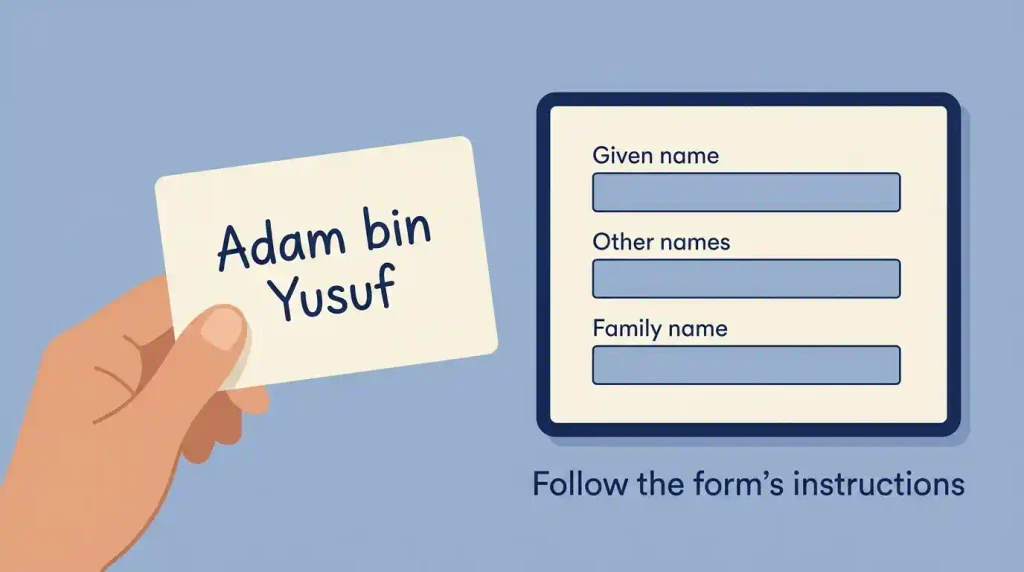
Forms may ask for first name, middle name, and last name even when a person’s name does not fit those categories. That mismatch is a design limitation of the form, not a defect in the name.
Do not assume that bin must go in the middle-name box or that the father’s name must go in the surname box. Both assumptions can be wrong for a particular institution or document.
Instead, read the instructions for the actual application and use the established name on the relevant identity documents. Where the mapping remains unclear, ask the receiving organization how it expects the name to be entered.
A Passport Name May Use Different Groupings
A passport may show a complete name in a single field or separate names into categories. Its presentation may differ from a school database, employment system, or website account.
For travel-related records, follow the provider’s instructions for matching the relevant passport. Do not reinterpret the name into a preferred Western structure without checking how that provider handles the document’s name fields.
The visible personal-details page and other passport representations may also present names differently. A general article should not prescribe a universal split from one illustrative name. The actual document and receiving system control the practical question.
What to Do When a Form Requires a Surname
Some people use names without an inherited surname, while a form still makes “last name” mandatory. This situation calls for the organization’s instructions rather than an invented family name.
Check whether the form supports a single full name, explains how to enter a patronymic, or provides a process for names without surnames. If its help text is unclear, contact support before submitting a consequential application.
Avoid filling mandatory boxes with guessed punctuation, duplicated names, or placeholder words unless the institution specifically directs that approach. Different systems process these workarounds differently, and a convenient entry can become a persistent record problem.
Keep Spelling Consistent Across Connected Records
When records are intended to refer to the same person, consistent spelling helps reduce confusion. Check the complete name, word order, spaces, and the spelling of both the personal name and the parental element.
If existing documents disagree, do not silently choose whichever version looks simpler. Ask the relevant issuing or receiving authority what evidence it needs and how a discrepancy should be addressed.
For a new child’s name registration, discuss the intended form with the registering authority before finalizing it. This is particularly helpful when parents use different naming traditions or expect to maintain records in more than one country.
Pronunciation, Capitalization, and Everyday Address
Ask How the Person Says Their Name
English readers often approximate bin with a short vowel, but an individual’s language and accent can affect pronunciation. The most respectful approach is to listen to the person and repeat the name as they use it.
Do not assume you can pronounce the whole name because bin looks familiar. The personal name and father’s name may contain sounds that need separate attention. Asking once and remembering the answer is more useful than repeated guessing.
Our name pronunciation guide can help you develop a practical approach to checking unfamiliar names. For an actual person, their preferred pronunciation remains the best starting point.
Capitalization Depends on Context
You may see bin in lowercase within running text and BIN in an all-capitals document. Other established spellings may use Bin, especially within a family name or a particular English presentation.
Preserve the person’s preferred written form in ordinary communication. For formal entries, follow the institution’s formatting instructions and the relevant established record rather than applying a blanket capitalization rule.
Capitalization alone does not prove a word’s role. BIN on a document may still mean son of, while Bin in another language may be a given name. Meaning comes from context rather than letter case.
Use the Person’s Preferred Short Form
For everyday address, a personal name is often more appropriate than a guessed surname. However, preference varies, so ask what the person likes to be called.
Do not automatically address Adam bin Yusuf as “Mr. Yusuf” just because Yusuf appears last. It may identify his father rather than a shared family surname, and Adam may use a different professional form.
Similarly, avoid using “Bin” alone as though it were the person’s personal name in a patronymic construction. A brief clarification prevents an awkward introduction and shows that you recognize the structure.
Reading Family Lineage and Genealogy
Follow Each Connector Separately
When a name contains repeated bin or ibn elements, read one relationship at a time. In Zayd bin Ali bin Hasan, Zayd is linked to Ali, and Ali is linked to Hasan. This gives the sequence structure.
It also prevents a common mistake: treating every word after the child’s personal name as a single inherited surname. A lineage chain can represent several generations rather than one family-name unit.
For genealogy, transcribe the source carefully before interpreting it. Keep the original wording available so that a later discovery can refine your reading without losing the evidence you started with.
A Name Is a Clue, Not Complete Proof
A patronymic may help distinguish people, but many individuals can share the same personal and parental names. Two men called Ali bin Hasan are not automatically the same person or close relatives.
Dates, places, family records, and other identifying evidence matter. Names can support research, yet they should not carry more certainty than the available documents justify.
The same caution applies to inherited surnames with a patronymic origin. A historical meaning may point toward ancestry, but it does not establish a specific modern relationship without additional evidence.
Preserve Longer Forms When Researching
An abbreviated name may be sufficient in conversation but insufficient for family-history research. Longer forms can contain distinctions that help separate individuals or identify a generation.
Record alternate spellings as variants rather than assuming one is a mistake. A name may have been transliterated differently in separate sources, particularly across languages or historical periods.
Exploring what is a name can help frame this broader role: names identify people, but they also reflect the systems and communities through which identity is recorded.
Common Mistakes and How to Avoid Them
Treating Every Second Word as a Middle Name
This mistake usually comes from applying a familiar three-part structure to every name. It overlooks multiword personal names, relationship markers, and family names containing several words.
Instead, identify function before assigning labels. Ask which words belong to the person’s own name, which identify a parent, and whether an inherited surname is present. If the answer is unclear, leave room for clarification.
Parents can prevent this confusion by teaching children a short explanation of their full name. That gives them a confident response when classmates or teachers ask about its structure.
Assuming All Muslim Boys Need Bin
Muslim communities use varied naming conventions. A boy’s name does not become incomplete simply because it lacks bin, and the presence of bin does not explain every aspect of someone’s religious identity.
If you are choosing an Islamic name, focus on the intended meaning, your family’s practice, and any religious guidance you specifically need. Do not add a connector solely because an online example appears to treat it as compulsory.
Name inspiration should help you make an informed choice. It should not replace the understanding of your own family and community.
Removing Bin to Make a Name Look Simpler
Removing bin may alter a complete recorded name or obscure the relationship it expresses. Even if a shorter conversational version is acceptable, that does not authorize changing the formal version everywhere.
Use short forms where the person prefers them and full forms where the context requires accuracy. These purposes can coexist without forcing one spelling or presentation into every setting.
A useful habit is to copy rather than reconstruct. When a person provides their name, preserve that form instead of rebuilding it from assumptions about first names and surnames.
Treating the Father’s Name as the Child’s Given Name
In a simple patronymic example, the word after bin identifies the father. It should not automatically be counted among the child’s given names.
For example, Adam bin Yusuf does not necessarily mean the child has two given names, Adam and Yusuf. It may mean that Adam is his personal name and Yusuf is his father’s personal name.
If you are considering can you have two middle names, distinguish additional given names from a lineage phrase. Several words in a full name do not necessarily represent several middle names.
Comparing Bin With Other Naming Traditions
U.S. Middle Names and Patronymics
In a common American naming pattern, an additional given name sits between a first given name and a family surname. It may honor a parent without explicitly saying “son of.”
Our guide to middle names in the us explores that familiar system. Comparing it with a patronymic makes the distinction clearer: a shared position does not guarantee a shared function.
American families also use diverse cultural naming practices. Living in the United States does not erase a family’s original naming structure, even when local databases require familiar field labels.
Other Cultures Need Their Own Explanations
Readers comparing do mexicans have middle names should distinguish given names from surnames before interpreting a longer name. A multiword full name does not necessarily contain several middle names.
The question do indians have middle names requires attention to regional, linguistic, and family differences. It cannot be answered by importing either an American template or one Malaysian Indian patronymic example.
Likewise, do greeks have middle names involves naming customs that deserve their own context. A parental name used in one tradition need not have the same status as a parental name used elsewhere.
Name Particles Are Not Interchangeable
A reader searching de middle name may also be trying to understand a short word within a longer name. However, de should not be treated as equivalent to bin simply because both can appear between other words.
The relevant language, family usage, and established name determine the role of each particle. Short words can express different relationships or belong to surnames with different histories.
The same careful approach applies when studying middle names in french. Identify the naming function in that context rather than assuming that every additional word matches an English category.
Cultural Comparisons Should Clarify Rather Than Flatten
Learning what cultures have middle names can reveal how varied naming systems are. The goal is to understand each structure on its own terms.
Avoid ranking one system as simpler, more modern, or more complete. A patronymic and an inherited surname solve identity questions differently, and families may combine elements from more than one tradition.
For a mixed-heritage boy, that combination can be meaningful. Parents should make the structure intentional, explain it clearly, and check how the chosen full name will be registered.
A Practical Name-Interpretation Checklist
Identify the Context Before the Category
Begin by asking what kind of text you are reading. A baby-name discussion, a historical biography, a school list, and a passport may present the same person’s name differently.
Next, consider the language and naming tradition. If bin appears in a clear “personal name + bin + parent’s name” construction, a patronymic reading is a strong starting point. If it appears as a romanized given name in another language, that reading may be irrelevant.
Finally, check whether the person or family has explained the name. Their established usage should guide everyday interpretation, while the receiving organization’s instructions guide formal field entry.
Separate Meaning From Data Entry
You can understand that bin means son of while still needing help completing a particular form. These are different tasks, and solving one does not automatically solve the other.
For a school introduction, you may only need the preferred personal name and pronunciation. For name registration, you need the intended complete name and the authority’s requirements. For travel, you need the relevant document and provider instructions.
This separation reduces avoidable confusion. It also keeps a useful cultural explanation from becoming an unsupported rule about passports, banks, or legal records.
Give Parents a Clear Final Decision
If you are choosing a boy’s name, write the complete proposed name and explain each element in plain language. If you cannot explain why a word is present, investigate before finalizing it.
Ask whether the personal name, parental relationship, and any family surname express what you intend. Then consider pronunciation, everyday use, and record consistency together.
Our Naming Guides can help you explore these related questions. A thoughtful choice gives your son a name that sounds comfortable, carries the intended meaning, and fits the traditions you want to preserve.
Frequently Asked Questions
Is Bin a Middle Name?
Usually no; in Arabic and many Malay patronymics, bin means “son of.”
What Does Adam Bin Yusuf Mean?
In a straightforward patronymic reading, it means Adam, son of Yusuf.
Are Bin and Ibn the Same?
They are related forms that can express “son of,” but established spellings should be preserved.
Is the Name After Bin Always a Surname?
No; it may be the father’s personal name rather than an inherited surname.
Is Bin Used Only in Arabic Names?
No; the patronymic marker also appears in Malay and some other naming contexts.
Do All Muslim Boys Have Bin in Their Names?
No; Muslim families follow many different naming traditions.
What Is the Difference Between Bin and Binti?
Bin means “son of,” while binti means “daughter of” in common Malay naming usage.
Can a Name Have More Than One Bin?
Yes; repeated bin elements can link successive generations in a lineage chain.
Can Bin Be Part of an Inherited Surname?
Yes; an established surname can preserve a historical patronymic element.
Can Bin Be a Given Name in Another Language?
Yes; a name spelled Bin in another language may have an unrelated meaning.
Should I Put Bin in the Middle-Name Field?
Follow the specific form’s instructions and established records rather than assuming a universal placement.
Can I Replace Bin With Ibn on Documents?
Preserve the established spelling unless the relevant authority directs a formal change.
Can a Boy Have Additional Given Names and a Patronymic?
Yes; additional given names and a patronymic can coexist, depending on family practice and registration.
Does Bin Prove Someone’s Nationality or Religion?
No; a name element alone cannot establish nationality or religious identity.
Final Thoughts
Is bin a middle name? Usually, it is a relationship marker meaning “son of,” rather than an additional given name. Its position within a full name can resemble a Western middle name, but its purpose is different. In a simple example such as Adam bin Yusuf, Adam identifies the boy and bin Yusuf identifies his relationship to his father. Other names may include longer lineage chains, inherited surnames, or unrelated given names spelled Bin. For parents, the best approach is to choose a meaningful personal name, understand every element of the complete name, and preserve the spelling your family intends to use. When official forms create uncertainty, follow the relevant instructions. Explore the naming resources linked throughout this guide to choose a boy’s name with confidence, clear meaning, and respect for your family’s traditions.