

What Does My Name Mean? Meaning, Origin, History, and How to Research It
What does my name mean? The answer may reveal much more than a simple dictionary definition. Your name can carry a literal meaning rooted in an ancient language, a connection to a particular culture or historical period, and a personal story explaining why your family chose it. For example, Theodore means “gift of God” in Greek, Henry is commonly interpreted as “home ruler” from Germanic elements, and Levi is traditionally associated with “joined” or “attached” in Hebrew. However, not every name has one clear meaning. Some developed from occupations, places, family relationships, or descriptive words, while others changed spelling and pronunciation as they moved between languages. Finding your name’s true origin requires more than entering it into an online name calculator. You need to examine its earliest recorded forms, linguistic roots, spelling variations, cultural background, and reliable historical evidence. Whether you’re researching your own first name, investigating your surname, or choosing a meaningful name for your baby, this guide explains how to find a name’s meaning and origin, compare trustworthy sources, understand disputed interpretations, and uncover the family history behind it.
Table of Contents
- What Does My Name Mean? The Short Answer
- Look Up Your Name’s Meaning, Origin, and Popularity
- What Can You Learn From Your Name?
- How Names Get Their Meanings
- How to Find the Meaning and Origin of Your Name
- How We Verify Name Meanings
- Name Origins and Naming Traditions
- Name Meanings by Language and Culture
- Where to Find Reliable Name Information
- Why Name Meaning Websites Sometimes Disagree
- Discover the Personal Story Behind Your Name
- Can Your Name Affect Your Identity or Choices?
- Name Meanings by Theme
- Frequently Asked Questions About Name Meanings
- Conclusion: Understanding the Story Behind Your Name
What Does My Name Mean? The Short Answer
If you’ve ever wondered, “What is the meaning of my name?” you’re asking a question that connects language, identity, culture, and history.
A name’s meaning is the linguistic or cultural significance associated with that name, often traced through its original language and earliest recorded forms.
Some names have relatively clear meanings.
For example:
- Theodore: Gift of God, from Greek.
- Henry: Home ruler, from Germanic roots.
- Roman: From Rome, from Latin.
- Levi: Traditionally interpreted as joined or attached, from Hebrew.
- Felix: Fortunate or happy, from Latin.
- Sophia: Wisdom, from Greek.
Other names have uncertain or disputed origins.
Julian, for example, developed from the Roman name Julianus, connected with the family name Julius. However, the deeper origin of Julius remains debated.
This means the answer to “What does this name mean?” depends partly on how confidently its history can be reconstructed.
A name’s meaning, origin, and history are different things
Although these terms are often used together, they describe different information.
| Name information | What it explains | Example |
| Meaning | The word or concept associated with a name | Theodore means gift of God |
| Origin | The language or naming tradition from which it developed | Theodore comes from Greek |
| History | How the name was used and changed over time | Theodore spread through Christian naming traditions |
| Pronunciation | How the name is spoken | THEE-uh-dor |
| Variants | Related spellings and forms | Theodor, Teodoro, Fyodor |
| Popularity | How frequently people receive the name | Theodore ranked #4 among U.S. boys in 2025 |
| Personal significance | Why a particular family chose it | Named in honor of a grandfather |
A name may have a simple literal meaning but a complicated history.
Likewise, a name can have a strong family meaning even when its original linguistic meaning is unknown.
Why one name can have multiple meanings or origins
Names travel across languages and generations.
During that process, their spellings, pronunciations, and cultural associations may change.
Sometimes two names that look identical develop independently in different languages.
Other names inherit competing interpretations because scholars disagree about their earliest roots.
Consider the name Blake.
It is associated with Old English words that may have referred to dark coloring or pale coloring.
The exact explanation can depend on the historical surname and linguistic evidence.
Similarly, one pronunciation of a name may correspond to different written characters in Chinese or Japanese, each with its own meaning.
Therefore, seeing multiple meanings for your name does not automatically mean that every source is incorrect.
The goal is to determine which interpretations are supported by historical evidence and which are speculative.
Look Up Your Name’s Meaning, Origin, and Popularity
If you’re wondering, “How can I find out what my name means?” begin with the exact name you want to research.
A complete name profile should explain more than one attractive phrase.
It should help you understand where the name came from, how it developed, and whether its commonly published meaning is supported by reliable evidence.
What a complete name profile should include
A reliable name profile should answer several questions.
What does the name mean?
Identify the best-supported literal meaning, including alternative interpretations where necessary.
Where does the name originate?
Determine the source language and distinguish it from countries where the name later became popular.
What is the earliest known form?
Look for historical spellings, related words, and documentary evidence.
How is the name pronounced?
Include the pronunciation most relevant to the language and country being discussed.
Is the name traditionally masculine, feminine, or used across genders?
Separate historical gender usage from contemporary birth records.
What variations exist?
Explain international forms, spelling variations, and nicknames.
How popular is the name?
Use rankings that identify their source, country, and year.
What remains uncertain?
A trustworthy guide should acknowledge disputed or unclear etymologies.
Meaning, language, pronunciation, variants, and popularity
Consider how a name profile might look for several familiar names.
| Name | Language origin | Established meaning or explanation | Pronunciation |
| Alex | Greek | Defender; short form of names such as Alexander | AL-eks |
| Henry | Germanic | Home ruler | HEN-ree |
| Theodore | Greek | Gift of God | THEE-uh-dor |
| Roman | Latin | From Rome | ROH-mun |
| Levi | Hebrew | Traditionally joined or attached | LEE-vye |
| Micah | Hebrew | Who is like God? | MY-kuh |
| Francis | Latin through French | Associated historically with the Franks or French | FRAN-sis |
| Julian | Latin | Derived from Julius; deeper origin disputed | JOO-lee-un |
These examples demonstrate why it’s useful to examine the entire history of a name rather than relying only on a short definition.
For example, the alex name meaning guide explains how Alex developed from longer Greek names connected with defending or protecting.
A complete profile also helps distinguish names that sound similar but have unrelated origins.

What Can You Learn From Your Name?
A personal name can preserve evidence of language, geography, religion, family relationships, and social history.
However, different types of information should be interpreted separately.
Literal meaning and linguistic roots
The literal meaning is usually the starting point.
A name may derive from a recognizable word or combination of words.
For example, the Greek name Theodore contains elements meaning God and gift.
The Germanic name Henry combines elements associated with home and rulership.
Some names also preserve grammatical structures from older languages.
A name might originally have described:
- A personal characteristic
- A profession
- A family relationship
- A geographical location
- A religious idea
- A plant, animal, or natural feature
- A historical title
Tracing these linguistic roots is called etymology.
Etymology helps explain how a name developed, but it does not necessarily reveal why your parents selected it.
Cultural, religious, and personal associations
Names often carry meanings beyond their literal definitions.
A biblical name may be associated with a religious figure.
A Greek name may evoke a philosopher, writer, or mythological character.
A historical royal name may suggest monarchy even when its original meaning has nothing to do with kingship.
For example, Henry means “home ruler,” but the name is also strongly associated with English kings.
Micah means “Who is like God?” and is connected with the biblical prophet whose teachings emphasized justice, mercy, and humility.
These associations add cultural significance without changing the underlying etymology.
The same name can also have different personal significance in different families.
One family might choose Henry to honor a relative, while another chooses it because of its classic sound.
Name history, variants, and spelling changes
Historical spellings can reveal how names traveled between languages.
For example, the Greek name Theodōros became Latin Theodorus and eventually English Theodore.
Other languages developed forms such as Teodoro, Theodor, and Fyodor.
A modern spelling may therefore preserve traces of several centuries of language change.
Historical records may also reveal older spellings that are no longer common.
When researching your name, do not assume that its present spelling existed in precisely the same form throughout history.
Name popularity and where it is used
Name popularity helps explain when and where a particular name became fashionable.
For example, names that were common in the early 1900s may decline and later return to popularity.
Different regions may also favor different names.
A name may be popular in the United States but uncommon in France, or traditional in Germany but relatively new to English-speaking parents.
Popularity information can reveal patterns of cultural influence, immigration, language contact, and generational change.
However, a name’s popularity does not establish its linguistic meaning.
How Names Get Their Meanings
Names develop through several processes.
Some begin as ordinary vocabulary words.
Others originate as surnames, titles, nicknames, family references, or place names.
Over time, these expressions become established personal names.
Etymological meaning
Etymological meaning concerns the original linguistic elements from which a name developed.
This is the most relevant type of meaning when asking, “Where does my first name come from?”
For example, Theodore comes from Greek elements meaning God and gift.
Roman comes from Latin Romanus, meaning Roman or associated with Rome.
Henry has Germanic roots connected with home and rulership.
A well-supported etymology should explain how these elements formed the historical name.
A familiar interpretation is not enough if there is no credible linguistic connection.
Cultural meaning
Cultural meaning develops through a name’s use within a community.
For example, a name may be associated with a saint, king, poet, historical event, or local tradition.
Such associations can become more familiar than the original literal meaning.
Julian is connected with ancient Rome and Christian saints, but its immediate Latin derivation is from the family name Julius.
The history of famous people named Julian does not automatically settle the debated deeper etymology of Julius.
Cultural meaning is valuable, but it should be described accurately.
Social meaning
Names can also develop social associations.
Some become fashionable among particular generations.
Others are perceived as formal, traditional, contemporary, rural, international, or gender-neutral.
These impressions can change significantly over time.
A name regarded as old-fashioned in one generation may become popular again several decades later.
Social associations are also shaped by local context.
One name may feel traditional in the United Kingdom but unusual in the United States.
These perceptions are not permanent definitions.
They are patterns of social usage.
Personal and family meaning
The most important meaning of a name may be the one your family gave it.
Perhaps you were named after a grandparent, a parent’s friend, a favorite author, or someone who played an important role in the family.
Maybe your parents chose your name because they appreciated its religious significance.
Some families select names based on dreams, family stories, cultural celebrations, or the circumstances surrounding a child’s birth.
These meanings may not appear in any dictionary.
A name can have one documented linguistic meaning and a completely different personal story. Both can matter.
How to Find the Meaning and Origin of Your Name
Finding the meaning of a name is easier when you follow a structured research process.
Instead of trusting the first definition you see, investigate the spelling, original language, and historical evidence.
Start with the exact spelling and known variants
Begin by writing your name exactly as it appears in your family or official records.
Record any alternative spellings.
For example:
- Henry, Henri, Heinrich
- Julian, Julien, Julián
- Theodore, Theodor, Teodoro
- Alex, Alec, Aleks
- Levi, Levy, Leevi
These spellings may reflect different language traditions.
However, similarity alone does not prove that they all have the same origin.
A name that looks almost identical to another may have developed independently.
Also record any accents or special characters.
For instance, Julián and Julian are related forms, but the accent mark signals an important pronunciation difference in Spanish.
Find the source language and earliest known form
Next, determine the language from which the name developed.
Ask:
- Is the name originally Hebrew, Greek, Latin, Germanic, Arabic, Sanskrit, or another language?
- Is it derived from an ordinary word?
- Was it originally a surname or place name?
- What is its earliest documented spelling?
- How old are the relevant records?
For example, Roman comes from the Latin form Romanus.
Its connection to Rome is straightforward.
However, not all names have such transparent origins.
If the earliest known form is uncertain, the final explanation should preserve that uncertainty.
Trace related forms and changes across languages
Names often move through several languages before reaching their modern form.
Consider a simplified example:
Greek Theodōros → Latin Theodorus → English Theodore
This sequence explains how the name developed while preserving its meaning.
Other names have more complicated histories.
Henry spread through Germanic, Latin, French, and English naming traditions.
Tracing historical forms can explain differences in pronunciation and spelling.
Be especially careful with transliterated names.
Transliteration represents words from one writing system using another alphabet.
It does not always reproduce every sound exactly.
Check pronunciation, nicknames, and related names
Pronunciation can provide useful clues.
Two names may look similar but sound different because they belong to different languages.
For example, English Julian and Spanish Julián are related but use different stress patterns.
Likewise, a nickname may have developed from a longer name centuries ago.
Harry is historically related to Henry.
Hank is another familiar nickname associated with Henry.
However, nicknames can also exist independently.
A person called Alex may have Alexander, Alexandra, Alexis, or simply Alex as their registered first name.
Research each relationship rather than assuming a nickname always has one source.
Compare independent, reliable sources
Never rely exclusively on one website when researching a complicated name.
Look for agreement between resources using credible historical or linguistic evidence.
Useful sources include:
- Scholarly etymological dictionaries.
- Historical personal-name dictionaries.
- Linguistic references.
- Original-language dictionaries.
- Historical manuscripts and records.
- Reliable academic publications.
- Established genealogy resources.
If several websites repeat the same wording, that does not necessarily mean they independently verified the claim.
They may have copied it from a single earlier source.
A trustworthy explanation should identify the original linguistic form and explain the relationship between that form and the modern name.
Separate documented meanings from guesses and folk etymology
A folk etymology is an explanation that becomes popular because it sounds plausible, even when linguistic evidence does not support it.
Sometimes people interpret an unfamiliar name by connecting it to a familiar modern word.
For instance, a name containing the letters rose does not necessarily come from the flower.
It might have developed from an unrelated language or surname.
Likewise, a name beginning with roy does not automatically mean king.
Before accepting a definition, ask whether the proposed roots actually existed in the relevant historical language.
Also check whether the sound changes are plausible.
Attractive interpretations can be meaningful, but they should not be mislabeled as established facts.
Keep uncertainty when experts disagree
Some names have genuinely uncertain origins.
Julian provides a useful example.
The name developed from Latin Julianus, which derived from the Roman family name Julius.
That relationship is well established.
However, the deeper origin of Julius remains debated.
Some explanations associate it with Greek ioulos, meaning downy-bearded.
Others propose a connection with Jupiter.
A responsible name guide should explain that these interpretations are possibilities rather than pretending one is conclusively proven.
The same principle applies to names with multiple independent origins.
The most accurate answer is sometimes “the origin is uncertain,” rather than an attractive but unsupported definition.

How We Verify Name Meanings
The academic study of names is known as onomastics.
The branch concerned with personal names is often called anthroponymy or anthroponomastics.
Name research combines linguistics, history, cultural studies, and historical documentation.
Etymology dictionaries, historical records, and scholarly references
A reliable etymology should be based on more than an attractive translation.
Researchers examine:
- Original-language words.
- Historical spelling patterns.
- Recorded personal names.
- Language changes over time.
- Related names in neighboring languages.
- Manuscripts and administrative records.
- Established linguistic scholarship.
Consider the name Henry.
Its Germanic roots contain elements associated with home and rulership.
Historical forms such as Heimirich and Heinrich help explain its later English spelling.
By contrast, the surname Blake has a more complicated explanation because of historical Old English words that could refer to different coloring.
The presence of alternate interpretations does not automatically make a name unreliable.
It means the available evidence requires careful explanation.
Cross-checking claims and identifying copied explanations
One of the biggest problems with online name research is the repetition of unsupported definitions.
A website may publish a questionable meaning.
Another website copies it.
Several more repeat the same claim until it appears widely accepted.
This creates an illusion of agreement.
To avoid that problem, compare the actual evidence rather than counting websites.
Ask whether each source provides:
- A source language.
- An original word or historical form.
- A credible reference.
- An explanation of linguistic development.
- Recognition of disputed interpretations.
If five websites use nearly identical wording without identifying evidence, they may all depend on one original explanation.
Independent scholarship carries more weight than repeated marketing descriptions.
Labeling well-supported, disputed, and uncertain meanings
A helpful way to evaluate name meanings is to distinguish three levels of confidence.
| Evidence category | What it means | Example |
| Well supported | Strong agreement on linguistic roots and development | Theodore: Greek for gift of God |
| Disputed | Several plausible interpretations exist | Deeper etymology of Julius |
| Uncertain | Insufficient evidence supports a definitive explanation | Some rare historical surnames |
This approach makes name information more useful.
Parents can still appreciate a symbolic interpretation while understanding its limitations.
The goal is not to remove meaning from names.
It is to distinguish documented history from speculation.
Name Origins and Naming Traditions
Names developed differently across societies.
Understanding naming traditions can help explain why your name exists and why it appears in its current form.
Given names and surnames
A given name is the personal name assigned to an individual.
A surname identifies family affiliation or another inherited or socially established naming relationship.
In many English-speaking countries, a person’s given name comes before the surname.
For example:
Henry Williams
Henry is the given name, while Williams is the surname.
However, this order is not universal.
In Japan, China, Korea, Hungary, and some other naming traditions, the family name traditionally appears first.
For instance, a Chinese name may be written with the surname before the personal name.
Some cultures also use patronymics, matronymics, multiple family names, or naming structures that do not fit neatly into a Western first-name/last-name system.
When researching a name, identify its function within the original naming tradition.
Occupational, geographic, and descriptive names
Many surnames began as descriptions.
Occupational names referred to work performed by an individual or ancestor.
Examples include:
- Smith: Metalworker.
- Baker: Someone associated with baking.
- Miller: Worker operating a mill.
- Taylor: A tailor.
Geographical names described places of origin or features of the landscape.
Examples include Hill, Wood, Brook, and some surnames derived from towns or settlements.
Descriptive names could refer to physical characteristics, age, or other qualities.
Names such as Young and Short sometimes developed from descriptive nicknames.
However, identical surnames can have multiple origins.
One family called Hill may have a different naming history from another unrelated family with the same surname.
Patronymic and matronymic names
A patronymic is a name derived from a father’s name.
A matronymic is derived from a mother’s name.
These traditions appear in numerous cultures.
Examples include:
| Naming form | Explanation |
| Johnson | Historically son of John |
| Harrison | Historically son of Harry |
| MacDonald | Gaelic formation associated with son of Donald |
| Ó Briain | Irish surname traditionally meaning descendant of Brian |
| Jónsson | Icelandic patronymic meaning son of Jón |
| Jónsdóttir | Icelandic patronymic meaning daughter of Jón |
Different societies use different grammatical patterns.
Some patronymics are inherited as fixed surnames.
Others change from one generation to the next.
For example, modern Icelandic naming commonly uses patronymic or matronymic formations rather than inherited family surnames in the usual English sense.
Understanding these differences is essential when tracing family history.
Religious, symbolic, and historical names
Religious traditions have influenced personal naming across the world.
Hebrew names often preserve references to God, biblical figures, and religious themes.
Christian communities have frequently used names associated with saints, apostles, and other historical figures.
Arabic naming traditions include names with religious, descriptive, and family associations.
In Hindu naming traditions, names may refer to Sanskrit concepts, deities, literature, virtues, and natural imagery.
Many communities also select names associated with historical leaders or culturally important individuals.
However, a name’s religious association does not prove the religious identity of everyone who uses it.
For example, Julian has Christian historical associations but originates from Roman naming traditions.
Similarly, Roman has Christian saints among its historical bearers, yet its literal origin is geographical and Latin.
Names passed down through families
Family naming traditions can preserve historical connections across generations.
Some families name children after grandparents.
Others reuse an important name across several generations.
Middle names may preserve maternal surnames or honor both sides of a family.
In some communities, children receive names that commemorate relatives who died before their birth.
Other families select names based on the day of birth, family circumstances, or local customs.
A name inherited through several generations may carry emotional significance that far exceeds its dictionary meaning.
Recording those stories can be valuable for future family members.
How immigration and record-keeping changed family names
Immigration often influenced name spelling and pronunciation.
Families moving to a new country sometimes adapted their names to make them easier to use in another language.
Changes could occur through:
- Personal preference.
- Translation or adaptation.
- Different alphabets.
- School and workplace records.
- Legal name changes.
- Clerical inconsistencies.
- Marriage and family naming customs.
A common American family story claims that immigration officials routinely changed people’s surnames at Ellis Island.
However, that explanation is frequently inaccurate.
Passenger manifests were generally created before ships arrived, and name changes often happened through other processes before or after immigration.
When researching immigrant ancestors, compare passenger lists, naturalization documents, census records, and family records rather than assuming where a change occurred.
How names travel between cultures and languages
Names frequently spread through migration, trade, conquest, religion, and literature.
Some remain recognizable despite changes in spelling.
For example:
| Historical or source form | Related forms |
| Greek Alexandros | Alexander, Alessandro, Alejandro, Aleksandr |
| Greek Theodōros | Theodore, Theodor, Teodoro, Fyodor |
| Germanic Heimirich | Henry, Henri, Heinrich, Henrik |
| Latin Romanus | Roman, Romano, Romain, Román |
| Hebrew Levi | Levi, Levy, Leevi |
| Hebrew Mikha | Micah, Micaiah and related forms |
These connections can reveal historical contact between languages.
However, every variation should be checked individually.
Two names may appear related because of spelling even when their historical origins differ.
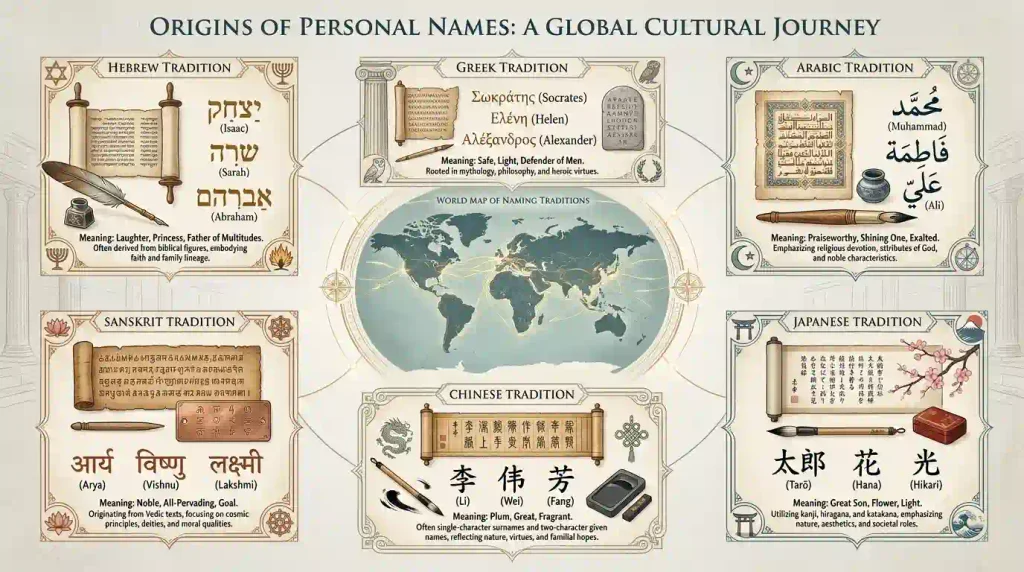
Name Meanings by Language and Culture
The meaning of a name often depends on the language and naming tradition from which it developed.
Different cultures may use similar sounds to express completely different ideas.
Hebrew and Aramaic names
Hebrew and Aramaic naming traditions have influenced Jewish, Christian, and other communities for centuries.
Many Hebrew names preserve religious concepts, family relationships, and historical narratives.
Examples include:
| Name | Traditional meaning |
| Michael | Who is like God? |
| Daniel | God is my judge |
| Gabriel | God is my strength |
| Nathaniel | God has given |
| Levi | Joined or attached |
| Micah | Who is like Yahweh? |
| Elijah | My God is Yahweh |
Aramaic was also widely used in the ancient Near East and influenced personal names and their transmission.
When researching Hebrew or Aramaic names, examine their original spelling and historical context.
The meaning assigned within a biblical narrative may sometimes be a traditional explanation rather than a settled linguistic reconstruction.
Our Levi name meaning and micah name meaning guides explain two Hebrew names with important biblical backgrounds.
Greek and Latin names
Greek and Latin have strongly influenced European personal naming.
Ancient Greek names often drew on concepts such as wisdom, victory, protection, and divine favor.
Latin names frequently developed from Roman family names, geographical identities, or descriptive words.
Examples include:
| Name | Origin | Meaning or explanation |
| Sophia | Greek | Wisdom |
| Theodore | Greek | Gift of God |
| Alexander | Greek | Defender of men or people |
| Felix | Latin | Fortunate, happy |
| Roman | Latin | From Rome |
| Julian | Latin | Derived from Julius; deeper meaning disputed |
| Victor | Latin | Conqueror |
| Clara | Latin | Clear, bright |
Some Greek names entered English through Latin or French.
This means the modern English spelling may not closely resemble the original Greek form.
For example, Theodore developed from Greek Theodōros through Latin Theodorus.
The julian name meaning guide explains a name derived from a Roman family tradition, while our roman name meaning article examines a name associated directly with Rome.
For another Greek name with a particularly clear meaning, explore theodore name meaning.
Germanic and Old English names
Germanic naming traditions often combined two meaningful elements.
These elements could express leadership, peace, strength, protection, family, or military ideas.
Examples include:
- Henry: Home ruler.
- Richard: Brave or strong ruler.
- Frederick: Peaceful ruler.
- Edward: Traditionally associated with wealth or fortune and protection.
- William: A name associated with will or desire and protection.
Old English surnames also developed from occupations, descriptive terms, and locations.
Blake provides an interesting example of disputed interpretation.
Its roots may involve Old English terms associated with dark or pale coloring.
For a closer examination, see our Blake name meaning guide.
The henry name meaning article offers a contrasting example of a Germanic compound with a well-established interpretation.
Celtic and Gaelic names
Celtic languages include Irish, Scottish Gaelic, Welsh, Breton, and related traditions.
These languages have different histories and should not be treated as interchangeable.
Irish names often reflect historical personal names, descriptive qualities, or natural imagery.
Examples include:
- Aodh: Associated with fire.
- Niamh: Brightness or radiance.
- Caoimhe: Derived from an Irish word associated with gentleness or beauty.
- Ronan: Little seal.
Gaelic naming traditions also include surnames formed through family relationships.
For example, Mac is associated with “son,” while Irish Ó traditionally identifies descent.
However, the presence of Mac or O in a modern spelling does not automatically settle a particular family’s ancestry.
Historical records remain important.
Arabic and Islamic names
Arabic names often preserve meanings related to virtues, praise, faith, family relationships, and social qualities.
Examples include:
Muhammad: Praised or praiseworthy, from an Arabic root associated with praise.
Ahmad: Commonly interpreted as more praiseworthy or highly praised.
Karim: Generous or noble.
Amin: Trustworthy or faithful.
Abd al-Rahman: Servant of the Most Merciful, using a divine epithet.
Not every Arabic name is specifically Islamic.
Arabic is a language used by people belonging to different religious communities.
Similarly, Muslims around the world use names originating in Arabic, Persian, Turkish, Urdu, Sanskrit, and many other languages.
A name’s language of origin and its religious usage should therefore be considered separately.
Sanskrit and Hindi names
Sanskrit has deeply influenced naming traditions across South Asia.
Many names are associated with virtues, natural elements, religious literature, and philosophical ideas.
Examples include:
- Ānanda: Bliss or joy.
- Āśā: Hope, wish, or aspiration.
- Prakāśa: Light or illumination.
- Vijaya: Victory.
- Kiran: Ray or beam of light, from Sanskrit kiraṇa.
Hindi uses many names of Sanskrit origin, but Hindi and Sanskrit are not the same language.
A modern name may also have regional forms in Bengali, Marathi, Gujarati, Nepali, or other languages.
Pronunciation and spelling may change accordingly.
For South Asian names, examining the original writing system is particularly useful.
Romanized spelling alone may not distinguish different vowel lengths or consonant sounds.
East Asian names, characters, and writing systems
Chinese, Japanese, and Korean naming systems often require an approach different from alphabet-based European name research.
In Chinese, the same pronunciation may correspond to different written characters.
For example, the sound Mei can be associated with characters such as 美, meaning beautiful, or 梅, meaning plum.
The meaning depends on which character is used.
Japanese personal names may also use different kanji characters with identical or similar readings.
For example, a name pronounced Haru can be written using characters associated with spring, sunshine, or clear weather, depending on the chosen form.
In Korean, many given names have meanings associated with the hanja characters selected by the family, although some names are formed from native Korean words.
Therefore, a name written only in Latin letters may not contain enough information to determine its exact meaning.
When researching East Asian names, ask for the original characters whenever possible.
African naming traditions
Africa contains thousands of languages and numerous distinct naming traditions.
It would be misleading to treat African names as belonging to one language or one unified cultural system.
Some names reflect the day of birth, while others express gratitude, hope, family circumstances, ancestry, or religious belief.
For example:
Kofi: An Akan male day name traditionally associated with Friday.
Oluwaseun: A Yoruba name expressing gratitude to God.
Themba: A name used in Nguni-language contexts and associated with hope or trust.
In many communities, naming ceremonies carry important social or spiritual significance.
However, customs vary greatly between regions and families.
For accurate research, identify the particular language and cultural tradition rather than simply labeling a name “African.”
How transliteration affects spelling and meaning
Transliteration converts writing from one script to another.
Examples include representing Arabic, Hebrew, Greek, Cyrillic, or Japanese words with Latin letters.
Different transliteration systems may produce different spellings for the same original name.
For instance, the Russian name Фёдор is commonly represented as Fyodor or Fedor in English.
These are spelling conventions rather than necessarily different historical names.
Likewise, Arabic and South Asian names may have several accepted romanizations.
When looking up a name meaning, try to find the original script.
If that is unavailable, collect plausible transliterations and compare them carefully.
Where to Find Reliable Name Information
Online name dictionaries can be useful, but accuracy depends on the sources and research methods behind their explanations.
Etymology dictionaries and scholarly name references
For a historically complicated name, specialized dictionaries and academic references are particularly valuable.
Look for resources that explain:
- The earliest recorded spelling.
- The source language.
- Historical word elements.
- Phonetic development.
- Related names.
- Competing etymological interpretations.
- References to historical documents.
Some books specialize in given names, while others focus on surnames.
Historical dictionaries may also provide information about when a name appeared in a particular country.
When using a modern baby-name website, check whether it distinguishes documented etymology from cultural symbolism.
A short description can be accurate, but it should not oversimplify disputed origins.
Historical records and family documents
Family records often help answer questions that dictionaries cannot.
Useful documents include:
- Birth certificates.
- Marriage certificates.
- Baptismal records.
- Family Bibles.
- School records.
- Historical letters.
- Immigration records.
- Naturalization documents.
- Cemetery inscriptions.
- Census records.
- Wills and probate documents.
These records may reveal older spellings or confirm that a name was passed down through several generations.
However, historical documents can also contain errors.
Names were sometimes recorded according to how they sounded, especially when the person writing the record spoke a different language.
Compare multiple records before assuming that one spelling is definitive.
Genealogy resources for surname origins
To research a surname, begin with your own family tree.
Identify the earliest ancestor whose name you can document reliably.
Then examine where that person lived.
The same surname may have developed independently in different locations.
A surname may also have several linguistic origins.
For example, a name resembling an English occupational surname could have an unrelated origin in another language.
Genealogy resources can help connect names to actual family records.
However, a general surname-origin page cannot prove that your family descends from a particular historical person or region.
That requires documentary research connecting one generation to the next.
What Social Security Administration popularity data can—and cannot—tell you
For U.S. baby-name popularity, the Social Security Administration provides one of the most authoritative public sources.
Its database includes historical birth-name records extending back to 1880.
The latest annual data available as of October 2026 covers babies born in 2025.
The Social Security Administration’s official baby-name database allows users to examine popular names, historical trends, and rankings.
It can help answer questions such as:
- How common was my name when I was born?
- Was my name more popular in earlier decades?
- Is my name becoming more common?
- Which names were popular in my state?
- How has a spelling’s usage changed?
However, SSA data has limitations.
It records names from Social Security card applications, not the original meanings of names.
Different spellings are generally counted separately.
Rankings are also separated by recorded sex category.
National data and state data may have different reporting limitations, particularly for uncommon names.
The SSA does not tell you why your family chose a particular name, prove your ancestry, or establish your name’s ancient etymology.
Its primary value is documenting American naming patterns.
Why Name Meaning Websites Sometimes Disagree
When you search “What does my name mean?” you may find several contradictory answers.
These differences can arise for legitimate historical reasons or from poor research practices.
A name can have more than one supported origin
Some names developed independently in multiple languages.
Others changed so much over time that their earliest forms are difficult to reconstruct.
A modern spelling may therefore be associated with several possible histories.
Consider surnames.
A surname that appears in English, Irish, and other traditions might have different sources depending on the family.
It would be inaccurate to assign every bearer one shared origin without evidence.
Likewise, names borrowed into new languages may acquire associations that differ from their original meanings.
Literal translations versus cultural associations
A frequent source of confusion is the difference between literal meaning and symbolic interpretation.
For example, Roman literally relates to Rome.
Because the Roman Empire was historically powerful, some websites describe Roman as meaning strong or powerful.
That may be an understandable cultural association, but it is not the word’s literal etymology.
Similarly, names associated with kings are sometimes described as meaning king even when their original linguistic roots express a different concept.
When comparing sources, ask whether the writer is explaining the name’s original language or offering a modern interpretation.
Both can be interesting, but they should be labeled accurately.
How copied claims and folk etymology spread
A questionable explanation can become popular through repetition.
One website publishes an appealing meaning.
Other websites reproduce the same statement.
Eventually, the claim appears widely accepted despite lacking historical evidence.
Folk etymology can also arise when a foreign name resembles a familiar English word.
This is especially common with names transmitted through several languages.
Look for explanations supported by original-language forms rather than descriptions based only on modern spelling.
If the claimed meaning cannot be connected to credible historical roots, treat it cautiously.
Why personality claims are not etymological meanings
Some name websites claim that people with a particular name are naturally intelligent, loyal, ambitious, generous, or successful.
These claims are often presented as if they are part of the name’s meaning.
They are not.
A name may have cultural associations with a historical figure who possessed certain qualities.
However, that does not mean everyone bearing the name shares those traits.
Numerology-based personality descriptions are also separate from linguistic research.
Understanding your name’s history can be meaningful without treating it as a prediction of who you will become.
Discover the Personal Story Behind Your Name
Historical research tells you where a name came from.
Family research can explain why it became yours.
These are related but different questions.
Ask relatives who chose your name and why
Begin with the people who selected your name.
If possible, ask your parents, grandparents, or other relatives.
Useful questions include:
- Who originally suggested my name?
- Was I named after someone?
- Were other names considered?
- Was my name chosen for religious reasons?
- Does it have a particular meaning in our family’s language?
- Was the spelling chosen intentionally?
- Is there a story associated with my birth or naming ceremony?
These conversations may uncover information that does not appear in public records.
For example, your name might honor a family member whose first name was different but who used your name as a nickname.
Look for namesakes in family records
A namesake is a person after whom another individual is named.
Investigating namesakes can reveal family traditions.
Search for recurring first names in birth certificates, census records, and family trees.
Notice whether certain middle names or surnames were preserved.
Some families reuse a name across generations.
Others alternate names between maternal and paternal relatives.
You may discover that your name was chosen to preserve a particular family connection.
Even a familiar name can have a distinctive personal history.
Compare family stories with documented origins
Family stories and historical records may not always agree.
For example, relatives may believe that a surname originated in one country, while records reveal an earlier spelling associated with another region.
This does not mean the family story has no value.
It may preserve a later stage of migration or naming history.
Try separating three questions:
What is the linguistic origin of the name?
This is answered through etymology.
Where did my family use the name?
This is answered through genealogy and historical records.
Why was I personally given the name?
This is often answered through family history and conversation.
Keeping these questions separate produces a much richer understanding of your identity.

Can Your Name Affect Your Identity or Choices?
Names are important social identifiers.
They can influence how people recognize, remember, and address one another.
Researchers have also studied whether names are associated with preferences or life decisions.
However, the evidence should be interpreted carefully.
Nominative determinism and aptronyms
Nominative determinism is the idea that a person’s name may be associated with their occupation, interests, or choices.
For example, a person with a surname resembling a profession might work in that field.
An aptronym is a name that appears especially appropriate for someone’s occupation or characteristics.
A hypothetical example would be a gardener named Rose.
Such coincidences can be amusing and memorable.
Researchers have investigated whether some patterns occur more often than expected by chance.
However, examples selected because they seem funny do not prove that a name caused a career choice.
Factors such as family background, geography, language, and social expectations can also influence outcomes.
Implicit egotism and the name-letter effect
The name-letter effect refers to a psychological finding that people sometimes show a preference for letters appearing in their own names, particularly their initials.
Researchers have explored whether this tendency reflects familiarity or positive associations with the self.
The broader idea of implicit egotism suggests that people may sometimes prefer things connected with themselves, even without conscious awareness.
Some studies have examined whether this could influence preferences for places, occupations, or other decisions.
However, evidence concerning major life choices is mixed and has been debated in psychological research.
Observational associations are particularly difficult to interpret because names may be associated with cultural background, language, family circumstances, and geography.
What these ideas do—and do not—prove
The name-letter effect and nominative determinism are interesting research topics, but they do not show that your name controls your destiny.
A child named Victor is not guaranteed to become successful.
Someone named Grace will not necessarily be graceful.
A name associated with wisdom does not ensure unusual intelligence.
Your identity develops through many influences, including experiences, relationships, culture, education, and personal decisions.
A name may carry meaningful associations, but it does not define every aspect of who you are.
For parents choosing a baby name, it is more useful to consider pronunciation, cultural significance, family meaning, and personal preferences than speculative claims about future personality.
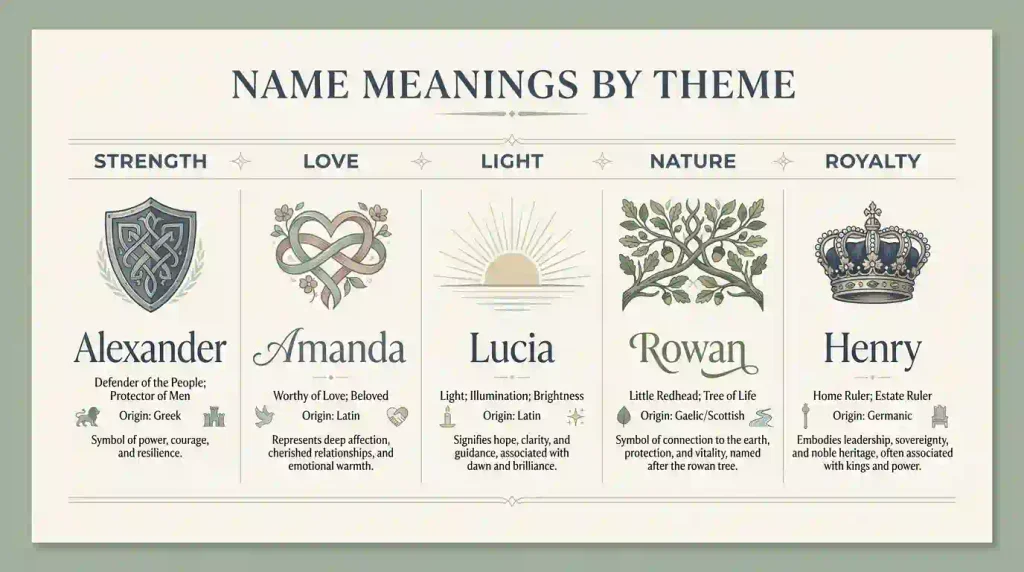
Name Meanings by Theme
Sometimes people are less interested in one specific name and more interested in finding names associated with particular ideas.
Thematic name research can help parents discover names that reflect their values or interests.
However, themes should distinguish literal definitions from symbolic associations.
Names meaning strength or beauty
Names associated with strength, protection, and beauty appear across many languages.
Examples include:
| Name | Origin | Meaning or association |
| Ethan | Hebrew | Traditionally interpreted as firm or enduring |
| Gabriel | Hebrew | God is my strength |
| Alexander | Greek | Defender of men or people |
| Valerie | Latin | Associated with strength or health |
| Bella | Italian and related languages | Beautiful |
| Callista | Greek | Most beautiful |
| Jamal | Arabic | Beauty |
Names associated with strength may refer to physical power, endurance, courage, or protective qualities.
Beauty-related names may express attractiveness, grace, or admiration.
Not every name in a thematic list shares the same literal meaning.
For example, Alexander relates to defending rather than literally meaning “strong.”
Names connected with love or hope
Love and hope are especially meaningful themes for many parents.
Examples include:
Amanda: Traditionally associated with being worthy of love, from Latin.
David: Commonly interpreted as beloved, from Hebrew.
Carys: A Welsh name associated with love.
Esme: Often associated with esteemed or loved, through French naming history.
Nadia: In several Slavic naming traditions, associated with hope.
Hope: An English virtue name with a direct meaning.
Some names express love literally, while others developed through words associated with affection or admiration.
Hope may refer to optimism, expectation, or spiritual trust depending on the cultural context.
Names associated with light, earth, or fire
Nature and the elements have inspired personal names for centuries.
Examples include:
| Theme | Name | Meaning or association |
| Light | Lucia | Associated with Latin light |
| Light | Lucian | Derived from Latin forms connected with light |
| Light | Prakash | Light or illumination |
| Earth | Terra | Latin for earth or land |
| Fire | Aodh | Associated with fire in Irish tradition |
| Fire | Ignatius | Traditionally associated with fire in some interpretations, though the original etymology is uncertain |
| Sun | Ravi | Sun, from Sanskrit |
These examples illustrate why etymological precision matters.
Some names are direct translations of natural concepts.
Others are connected through cultural interpretations or debated historical roots.
A reliable name list should explain the difference.
Names connected with flowers, nature, or hunting
Nature-inspired names may refer to plants, landscapes, animals, or traditional occupations.
Examples include:
- Rose: Associated with the flower.
- Lily: Flower name.
- Hazel: Tree name.
- Ivy: Climbing plant.
- Oliver: Associated with the olive tree through its established French and Latin-related naming history, although its deeper development is more complex.
- Hunter: English occupational surname referring to hunting.
- Forest: Associated with woodland.
- Rowan: Associated with the rowan tree in some naming traditions.
Such names often appeal to parents who appreciate the outdoors.
However, a nature association is not always the original meaning of every spelling or variant.
For example, a similar-looking name in another language might have an unrelated origin.
Names associated with royalty or holiness
Some names carry associations with rulership, nobility, or religion.
Examples include:
Henry: Home ruler, from Germanic elements.
Frederick: Peaceful ruler, from Germanic roots.
Richard: Brave ruler, from Germanic elements.
Basil: Associated with Greek basileus, meaning king.
Sarah: Princess, from Hebrew.
Theodore: Gift of God, from Greek.
Micah: Who is like God?, from Hebrew.
Francis: Historically associated with the Franks or French, with later Christian associations through saints.
The meaning of a name should not be confused with the status of its famous bearers.
For example, Henry has royal associations because several English kings carried the name, but it does not literally mean “king.”
The Francis name meaning guide explores another name whose cultural and religious associations developed beyond its linguistic origins.
For individual etymologies, pronunciations, histories, and popularity information, browse our Individual Boy Name Guides.
Frequently Asked Questions About Name Meanings
Is there one official meaning for every name?
No. Some names have well-established linguistic meanings, while others have multiple interpretations, disputed origins, or no securely documented original meaning.
Can a name have more than one origin?
Yes. Identical or similar names can develop independently in different languages or acquire several historical forms through migration and cultural contact.
Are name meaning lists accurate?
Some are well researched, but others repeat unsupported interpretations, so important claims should be checked against reliable etymology dictionaries and historical records.
How can I find the origin of my last name?
Start with family documents, trace the earliest known ancestor, examine historical spellings, and compare reliable genealogy and surname-etymology resources.
Can a name’s popularity change its meaning?
Popularity can change a name’s social associations, but it does not automatically change the original linguistic meaning.
Can the same name mean different things in different languages?
Yes. Similar or identical spellings can represent separate names in different languages, and names written with different characters may have different meanings despite similar pronunciations.
Conclusion: Understanding the Story Behind Your Name
The answer to “What does my name mean?” may uncover much more than a short definition. Every name has a history shaped by language, culture, family traditions, and the people who have carried it. Some names have clear linguistic roots, while others preserve disputed meanings or several independent origins. To understand your name accurately, begin with its spelling, investigate the original language, compare trustworthy references, and explore your family’s personal story. Remember that a name’s literal meaning does not determine your personality or future. Its significance can grow through your own experiences and relationships. Whether you’re discovering the history of your first name or searching for a meaningful name for a child, explore our collection of Boy Names to learn about name origins, pronunciations, variations, and popularity.