

Blake Name Meaning, Origin, History, Pronunciation, and Popularity
The Blake name meaning is unusually interesting because its English history points to two almost opposite ideas: “dark” or “black” from Old English blæc, and “pale,” “fair,” or “white” from Old English blāc. The two words became difficult to distinguish as English developed, so it is not always possible to know which description originally produced a particular Blake surname. Blake also has a separate Irish surname connection through Gaelic Ó Bláthmhaic, associated with a personal name built from bláth, meaning “flower” or “blossom,” and mac, meaning “son.” Today, Blake is a short, strong, one-syllable given name used for both boys and girls. In the United States, it has a long history as a boy’s name but has become remarkably gender-neutral in modern use. This guide explores Blake’s meaning, pronunciation, surname history, gender use, latest popularity, famous namesakes, spellings, nicknames, middle-name combinations, sibling names, numerology, and everything parents should consider before choosing Blake for a baby boy.
Table of Contents
- Blake Name Overview
- What Does the Name Blake Mean?
- Blake’s Origin and History
- How to Pronounce Blake
- Is Blake a Boy’s Name, a Girl’s Name, or Gender-Neutral?
- How Popular Is the Name Blake?
- Famous People and Characters Named Blake
- Blake Name Variations, Spellings, and Nicknames
- Names Similar to Blake
- Middle Names and Sibling Names for Blake
- How to Test Blake with a Full Name
- What to Consider Before Choosing Blake
- Blake in Numerology and Astrology
- Creative Blake Name Features
- Frequently Asked Questions About the Name Blake
- Final Thoughts
Blake Name Overview
Blake is one of those names that feels simple at first but becomes much more interesting when you explore its history.
It began primarily as a surname and eventually developed into a familiar given name. For parents searching through Boy Names, Blake offers a combination that many modern families look for: short spelling, easy pronunciation, strong sound, recognizable history, and contemporary gender-neutral appeal.
Meaning, origin, gender, and pronunciation
Here is Blake at a glance:
| Feature | Blake |
| Name | Blake |
| Primary origin | English |
| Additional surname connection | Irish |
| Historical form | English surname |
| Possible English meanings | Dark, black; pale, fair, white |
| Irish connection | Ó Bláthmhaic |
| Gender | Gender-neutral; historically stronger for boys in the U.S. |
| Pronunciation | BLAYK |
| IPA | /bleɪk/ |
| Syllables | 1 |
| Letters | 5 |
| Name style | Short, surname-style, modern-classic |
| Common spelling | Blake |
| Nickname | Blakey |
| 2025 U.S. boy rank | #316 |
| 2025 U.S. girl rank | #295 |
The most important thing to understand about the Blake name meaning is that there is no single perfectly certain English meaning that applies to every historical bearer of the surname.
Syllables, length, and name style
Blake contains five letters and only one syllable.
Blake = BLAYK
Its compact structure gives it a direct and confident sound. It belongs to the same broad naming style as names such as:
- Cole
- Grant
- Reid
- Dean
- Chase
- Clark
- Brooks
- Miles
- Jack
- Tate
Blake also fits the popular surname-as-first-name tradition seen in names such as Carter, Parker, Hudson, Cooper, Mason, and Bennett.
Unlike some newer surname names, however, Blake has a substantial history of first-name use.
What Does the Name Blake Mean?
The answer to “What does Blake mean?” is more complicated than a one-word baby-name definition might suggest.
Most discussions of the English surname trace Blake to one or both of two Old English words.
The Old English roots blæc and blāc
The first important root is Old English blæc, associated with the meaning:
black, dark, or dark-complexioned
A surname derived from this root may originally have functioned as a descriptive nickname for someone with dark hair, a dark complexion, or another noticeably dark feature.
The second important root is Old English blāc, associated with ideas such as:
pale, fair, wan, white, or light in appearance
That creates an unusual etymological situation.
The same modern surname can potentially reflect an ancestral description meaning either dark or fair.
How the roots blæc (“dark”) and blāc (“pale or fair”) differ
In Old English, blæc and blāc were distinct words.
One could describe darkness or blackness.
The other could describe paleness or fairness.
Over time, pronunciation and spelling changed. In Middle English, forms connected with these words could appear very similar or become effectively indistinguishable in written records.
That linguistic convergence is the main reason Blake sometimes receives apparently contradictory meanings on modern naming websites.
It is not necessarily because one source is claiming the name means “black” while another independently invented “white.”
The contradiction is rooted in the history of the language itself.
Why these words’ histories can be confused
English spelling was not standardized in the medieval period.
Scribes could write the same surname in different ways, and vowel length was not always represented in a way that makes the original distinction obvious to modern readers.
As the older forms evolved toward Middle English blake, identifying whether a particular medieval nickname referred to a dark person or a pale person became difficult.
This means that a historical man recorded as “John Blake,” for example, cannot automatically be assumed to have received the surname from either the “dark” root or the “fair” root without additional genealogical evidence.
What the evidence can—and cannot—establish about Blake’s original meaning
The strongest conclusion is therefore:
Blake is an English surname that may derive from descriptive words referring either to dark coloring or pale/fair coloring.
You may see Blake summarized as:
- Dark
- Black
- Dark-haired
- Pale
- Fair
- Fair-haired
- White
These definitions are useful shorthand, but they should not be presented as equally certain for every family lineage.
For parents, this ambiguity does not make Blake a bad choice. In fact, it gives the name one of the more unusual etymological stories among familiar English names.
It is a rare case in which the historical possibilities appear almost opposite.
Blake’s Origin and History
Blake is principally associated with English surname history, but the surname also has important Irish connections.
This matters because not every Blake family necessarily shares the same etymological path.
Blake as an English surname
In England, Blake developed as a surname or nickname-based family name.
Historical surname research links it to Middle English forms influenced by the Old English words discussed above.
The surname appears in medieval records centuries before Blake became widely familiar as a personal first name.
Recorded examples of the surname occur in different parts of England, including Yorkshire and southern counties.
This makes Blake part of a large group of English surnames that originally described a person, family relationship, occupation, hometown, physical appearance, or distinguishing characteristic.
The Irish surname connection to Ó Bláthmhaic
Blake also has an Irish Gaelic surname connection.
One etymological path treats Blake as an Anglicized form associated with Ó Bláthmhaic, meaning a descendant of Bláthmhac.
The personal name Bláthmhac contains elements including:
- bláth — flower, blossom, and in some contexts ideas connected with flourishing or prosperity
- mac — son
This Irish origin should not simply be merged with the Old English “dark” and “fair” explanations.
They can represent different historical surname paths that eventually share the English spelling Blake.
Why Blake may have separate English and Irish origin paths
Surnames that look identical today do not always come from one ancestral source.
Migration, language change, Anglicization, local pronunciation, and independent surname formation can produce the same modern spelling from different roots.
Blake illustrates this clearly.
One family named Blake might trace its surname to an English descriptive nickname.
Another could have an Irish Gaelic connection.
There were also English Blake families established in Ireland following medieval Anglo-Norman settlement.
The Blake family became especially prominent in Galway and was traditionally counted among the 14 Tribes of Galway, the merchant families associated with the city’s political and commercial life.
That historical Galway association should not be confused with the separate Gaelic Ó Bláthmhaic derivation.
Both belong to the broader history surrounding the surname.
How Blake shifted from a surname to a given name
English-speaking societies have a long tradition of turning surnames into first names.
Sometimes a mother’s maiden name was given to a child.
Sometimes a family surname was used to honor an ancestor.
Over time, surnames that repeatedly appeared in the first-name position began to function independently as given names.
Blake followed this pattern.
It eventually became recognizable without requiring any connection to a family surname.
Today, few parents naming a baby Blake are necessarily choosing it because Blake appears in their genealogy.
They may simply like the sound and style.
When Blake began appearing as a first name
It is difficult to identify the first person in history ever given Blake as a personal name because older records are incomplete.
A more reliable statement can be made about American statistics.
In the U.S. Social Security Administration’s historical baby-name dataset, Blake appears as a male given name by 1883, when at least five boys were recorded with the name.
Usage remained relatively limited for decades.
Blake began gaining much more momentum during the second half of the twentieth century.
Its rise accelerated around the early 1980s.
By 1989, Blake had reached approximately the U.S. Top 100 for boys, and it remained a familiar masculine choice through much of the following decades.
How surname-style names became more common as first names
Blake benefited from a broader American preference for surname-style names.
Names such as:
- Taylor
- Jordan
- Parker
- Carter
- Cooper
- Mason
- Logan
- Hudson
- Jackson
helped make surnames feel increasingly natural in the first-name position.
Blake had an advantage because it was shorter than many surname names.
One syllable gives it a crisp quality that can work from childhood through adulthood.
If you enjoy researching the story behind specific names rather than browsing broad lists, our Individual Boy Name Guides explore origins, meanings, pronunciations, and popularity in the same way.
How to Pronounce Blake
Blake is one of the easier English names to pronounce.
The standard pronunciation and syllable
Blake is pronounced:
BLAYK
IPA:
/bleɪk/
It contains only one syllable.
The vowel sounds like the vowel in:
- Cake
- Lake
- Make
- Jake
Blake rhymes directly with Jake, Drake, Lake, and Make.
Spelling variants and common pronunciation questions
The standard spelling is overwhelmingly:
Blake
Alternative forms include:
- Blayke
- Blayk
- Bleik
- Blaque
Blayke is usually pronounced exactly like Blake because the inserted “y” emphasizes the long-a sound.
Blayk is also intended to preserve the same pronunciation.
Bleik can vary depending on linguistic context but may be used as a phonetic-looking alternative.
Blaque is a highly unusual stylized form and could create pronunciation uncertainty.
Longer names such as Blakely and Blakeley contain Blake visually but are separate names rather than simple spelling substitutions.
Is Blake a Boy’s Name, a Girl’s Name, or Gender-Neutral?
Blake is genuinely gender-neutral in modern American naming.
For a website focused on boys, however, it is worth understanding that Blake has a much deeper history of substantial U.S. use among boys.
How Blake is used for boys and girls
Historically, Blake was primarily recognized as a surname and then as a boy’s given name.
Thousands of American boys were being named Blake annually well before significant female use developed.
That masculine history is why many adults still initially interpret Blake as a boy’s name.
But the modern statistics have changed the picture dramatically.
In 2025, U.S. records show:
| Gender | Babies Named Blake | National Rank |
| Boys | 1,080 | #316 |
| Girls | 1,035 | #295 |
That is only a 45-baby difference.
So if you are asking “is Blake a gender neutral name?”, the current U.S. data provides a particularly strong yes.
Blake is now one of the clearest examples of a name with substantial use on both sides.
How its gender use has changed over time
Male use developed much earlier and became especially strong in the late twentieth and early twenty-first centuries.
Female use was relatively uncommon for much of Blake’s American history.
That began changing more noticeably during the 2000s and particularly the 2010s.
Celebrity visibility may have helped reinforce feminine recognition of the name. Actress Blake Lively is probably the most prominent female bearer.
By the early 2020s, girls named Blake were no longer unusual.
So, is Blake a girl name?
Yes, Blake is now well established for girls.
But it is equally accurate to describe Blake as a boy’s name with a long masculine history and a modern gender-neutral identity.
For parents specifically looking for a boy’s name, Blake remains completely natural and established.
How Popular Is the Name Blake?
The answer depends on whether you look at boys, girls, total usage, or historical trends.
For current U.S. data, Blake is familiar but no longer highly common.
Blake’s latest U.S. rankings and birth counts
The most recent available full U.S. data covers babies born in 2025.
According to the Social Security Administration baby-name records:
Boys:
- Rank: #316
- Births: 1,080
Girls:
- Rank: #295
- Births: 1,035
Combined births with the exact spelling Blake:
- 2,115
So, is Blake a popular name?
It remains widely recognized and regularly used, but it is no longer among America’s most frequently chosen baby names.
That can be appealing for parents who want something familiar without choosing a current Top 20 or Top 50 name.
Popularity trends for boys and girls
Blake has followed very different trajectories for boys and girls.
Recent U.S. figures illustrate the change:
| Year | Boys Named Blake | Boy Rank | Girls Named Blake | Girl Rank |
| 2025 | 1,080 | #316 | 1,035 | #295 |
| 2024 | 1,321 | #265 | 1,461 | #210 |
| 2023 | 1,374 | #254 | 1,351 | #221 |
| 2022 | 1,581 | #228 | 1,448 | #200 |
| 2021 | 1,850 | #205 | 1,504 | #199 |
| 2020 | 1,815 | #209 | 1,319 | #222 |
| 2019 | 2,141 | #183 | 1,388 | #224 |
| 2018 | 2,466 | #158 | 1,185 | #280 |
| 2017 | 2,626 | #149 | 1,185 | #269 |
| 2016 | 3,290 | #127 | 1,098 | #298 |
| 2015 | 4,234 | #96 | 752 | #424 |
The pattern is clear.
Blake has declined substantially among boys since the mid-2010s.
At the same time, its use for girls expanded enough to create an almost even gender split.
Blake’s historical use and popularity changes
Blake was recorded for boys in U.S. data as early as 1883.
For much of the early twentieth century, it remained relatively uncommon.
Usage gradually increased after World War II and accelerated significantly around 1980.
In 1980, fewer than 1,000 boys received the name.
Only a few years later, annual use had risen into the thousands.
Blake entered the U.S. Top 100 for boys around the end of the 1980s.
The 1990s and 2000s were particularly strong periods.
According to SSA decade data:
- Blake was the #84 boy name of the 1990s, with more than 45,000 recorded births.
- It ranked #86 across the 2000s, with more than 50,000 boys named Blake.
- During the 2010s it ranked #95, with more than 41,000 boys receiving the name.
Its strongest individual year for boys came in 2012, when about 6,047 boys were named Blake and it ranked #71.
Since then, male usage has generally declined.
That answers another common query: is Blake a rare name?
No.
Blake is not rare in the broader American population. Generations of Blakes already exist, and more than a thousand boys still received the name in 2025.
But it is significantly less common among newborn boys than it was around 2012.
For some parents, that is an ideal position: recognizable without being overly saturated.
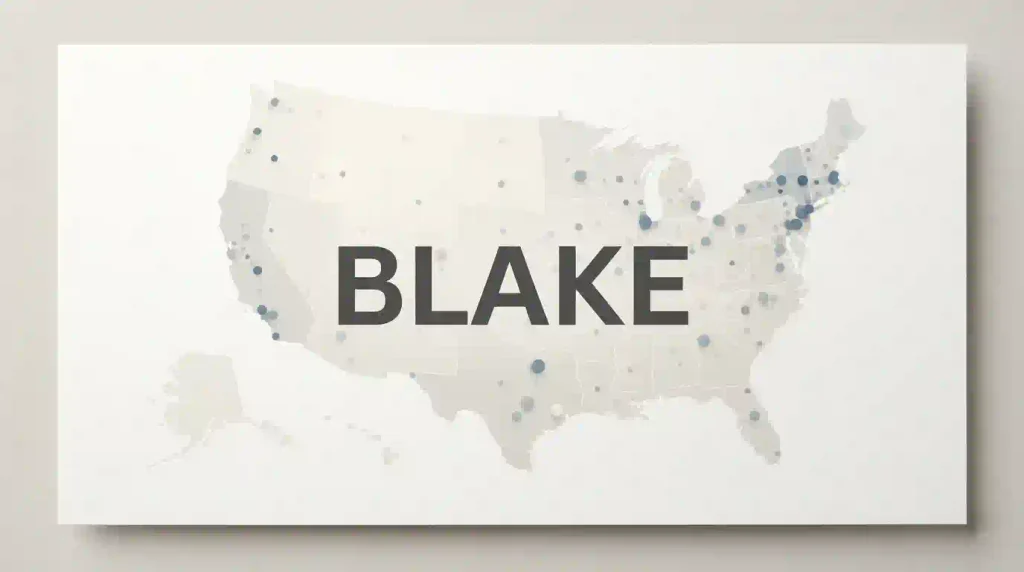
Blake’s popularity by U.S. state
Raw state totals show Blake appearing most often historically in populous states such as:
- California
- Texas
- Florida
- Ohio
- Michigan
- Illinois
- Missouri
- Pennsylvania
However, raw totals can be misleading because states such as California and Texas have much larger populations.
When recent boy-name rankings are considered rather than total births alone, Blake has shown relatively strong regional usage in places including Vermont, North Dakota, Michigan, Wyoming, Maine, New Hampshire, and Wisconsin.
That suggests Blake has not been equally fashionable in every part of the country.
It also illustrates an important naming-data principle: a name can feel common in one region but relatively unusual in another.
Blake’s popularity in other countries
Blake is not limited to the United States.
It is also used in several English-speaking countries, including:
- England and Wales
- Scotland
- Canada
- Ireland
- Northern Ireland
- Australia
- New Zealand
Recent national datasets show Blake continuing to receive regular use in countries such as Canada, Scotland, England and Wales, and Ireland.
Its exact position varies substantially by country.
This makes sense for an English-language surname name whose cultural recognition has spread through literature, entertainment, sports, and international naming trends.
Parents should avoid directly comparing rank numbers across countries without context because each country has a different number of births, reporting system, privacy threshold, and ranking methodology.
Data source and last-checked date
U.S. popularity source: Social Security Administration baby-name records.
Most recent birth year available: 2025.
Last checked for this guide: October 6, 2026.
SSA figures count each spelling separately.
Therefore, Blake does not include babies registered as Blayke, Blayk, or other variants.
Famous People and Characters Named Blake
Famous bearers can influence how a name feels without determining its meaning.
Blake has a wide range of associations in literature, music, sports, television, and film.
Notable people named Blake
Blake Shelton — American country singer and television personality known for his long-running role on The Voice.
Blake Griffin — American professional basketball player known for his NBA career and athletic style of play.
Blake Edwards — American filmmaker, director, screenwriter, and producer associated with films including Breakfast at Tiffany’s and the Pink Panther series.
Blake Lively — American actress whose prominence has helped make Blake especially recognizable as a female given name.
Other public figures named Blake appear across professional sports, entertainment, journalism, and creative fields.
The name also has an important surname association:
William Blake — the English poet, painter, and printmaker whose works made Blake one of the best-known literary surnames in the English-speaking world.
Although William’s first name was not Blake, his cultural importance strengthens the name’s literary association.
Blake in books, movies, television, and other pop culture
One well-known fictional bearer is Blake Carrington, a central character in the television franchise Dynasty.
The character reinforces an older upper-class surname-name image for Blake.
Across fiction, Blake is often chosen for characters because it is short, memorable, easy to pronounce, and works convincingly across different age groups.
Its gender flexibility has also made it useful to writers who want a contemporary name without immediately signaling gender.
Blake Name Variations, Spellings, and Nicknames
Blake has relatively few established spelling variations compared with names such as Alexander or Jackson.
That simplicity is one of its strengths.
Alternative spellings and related forms
Possible spellings include:
Blake — standard and overwhelmingly most familiar spelling.
Blayke — modern alternative that preserves the BLAYK pronunciation.
Blayk — uncommon simplified variant.
Bleik — rare spelling seen in different linguistic or modern naming contexts.
Blaque — highly unusual stylized spelling.
Names visually or historically related to Blake include:
- Blakely
- Blakeley
- Blakelee
- Blakeney
- Blakeman
These should not all be treated as interchangeable versions of Blake.
Blakely, for example, functions as its own surname and given name.
Blake’s nicknames and short forms
Because Blake already contains only one syllable, it does not require shortening.
The most intuitive nickname is:
Blakey
Other playful family nicknames might include:
- B
- B-B
- Blakes
- Blake-y
Many parents will simply use Blake without a nickname.
That can be attractive to people who prefer names that are unlikely to be automatically shortened.
Blake and related names in other languages
Blake is fundamentally an English-language surname and given name, so it does not have a traditional set of direct translations comparable with names such as John, Alexander, or Michael.
A person named Blake usually remains Blake when speaking another language.
This is important because lists that claim foreign names are “translations of Blake” may actually be giving names with vaguely similar meanings rather than genuine linguistic equivalents.
Names Similar to Blake
If you like Blake but are not completely decided, compare it with names that share its sound, meaning, length, or surname-inspired style.
You may also enjoy comparing the detailed history of alex name meaning or the more traditional nickname-style appeal covered in our archie name meaning guide.
Names that sound like or rhyme with Blake
The closest sound matches include:
- Jake
- Drake
- Blaine
- Blaise
Names with a similar sharp one-syllable structure include:
- Chase
- Cole
- Dean
- Grant
- Hayes
- Jack
- Jude
- Knox
- Luke
- Miles
- Nash
- Reid
- Rhett
- Tate
- Wade
Jake is Blake’s clearest direct rhyme.
Drake shares both the long-a vowel and final “-ake” sound.
Names with meanings similar to Blake
Because Blake can have both “dark” and “fair” etymological interpretations, meaning-based alternatives are unusual.
If you like the dark association, you might consider:
Cole — often associated with coal or dark coloring through surname and word connections.
Keir — a Scottish name sometimes connected with darker coloring.
If you prefer the fair or light side:
Finn — from Irish Fionn, associated with “fair” or “white.”
Fionn — the traditional Irish form carrying the fair/white meaning more directly.
Rather than treating these as equivalents of Blake, think of them as names sharing one part of its possible historical symbolism.
Names with a similar style or feel
Parents who like Blake often appreciate names that are concise, modern, surname-inspired, or slightly preppy.
Strong alternatives include:
- Brooks
- Carter
- Clark
- Cole
- Dean
- Grant
- Hayes
- Hudson
- Miles
- Parker
- Reid
- Rhett
- Sawyer
- Tate
- Wyatt
For the closest overall feel, Cole, Grant, Reid, Brooks, Clark, and Tate are especially strong comparisons.
Middle Names and Sibling Names for Blake
Because Blake is short and one syllable, it pairs especially well with longer middle names.
Middle names that pair well with Blake
Classic middle names
- Blake Alexander
- Blake Benjamin
- Blake Christopher
- Blake Daniel
- Blake Edward
- Blake Henry
- Blake James
- Blake Joseph
- Blake Matthew
- Blake Nathaniel
- Blake Samuel
- Blake Theodore
- Blake Thomas
- Blake William
Modern middle names
- Blake August
- Blake Carter
- Blake Everett
- Blake Harrison
- Blake Hudson
- Blake Oliver
- Blake Rowan
- Blake Sebastian
- Blake Sullivan
- Blake Wesley
Short middle names
A one-syllable first name can also work with another short name when the surname provides enough rhythm.
Examples include:
- Blake Dean
- Blake James
- Blake John
- Blake Jude
- Blake Reid
- Blake Rhys
Generally, though, a two-, three-, or four-syllable middle name gives Blake a smoother contrast.
Blake Alexander and Blake Theodore, for example, create a strong short-long rhythm.
Brother names for Blake
Good brother-name combinations include:
- Blake and Carter
- Blake and Cole
- Blake and Dean
- Blake and Grant
- Blake and Hayes
- Blake and Hudson
- Blake and Jack
- Blake and Miles
- Blake and Owen
- Blake and Reid
- Blake and Rhett
- Blake and Wyatt
For a coordinated but not overly matching set, Blake and Grant, Blake and Miles, or Blake and Owen work particularly well.
Sister names for Blake
Possible sister names include:
- Blake and Avery
- Blake and Blair
- Blake and Brooke
- Blake and Claire
- Blake and Emma
- Blake and Nora
- Blake and Paige
- Blake and Quinn
- Blake and Reese
- Blake and Sloane
Because Blake itself is gender-neutral, avoid sibling combinations that become confusing if that matters to you.
For example, Blake and Blair have an attractive coordinated sound, but people hearing the names without context may not immediately know which child is the boy.
How to Test Blake with a Full Name
Liking a first name by itself is only one part of choosing a baby name.
Test Blake with the complete name your child will actually use.
How Blake sounds with different surname lengths
Blake works especially well because its one-syllable structure can balance longer surnames.
Consider the rhythm:
Blake Anderson
Blake Montgomery
Blake Richardson
The short first name gives longer surnames space.
Blake can also work with short surnames:
Blake Jones
Blake Reed
Blake Clark
These combinations sound sharper and more compact.
Neither style is wrong.
The best choice depends on your preference.
Check the initials, rhythm, and repeated sounds
Write down the complete initials.
For example:
Blake Alexander Thomas = B.A.T.
That may or may not bother you.
Check for unintended words, abbreviations, organizations, or jokes.
Also look for repeated sounds.
A surname beginning with a strong K sound can create a noticeable transition:
Blake Carter
That may sound crisp to one parent and overly clipped to another.
Say the full name aloud in everyday situations
Try using Blake as though your baby were already here.
Say:
“Blake, dinner is ready.”
“Blake James Carter.”
“Mr. Blake Carter.”
“Dr. Blake Carter.”
“Blake, come here please.”
Imagine the name on:
- A school register
- A college application
- A business card
- A wedding invitation
- A professional email
- A sports jersey
A good baby name should ideally feel comfortable beyond infancy.
Blake performs particularly well in this test because it does not sound limited to one age group.
What to Consider Before Choosing Blake
If you are wondering “is Blake a good name?”, there are several strengths and a few possible considerations.
Potential advantages of the name
Easy to spell:
Most English speakers recognize the standard Blake spelling immediately.
Easy to pronounce:
BLAYK is straightforward and rarely mispronounced.
Works across ages:
Blake suits a baby, teenager, adult, and older person.
Strong without being aggressive:
Its one-syllable structure sounds confident without requiring an overtly macho meaning.
Recognizable but less common than before:
Parents can choose a familiar name without selecting a current Top 20 name.
Surname heritage:
Families who enjoy surname names may appreciate Blake’s long history.
International usability:
Its simple spelling and sound make it reasonably portable across English-speaking countries.
Possible drawbacks or associations
Gender ambiguity:
Some parents specifically want a name that immediately signals “boy.” Blake no longer does that consistently because female use is now nearly as high in the United States.
Meaning ambiguity:
If you strongly prefer a name with one clear documented definition, Blake’s “dark versus fair” history may feel less straightforward.
Strong celebrity associations:
Some people may initially think of Blake Shelton, Blake Griffin, or Blake Lively.
Surname feel:
Parents who prefer traditional given names such as William, Thomas, or Alexander may find Blake too surname-like.
None of these is objectively negative. They simply depend on what matters to your family.
Historical meaning versus personal symbolism
A name’s dictionary or etymological meaning does not have to determine why you choose it.
You might choose Blake because:
- It honors a relative.
- It is a family surname.
- You like how it sounds.
- It pairs beautifully with your surname.
- You like William Blake’s literary connection.
- It reminds you of someone meaningful.
- You prefer short boy names.
- You simply love the name.
Those personal reasons can become more meaningful to your child’s identity than an Old English adjective used centuries ago.
What a name meaning can—and cannot—say about personality
The historical meaning of Blake tells us something about language and surname development.
It does not predict whether a child named Blake will be:
- Brave
- Intelligent
- Creative
- Quiet
- Athletic
- Successful
- Kind
- Confident
There is no scientific basis for assigning personality traits to a person simply from the etymology of their name.
Name meanings are valuable for culture, history, symbolism, and personal interpretation—not personality prediction.
Blake in Numerology and Astrology
Numerology and astrology are popular additions to baby-name research, but they should be treated separately from linguistic etymology and official naming data.
They are cultural or spiritual interpretation systems rather than scientifically established methods of predicting personality.
Blake’s numerology and personality interpretations
Using the common Pythagorean numerology system:
- B = 2
- L = 3
- A = 1
- K = 2
- E = 5
Total:
2 + 3 + 1 + 2 + 5 = 13
Then reduce:
1 + 3 = 4
Therefore, Blake is commonly assigned the numerology number 4.
In numerology traditions, Number 4 is often associated with ideas such as:
- Stability
- Organization
- Discipline
- Practicality
- Reliability
- Persistence
- Strong foundations
These descriptions are symbolic numerology interpretations, not scientifically demonstrated personality characteristics of people named Blake.
Blake’s Western zodiac association
Blake does not have an inherent Western zodiac sign.
Western zodiac signs are based on a person’s birth date.
A Blake born in March might be Pisces or Aries, while a Blake born in October might be Libra or Scorpio.
Therefore, claims such as “Blake’s zodiac sign is Taurus” should not be treated as a genuine property of the name.
You need the baby’s birth date to determine a Western sun sign.
Blake’s Vedic zodiac and birth-star association
Similarly, the name Blake by itself cannot reliably determine a Vedic zodiac sign or nakshatra, also called a birth star.
Traditional Vedic astrology uses details such as:
- Date of birth
- Exact time of birth
- Place of birth
- Lunar position
Some naming traditions select starting syllables based on a child’s calculated nakshatra.
That process works from the birth chart toward the name—not by taking an already chosen English name and declaring that it belongs to a particular birth star.
If you want an astrologically selected name, a properly calculated birth chart is more relevant than the letters in “Blake.”
Creative Blake Name Features
Parents sometimes want more than meaning and popularity data when saving a potential baby name.
Here are a few creative ways to personalize Blake.
Blake in a QR code
You can turn the word Blake into a QR-linked keepsake.
A QR code could point to:
- A digital baby announcement
- A private photo gallery
- A family-history page
- A birth story
- A personalized Blake name-meaning page
For safety, avoid putting private information such as a child’s home address, full birth certificate details, or other sensitive information into a publicly shared QR destination.
Blake in sign language
In American Sign Language contexts, a proper name such as Blake can be fingerspelled:
B – L – A – K – E
A person who becomes part of a Deaf community may eventually receive a personal name sign, but name signs are culturally assigned rather than created simply by translating an English name.
Blake in decorative fonts and wallpapers
The five-letter structure makes Blake easy to use in:
- Nursery wall art
- Personalized blankets
- Name bracelets
- Birth announcements
- Wooden name signs
- Phone wallpapers
- Baby books
- Social graphics
Styles that pair well with Blake include:
BLAKE — bold minimalist
Blake — classic
𝓑𝓵𝓪𝓴𝓮 — decorative script
BLAKE — modern display style
Always make sure decorative fonts remain readable before using them on personalized products.
Blake-inspired songs, acrostic poems, and name lists
A simple acrostic can use each letter creatively:
B — Brave
L — Loyal
A — Adventurous
K — Kind
E — Energetic
These traits are creative symbolism rather than the linguistic meaning of Blake.
You can also use Blake in personalized:
- Lullabies
- Nursery poems
- Baby shower games
- Birth announcements
- Name reveal videos
- Keepsake books
Frequently Asked Questions About the Name Blake
What does Blake mean?
Blake may derive from Old English roots meaning “dark/black” or “pale/fair,” while some Irish surname lines connect with Gaelic Ó Bláthmhaic.
What is the origin of Blake?
Blake is primarily an English surname-turned-given-name, with additional Irish surname connections.
Why does Blake have both dark and pale meanings?
Two distinct Old English words, blæc and blāc, developed into very similar Middle English forms, making the original surname meaning difficult to distinguish in some cases.
How do you pronounce Blake?
Blake is pronounced BLAYK, /bleɪk/, as one syllable.
Is Blake commonly used as a boy’s name?
Yes; Blake has a long history as a U.S. boy’s name and ranked #316 for boys in 2025 with 1,080 recorded births.
What are common nicknames and spellings of Blake?
Blakey is the most natural nickname, while alternative spellings include Blayke and Blayk.
Is Blake a gender-neutral name?
Yes; in 2025 the U.S. recorded 1,080 boys and 1,035 girls named Blake, making current usage remarkably balanced.
Is Blake a girl name?
Yes, Blake is well established for girls today, although historically its substantial U.S. given-name use was much stronger among boys.
Is Blake a popular name?
Blake remains a recognizable and regularly used name, but it is much less popular for newborn boys than at its 2012 peak.
Is Blake a common name?
Blake is common enough to be familiar across the United States but is no longer one of the most frequently chosen names for newborn boys.
Is Blake a rare name?
No; Blake has been used extensively for generations, although a boy named Blake today is less likely to share his name with several classmates than during its peak years.
Is Blake a good name?
Blake can be an excellent choice for parents who want a short, strong, easy-to-pronounce boy name with surname history and modern gender-neutral appeal.
Final Thoughts on the Name Blake
The Blake name meaning has one of the most fascinating contradictions among familiar English names, with possible roots connected to both “dark” and “pale or fair.” Its history as an English surname, additional Irish connections, simple BLAYK pronunciation, and surname-to-first-name evolution give Blake much more depth than its five letters suggest. For boys, Blake has decades of established American use, yet today’s nearly equal male and female birth counts also make it genuinely gender-neutral. Its popularity has fallen considerably from its 2012 peak, which may appeal to parents looking for something familiar without choosing an overly common current name. If you like short, confident, surname-style boy names that work equally well on a child and an adult, Blake deserves a place on your shortlist.