

Henry Name Meaning, Origin, History, and Popularity
The Henry name meaning is “home ruler,” “ruler of the household,” or “estate ruler.” This timeless boy’s name comes from the ancient Germanic elements heim, meaning “home,” and ric, meaning “ruler” or “power.” Henry developed from early Germanic names such as Heimirich and Heimeric, eventually reaching England through the Norman French name Henri after the Norman Conquest of 1066. With more than a thousand years of history, Henry has been carried by eight English kings, influential writers, scientists, and notable public figures. Today, it remains a favorite among American parents seeking a traditional name that feels both distinguished and approachable. Pronounced HEN-ree, Henry is a two-syllable masculine name with familiar nicknames including Harry, Hank, and Hal. According to the U.S. Social Security Administration, Henry ranked #5 among boys’ names in 2025, with 12,020 recorded male births. Whether you’re attracted to its royal heritage, strong Germanic meaning, or classic sound, this guide explores Henry’s origins, history, pronunciation, gender, international variations, popularity, and the best middle and sibling names.
Table of Contents
- Henry Name at a Glance
- What Does the Name Henry Mean?
- Henry’s Origin and History
- How Do You Pronounce Henry?
- Is Henry a Boy’s or Girl’s Name?
- Henry Variations in Different Languages
- Nicknames for Henry
- How Popular Is the Name Henry?
- Famous People and Historical Figures Named Henry
- Henry in Fiction, Film, Television, and Songs
- Names Similar to Henry
- Middle Names and Sibling Names for Henry
- How to Decide Whether Henry Is the Right Name
- How We Verified Henry’s Meaning and Popularity
- Henry in Numerology and Astrology
- Frequently Asked Questions About the Name Henry
- Final Thoughts
Henry Name at a Glance
Meaning, origin, gender, and pronunciation
Henry is a traditional masculine given name of Germanic origin. Its established meaning connects the ideas of home, authority, and leadership.
| Feature | Details |
| Name | Henry |
| Primary meaning | Home ruler |
| Alternative meanings | Ruler of the household, estate ruler |
| Linguistic origin | Germanic |
| Historical roots | Old Frankish and Old High German |
| Early forms | Heimeric, Heimirich |
| French form | Henri |
| Latinized form | Henricus |
| Gender | Traditionally masculine |
| Pronunciation | HEN-ree |
| IPA pronunciation | /ˈhɛn.ri/ |
| Syllables | Two |
| Letters | Five |
| Name style | Classic, traditional, royal |
| Common nicknames | Harry, Hank, Hal |
| Feminine relatives | Henrietta, Harriet |
| U.S. boys’ rank (2025) | #5 |
| U.S. boys born with the name (2025) | 12,020 |
Henry is especially recognizable in English-speaking countries, although related forms are used throughout Europe.
Popularity and common nicknames
Henry’s greatest appeal is its combination of familiarity and historical depth.
The name has been used for centuries, but its current popularity is far from old-fashioned. In fact, Henry reached #5 in the United States in 2025, its highest annual ranking in records dating back to 1880.
Its traditional nicknames also offer flexibility:
- Harry: An established English form with royal associations.
- Hank: A familiar, friendly American nickname.
- Hal: A short traditional nickname with literary connections.
- Hen: A simple affectionate option.
- Henny: A playful, less common nickname.
Parents looking for traditional Boy Names often appreciate Henry because it sounds equally natural for a baby, teenager, and adult.
What Does the Name Henry Mean?
The Germanic elements heim and ric
The Henry name meaning comes from two ancient Germanic linguistic elements.
The first, heim, means “home,” “dwelling,” or “homeland.”
The second, ric or rīc, is associated with “ruler,” “power,” or “authority.”
These elements formed Germanic personal names associated with leadership over a household or home territory.
The reconstructed Old Frankish form Heimeric and Old High German Heimirich preserve this compound structure.
Over time, pronunciation and spelling evolved as the name spread across different European languages.
The same ric element appears in several other Germanic names, including Richard and Frederick, although the complete meanings of those names differ.
“Home ruler,” “ruler of the household,” and “estate ruler”
Three common interpretations appear in baby-name references.
| Interpretation | Explanation |
| Home ruler | The most direct conventional meaning |
| Ruler of the household | An expanded interpretation of the Germanic elements |
| Estate ruler | A broader rendering emphasizing authority over a household or estate |
All three meanings reflect essentially the same linguistic origin.
The term “estate ruler” does not mean every historical person named Henry owned a large estate or held a noble title.
It is simply another English rendering of the underlying Germanic elements.
What Henry’s meaning does—and does not—mean
Henry’s meaning is associated with household leadership, but it does not literally mean “king,” “prince,” or “royal warrior.”
The connection with kingship developed because numerous European rulers carried the name.
Similarly, qualities such as confidence, responsibility, loyalty, and strength are modern associations rather than guaranteed personality traits.
Parents may appreciate these symbolic meanings, but a person’s name cannot scientifically determine character or future success.
The most historically supported meaning of Henry remains “home ruler.”

Henry’s Origin and History
From Heimirich and Heimeric to Henry
Henry’s history begins with Germanic naming traditions established long before the modern English form existed.
The early personal name developed through forms such as Heimeric, Heimirich, and later Heinrich.
These names combined the ideas of home and rulership.
Germanic compound names were common among early European communities, with elements expressing concepts such as strength, protection, leadership, and ancestry.
The form Heimirich gradually changed through linguistic developments and contact between different European peoples.
Medieval Latin documents commonly used the form Henricus, which helped standardize the name in written records.
The French form Henri and the Norman Conquest
One of the most important events in Henry’s English history was the Norman Conquest of 1066.
The Normans brought their own naming traditions into England, including the French form Henri.
Following the conquest, names of Norman French origin became increasingly influential, particularly among ruling families and the nobility.
Henry was already established among continental European rulers, helping it gain prestige in England.
Over time, the name moved beyond noble families and became part of wider English naming traditions.
How Henry’s spelling and pronunciation developed
Medieval English spelling was less standardized than modern English.
Names could appear in several forms depending on language, region, and the writer’s preferences.
Henry was represented through forms including Henri, Henricus, and the English vernacular Harry.
The spelling Henry eventually became the familiar English standard.
Its pronunciation also changed as English developed.
The modern name is typically pronounced HEN-ree, with stress on the first syllable.
Despite centuries of linguistic evolution, its Germanic meaning remained recognizable.
Henry’s history as a royal name
Henry became one of Europe’s most prominent royal names.
German rulers used forms such as Heinrich, while French kings used Henri.
In England, the name became closely associated with the monarchy from the early 12th century onward.
Its royal popularity helped establish Henry as a name associated with power, leadership, and tradition.
However, Henry was not exclusively aristocratic.
As naming customs developed, it became widely used by ordinary families as well.
The eight English kings named Henry
Eight kings of England bore the name Henry between the 12th and 16th centuries.
| King | Reign | Historical association |
| Henry I | 1100–1135 | Administrative reforms and Norman royal government |
| Henry II | 1154–1189 | Expansion of royal justice and the Angevin Empire |
| Henry III | 1216–1272 | One of England’s longest-reigning medieval monarchs |
| Henry IV | 1399–1413 | First Lancastrian king of England |
| Henry V | 1413–1422 | Victory at the Battle of Agincourt |
| Henry VI | 1422–1461; 1470–1471 | Wars of the Roses |
| Henry VII | 1485–1509 | Founder of the Tudor dynasty |
| Henry VIII | 1509–1547 | English Reformation and six marriages |
Henry VIII is perhaps the most internationally recognizable English king with this name.
His reign transformed England’s religious and political history, including the separation of the Church of England from papal authority.
Because of this remarkable royal history, Henry remains closely linked with the English monarchy.
How Henry became Harry in spoken English
Harry is historically more than a casual modern nickname.
It developed as an English vernacular form of Henry during the medieval period.
The two names were often treated as related or interchangeable in historical contexts.
For example, Shakespeare sometimes refers to King Henry V as Harry.
The relationship continued through later centuries.
Prince Harry, Duke of Sussex, was born Henry Charles Albert David, although he has long been publicly known as Harry.
Today, Harry is also used independently as a given name.
Henry as a given name and surname
Henry is best known as a first name, but it also developed into a surname.
In some families, the surname originated from an ancestor’s personal name.
This is called a patronymic naming tradition.
Related surnames include:
- Henry
- Henley, which has a distinct place-name history in many cases
- Henryson
- Harrison
- Harris
- Henderson
Harrison and Harris can derive from Harry, the historical English form of Henry.
However, similar-sounding surnames do not always share the same etymology.
The surname Henry appears across English-speaking regions and communities with different historical backgrounds.

How Do You Pronounce Henry?
English pronunciation, syllables, and stress
Henry is pronounced HEN-ree in standard American and British English.
It contains two syllables:
HEN – ree
The first syllable receives the main stress.
Its phonemic representation is commonly written as /ˈhɛn.ri/.
The first syllable sounds like the beginning of “henhouse,” while the second sounds similar to “ree.”
Henry’s relatively straightforward spelling and pronunciation make it practical for everyday use.
Most English speakers recognize it immediately.
Pronunciation in French and German
International forms of Henry have different pronunciations.
| Name | Language | Approximate pronunciation |
| Henry | English | HEN-ree |
| Henri | French | Ahn-REE |
| Heinrich | German | HINE-rikh |
| Henrik | Danish, Norwegian, Swedish and others | HEN-rik, with regional variation |
| Enrico | Italian | En-REE-ko |
| Enrique | Spanish | En-REE-keh |
| Henrique | Portuguese | En-REE-keh, approximately, varying by accent |
These are simplified English pronunciation guides.
French Henri contains a nasal vowel that does not have an exact English equivalent.
German Heinrich includes a consonant sound at the end that may be unfamiliar to English speakers.
Is Henry a Boy’s or Girl’s Name?
Henry’s use as a masculine name
Henry is overwhelmingly recognized as a masculine name.
Its historical use among kings, political leaders, writers, and other prominent men has reinforced this association.
In the United States, Henry consistently ranks among boys’ names and is currently one of the most popular choices for male babies.
Its traditional masculine identity is also reflected in international forms such as Heinrich, Enrique, and Enrico.
Feminine forms and occasional use for girls
Although Henry is traditionally masculine, a small number of girls have also received the exact spelling.
U.S. birth records for 2025 show approximately 20 girls named Henry, compared with 12,020 boys.
This makes female usage exceptionally uncommon.
Parents wanting a related feminine name may prefer:
- Henrietta: A traditional feminine form.
- Harriet: An English feminine name historically related to Henri.
- Henriette: A French feminine form.
- Enrica: An Italian feminine form.
Henry itself can be used outside traditional gender conventions, but its overwhelmingly masculine usage makes it different from more balanced gender-neutral names.
Henry Variations in Different Languages
Henri, Heinrich, Henrik, Enrico, Enrique, and other forms
Henry has numerous international relatives, reflecting its long European history.
| Name variation | Language or region |
| Henry | English |
| Henri | French |
| Heinrich | German |
| Henrik | Scandinavian languages and several other European languages |
| Hendrik | Dutch |
| Enrico | Italian |
| Enrique | Spanish |
| Henrique | Portuguese |
| Henryk | Polish |
| Jindřich | Czech |
| Heimirich | Historical Germanic form |
| Henricus | Medieval Latin |
These forms share related linguistic roots but differ in local pronunciation and spelling.
Henri has a particularly close connection to the form introduced into England by the Normans.
Heinrich preserves a recognizable German development of the earlier compound name.
Enrico and Enrique illustrate how the name evolved within Romance languages.
Feminine variations of Henry
The most familiar feminine relatives include Henrietta, Harriet, Henriette, Enrica, and Enriqueta.
Henrietta has an elegant, traditional sound and was used in English-speaking countries for generations.
Harriet is especially recognizable as a classic girl’s name and has a historical connection to the French feminine form Henriette.
These names are related to Henry but possess their own histories and modern usage patterns.
How language variants differ from nicknames
A language variant is an established form used within a particular language or naming tradition.
For example, Enrique is a Spanish form of Henry.
A nickname is an abbreviated, affectionate, or informal name used for someone with a longer or different registered name.
Harry, Hank, and Hal are traditional English nicknames associated with Henry.
Therefore, Enrique is an international equivalent, while Hank is a nickname.
This distinction is helpful when comparing names across languages.
Nicknames for Henry
Traditional nicknames: Harry, Hank, and Hal
Henry has several well-established nicknames.
Harry
Harry developed historically as an English form of Henry and remains recognizable as both a nickname and independent given name.
It has strong royal connections through Prince Harry and earlier English historical usage.
Hank
Hank is particularly familiar in American English.
It sounds friendly, confident, and informal.
Many prominent people named Henry have used Hank professionally.
Hal
Hal is another established traditional nickname.
It has strong literary associations, including Shakespeare’s portrayal of Prince Hal, who becomes King Henry V.
Although Hal is less common today, it offers a short vintage alternative.
Other familiar and less common nicknames
Parents may also consider:
| Nickname | Style |
| Harry | Traditional and royal |
| Hank | Friendly and American |
| Hal | Vintage and literary |
| Hen | Short and affectionate |
| Henny | Playful and warm |
| Hen-Hen | Family-created childhood nickname |
| H | Minimalist and informal |
Not every nickname needs to be used publicly.
Some families choose Henry for formal situations and use a personal nickname at home.
For parents who appreciate classic names with approachable nicknames, the archie name meaning guide explores another vintage choice with strong historical roots.
How Popular Is the Name Henry?
Henry’s current U.S. popularity and rank
Henry is currently one of America’s most popular baby boy names.
According to the latest available data from the U.S. Social Security Administration (SSA), Henry ranked #5 among boys born in 2025.
That year, 12,020 boys received the name.
It improved from #6 in 2024, when 11,596 boys were named Henry.
| Popularity measure | Latest information |
| Country | United States |
| Latest available birth year | 2025 |
| Boys’ ranking | #5 |
| Boys named Henry | 12,020 |
| Previous year’s ranking | #6 in 2024 |
| Historical data coverage | From 1880 |
| Best recorded annual ranking | #5 in 2025 |
| Main trend | Strong popularity in recent years |
For parents wondering whether Henry is an uncommon choice, the answer is clear: it is currently very popular in the United States.
However, popularity does not necessarily make Henry feel trendy or temporary.
Its centuries of continuous use give it a more traditional identity than many recently fashionable names.
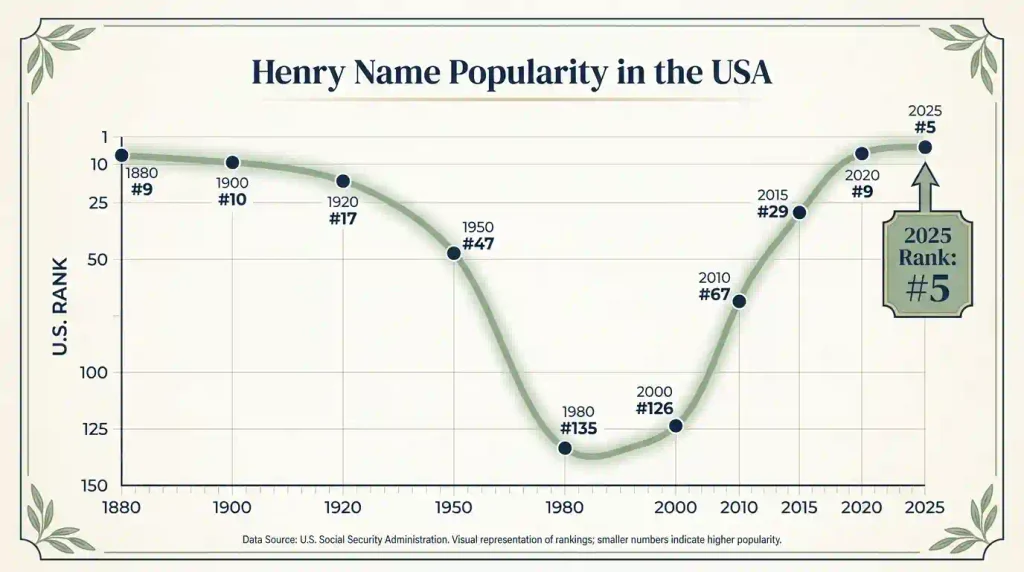
Henry’s popularity over time
Henry has remained recognizable throughout American naming history.
It was already common in the late 19th century.
During the middle and late 20th century, its ranking gradually declined as naming preferences changed.
Interest began increasing again around the turn of the 21st century.
By the 2010s, Henry was rapidly moving back toward the top of the popularity charts.
| Year | U.S. boys’ ranking |
| 1880 | #9 |
| 1900 | #10 |
| 1920 | #17 |
| 1950 | #47 |
| 1980 | #135 |
| 2000 | #126 |
| 2010 | #67 |
| 2015 | #29 |
| 2020 | #9 |
| 2023 | #8 |
| 2024 | #6 |
| 2025 | #5 |
The pattern is particularly interesting because Henry was extremely familiar more than a century ago, became less prominent, and eventually returned to the Top 10.
This is an example of a classic name experiencing renewed popularity across generations.
Henry reached its highest recorded annual U.S. boys’ ranking in 2025, although it was also exceptionally common relative to other names during parts of the 19th and early 20th centuries.
Henry’s popularity by U.S. state
Henry’s popularity differs across American states.
The official SSA 2025 state-level Top 5 rankings show particularly strong usage in parts of the Midwest and Northeast.
| State | Henry’s 2025 boys’ rank |
| Minnesota | #2 |
| Montana | #2 |
| New Hampshire | #2 |
| North Dakota | #2 |
| Alaska | #3 |
| Iowa | #3 |
| Maine | #3 |
| Massachusetts | #3 |
| Wisconsin | #3 |
| Illinois | #5 |
Henry also appears in the Top 5 in several other states.
However, it does not rank equally everywhere. For example, it did not appear among the five most frequently used boys’ names in California or Texas in 2025.
State rankings depend on the number of boys receiving the name in each location, not simply the total number nationwide.
A name can therefore be extremely popular nationally while having different regional rankings.
Henry’s popularity in other countries
Henry remains familiar beyond the United States.
England and Wales: Henry ranked #13 among boys in 2025 according to birth-registration data.
Australia: Henry is a well-established and popular traditional boys’ name, with rankings varying by state and year.
Canada: Henry is widely recognized and used, although rankings differ by province and reporting period.
France: Henri is the traditional French counterpart.
Germany: Heinrich is the historical German form, while related forms and naming preferences have changed over time.
Scandinavian countries: Henrik is a recognized traditional form.
International rankings should be compared carefully because different countries use different reporting systems.
How to interpret popularity rankings and data
Popularity rankings describe how frequently a name was recorded relative to other names during a particular period.
A rank of #5 does not mean that five percent of boys received the name.
It means that Henry was the fifth most frequently recorded boys’ name in the relevant dataset.
Birth counts provide additional context.
The SSA records names using the spelling submitted in Social Security applications.
Therefore, Henry, Henri, and Heinrich are counted separately.
Similarly, Harry and Hank are not automatically included in Henry’s total.
For the most authoritative U.S. figures, consult the Social Security Administration’s official baby-name statistics.
If you’re searching for a classic name that is less common today, other traditional choices may provide alternatives.
For example, our Francis name meaning guide examines a historic masculine name with a different popularity pattern.
Famous People and Historical Figures Named Henry
Kings and other notable royals
Henry’s royal history extends well beyond the English monarchy.
Several German rulers bore forms of Henry, including Henry I the Fowler, King of East Francia from 919 to 936.
France also had kings named Henri, including Henry IV of France, who ruled from 1589 to 1610.
In England, the name’s association with eight kings made it particularly influential.
Henry VIII remains among its most famous historical bearers.
In modern British royalty, Prince Harry’s birth name is Henry Charles Albert David.
These royal associations give Henry an established historical identity, although they do not change its literal Germanic meaning.
Writers, artists, athletes, and public figures
Henry has been carried by many influential people.
Henry Ford (1863–1947)
An American industrialist who founded the Ford Motor Company and helped popularize assembly-line automobile production.
Henry David Thoreau (1817–1862)
An American writer and philosopher best known for Walden and his essay on civil disobedience.
Henry Wadsworth Longfellow (1807–1882)
An American poet known for works including Paul Revere’s Ride and The Song of Hiawatha.
Henry Cavill (born 1983)
A British actor known for portraying Superman and Geralt of Rivia in The Witcher television series.
Henry Mancini (1924–1994)
An American composer and conductor celebrated for film and television music, including Moon River and The Pink Panther Theme.
Henry Kissinger (1923–2023)
A German-born American diplomat who served as U.S. secretary of state and national security adviser.
These figures demonstrate Henry’s long presence across politics, literature, industry, acting, and music.
Famous people known by a Henry nickname
Several well-known individuals were born Henry but became famous under a nickname.
Hank Aaron (1934–2021)
Born Henry Louis Aaron, he was one of Major League Baseball’s most celebrated players.
Hank Green
Born William Henry Green II, he is known as an American author, science communicator, and online creator.
Prince Harry
Born Henry Charles Albert David, he is internationally known by the traditional English form Harry.
These examples illustrate how Henry offers flexibility between a formal legal name and a familiar everyday identity.
Henry in Fiction, Film, Television, and Songs
Fictional characters named Henry
Henry has appeared in numerous novels, television series, and films.
Henry Huggins
The title character of Beverly Cleary’s Henry Huggins children’s books, first introduced in 1950.
Henry Clerval
A character in Mary Shelley’s Frankenstein, known as a close friend of Victor Frankenstein.
Lord Henry Wotton
An influential character in Oscar Wilde’s novel The Picture of Dorian Gray.
Henry Mills
A character in the fantasy television series Once Upon a Time.
Henry Hart
The main character of Nickelodeon’s superhero comedy Henry Danger.
Henry DeTamble
One of the central characters in Audrey Niffenegger’s novel The Time Traveler’s Wife and its screen adaptations.
These appearances demonstrate Henry’s versatility across classic literature, children’s entertainment, fantasy, and contemporary fiction.
Songs that mention Henry
Henry has also appeared in musical history.
“I’m Henery the Eighth, I Am”
A popular music-hall song written by Fred Murray and R. P. Weston in 1910.
Its spelling Henery reflects a colloquial pronunciation.
The song later became widely known through Herman’s Hermits, who released a successful version in 1965.
“Henry Lee”
A traditional ballad recorded by Nick Cave and the Bad Seeds with PJ Harvey for the 1996 album Murder Ballads.
The song belongs to a much older ballad tradition and uses Henry as the name of a central character.
Henry’s appearance in both traditional and modern music reinforces its long cultural presence.
Names Similar to Henry
Names with a similar sound
If you appreciate Henry’s gentle two-syllable sound, you may also like:
- Harry
- Harvey
- Hendrik
- Henrik
- Henri
- Henley
- Hendrix
- Emery
Not all these names share Henry’s meaning.
For example, Harvey has a distinct etymology, while Hendrik and Henrik are true international relatives.
Parents who enjoy short, recognizable names may also appreciate the alex name meaning guide, which explores a familiar name with Greek origins.
Names with a similar meaning
Because Henry means “home ruler,” names associated with leadership and authority may appeal to parents seeking related meanings.
| Name | Common meaning |
| Richard | Brave ruler |
| Frederick | Peaceful ruler |
| Walter | Ruler of the army |
| Eric | Often interpreted as ever-ruler or sole ruler |
| Reynold | Counsel and rule |
| Harold | Army ruler or army leader |
These names share themes of authority or leadership, but their linguistic origins are not identical.
Names that rhyme with Henry
Henry has relatively few exact rhymes commonly used as first names.
Henri sounds identical when pronounced in the English style, although its usual French pronunciation differs.
Names such as Emery, Lenny, and Benny have somewhat similar rhythms but are not perfect rhymes.
If sound compatibility matters more than exact rhyme, parents may prefer names with a similar number of syllables and soft consonants.
Other names beginning with H
Parents searching for H-initial boy names might consider:
- Harrison
- Hudson
- Hugo
- Harvey
- Holden
- Hayden
- Hunter
- Hector
- Hugh
- Heath
- Harlan
- Harold
Harrison is particularly interesting because it developed historically from Harry, an established form of Henry.
Therefore, Harrison and Henry are connected through English naming traditions rather than simply sharing their first letter.
Classic names with a similar style
Henry belongs to a group of traditional names that remain fashionable without losing their historical character.
Similar choices include:
Edward, William, George, Theodore, Oliver, Arthur, Charles, Benjamin, Samuel, and Frederick.
Edward and William offer strong English royal associations.
Theodore and Oliver combine historical roots with significant modern popularity.
Arthur provides a legendary and traditional character, while George has a straightforward, familiar sound.
Parents who prefer a surname-inspired alternative may enjoy our Blake name meaning guide.
For another contemporary name with English geographical roots, explore Camden Name Meaning.
Middle Names and Sibling Names for Henry
Middle names that pair well with Henry
Henry works with many middle names because of its short, balanced pronunciation.
A longer middle name can provide a formal rhythm, while a shorter name keeps the complete combination simple.
| Classic middle names | Modern middle names |
| Henry James | Henry Brooks |
| Henry Alexander | Henry Jude |
| Henry William | Henry Hayes |
| Henry Thomas | Henry River |
| Henry Edward | Henry Reid |
| Henry Joseph | Henry Wilder |
| Henry Charles | Henry Blake |
| Henry Michael | Henry Rowan |
| Henry Benjamin | Henry Cole |
| Henry Frederick | Henry Finn |
Henry James is a particularly familiar combination, partly because of the celebrated American-British novelist Henry James.
Henry Alexander has a longer, more formal rhythm.
Henry Jude and Henry Reid provide shorter modern options.
The best pairing depends on your surname, family traditions, and personal preferences.
Brother names that pair well with Henry
If Henry is one child’s name, consider brother names that share its timeless style without sounding identical.
Strong combinations include:
- Henry and Oliver
- Henry and Theodore
- Henry and William
- Henry and Arthur
- Henry and Edward
- Henry and George
- Henry and Benjamin
- Henry and Charles
- Henry and Samuel
- Henry and Frederick
Henry and Arthur create a traditional British-inspired pairing.
Henry and Oliver feel classic yet contemporary.
Henry and Theodore work particularly well for families who appreciate longer historical names with familiar nicknames.
Sister names that pair well with Henry
For a sister, consider traditional names with similar warmth and familiarity.
Examples include:
- Henry and Charlotte
- Henry and Eleanor
- Henry and Alice
- Henry and Amelia
- Henry and Clara
- Henry and Margaret
- Henry and Elizabeth
- Henry and Josephine
- Henry and Lucy
- Henry and Beatrice
Henry and Eleanor make a particularly balanced classic pairing.
Henry and Charlotte have strong contemporary appeal while retaining royal connections.
Henry and Alice sound simple, friendly, and timeless.
For more individual name histories and sibling-name inspiration, explore our Individual Boy Name Guides.
How to Decide Whether Henry Is the Right Name
Consider Henry’s classic style and current popularity
Henry is an excellent option for parents who appreciate traditional names.
Its Germanic meaning, royal history, international variants, and recognizable nicknames give it enduring appeal.
However, it is also extremely popular.
With a #5 U.S. ranking in 2025, parents should expect to encounter other children named Henry.
If having a highly uncommon name is essential, Henry may not meet that preference.
If familiarity, easy spelling, and historical substance matter more, Henry is worth serious consideration.
Try the full name with possible nicknames
Before deciding, say Henry aloud in different situations.
Imagine introducing a baby named Henry, calling for a school-age child, and addressing an adult in a professional setting.
Also consider potential nicknames.
You might love the full name Henry but dislike Hank or Harry.
Although parents can choose their preferred nickname, children may eventually develop their own preferences.
Selecting a name whose common forms you also enjoy may make the decision easier.
Check how Henry sounds with your surname
Henry has two syllables and ends with a vowel sound, making it compatible with many surnames.
However, rhythm can change depending on the length and sounds of the family name.
Try saying:
Henry James Anderson
Henry Alexander Brooks
Henry Thomas Bennett
Read the complete name aloud several times.
Consider how the syllables flow and whether repeating sounds create awkward combinations.
You may also want to check the initials, spelling, and how the name appears on written documents.
Personal significance should remain central to the decision.
How We Verified Henry’s Meaning and Popularity
Etymology sources and alternate interpretations
Henry’s origin was checked against established etymological explanations identifying the ancient Germanic elements heim and ric.
Historical references, including the Dictionary of American Family Names, document the Norman introduction of the personal name into England.
Other linguistic references, such as the Online Etymology Dictionary and Behind the Name, also connect Henry with Heimirich and the meaning “home ruler.”
The alternative phrases “ruler of the household” and “estate ruler” describe the same underlying linguistic concept.
Later royal associations should not be confused with the literal original meaning.
U.S. popularity data and ranking years
Popularity information is based on U.S. Social Security Administration baby-name statistics.
The latest available annual data covers babies born in 2025.
Henry ranked #5 among boys that year, with 12,020 recorded male births.
Historical rankings were compared using SSA data extending back to 1880.
State-level results were examined separately from national rankings.
Different spellings and international forms, including Henri and Heinrich, are not combined with Henry’s U.S. count.
Henry in Numerology and Astrology
Name numerology for Henry
In Pythagorean numerology, letters are assigned numerical values.
For Henry, the calculation is:
| Letter | Value |
| H | 8 |
| E | 5 |
| N | 5 |
| R | 9 |
| Y | 7 |
| Total | 34 |
The total is reduced by adding 3 + 4.
This gives Henry the numerology number 7.
In numerological traditions, seven is often associated with intellectual curiosity, reflection, analytical thinking, and an interest in deeper questions.
However, numerology is a symbolic belief system rather than a scientifically validated method for measuring personality or predicting life outcomes.
Western and Vedic astrology associations
Henry does not have one fixed Western zodiac sign.
In Western astrology, zodiac sun signs are associated with birth dates rather than first names.
Therefore, a boy named Henry may belong to any of the twelve zodiac signs.
Vedic astrology also uses concepts such as rashi and nakshatra, based on specific astrological calculations.
Some traditional naming systems associate particular starting sounds with birth stars, but the English spelling Henry alone cannot establish someone’s Vedic birth sign.
These interpretations may be culturally meaningful to some families, but they are separate from Henry’s documented Germanic etymology.
Frequently Asked Questions About the Name Henry
What does Henry mean in the Bible?
Henry does not originate in the Bible; it is a Germanic name meaning “home ruler,” although Christians have used it for centuries.
Is Harry short for Henry?
Yes. Harry is a traditional English form and nickname of Henry, although it is also widely used as an independent given name.
Is Henry a popular name in the United States?
Yes. Henry ranked #5 among U.S. boys’ names in 2025, with 12,020 recorded male births.
What are the most common variations of Henry?
Common international forms include Henri, Heinrich, Henrik, Hendrik, Enrico, and Enrique.
What names sound good with Henry?
Edward, William, Theodore, Oliver, George, Arthur, Charlotte, Eleanor, and Alice pair naturally with Henry.
Final Thoughts
The Henry name meaning combines ancient Germanic roots with centuries of European and American history. Originally meaning “home ruler,” Henry developed from early forms such as Heimirich and became firmly established in English through Norman influence. Its association with eight English kings, celebrated writers, scientists, and modern public figures gives it a distinctive historical identity.
With its simple pronunciation, familiar nicknames, and strong popularity in the United States, Henry remains an appealing choice for parents seeking a traditional boy’s name.
Whether you love Henry for its meaning, royal heritage, or warm and approachable sound, it offers a balance of elegance and familiarity.
Still exploring? Visit Boy Names to discover more baby-name meanings, origins, pronunciations, and popularity guides to help you find the right name for your son.