

Levi Name Meaning, Origin, History, and Popularity
The Levi name meaning is “joined,” “attached,” or “connected,” reflecting its ancient Hebrew origins and strong biblical significance. Derived from the Hebrew name Levi (לֵוִי), it is traditionally associated with the Hebrew root lavah, meaning “to join” or “to attach.” In the Old Testament, Levi was the third son of Jacob and Leah and became the ancestor of the tribe of Levi, one of the twelve tribes of Israel. The name also appears in the New Testament, where Levi is traditionally identified with Matthew the apostle. Pronounced LEE-vye in American English, Levi is a short, two-syllable boy’s name that combines thousands of years of religious history with a modern, approachable sound. It has become increasingly popular among American parents, ranking #12 among boys’ names in 2025, with 9,642 recorded male births. Although traditionally masculine, Levi is occasionally used for girls. Whether you appreciate its biblical roots, meaningful connection to family and belonging, or simple four-letter spelling, this complete guide explores Levi’s meaning, origin, gender, pronunciation, popularity, nicknames, and the best middle and sibling names.
Table of Contents
- Levi Name at a Glance
- What Does the Name Levi Mean?
- Levi’s Origin and History
- How to Pronounce Levi
- Is Levi a Boy’s, Girl’s, or Gender-Neutral Name?
- How Popular Is the Name Levi?
- Levi Name Variations, Spellings, and Related Forms
- Nicknames for Levi
- Names Similar to Levi
- Middle Names and Sibling Names for Levi
- How to Decide Whether Levi Is the Right Name
- Famous People Named Levi
- Levi in Fiction and Popular Culture
- Numerology and Astrology Associated with Levi
- Other Ways to Represent the Name Levi
- Frequently Asked Questions About the Name Levi
- Sources and Methodology
- Final Thoughts
Levi Name at a Glance
Meaning, origin, gender, and pronunciation
Levi is a traditional Hebrew masculine name with an established place in Jewish and Christian naming traditions.
Its meaning is closely associated with joining, attachment, and connection.
| Feature | Details |
| Name | Levi |
| Primary meaning | Joined, attached |
| Traditional interpretation | Connected or joined together |
| Origin | Hebrew |
| Original spelling | לֵוִי |
| Hebrew transliteration | Levi, Leviy |
| Gender | Traditionally masculine |
| Modern usage | Predominantly boys; occasionally girls |
| American pronunciation | LEE-vye |
| Hebrew pronunciation | Approximately lay-VEE |
| Syllables | Two |
| Letters | Four |
| Name style | Biblical, classic, short, modern |
| Religious connections | Judaism and Christianity |
| Biblical namesake | Third son of Jacob and Leah |
| Common nicknames | Lev, Lee, Vee |
| U.S. boys’ rank (2025) | #12 |
| U.S. male births (2025) | 9,642 |
| U.S. female births (2025) | 71 |
Levi is recognizable in many English-speaking countries and has related forms in several European languages.
Syllables, spelling, and name length
Levi contains four letters and two syllables:
Le-vi
The name has a short, straightforward spelling that most English speakers can recognize.
Its opening L sound gives it a gentle quality, while the final vowel sound creates a friendly, energetic impression.
Unlike longer traditional names, Levi rarely needs to be shortened for everyday use.
Parents may appreciate its combination of biblical heritage and modern simplicity.
Levi also works well from childhood through adulthood, making it a versatile choice for families seeking a meaningful name that does not feel overly formal.
What Does the Name Levi Mean?
The traditional meanings “joined” and “attached”
The most widely accepted traditional meaning of Levi is “joined” or “attached.”
This interpretation comes from its association with the Hebrew verb lavah (לָוָה), meaning “to join,” “to attach,” or “to accompany.”
The name is often understood as expressing a connection between people.
Some baby-name references also translate Levi as “joiner.”
However, “joiner” is better understood as an interpretive English rendering than a separate, firmly established literal meaning.
The ideas behind the name include:
- Joining together
- Attachment
- Connection
- Companionship
- Belonging
For parents, these interpretations may symbolize the close relationship between a child and family.
However, symbolic associations should be distinguished from the name’s historical linguistic development.
How Levi’s meaning is connected to Leah and Jacob
Levi’s traditional meaning is explained through the story of his birth in Genesis 29:34.
According to the biblical account, Leah was married to Jacob and hoped to receive greater affection from him.
After giving birth to her third son, she expressed the hope that her husband would now become more closely attached to her.
The Hebrew text uses the word yillaveh, related to the idea of joining or attachment.
Leah’s statement provides the narrative explanation for the name Levi.
This is why “joined” and “attached” remain its most familiar meanings.
The biblical story gives Levi an emotional connection with relationships, family bonds, and the desire for closeness.
However, the text describes Leah’s personal circumstances rather than assigning a universal personality trait to every child named Levi.
What is known—and uncertain—about the name’s etymology
The traditional Hebrew explanation is well established within the biblical narrative.
Nevertheless, historical linguists distinguish between a name’s biblical wordplay and its independently established linguistic origin.
Some scholars have questioned whether the name Levi originally developed directly from the root lavah or whether the biblical narrative preserves a later explanation.
Other historical interpretations have connected the name with groups attached to religious service or particular tribal communities.
These alternative theories are not all equally supported.
The most accurate explanation is therefore:
Levi is a Hebrew biblical name traditionally interpreted as “joined” or “attached,” although its deeper historical etymology is not completely certain.
The name should not automatically be assigned unrelated meanings such as “brave warrior,” “king,” or “gift from God.”
Those ideas may be meaningful in other naming traditions, but they are not established literal definitions of Levi.

Levi’s Origin and History
Levi in the Old Testament and the tribe of Levites
Levi is one of the prominent names in the Old Testament.
According to Genesis, Levi was the third son of Jacob and Leah.
Jacob, also known as Israel, had twelve sons whose descendants became associated with the twelve tribes of Israel.
Levi was the ancestor of the tribe of Levi.
The tribe later became especially important in Israelite religious traditions.
The tribe of Levi and its religious responsibilities
The Levites were associated with religious service and responsibilities connected with the Tabernacle and, later, the Temple.
The biblical books of Numbers and Deuteronomy describe their duties.
These included assisting with aspects of worship, caring for sacred spaces and objects, and supporting priestly activities.
However, not every Levite was a priest.
In the biblical tradition, the priesthood was specifically associated with Aaron and his descendants, who belonged to the tribe of Levi.
Other Levites carried out supporting religious responsibilities.
This distinction is important because baby-name websites sometimes describe the entire tribe as if every member performed identical priestly duties.
Levi and the twelve tribes of Israel
Unlike most of the other tribes, the Levites did not receive one large, continuous territorial inheritance in the same way.
Instead, biblical accounts describe their allocation of cities among the territories of other tribes.
This arrangement reinforced their distinctive religious responsibilities.
The history of the Levites contributed significantly to the continued recognition of Levi as a Jewish personal and family name.
Levi in the New Testament and its connection to Matthew
The name Levi also appears in the New Testament.
In Mark 2:14, Jesus calls a tax collector named Levi, identified as the son of Alphaeus.
A similar account appears in Luke 5:27.
However, Matthew 9:9 describes the calling of a tax collector named Matthew.
Because the narratives are closely parallel, Christian tradition commonly identifies Levi with Matthew the apostle.
Under this traditional interpretation, Levi and Matthew were two names used for the same person.
It was not unusual for people living in the ancient Mediterranean world to have more than one name.
Nevertheless, the Gospel accounts do not explicitly explain that Levi changed his name to Matthew.
Some biblical scholars therefore discuss the identification with appropriate historical caution.
For baby-name purposes, Levi has a recognized New Testament association with the calling of a disciple.
How the name moved across Hebrew, Greek, Latin, and English
Levi originated in Hebrew and became familiar in other languages through religious texts and naming traditions.
The name’s linguistic journey can be summarized as:
Hebrew Levi → Biblical Greek Leui → Biblical Latin Levi → English Levi
The Greek New Testament uses forms representing the Hebrew name within the Greek writing system.
Latin biblical translations preserved a closely related form.
As the Bible spread through Europe, Levi became recognizable among readers and religious communities using different languages.
Unlike some biblical names that underwent major spelling changes, Levi retained a relatively simple written form.
This helped preserve its recognizable identity in English.
The name was recorded in American naming data as early as 1880, the first year covered by the Social Security Administration’s historical name records.
Levi’s place in Jewish and Christian traditions
Levi has substantial religious significance in Judaism.
The tribe of Levi forms an important part of Jewish biblical history and religious heritage.
In some Jewish communities, a person’s traditional Levitical family status continues to have ceremonial significance.
The surnames Levi and Levy may also reflect historical associations with Levitical ancestry.
However, sharing the surname Levi does not automatically establish a person’s ancestry, religious identity, or ceremonial status.
Christian families may appreciate Levi because of its Old Testament history and its New Testament association with Matthew.
The name therefore has significance in both Jewish and Christian traditions.
At the same time, Levi is now chosen by many families primarily because of its sound, simplicity, or personal meaning rather than religious affiliation.
How to Pronounce Levi
Common U.S. and Hebrew pronunciations
In American English, Levi is pronounced:
LEE-vye
The first syllable rhymes with “see,” while the second rhymes with “eye.”
It is the pronunciation most commonly heard in the United States.
The English phonemic representation is:
/ˈliː.vaɪ/
The traditional Hebrew pronunciation is different.
In Hebrew, the name is commonly approximated in English as lay-VEE, with a sound closer to a long e in the final syllable.
Pronunciation may differ between Hebrew-speaking communities and Jewish English-speaking traditions.
These differences reflect language and cultural usage rather than separate meanings.
Syllables and pronunciation differences across languages
Levi is generally a two-syllable name, but its sounds vary across languages.
| Language or usage | Approximate pronunciation |
| American English | LEE-vye |
| British English | LEE-vye |
| Hebrew | lay-VEE |
| German | LEH-vee |
| Finnish form Leevi | LEH-vee, with a longer first vowel |
| Some Scandinavian usages | LEH-vee |
These are simplified English pronunciation guides.
Actual sounds depend on regional accents and the individual language’s phonology.
Parents living in multilingual households may want to discuss which pronunciation they prefer.
For example, a family may choose the English LEE-vye while relatives speaking Hebrew naturally use a different pronunciation.
Neither usage changes the name’s biblical origin.

Is Levi a Boy’s, Girl’s, or Gender-Neutral Name?
Levi is traditionally a masculine name, both in its biblical origin and modern American usage.
The original biblical Levi was male, and the name has remained strongly associated with boys across many cultures.
However, a small number of girls also receive the name.
The U.S. Social Security Administration’s 2025 data records:
| Gender category | Babies named Levi |
| Boys | 9,642 |
| Girls | 71 |
| Combined | 9,713 |
Approximately 99.3% of babies named Levi in the United States in 2025 were boys.
The remaining approximately 0.7% were girls.
Is Levi a gender-neutral name?
Levi can be used for children of different genders, but it is not evenly gender-neutral in current American naming patterns.
It is overwhelmingly perceived as a boy’s name.
Parents seeking a truly balanced unisex name may prefer other options, while those who appreciate traditionally masculine names with occasional female usage may find Levi appealing.
There is no widely established feminine equivalent of Levi comparable to pairs such as Francis and Frances.
Some parents choose related-sounding names such as Livia or Liv for girls, but those names have different linguistic histories.
How Popular Is the Name Levi?
Levi’s current U.S. popularity and ranking
Levi is currently one of the most popular baby boy names in the United States.
According to the latest available U.S. Social Security Administration data, Levi ranked #12 among boys born in 2025.
A total of 9,642 boys received the name that year.
Levi maintained the same national ranking as in 2024.
| Popularity measure | U.S. result |
| Latest available birth year | 2025 |
| Boys’ popularity rank | #12 |
| Boys named Levi | 9,642 |
| Girls named Levi | 71 |
| Girls’ rank | #2,504 |
| Combined births | 9,713 |
| Boys’ rank in 2024 | #12 |
| Highest recorded boys’ rank | #12 |
| Highest recorded annual male birth count | 9,869 in 2022 |
Is Levi a popular name?
Yes. Its Top 20 ranking makes it a mainstream American choice.
Parents searching for a rare name should understand that Levi is currently quite common among newborn boys.
However, the name’s ancient history gives it a traditional identity that distinguishes it from many recently invented names.
How Levi’s popularity has changed over time
Levi has a long history of use in the United States.
It appeared in the earliest SSA naming records from 1880.
During the late 19th century, Levi was recognizable but far less common than many traditional names such as John, William, and James.
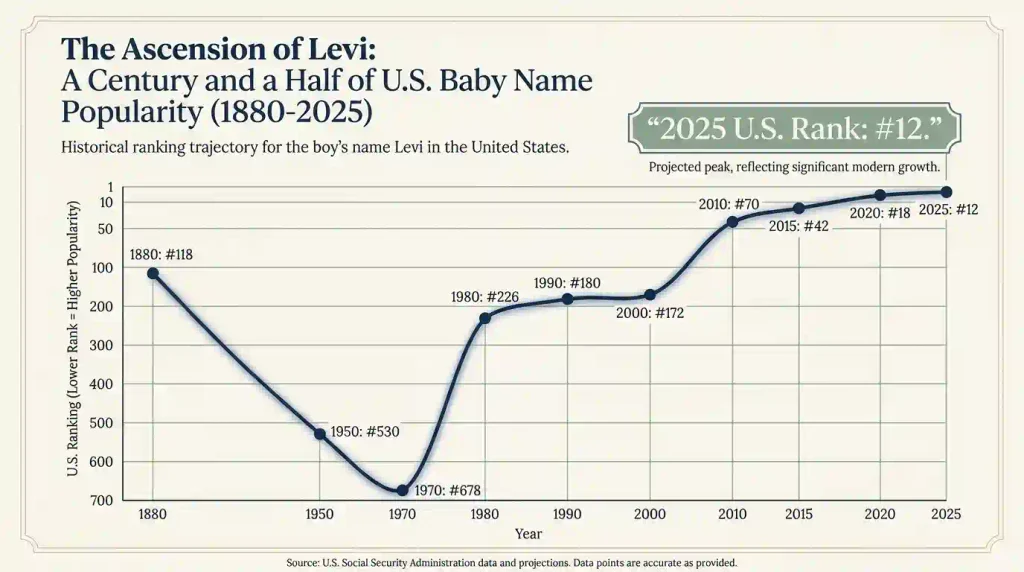
Its popularity decreased during parts of the 20th century before recovering in the 1970s and 1980s.
The most significant growth began during the 2000s and continued into the 2010s.
| Year | U.S. boys’ rank |
| 1880 | #118 |
| 1950 | #530 |
| 1970 | #678 |
| 1980 | #226 |
| 1990 | #180 |
| 2000 | #172 |
| 2005 | #141 |
| 2010 | #70 |
| 2015 | #42 |
| 2018 | #33 |
| 2020 | #18 |
| 2021 | #12 |
| 2022 | #12 |
| 2023 | #12 |
| 2024 | #12 |
| 2025 | #12 |
The data reveals a substantial long-term rise.
Levi moved from #172 in 2000 to #12 in 2021 and maintained that ranking through 2025.
Its highest recorded annual number of male births occurred in 2022, when 9,869 boys received the name.
The difference between its highest birth count and highest ranking reflects changes in the overall naming landscape.
Where Levi is most popular in the United States
Levi’s popularity varies across states.
Some states have a higher proportion of boys named Levi than the national average.
Based on 2025 state-level SSA birth records, several states with relatively high usage included:
| State | Boys named Levi per 1,000 recorded male births | Number of boys |
| Wyoming | 14.7 | 16 |
| Maine | 13.8 | 53 |
| Hawaii | 13.7 | 40 |
| Alaska | 12.8 | 29 |
| New Hampshire | 11.8 | 53 |
| Rhode Island | 10.2 | 32 |
| Delaware | 10.2 | 30 |
| New Mexico | 9.7 | 63 |
Maine also placed Levi at #5 in its official 2025 boys’ Top 5.
These statistics compare the share of male births receiving the name in each state.
They should not be confused with the total number of babies named Levi.
For example, Texas and California recorded substantially more boys named Levi because their populations are much larger.
In 2025, Texas recorded 1,163 boys named Levi, while California recorded 1,142.
A small state can have fewer total Levis but a higher percentage of births receiving the name.
Levi’s popularity around the world
Levi is used internationally, particularly in countries with established biblical naming traditions.
England and Wales
Levi ranked approximately #107 among boys in 2025, with around 490 recorded births.
It is recognized but less common relative to other names than in the United States.
Australia
Levi is a popular contemporary boys’ name in several Australian states.
In 2025, it ranked #8 in New South Wales and #9 in Victoria.
It also appeared among the Top 10 boys’ names in several other Australian jurisdictions.
Finland
The Finnish form Leevi is an established masculine given name.
It has its own pronunciation and popularity history.
Israel
Levi remains recognizable through Hebrew language and Jewish history, both as a personal name and as a surname associated with biblical traditions.
Other European countries
Levi and related forms appear in Germany, the Netherlands, and Scandinavia.
However, direct international comparisons should be made carefully because each country uses its own birth-registration systems.
How U.S. baby-name rankings and birth counts are measured
The U.S. Social Security Administration compiles baby-name data using Social Security card applications.
Names are recorded according to their submitted spellings and the sex category in the record.
The SSA’s published national data covers births dating back to 1880.
A name’s popularity ranking represents its position compared with other names during a particular year.
A #12 ranking means Levi was the 12th most frequently recorded boys’ name.
It does not mean that 12% of all boys received the name.
Birth count refers to the number of babies recorded with the exact spelling.
Levi, Levy, Lewi, and Leevi are counted separately.
This distinction matters when comparing related names.
Parents can review official data through the U.S. Social Security Administration’s baby-name statistics.
If you’re comparing Levi with other short biblical or traditional names, our henry name meaning guide offers another well-established option with a different origin and popularity history.
Levi Name Variations, Spellings, and Related Forms
Levi, Levy, Lewi, and Leevi: What’s the difference?
Several names resemble Levi in spelling or pronunciation.
Some are direct linguistic forms, while others have developed distinctive usage as surnames or given names.
| Name | Background |
| Levi | Familiar English form of the Hebrew biblical name |
| Levy | Related spelling, especially familiar as a surname |
| Lewi | Biblical Hebrew-related spelling used in some languages |
| Leevi | Established Finnish form |
| Levey | Related surname spelling |
| Lewy | Surname and spelling variant in some traditions |
| Lev | Distinct given name with multiple origins |
| Levon | Armenian given name with a different etymological history |
| Levente | Hungarian name with a separate origin |
Levi
This is the most recognizable spelling in modern American baby naming.
It preserves the traditional biblical connection while remaining short and easy to spell.
Levy
Levy is a familiar surname that can be associated with the tribe of Levi.
It also appears as a given name in some communities.
Its pronunciation may differ according to language and family tradition.
Lewi
Lewi is found in biblical and European naming contexts.
It is less common than Levi as a modern American first name.
Leevi
Leevi is the Finnish form of Levi.
The double e reflects Finnish spelling and pronunciation conventions rather than a different biblical origin.
Levey and Lewy
These forms are especially recognizable as surnames, although personal-name use also occurs.
Similar spellings do not always establish identical family ancestry.
Related names and longer forms
Parents sometimes look for a longer form of Levi.
Unlike names such as Alexander, which naturally shortens to Alex, Levi is already a complete traditional given name.
It does not require a longer form.
Names such as Levon and Levente may resemble Levi, but they should not automatically be described as expanded versions of it.
Levon is an Armenian name with its own historical background.
Levente is a Hungarian name with a distinct origin.
Lev also has independent naming traditions.
For parents who prefer a longer biblical name with a related style, alternatives include:
- Elijah
- Elias
- Leviathan, which is not an established conventional expansion of Levi
- Nathaniel
- Benjamin
- Ezekiel
- Gabriel
Of these, Elijah, Elias, Benjamin, and Gabriel are more conventional baby-name alternatives.
Levi remains a complete name in its own right.
Nicknames for Levi
Because Levi is already short, many parents prefer to use the full name.
However, it offers several affectionate nickname possibilities.
| Nickname | Style |
| Lev | Short and distinctive |
| Lee | Simple and familiar |
| Vee | Modern and playful |
| Levvy | Affectionate family nickname |
| L | Minimalist |
| Le-Le | Playful childhood nickname |
Lev is an especially attractive option for parents who appreciate one-syllable names.
However, Lev also exists as an independent given name in other linguistic traditions, so it should not always be treated as merely a nickname.
Lee is straightforward and easy to pronounce.
Vee offers a less conventional modern option.
Families may also develop personal nicknames based on a child’s personality or shared experiences.
For parents who appreciate names with more traditional nickname options, the archie name meaning guide explores another charming boy’s name with a different historical background.
Names Similar to Levi
Names with a similar sound
If you love Levi’s short, friendly sound, consider names with similar rhythms or vowel patterns.
- Eli
- Leo
- Luca
- Liam
- Levy
- Lenny
- Louis
- Arlo
- Milo
- Ezra
Eli is particularly appealing because it shares Levi’s biblical background and short pronunciation.
Leo offers another compact name with international recognition.
Luca has a similarly gentle sound and works well across languages.
Ezra combines biblical history with a modern American naming style.
These names are stylistically similar, but their literal meanings differ.
Names with a similar meaning or origin
Names with Hebrew or biblical connections may appeal to parents who appreciate Levi’s history.
| Name | Common meaning or association |
| Eli | My God; also an Old Testament figure |
| Asher | Happy, blessed |
| Benjamin | Son of the right hand |
| Nathaniel | God has given |
| Jonathan | God has given |
| Ezra | Help |
| Samuel | Traditionally associated with God hearing |
| Jacob | Traditional meaning connected with the heel |
| Aaron | Biblical name with uncertain etymology |
| Matthew | Gift of God |
Not all these names mean “joined” or “attached.”
Instead, they share Levi’s Hebrew or biblical naming background.
Parents seeking a name connected with family relationships may appreciate Benjamin or Jonathan.
For a different traditional name with religious associations, explore the Francis name meaning guide.
Names that rhyme with Levi
Levi has relatively few perfect rhymes commonly used as first names.
Because its standard English pronunciation ends in “vye,” exact rhyming choices are limited.
Names such as Eli, Kai, and Malachi share the final long eye sound, but they are not perfect rhymes for the complete two-syllable name Levi.
If sound compatibility matters more than exact rhyme, consider:
- Eli
- Kai
- Riley
- Wiley
- Ty
- Milo
These names share certain vowel patterns or rhythms.
However, a similar sound does not imply a shared linguistic origin.
Other names beginning with L
Parents interested in L-initial names may enjoy:
Liam, Lucas, Luke, Leo, Logan, Lincoln, Landon, Louis, Luca, Lennox, and Lawrence.
Liam is one of the most popular contemporary American boy names.
Luke offers a shorter biblical option.
Lincoln has an English surname and place-name background.
Lawrence is a longer traditional name with Latin roots.
If you prefer historically established names with simple pronunciation, our julian name meaning guide explores another Latin-origin choice with international appeal.
Middle Names and Sibling Names for Levi
Middle names that go well with Levi
Levi has two syllables and ends with a vowel sound.
This makes it compatible with many classic and modern middle names.
A longer middle name can create a formal rhythm, while a short middle name keeps the full combination simple.
| Classic middle names | Modern middle names |
| Levi James | Levi Brooks |
| Levi Alexander | Levi Hayes |
| Levi William | Levi Jude |
| Levi Thomas | Levi River |
| Levi Benjamin | Levi Blake |
| Levi Nathaniel | Levi Wilder |
| Levi Joseph | Levi Reid |
| Levi Henry | Levi Rowan |
| Levi Samuel | Levi Cole |
| Levi Daniel | Levi Finn |
Levi James is short and traditional.
Levi Alexander creates a balanced combination of two and four syllables.
Levi Benjamin brings together two familiar Hebrew-origin names.
Levi Henry pairs a biblical name with a classic Germanic choice.
Levi Blake combines the soft ending of Levi with a strong one-syllable middle name.
For more information about Blake’s linguistic history, explore our Blake name meaning guide.
Brother names that pair with Levi
When choosing a brother’s name, many parents prefer names that share Levi’s simple, approachable style.
Good combinations include:
- Levi and Noah
- Levi and Ezra
- Levi and Asher
- Levi and Elijah
- Levi and Jonah
- Levi and Caleb
- Levi and Isaac
- Levi and Samuel
- Levi and Oliver
- Levi and Henry
Levi and Ezra create a coordinated biblical pairing without sounding too similar.
Levi and Noah are both short, recognizable names.
Levi and Elijah combine two strong Hebrew-origin names with different lengths.
Levi and Henry blend biblical and classic European naming styles.
Sister names that pair with Levi
Levi works with many traditional and modern girl names.
Consider:
- Levi and Hannah
- Levi and Naomi
- Levi and Abigail
- Levi and Esther
- Levi and Leah
- Levi and Amelia
- Levi and Charlotte
- Levi and Clara
- Levi and Eliza
- Levi and Sophie
Levi and Naomi offer a balanced pair with Hebrew roots.
Levi and Hannah create a familiar biblical combination.
Levi and Amelia feel contemporary while retaining traditional backgrounds.
Levi and Charlotte pair a short masculine name with a classic feminine choice.
For additional naming inspiration, explore our Individual Boy Name Guides.
How to Decide Whether Levi Is the Right Name
Test Levi with your surname, initials, and middle-name choices
Before choosing Levi, try saying the full name aloud.
For example:
Levi James Anderson
Levi Alexander Brooks
Levi Benjamin Carter
Levi Henry Mitchell
Listen to the rhythm between the first name, middle name, and surname.
Because Levi ends in a vowel sound, some combinations flow especially smoothly, while others may produce repeated vowel sounds.
Check the initials as well.
A combination that looks attractive on paper may create an unexpected abbreviation.
Also consider how the name looks on school forms, professional documents, and personalized keepsakes.
Levi is short enough to work well with many long surnames, but personal preference should guide the final decision.
Consider pronunciation, spelling, popularity, and family meaning
Levi offers several practical advantages.
Its four-letter spelling is easy to remember.
Its American pronunciation is familiar.
Its biblical history provides a meaningful connection for many families.
However, its popularity may influence your decision.
With a #12 U.S. ranking, Levi is not a rare name.
Some parents appreciate choosing a recognizable name, while others prefer something less frequently used.
If you want a name with similar historical depth but a different sound, the alex name meaning guide offers another short option with a long history.
For parents who appreciate English surname-inspired names, our Camden Name Meaning article provides a different style.
Ultimately, Levi is worth considering if you enjoy its Hebrew heritage, compact spelling, and connection with family and belonging.
Famous People Named Levi
Several notable historical and contemporary figures have carried the name Levi.
Levi Strauss (1829–1902)
Levi Strauss was a German-born American businessman associated with the development and commercialization of riveted denim work pants.
He founded the company that became Levi Strauss & Co.
His surname became internationally recognizable through the Levi’s clothing brand.
Although the brand association is strong, the biblical personal name Levi existed thousands of years before the company.
Levi P. Morton (1824–1920)
Levi Parsons Morton was an American politician who served as the 22nd vice president of the United States from 1889 to 1893 under President Benjamin Harrison.
He later served as governor of New York.
His historical career provides an example of Levi’s established use in 19th-century American society.
Levi Stubbs (1936–2008)
Levi Stubbs was an American singer best known as the lead vocalist of the Motown group the Four Tops.
The group recorded influential songs including “Reach Out I’ll Be There” and “I Can’t Help Myself (Sugar Pie, Honey Bunch).”
Stubbs was celebrated for his powerful and emotionally expressive voice.
Levi Miller (born 2002)
Levi Miller is an Australian actor known for portraying Peter Pan in the 2015 film Pan.
His career provides a modern entertainment association with the name.
Levi ben Sisi
Levi ben Sisi was an early rabbinic scholar associated with Jewish religious learning during the early centuries of the Common Era.
His name reflects the continued use of Levi within Jewish scholarly and religious traditions long after the biblical period.
These figures demonstrate Levi’s presence across religion, politics, business, music, and acting.
Levi in Fiction and Popular Culture
Characters named Levi in books, television, and film
Levi has appeared in several well-known fictional works.
Levi Ackerman — Attack on Titan
Levi Ackerman is a major character in the Japanese manga and anime series Attack on Titan.
He is recognized for his exceptional combat ability, discipline, and role in the Survey Corps.
The character has become one of the most recognizable modern fictional bearers of the name.
Levi Schmitt — Grey’s Anatomy
Dr. Levi Schmitt is a character in the medical drama Grey’s Anatomy, portrayed by Jake Borelli.
The character became known through his development from a medical intern into a more experienced physician.
Levi Everdene — Far from the Madding Crowd
Levi Everdene is the father of Bathsheba Everdene in Thomas Hardy’s novel Far from the Madding Crowd.
This literary appearance demonstrates the name’s use in 19th-century English fiction.
These references show how Levi works naturally in historical literature, contemporary television, and international popular culture.
Songs and movies featuring the name Levi
Levi’s musical associations are particularly strong through performers who carry the name.
Levi Stubbs and the Four Tops
Levi Stubbs helped popularize numerous Motown recordings during the 1960s and later decades.
Although the songs themselves are not necessarily about someone named Levi, his career made the name familiar within American music history.
Levi Miller in Pan
The 2015 fantasy film Pan featured Levi Miller in the title role.
This provides a direct film-industry association with a contemporary bearer.
Levi Ackerman and anime culture
The popularity of Attack on Titan has also increased cultural familiarity with Levi among anime and manga audiences.
However, popularity in entertainment does not necessarily establish why parents choose a name.
Some may be influenced by favorite characters, while others select Levi primarily for its biblical meaning or short pronunciation.

Numerology and Astrology Associated with Levi
Name numerology and personality interpretations
Numerology assigns symbolic values to letters and numbers.
In the Pythagorean numerology system, each letter receives a number.
For Levi:
| Letter | Numerical value |
| L | 3 |
| E | 5 |
| V | 4 |
| I | 9 |
| Total | 21 |
The total is reduced by adding 2 + 1.
This produces the numerology number 3.
In traditional numerological interpretations, three is often associated with:
- Creativity
- Communication
- Optimism
- Social expression
- Imagination
These interpretations are symbolic rather than scientifically established personality predictions.
A child named Levi is not guaranteed to be outgoing, artistic, or especially expressive because of the letters in the name.
Parents may enjoy numerology as a cultural or recreational naming tradition, but it should remain separate from the name’s historical etymology.
Western zodiac and Vedic birth-star associations
Levi does not have an inherent Western zodiac sign.
In Western astrology, zodiac sun signs are traditionally determined by birth dates.
Therefore, a boy named Levi could belong to any of the twelve zodiac signs.
Vedic astrology uses additional concepts such as rashi and nakshatra.
These are associated with astrological calculations based on birth information.
Some naming traditions connect particular sounds or syllables with specific birth stars.
However, the spelling Levi alone cannot reliably determine someone’s Vedic zodiac sign or birth star.
These associations may be meaningful within particular cultural traditions, but they do not change Levi’s Hebrew origin.
Other Ways to Represent the Name Levi
Levi in sign languages
In American Sign Language (ASL), the name Levi can be represented through fingerspelling.
The letters are signed individually:
L – E – V – I
Fingerspelling is a common way to communicate names that do not have an established personal sign.
An individual may also have a sign name assigned or used within the Deaf community.
Sign names are personal and culturally meaningful; there is no universal sign name automatically assigned to every person called Levi.
The representation of Levi in other sign languages may differ because sign languages are independent languages with their own conventions.
Levi in a QR code
Parents can create a personalized QR code containing the name Levi.
For example, the QR code could link to:
- A digital birth announcement
- A baby photo gallery
- A personalized family webpage
- A name-meaning page
- A birthday invitation
- A keepsake message
A QR code is not a special linguistic translation of Levi.
It simply encodes text, a URL, or another supported piece of information.
Families can use a reputable QR-code generator to create a scannable graphic.
For long-term keepsakes, use a stable destination link so the QR code remains useful.
Decorative fonts, acrostic poems, and shareable graphics
Levi’s short spelling works particularly well in personalized name art.
Popular design ideas include minimalist nursery prints, Hebrew-inspired typography, birth-announcement cards, and elegant name-meaning graphics.
A traditional name card might feature:
LEVI
Meaning: Joined or Attached
Origin: Hebrew
Acrostic Poem for Levi
An acrostic poem uses each letter of a name to begin a line.
L — Loved beyond measure
E — Every day a new adventure
V — Valued for who you are
I — Inspiring joy wherever you go
This makes a charming personalized keepsake.
It is a creative tribute rather than a prediction of personality.
Parents may also use the name in custom wallpapers, nursery decorations, or social-media birth announcements.
For the best visual result, choose readable lettering and avoid adding so many decorative elements that the name becomes difficult to see.
Frequently Asked Questions About the Name Levi
What does the name Levi mean?
Levi is a Hebrew name traditionally meaning “joined” or “attached,” reflecting the biblical story of Leah and Jacob.
Is Levi a biblical name?
Yes. Levi appears in both the Old and New Testaments and is associated with the tribe of Levi and the traditional identification of Levi with Matthew.
Is Levi a boy’s or a girl’s name?
Levi is traditionally masculine and overwhelmingly used for boys, although it is occasionally given to girls.
Is Levi a gender-neutral name?
Levi can be used for different genders, but approximately 99% of U.S. babies given the name in 2025 were boys.
How popular is the name Levi?
Levi ranked #12 among U.S. boys’ names in 2025, with 9,642 recorded male births.
Is Levi a common name?
Yes. Levi is a common contemporary American boy’s name and has remained in the Top 20 since 2020.
Is Levi a rare name?
No. Levi is not rare in the United States, although its popularity varies by country, region, and spelling.
What are common nicknames for Levi?
Lev, Lee, Vee, and Levvy are possible nicknames, although many families prefer using the full name.
Is Levi a Jewish name?
Levi has ancient Hebrew origins and important Jewish religious associations, but it is also used by Christian and nonreligious families.
Is Levi short for another name?
No. Levi is a complete traditional given name rather than an abbreviation of a longer name.
What middle names go well with Levi?
James, Alexander, Benjamin, Henry, Thomas, Blake, Jude, and Samuel pair naturally with Levi.
Does Levi mean “joiner”?
“Joiner” is sometimes used as an interpretive translation, although “joined” or “attached” is the more familiar traditional explanation.
Sources and Methodology
References for Levi’s history, meaning, and cultural context
The historical meaning of Levi was reviewed using its appearance in Genesis 29:34 and established Hebrew lexical interpretations.
The traditional connection with the verb lavah was distinguished from scholarly uncertainty concerning the name’s deeper linguistic origin.
Historical information about the Levites was compared with the biblical descriptions in Exodus, Numbers, and Deuteronomy.
The New Testament connection between Levi and Matthew was examined through the parallel accounts in Mark 2:14, Luke 5:27, and Matthew 9:9.
The article distinguishes established biblical traditions from interpretations that are not explicitly confirmed in the texts.
International variants were evaluated according to their linguistic backgrounds, rather than assuming that every similarly spelled name shares Levi’s exact origin.
U.S. popularity data source and last-updated date
The popularity information in this guide uses U.S. Social Security Administration birth-name data for 2025, the latest annual dataset available as of October 2026.
National rankings and birth counts refer to babies recorded under the exact spelling Levi.
Male and female records were examined separately.
The 2025 figures are:
- Boys’ rank: #12
- Male births: 9,642
- Female births: 71
- Combined births: 9,713
Historical rankings were compared using SSA records dating back to 1880.
State-level data was interpreted using both birth counts and the proportion of recorded male births receiving the name.
International naming information was treated separately because birth-registration methods differ between countries.
Final Thoughts
The Levi name meaning combines ancient Hebrew history with a short, modern sound that appeals to many American parents. Traditionally interpreted as “joined” or “attached,” Levi carries a meaningful connection with family, belonging, and biblical heritage. From the third son of Jacob and Leah to the religious history of the Levites and the New Testament, the name has remained recognizable for thousands of years.
Today, Levi is firmly established among the most popular boy names in the United States, ranking #12 in 2025. Its easy spelling, two-syllable pronunciation, and flexible middle-name combinations make it a practical choice for modern families.
Whether you love its religious background or simply enjoy its friendly sound, Levi is a name with lasting appeal.
Explore more meaningful Boy Names to discover their origins, histories, pronunciations, and popularity.