

Julian Name Meaning, Origin, History, and Popularity
The Julian name meaning is commonly interpreted as “youthful,” “downy-bearded,” or “belonging to the family of Julius.” This elegant boy’s name has ancient Latin origins, developing from the Roman personal name Julianus, which itself comes from the distinguished Roman family name Julius. Some sources also connect Julian with Jupiter, the chief god of Roman mythology, although that interpretation remains debated. Pronounced JOO-lee-un, Julian is a three-syllable name traditionally used for boys, with historical feminine usage and related forms such as Juliana, Julia, and Julianne. Its history stretches from ancient Rome and Emperor Julian to medieval England, Christian saints, writers, musicians, and modern popular culture. Today, Julian remains a favorite among American parents who appreciate classic names with international appeal. According to U.S. Social Security Administration data for 2025, Julian ranked #25 among boys’ names, with 7,603 recorded male births. Whether you love its gentle sound, Roman heritage, youthful symbolism, or familiar nicknames such as Jules and Jay, this guide explores Julian’s meaning, history, pronunciation, gender, popularity, variations, and beautiful middle-name combinations.
Table of Contents
- Julian Name at a Glance
- What Does the Name Julian Mean?
- Julian’s Origin and History
- How Do You Pronounce Julian?
- Is Julian a Boy’s or Girl’s Name?
- Julian Variations and Related Names
- Nicknames for Julian
- How Popular Is the Name Julian?
- Famous People and Historical Figures Named Julian
- Julian in Literature, Film, Television, and Music
- Names Similar to Julian
- Middle Names and Sibling Names for Julian
- Is Julian the Right Name for Your Baby?
- Frequently Asked Questions About the Name Julian
- Final Thoughts
Julian Name at a Glance
Meaning, origin, gender, and pronunciation
Julian is a classic masculine name of Latin origin, historically connected with the Roman family name Julius.
| Feature | Details |
| Name | Julian |
| Primary historical meaning | Belonging to Julius; descended from Julius |
| Common interpretations | Youthful, downy-bearded |
| Alternative interpretation | Associated with Jupiter |
| Origin | Latin |
| Historical form | Julianus (Iulianus) |
| Related Roman family name | Julius (Iulius) |
| Gender | Predominantly masculine |
| Pronunciation | JOO-lee-un |
| IPA pronunciation | /ˈdʒuː.li.ən/ |
| Syllables | Three |
| Letters | Six |
| Name style | Classic, Roman, elegant, international |
| Common nicknames | Jules, Jay, Ju, Juli |
| Feminine relatives | Julia, Juliana, Julianne, Julianna |
| U.S. boys’ rank (2025) | #25 |
| U.S. male births (2025) | 7,603 |
Although Julian is frequently translated as “youthful,” its most certain linguistic connection is to the Roman name Julianus and the family name Julius.
Syllables, spelling, and name style
Julian contains six letters and three syllables:
Ju-li-an
Its gentle vowel sounds and strong opening consonant give it a balanced pronunciation.
The name is relatively straightforward to spell in English, making it practical for everyday use.
Julian also offers an appealing combination of traditional and modern qualities.
It feels historical without sounding outdated, sophisticated without being overly formal, and recognizable without belonging exclusively to one culture.
Parents exploring traditional Boy Names may appreciate Julian because it works naturally from childhood into adulthood.
What Does the Name Julian Mean?
The established link to Julianus and Julius
The historical origin of Julian is well documented.
Julian comes from the Latin name Iulianus, commonly written as Julianus in modern English references.
This name developed from Iulius, or Julius, an important Roman family name.
The most direct interpretation of Julian is therefore:
“Belonging to Julius” or “associated with the family of Julius.”
In ancient Roman naming traditions, names frequently indicated membership in a particular family or lineage.
Julianus was an adjective-like name formed from Julius and eventually became an independent personal name.
This historical relationship is more firmly established than the commonly repeated symbolic meanings.
“Youthful,” “downy-bearded,” and “of Jupiter”
Three major interpretations appear in name dictionaries.
1. Youthful
Julian is often described as meaning “youthful.”
This interpretation is traditionally connected with the Greek word ioulos, which can refer to the first growth of facial hair.
The broader association is with youth or early adulthood.
2. Downy-bearded
The Greek word ioulos is sometimes translated as “downy-bearded,” referring to the soft facial hair associated with young men.
Some etymological references propose that the Roman family name Julius may ultimately be connected with this Greek word.
However, this connection remains a theory rather than a fully established linguistic fact.
3. Of Jupiter
Another proposed interpretation associates Julius with Jupiter, the chief deity of ancient Roman religion.
Jupiter was regarded as a sky god and was associated with divine authority.
Under this theory, Julian may be interpreted as having a connection with Jupiter.
However, this explanation is also disputed.
Which meaning interpretations are certain and which are disputed
It is important to distinguish a documented name relationship from a proposed ancient word origin.
| Meaning or connection | Historical confidence |
| Julian comes from Julianus | Established |
| Julianus derives from Julius | Established |
| Belonging to Julius | Direct historical interpretation |
| Youthful | Common traditional interpretation |
| Downy-bearded | Proposed deeper etymology |
| Of Jupiter | Alternative disputed interpretation |
The safest answer is that Julian is a Latin name meaning “belonging to Julius,” traditionally associated with youthfulness.
Parents may still enjoy the symbolism of youth, energy, and new beginnings.
However, these ideas should not be presented as guaranteed characteristics of someone named Julian.

Julian’s Origin and History
The Roman name Julianus and the family name Julius
Julian’s history begins in ancient Rome.
Roman citizens traditionally used several naming elements, including personal names and family names.
The name Julius identified members of the distinguished Roman gens Julia, one of the prominent Roman clans.
The Latin form Julianus developed from that family name.
Over time, Julianus became a recognizable personal name used by individuals beyond the original Roman family.
As Latin and Roman culture spread throughout Europe, related forms of the name entered different languages.
This development eventually produced names such as Julian, Julien, Julián, and Giuliano.
Julius Caesar and the gens Julia
The most famous historical association with Julius is Gaius Julius Caesar (100–44 BCE).
Caesar was a Roman general, statesman, and dictator whose military and political activities helped transform the Roman Republic.
He belonged to the gens Julia, the family from which Julian’s underlying name developed.
According to Roman tradition, the Julian clan claimed ancestry through Iulus, also known as Ascanius, the son of the Trojan hero Aeneas.
This legendary genealogy connected the family with the goddess Venus through Aeneas.
However, legendary ancestry should be distinguished from verifiable historical genealogy.
Julian does not literally mean “Caesar” or “emperor.” Its connection to Julius Caesar is through the Roman family name Julius.
Julian in ancient Rome and the Roman Empire
One of the best-known historical bearers was Julian the Apostate (331/332–363 CE).
Born Flavius Claudius Julianus, he became Roman emperor in 361 CE.
He is remembered for attempting to restore traditional Roman religious practices after Christianity had gained imperial support.
His reign was relatively short, ending with his death during a military campaign against the Sasanian Empire in 363.
Because of his religious policies, later Christian writers commonly called him Julian the Apostate.
The emperor’s historical significance helped preserve recognition of the name Julianus.
However, Julian was already an established Roman personal name before his reign.
Julian’s use in medieval England
Julian reached England through the influence of Latin, Norman French, and medieval Christian naming traditions.
It appeared in English records during the Middle Ages.
Interestingly, medieval English usage was not exclusively masculine.
Forms related to Julian and Juliana were also used for women.
One particularly important historical figure is Julian of Norwich, a 14th-century English religious writer.
She is associated with Revelations of Divine Love, often described as the earliest surviving English-language book known to have been written by a woman.
Her exact birth name is uncertain, and she may have become known as Julian through her association with St. Julian’s Church in Norwich.
Nevertheless, her historical identity demonstrates the feminine use of Julian in medieval English contexts.
Julian as a name for boys and girls through history
Julian has a complicated gender history.
In ancient Roman naming traditions, Julianus was masculine, while Juliana developed as a feminine form.
In medieval English, Julian could sometimes be used for women as well.
Over time, English naming conventions became more clearly differentiated.
Julian remained primarily masculine, while Julia, Juliana, Julianne, and related forms became established feminine names.
Modern American naming follows this general pattern.
Julian is overwhelmingly used for boys, although the exact spelling occasionally appears in female birth records.
A timeline of Julian’s use from ancient Rome to today
| Historical period | Important development |
| Ancient Roman Republic | Julius established as a Roman family name |
| Late Roman Republic | Julius Caesar becomes a prominent historical figure |
| Roman imperial period | Julianus used as a personal name |
| 361–363 CE | Julian the Apostate rules as Roman emperor |
| Early Christian centuries | Various saints and religious figures carry the name Julian |
| Middle Ages | Julian and related forms appear across European languages |
| 14th–15th centuries | Julian of Norwich becomes a prominent English religious writer |
| 19th century | Julian appears in early U.S. baby-name records |
| Late 20th century | Julian gains popularity among American parents |
| 2017 | Highest recorded U.S. male birth count: 8,455 |
| 2025 | Julian reaches its highest recorded U.S. boys’ ranking: #25 |
The timeline shows how Julian developed from a Roman family-related name into a widely recognized international given name.
Saints named Julian and Julian’s name days
Several Christian saints have carried the name Julian.
Saint Julian the Hospitaller
A figure associated with medieval Christian tradition and the protection of travelers, pilgrims, and people seeking hospitality.
His traditional feast day is February 12.
The detailed account of his life is largely legendary rather than firmly documented through contemporary historical records.
Saint Julian of Le Mans
Traditionally remembered as an early bishop of Le Mans in France.
His feast day is generally observed on January 27.
Julian of Norwich
The English religious writer is commemorated in the Church of England on May 8.
Although widely honored as a spiritual writer, her position in different churches’ calendars and formal sainthood traditions varies.
There is therefore no single worldwide name day for everyone named Julian.
Families who observe name days can select a date appropriate to their religious or cultural tradition.

How Do You Pronounce Julian?
English pronunciation, syllables, and stress
Julian is most commonly pronounced:
JOO-lee-un
It contains three syllables:
JOO – lee – un
The stress falls on the first syllable.
A common American English phonemic representation is:
/ˈdʒuː.li.ən/
Some English speakers pronounce the name closer to two syllables in rapid speech, but the standard careful pronunciation generally has three.
Julian is relatively easy to pronounce in English because its spelling follows a familiar pattern.
Pronunciation in other languages
International forms of Julian may sound noticeably different.
| Name | Language | Approximate pronunciation |
| Julian | English | JOO-lee-un |
| Julián | Spanish | Hoo-LYAHN |
| Julien | French | ZHOO-lyehn, with a nasal ending |
| Julian | German | YOO-lee-ahn |
| Giuliano | Italian | Joo-LYAH-no |
| Iulian | Romanian | Yoo-lee-AHN |
| Yulian | Slavic transliterations | Yoo-lee-AHN |
These pronunciation guides are simplified approximations.
Actual pronunciations depend on native-language sounds and regional accents.
For example, the Spanish form Julián places emphasis on the final syllable, while English Julian places emphasis on the first.
Parents raising children in multilingual families may want to consider how relatives will pronounce the name.
Is Julian a Boy’s or Girl’s Name?
Julian’s use in the United States today
Julian is predominantly a boy’s name in the United States.
In 2025, the U.S. Social Security Administration recorded:
| Gender category | Babies named Julian in 2025 |
| Boys | 7,603 |
| Girls | 23 |
| Total | 7,626 |
These figures show that over 99% of U.S. babies receiving the exact spelling Julian in 2025 were boys.
Nevertheless, Julian has historical feminine usage, so it is not a name that has exclusively belonged to men throughout history.
Is Julian a gender-neutral name?
It can be used across genders, but modern American usage is overwhelmingly masculine rather than evenly gender-neutral.
The name also does not belong exclusively to one ethnic or religious community.
Julian appears among families with many cultural backgrounds, including Hispanic, Black American, European, and other communities.
It is not originally a Hebrew or specifically Jewish name, although Jewish families can choose it.
Likewise, Julian is used in Germany, Mexico, and other countries, but its underlying linguistic origin remains Latin rather than Germanic or Spanish.
Feminine forms such as Juliana, Julianne, Julia, and Gillian
Several feminine names share Julian’s historical roots.
| Feminine name | Background |
| Julia | Classical feminine form related to Julius |
| Juliana | Latin feminine form derived from Julianus |
| Julianna | Spelling variation of Juliana |
| Julianne | French-influenced feminine form |
| Julie | Familiar French and English feminine form |
| Juliet | Related feminine name with literary associations |
| Gillian | Historically related to medieval English forms of Juliana |
| Jill | Short form associated with Gillian |
Gillian is particularly interesting because its historical development connects with feminine forms that existed in medieval England.
However, each modern name has its own pronunciation, popularity, and cultural associations.
Julian Variations and Related Names
Julián, Julien, Julio, Giuliano, Iulian, and Yulian
Julian has spread across numerous languages.
| Name | Language or region | Relationship |
| Julian | English, German, Polish and others | Established international form |
| Julián | Spanish | Spanish form of Julian |
| Julien | French | French form of Julian |
| Giuliano | Italian | Italian form of Julian |
| Iulian | Romanian | Romanian form |
| Yulian | Slavic-language transliteration | Related form |
| Julyan | English | Historical spelling variant |
| Jolyon | English | Historical related form |
| Julio | Spanish | Spanish form of Julius |
| Jules | French | French form of Julius |
The similarities between these names reflect their shared Roman linguistic background.
However, Julio and Jules are more directly connected with Julius than with Julianus.
These distinctions matter when describing exact etymology.
Julian, Julianus, and Julius: how the names differ
Although closely related, the three names are not identical.
Julius is the Roman family name underlying the naming tradition.
Julianus is a Latin personal name derived from Julius.
Julian is the familiar English form of Julianus.
The relationship can be summarized as:
Julius → Julianus → Julian
This explains why Julius Caesar and the emperor Julian the Apostate are both historically relevant to the name.
Language variants versus separate related names
A language variant generally represents the same underlying name adapted to a different linguistic tradition.
For example, Julien is a French form of Julian.
A related name shares historical roots but may have developed from a different branch of the same name family.
For instance, Julio is a Spanish form of Julius, making it related to Julian without being a direct spelling equivalent.
Parents researching names should distinguish these relationships rather than assuming that every similar spelling has exactly the same history.
Feminine forms and related names
The feminine branch includes Julia, Juliana, Julianna, Julianne, Julie, and related names.
These names offer different stylistic options.
Julia is short and classical.
Juliana and Julianna have a flowing, romantic sound.
Julianne feels formal and familiar.
Julie is simple and approachable.
For families who appreciate Julian’s Roman origins but prefer a feminine form, these names provide several established choices.
Nicknames for Julian
Jules, Jay, Ju, and other common nicknames
Julian offers several affectionate nicknames.
| Nickname | Style |
| Jules | Classic and stylish |
| Jay | Short and modern |
| Ju | Minimal and playful |
| Juli | Soft and affectionate |
| Julesy | Informal and cheerful |
| J | Simple initial-based nickname |
| Juju | Playful family nickname |
Jules is probably the most immediately recognizable nickname associated with Julian, especially because it is also an established French given name related to Julius.
Jay offers a simple alternative that works naturally in English-speaking countries.
Juju and Julesy may be particularly appealing within families, although these are less formal choices.
For parents who appreciate short names with flexible nicknames, the alex name meaning guide explores another familiar option with a different ancient origin.
How Popular Is the Name Julian?
Julian’s current U.S. rank and birth count
Julian is currently one of the more popular baby boy names in the United States.
According to the latest available Social Security Administration birth-name data, Julian ranked #25 among boys in 2025.
A total of 7,603 boys received the exact spelling Julian that year.
This represented an improvement from #30 in 2024.
| Popularity measure | U.S. result |
| Latest available year | 2025 |
| Boys’ rank | #25 |
| Male births | 7,603 |
| Female births | 23 |
| Boys’ rank in 2024 | #30 |
| Highest recorded boys’ rank | #25 in 2025 |
| Highest recorded annual male birth count | 8,455 in 2017 |
Is Julian a popular name?
Yes. A Top 25 ranking means Julian is a well-established and frequently selected name among American boys.
It is not considered rare by national usage.
Julian’s popularity over time
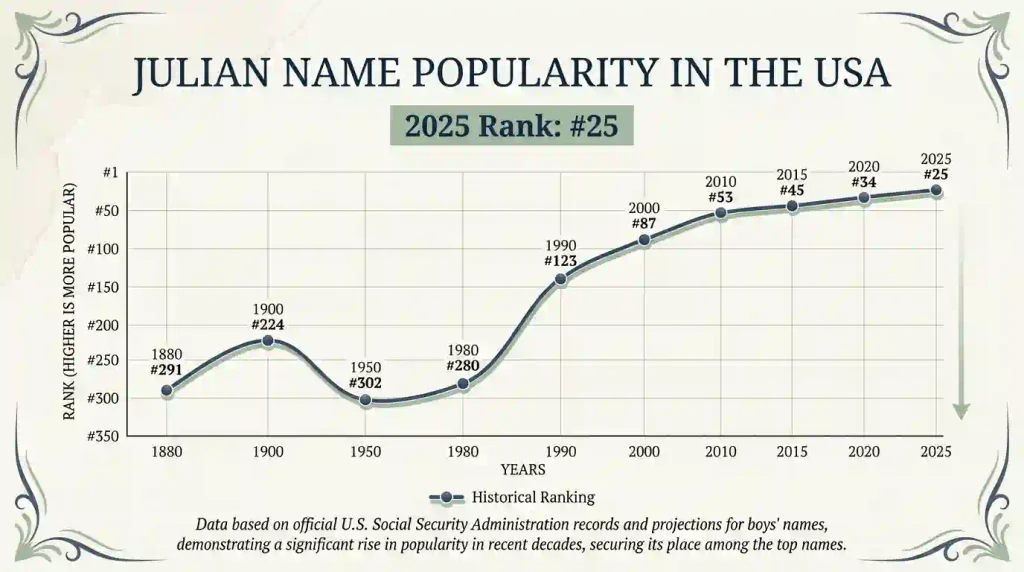
Julian has experienced a substantial increase in popularity over the past several decades.
It appeared in American naming records during the late 19th century but was not among the most commonly selected boy names at that time.
Throughout much of the 20th century, Julian maintained a recognizable presence without consistently reaching the highest rankings.
Its popularity grew significantly during the 1990s and 2000s.
By the 2010s, Julian was firmly established within the Top 100.
| Year | U.S. boys’ rank |
| 1880 | #291 |
| 1900 | #224 |
| 1920 | #195 |
| 1950 | #302 |
| 1980 | #280 |
| 1990 | #123 |
| 2000 | #87 |
| 2010 | #53 |
| 2015 | #45 |
| 2017 | #37 |
| 2020 | #34 |
| 2023 | #33 |
| 2024 | #30 |
| 2025 | #25 |
The most noticeable long-term development is Julian’s rise from a relatively uncommon traditional name to a mainstream American choice.
Peak years and popularity trends
Julian has two different popularity milestones.
Highest recorded annual male birth count: 2017, with 8,455 boys named Julian.
Highest recorded boys’ popularity ranking: 2025, when Julian reached #25.
These milestones occur in different years because rankings depend on how frequently parents choose Julian compared with other names.
The total number of births also changes from year to year.
A name can improve its ranking even when fewer babies receive it than during an earlier year.
Julian’s recent upward movement suggests continued interest in names that combine classical origins with approachable modern sounds.
However, its high rank means parents should expect to encounter other children named Julian.
Julian’s popularity by U.S. state
Julian is especially recognizable in several Western and Southwestern states, although usage varies across the country.
Published SSA-derived state rankings for 2025 show:
| State | Julian’s boys’ rank in 2025 |
| California | #6 |
| Nevada | #10 |
| Arizona | #14 |
| New Mexico | #20 |
| Illinois | #16 |
| Washington | #18 |
These state rankings show that Julian’s popularity is not geographically uniform.
Its presence in California, Nevada, Arizona, and New Mexico also illustrates its familiarity in communities where English- and Spanish-language naming traditions coexist.
However, naming data alone cannot determine a child’s ethnicity or family background.
Julian is used by families of many cultural backgrounds.
Julian’s popularity in other countries
Julian and its international forms are recognized across Europe and the Americas.
Germany: Julian is a familiar masculine given name with a pronunciation different from the English form.
Spain and Latin America: Julián is a recognizable traditional name, particularly in Spanish-speaking communities.
France: Julien is the established French equivalent.
Italy: Giuliano is the traditional Italian counterpart.
Romania: Iulian is a common linguistic form.
England and Wales: Julian is established but less popular than in the United States. Published 2025 birth-registration data places the exact spelling Julian around #316 among boys, with 141 recorded births.
International rankings should be interpreted carefully because national data sources use different collection methods.
They may also count accented forms, such as Julián, separately from unaccented Julian.
How to interpret rankings, birth counts, and data sources
The U.S. Social Security Administration publishes baby-name information based on applications for Social Security cards.
The data is organized by year, spelling, and recorded sex category.
A name ranked #25 is the 25th most frequently recorded name within that category for the relevant year.
This ranking does not mean that 25% of babies received the name.
The number of births provides additional context.
Similarly, Julian, Julien, and Julián may appear as separate spellings in national datasets.
Parents comparing name popularity should consider:
- The exact spelling
- The year of the data
- The country or state
- Whether the statistic covers boys, girls, or both
- Whether the figure represents rank or actual births
- Whether alternate spellings are included
For authoritative American popularity data, consult the U.S. Social Security Administration baby-name statistics.
Famous People and Historical Figures Named Julian
Roman emperors and other historical figures
Julian the Apostate (331/332–363 CE) is one of the most historically prominent bearers of the name.
As Roman emperor, he attempted to restore traditional Roman religious practices during a period when Christianity was becoming increasingly influential.
His reign is an important part of the name’s Roman history.
Another significant figure is Julian of Norwich, the medieval English religious writer whose works remain influential in Christian spirituality and literary history.
These historical bearers represent very different religious and cultural traditions associated with the name.
Saints, writers, musicians, actors, and athletes
Julian has been carried by many notable figures.
Julian of Norwich (c. 1342–after 1416)
An English religious writer associated with Revelations of Divine Love, a major work of medieval Christian spirituality.
Julian Lennon (born 1963)
An English musician and photographer and the son of John Lennon.
Julian Casablancas (born 1978)
An American singer and musician best known as the lead vocalist of The Strokes.
Julian Edelman (born 1986)
A former American football player who won three Super Bowls with the New England Patriots and received Super Bowl LIII Most Valuable Player honors.
Julian McMahon (1968–2025)
An Australian actor known for roles in Nip/Tuck, Charmed, and Fantastic Four.
Julian Fellowes (born 1949)
An English actor, novelist, and screenwriter known for creating Downton Abbey.
The variety of famous Julians demonstrates how the name has remained recognizable across religion, literature, sports, music, and entertainment.
Julian in Literature, Film, Television, and Music
Fictional characters named Julian
Julian has appeared in numerous fictional works.
Julian Bashir
A major character in the science-fiction television series Star Trek: Deep Space Nine, portrayed by Alexander Siddig.
Julian Albans
A character in R. J. Palacio’s novel Wonder who later becomes the focus of related stories.
Julian Blackthorn
A character in Cassandra Clare’s The Dark Artifices fantasy series.
Julian Morrow
An influential professor in Donna Tartt’s novel The Secret History.
These characters demonstrate Julian’s continuing use across science fiction, contemporary literature, and fantasy.
Julian in books and other literary works
Julian’s literary identity goes beyond fictional characters.
The medieval author Julian of Norwich helped establish the name’s place in English literary history.
Her writings explore faith, suffering, hope, and spiritual understanding.
In modern fiction, the name is frequently used for characters with varied personalities, backgrounds, and roles.
For parents who enjoy literary-inspired naming traditions, Julian offers historical substance without being tied exclusively to one famous fictional figure.
Songs and other pop-culture references
Julian has several recognizable musical associations.
Perhaps the most famous indirect connection is “Hey Jude” by the Beatles.
Paul McCartney originally developed the song as “Hey Jules,” referring to Julian Lennon during his parents’ separation.
The title eventually became “Hey Jude.”
Julian Lennon later established his own musical career, while Julian Casablancas became prominent through The Strokes.
These associations give Julian a recognizable place in contemporary music culture.
However, musical and fictional references are cultural associations, not evidence of the name’s original meaning.
Names Similar to Julian
Names with a similar sound
Parents who enjoy Julian’s soft three-syllable rhythm may also like:
- Julius
- Julien
- Adrian
- Lucian
- Damian
- Sebastian
- Fabian
- Gabriel
- Elijah
- Florian
Some names share Julian’s sound, while others offer a similar elegant or classical style.
Lucian is especially close in rhythm and also has Latin roots, though its meaning is associated with light rather than the Julius family.
Adrian is another established Roman-derived name with international usage.
Names with a similar meaning or origin
Julian is commonly associated with youthfulness, so parents may appreciate names that evoke renewal or youthful qualities.
However, exact equivalents are uncommon because the deeper etymology of Julius remains disputed.
More direct historical relatives include:
- Julius
- Julien
- Julián
- Giuliano
- Juliano
- Iulian
For a different classical name with strong historical roots, explore our Francis name meaning guide.
It explains a traditional name connected with medieval Latin and European naming history.
Other Latin and Roman names
If Julian appeals because of its Roman heritage, consider:
| Name | Origin or association |
| Augustus | Latin; associated with imperial honorifics |
| Marcus | Roman personal name |
| Felix | Latin; fortunate or happy |
| Lucius | Roman personal name associated with light |
| Adrian | Latin; associated with Hadria |
| Julius | Roman family name |
| Titus | Ancient Roman personal name |
| Cassius | Ancient Roman family name |
| Maximus | Latin; greatest |
| Florian | Latin; associated with flowering |
These names offer a similar connection to ancient Roman culture without necessarily sharing Julian’s precise etymology.
Other names beginning with J
Parents exploring J-initial boy names may enjoy:
James, Jacob, Joseph, Joshua, Jasper, Jonathan, Jude, Jonah, Joel, and Jeremiah.
James and Joseph are established traditional choices.
Jasper feels vintage yet distinctive.
Jude offers a short, modern-friendly style.
For a classic English name with a royal history, our henry name meaning guide offers another useful comparison.
Middle Names and Sibling Names for Julian
Middle names that pair well with Julian
Julian has three syllables, so shorter middle names often create a balanced rhythm.
However, longer traditional names can also sound elegant.
| Classic combinations | Modern combinations |
| Julian James | Julian Brooks |
| Julian Alexander | Julian Hayes |
| Julian Thomas | Julian Reid |
| Julian Edward | Julian River |
| Julian William | Julian Blake |
| Julian Charles | Julian Jude |
| Julian Michael | Julian Rowan |
| Julian Henry | Julian Cole |
| Julian Frederick | Julian Wilder |
| Julian Joseph | Julian Finn |
Julian James has a memorable alliterative sound.
Julian Alexander offers a long, formal combination.
Julian Henry pairs two historically established European names.
Julian Blake is short, balanced, and contemporary.
For more background on Blake’s origins, see the Blake name meaning guide.
Brother names that pair well with Julian
Julian works particularly well with brother names that combine classical roots and international familiarity.
Consider:
- Julian and Adrian
- Julian and Sebastian
- Julian and Gabriel
- Julian and Oliver
- Julian and Theodore
- Julian and Alexander
- Julian and Lucas
- Julian and Nathaniel
- Julian and Vincent
- Julian and Henry
Julian and Adrian create a coordinated Latin-inspired pairing.
Julian and Sebastian offer a longer, elegant rhythm.
Julian and Oliver feel familiar in modern American naming while retaining historical depth.
For a different vintage style, explore the archie name meaning guide.
Sister names that pair well with Julian
For sisters, consider names that share Julian’s timeless and international qualities.
Examples include:
- Julian and Amelia
- Julian and Sophia
- Julian and Isabella
- Julian and Clara
- Julian and Elena
- Julian and Charlotte
- Julian and Olivia
- Julian and Emilia
- Julian and Cecilia
- Julian and Victoria
Julian and Cecilia offer a graceful classical combination.
Julian and Amelia feel familiar and balanced.
Julian and Victoria create a traditional pairing with strong historical associations.
For more baby-name origins, popularity comparisons, and naming ideas, explore our Individual Boy Name Guides.
Is Julian the Right Name for Your Baby?
Why parents choose Julian
Julian offers several qualities that appeal to modern parents.
Its Latin origin provides historical depth, while its pronunciation feels gentle and contemporary.
The name also works internationally.
Parents may appreciate Julian because it is:
- Familiar without sounding overly informal
- Rooted in ancient Roman history
- Easy to recognize in English
- Suitable for childhood and adulthood
- Connected with established international variants
- Flexible through nicknames such as Jules and Jay
Julian is also recognizable across diverse cultural communities.
It is not limited to one nationality, religion, or ethnic background.
Points to consider, including popularity and historical associations
Julian is currently a Top 25 American boy’s name.
For some parents, that is an advantage because the name is familiar and easy to recognize.
For others, the possibility of several children sharing the same first name may be a drawback.
If rarity is particularly important, consider the popularity of Julian in your state rather than relying only on the national ranking.
Historical associations may also influence your decision.
Some parents appreciate its links to Roman history and Christian saints.
Others simply enjoy its sound.
Neither approach is inherently better.
A meaningful baby name can be chosen for its history, cultural traditions, family significance, or personal appeal.
Test Julian with your surname, initials, and preferred nicknames
Before choosing Julian, say the full name aloud.
Try combinations such as:
Julian James Carter
Julian Alexander Brooks
Julian Henry Williams
Listen for the rhythm between the first, middle, and last names.
Consider whether any sounds repeat awkwardly.
Also check initials.
A name that looks attractive on paper may create an unexpected abbreviation when combined with a surname.
Finally, think about nicknames.
If you strongly prefer Julian over Jules or Jay, remember that children may eventually choose their own familiar forms.
Consider pronunciation across your family’s languages
Julian is used across different language traditions, but its pronunciation may change.
An English-speaking relative may say JOO-lee-un, while a German-speaking relative may say YOO-lee-ahn.
Spanish-speaking relatives may naturally prefer Julián, pronounced hoo-LYAHN.
These differences do not make one pronunciation universally correct for every family.
If your household uses multiple languages, discuss which form and pronunciation you prefer.
Some families retain Julian as the legal spelling while allowing relatives to use familiar language-specific pronunciations.
Others choose Julián or Julien to reflect their cultural background.
For another English name with a historical geographical connection, see our Camden Name Meaning article.
Frequently Asked Questions About the Name Julian
What does Julian mean?
Julian comes from the Latin name Julianus, meaning “belonging to Julius,” and is commonly associated with “youthful” or “downy-bearded.”
Is Julian a popular name in the United States?
Yes. Julian ranked #25 among U.S. boys’ names in 2025, with 7,603 recorded male births.
Is Julian a gender-neutral name?
Julian has historical feminine usage, but it is overwhelmingly masculine in the United States today.
What are common nicknames for Julian?
Jules, Jay, Ju, Juli, and Juju are familiar or affectionate nickname options.
What names go well with Julian?
Adrian, Sebastian, Gabriel, Oliver, Amelia, Sophia, Cecilia, and Charlotte pair naturally with Julian.
Final Thoughts
The Julian name meaning combines ancient Roman history, elegant pronunciation, and enduring international appeal. Derived from the Latin Julianus, the name originally indicated a connection with Julius and is traditionally interpreted as “youthful” or “downy-bearded,” although its deeper etymology remains debated. With connections to Roman emperors, medieval religious writers, Christian saints, musicians, and fictional characters, Julian has maintained its cultural relevance for centuries.
Today, Julian ranks among the most popular American boy names, making it a familiar yet historically meaningful choice.
Its three-syllable sound, approachable nicknames, and international variations offer flexibility for families with different naming preferences.
Still exploring names for your baby boy? Visit Boy Names for more detailed guides covering name meanings, origins, pronunciation, gender, history, and popularity.


