Most Popular Boy Names in the World: Global Rankings, Meanings & Trends
Summary
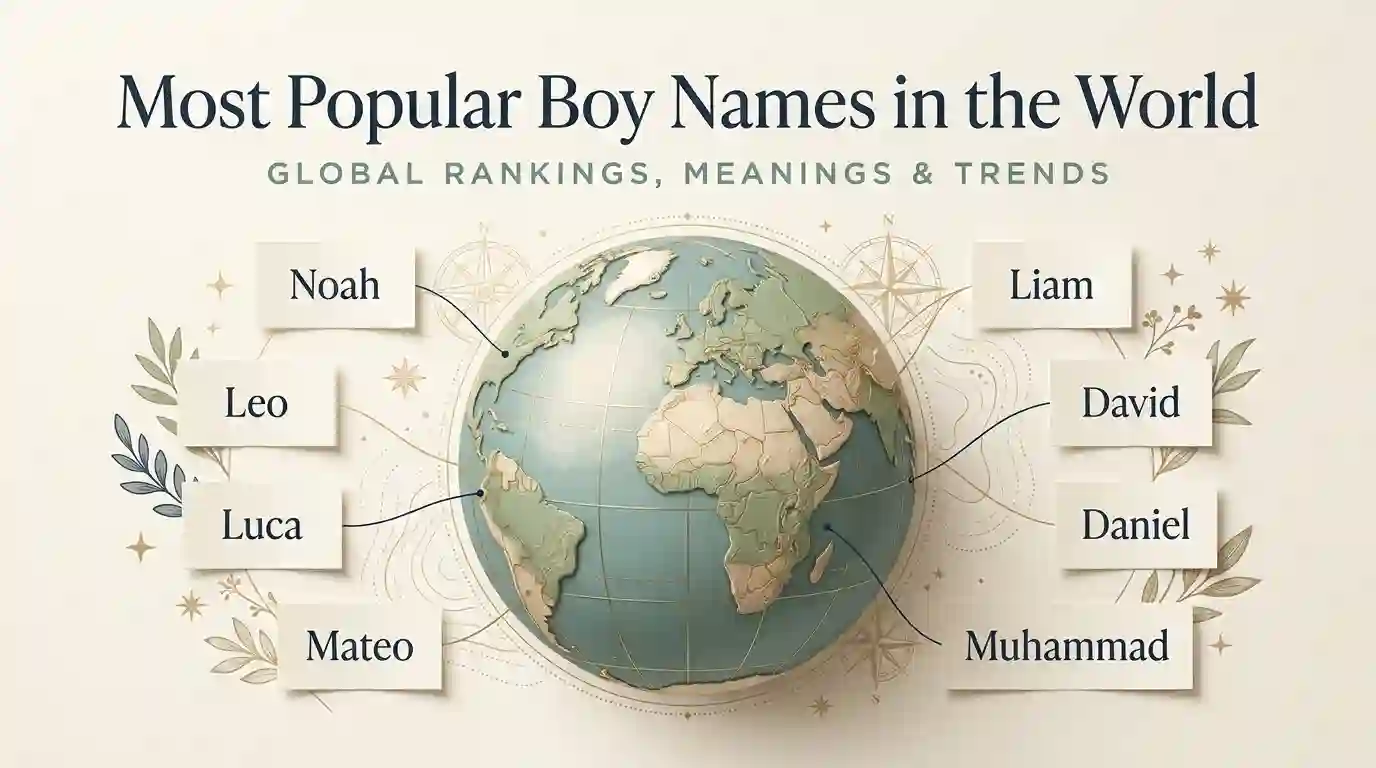
The most popular boy names in the world include Noah, Leo, Luca, Mateo, Liam, David, Daniel, and Muhammad, but determining the world’s number-one male name is more complicated than comparing national baby-name charts. According to Nameberry’s September 2026 international study, Noah is the leading boy-name family across the national and regional top-10 lists it examined. Meanwhile, NameKun’s 139-country research identifies David as its highest-scoring international male name, appearing in 113 countries.
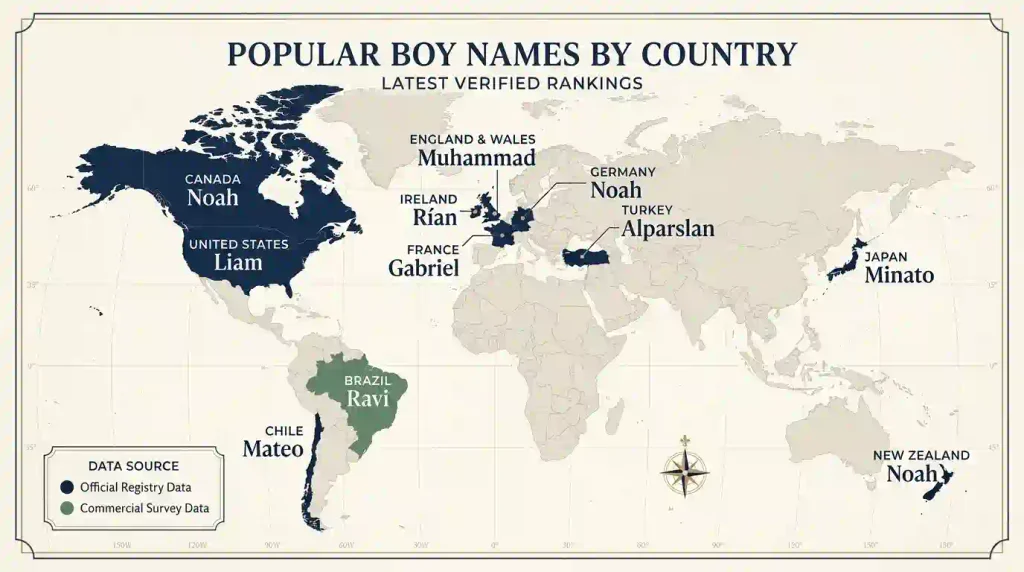
Recent national rankings reveal fascinating differences. Liam leads the United States, Noah tops several European countries, Muhammad ranks first in England and Wales, Ravi leads Brazil, and Mateo remains a favorite in Chile. These results demonstrate how religion, language, culture, family traditions, and historical influences shape naming preferences around the globe.
In this comprehensive guide, explore 50 internationally popular boy names, their meanings, country-by-country rankings, continental naming patterns, alternative spellings, historical trends, and multicultural traditions. You’ll also discover how global name frequency is measured, why rankings differ, and which names work beautifully across languages.
Whether you’re researching worldwide naming trends or choosing an international name for your son, this guide combines verified statistics with meaningful naming inspiration.
Data updated: November 2026. Worldwide comparisons use the latest verified sources available for each country, primarily 2025 birth records released in 2026. No single official organization produces a complete global baby-name ranking.
Table of Contents
- Most Popular Boy Names in the World: Quick Overview
- Top 50 Most Popular International Boy Names
- Most Popular Baby Names Around the World by Continent
- Most Popular Boy Names by Country
- How Do Popular Boy Names Differ Around the World?
- How Common Are the World’s Most Popular Boy Names?
- Popular Boy Names With Different Spellings Around the World
- Most Common Male Names Among Adults vs. Newborn Boys Worldwide
- Religious and Biblical Boy Names Popular Around the World
- International Boy Name Meanings and Origins
- Cultural Naming Traditions Around the World
- Historical Global Baby Name Trends and Fastest-Rising International Names
- International Boy Names That Are Gender-Neutral in Different Cultures
- Most Popular International Boy Names by Length and Sound
- Why Are Certain Boy Names Popular Around the World?
- Popular International Boy Names by Style and Inspiration
- How to Choose an International Baby Boy Name
- Where Do Worldwide Baby Name Rankings Come From, and How Accurate Are They?
- Frequently Asked Questions About the Most Popular Boy Names in the World
- Final Thoughts: Most Popular Boy Names in the World
1. Most Popular Boy Names in the World: Quick Overview
Baby names reflect the languages, beliefs, traditions, and histories of families around the world. Some names have remained recognizable for centuries, while others have become internationally popular through migration, cultural exchange, and changing parental preferences.
However, a name’s worldwide popularity can be measured in several ways.
One study might identify names appearing in the greatest number of national top-10 lists. Another might analyze how widely names are used among living populations. A third might compare birth registrations from different countries.
Understanding these differences is essential before deciding which name deserves the title of the world’s most popular.
1.1 What Is the Most Popular Boy Name in the World?
Noah is the leading international boy-name family in Nameberry’s September 2026 comparison of national and regional top-10 baby-name rankings.
The study compared recent naming statistics from 38 countries, along with selected provinces and regions.
Noah appeared in leading rankings across countries including the United States, Canada, France, Germany, Norway, Sweden, New Zealand, and several others.
The name also appeared in related forms, including Nojus in Lithuania and Noe in Georgia.
However, other studies produce different results.
NameKun’s international research identifies David as its leading male name based on a popularity-score methodology covering 139 countries.
Meanwhile, Muhammad and its spelling variations are widely used across Muslim communities worldwide.
There is no verified universal number-one male name based on the total number of living people or newborn boys across every country.
1.2 Top 10 Most Popular Boy Names Worldwide
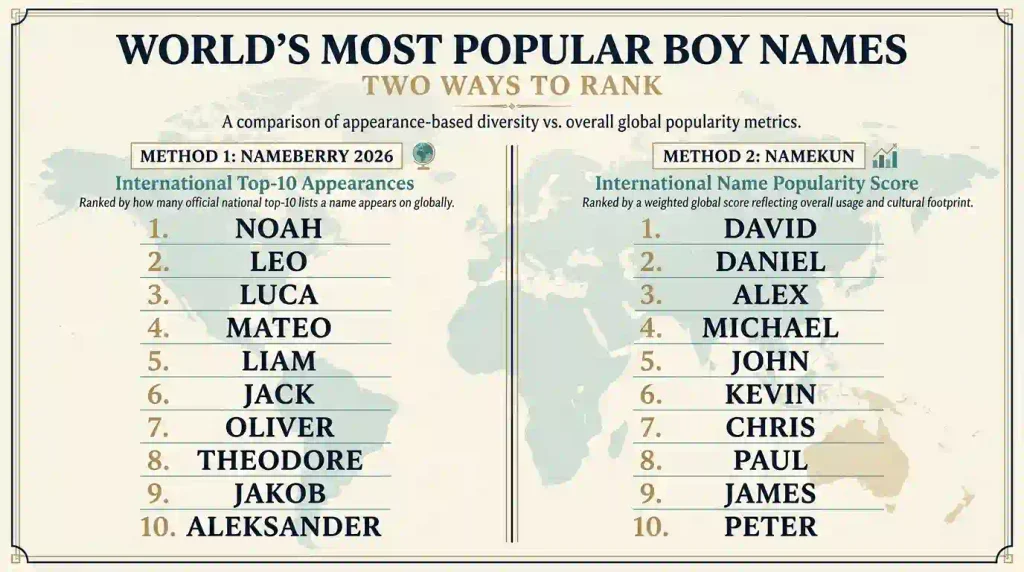
The following ranking comes from Nameberry’s September 2026 international study.
It is based on the number of national or regional top-10 appearances for each name family, rather than total worldwide births.
| Global rank | Boy-name family | Examples of related forms |
| 1 | Noah | Noah, Nojus, Noe |
| 2 | Leo | Leo, Léo, Leon, Leonardo, Leonas |
| 3 | Luca | Luca, Lucas, Lukas, Luka |
| 4 | Mateo | Mateo, Matteo, Matej, Mattia, Matthew |
| 5 | Liam | Liam, William |
| 6 | Jack | Jack and other John-family forms |
| 7 | Oliver | Oliver |
| 8 | Theodore | Theodore, Theo, Theodor, Teodor |
| 9 | Jakob | Jakob, Jacob, Jakub, Jakov, James |
| 10 | Aleksander | Aleksander, Alexander, Alejandro, Alessandro |
Important: These positions describe the order reported in Nameberry’s study, not a universally standardized ranking of every newborn on Earth.
The classification groups related historical names and translations, sometimes across very different modern spellings.
1.3 Most Popular International Boy Names at a Glance
| Popularity measure | Leading name or finding | Source context |
| Leading international newborn-name family | Noah | Nameberry, 2026 |
| Highest international popularity score | David | NameKun, 139-country study |
| Most popular boy name in the US | Liam | SSA, 2025 births |
| Most popular boy name in England and Wales | Muhammad | ONS, 2025 births |
| Most popular boy name in Canada | Noah | Statistics Canada, 2025 |
| Most popular boy name in France | Gabriel | INSEE, 2025 |
| Most popular boy name in Germany | Noah | GfdS, 2025 |
| Most popular boy name in Brazil | Ravi | Civil registration research, 2025 |
| Most popular boy name in New Zealand | Noah | Department of Internal Affairs, 2025 |
| Most popular boy name in Ireland | Rían | CSO, 2025 |
Each finding describes a particular source, geography, and reporting period.
1.4 Which Boy Names Are Popular Across Multiple Countries?
Noah, Leo, Luca, Mateo, Liam, Oliver, Theodore, and Alexander-related names are especially visible across recent international rankings.
Their appeal varies.
Noah is recognizable through biblical traditions and widely used in European and English-speaking countries.
Leo and Luca are compact names with familiar pronunciations in several languages.
Mateo belongs to a widespread family of names derived from Matthew.
Alexander-related names have long histories across Greek, Slavic, Romance, and other linguistic traditions.
These qualities help explain why some names cross national boundaries, although they do not establish the motivations of individual parents.
1.5 What Are the Biggest Global Baby Name Trends?
Recent international naming comparisons highlight several patterns.
Short names: Noah, Leo, Luca, Liam, Theo, and Kai are prominent in different countries.
Historical and biblical names: David, Daniel, Jacob, Muhammad, Noah, and Gabriel maintain strong cultural significance.
International equivalents: Names such as Mateo, Matteo, Matthew, and Matej connect linguistic traditions.
Vintage revival: Theodore, Arthur, Oscar, Alfred, and Leon have attracted renewed attention in various countries.
Multicultural naming: Many parents choose names that are meaningful within their family heritage and recognizable in more than one language.
These trends differ by region and should not be presented as equally widespread everywhere.
1.6 Is There an Official Worldwide Baby Name Ranking?
No.
Countries collect birth-name information through different government departments, civil registries, population agencies, and research organizations.
Some publish comprehensive annual rankings. Others release only limited lists, while many do not provide reliable public name-frequency statistics.
Different countries also have different rules for counting spellings, multiple given names, and transliterations.
As a result, worldwide rankings must be interpreted as research comparisons rather than a single official global census.
2. Top 50 Most Popular International Boy Names
A global top-50 list provides an overview of names used across multiple countries.
However, worldwide popularity can refer to name recognition, frequency across countries, or total recorded births.
The following list uses NameKun’s published international popularity-score ranking.
It should not be interpreted as a ranking of the total number of newborn boys worldwide.
2.1 Complete List of the Top 50 International Boy Names
NameKun analyzed 27,599 top-100 name entries from 139 countries, covering 8,336 unique names.
Its popularity score combines country-level name-frequency information using the researcher’s own methodology.
| Rank | Boy name | Countries represented | NameKun popularity score |
| 1 | David | 113 | 87.4% |
| 2 | Daniel | 104 | 81.0% |
| 3 | Alex | 103 | 66.2% |
| 4 | Michael | 90 | 61.2% |
| 5 | John | 87 | 57.4% |
| 6 | Kevin | 74 | 47.9% |
| 7 | Chris | 64 | 46.9% |
| 8 | Paul | 67 | 44.7% |
| 9 | James | 57 | 42.5% |
| 10 | Peter | 65 | 41.3% |
| 11 | Robert | 67 | 39.9% |
| 12 | Mark | 62 | 38.9% |
| 13 | Richard | 64 | 35.5% |
| 14 | Ali | 50 | 34.1% |
| 15 | Andrew | 51 | 33.4% |
| 16 | Martin | 60 | 33.4% |
| 17 | Mohamed | 41 | 33.1% |
| 18 | Jonathan | 63 | 33.1% |
| 19 | Mike | 54 | 31.4% |
| 20 | Ahmed | 44 | 31.0% |
| 21 | Christian | 55 | 29.7% |
| 22 | Victor | 51 | 28.9% |
| 23 | Ivan | 49 | 28.6% |
| 24 | Patrick | 54 | 28.3% |
| 25 | Ibrahim | 37 | 27.1% |
| 26 | Jose | 34 | 27.0% |
| 27 | Carlos | 32 | 26.9% |
| 28 | Eric | 45 | 26.7% |
| 29 | Thomas | 54 | 26.6% |
| 30 | Omar | 38 | 25.1% |
| 31 | Ryan | 39 | 25.0% |
| 32 | Luis | 32 | 24.8% |
| 33 | Jason | 36 | 24.6% |
| 34 | Ben | 45 | 24.5% |
| 35 | Adam | 42 | 24.4% |
| 36 | Mohammed | 32 | 24.2% |
| 37 | Mario | 41 | 23.7% |
| 38 | Tom | 47 | 23.7% |
| 39 | Brian | 40 | 23.6% |
| 40 | Antonio | 36 | 23.5% |
| 41 | Sam | 41 | 23.3% |
| 42 | Simon | 42 | 23.2% |
| 43 | Jorge | 28 | 22.6% |
| 44 | Joseph | 40 | 22.4% |
| 45 | Steve | 39 | 22.0% |
| 46 | Joe | 37 | 21.9% |
| 47 | Fernando | 27 | 21.9% |
| 48 | Miguel | 28 | 20.9% |
| 49 | Gabriel | 39 | 20.6% |
| 50 | Anthony | 42 | 20.5% |
The percentage in this table is a research popularity score, not the percentage of newborn boys or living men worldwide with the name.
For example, David’s 87.4% score does not mean 87.4% of males are named David.
2.2 Top Global Boy Names According to Nameberry
Nameberry’s September 2026 findings focus on name families appearing in top-10 charts across its selected countries and regions.
Its leading ten include Noah, Leo, Luca, Mateo, Liam, Jack, Oliver, Theodore, Jakob, and Aleksander.
A significant feature of the research is its treatment of translations and related historical forms.
For example, the Mateo family includes forms associated with Matthew, while the Jack group includes several names historically connected to John.
This approach is useful for international comparisons but must be distinguished from exact-spelling birth counts.
2.3 Top International Male Names According to NameKun
NameKun takes a different approach.
Its research emphasizes how frequently names occur within national top-100 datasets.
David leads, followed by Daniel, Alex, Michael, and John.
Unlike Nameberry’s recent newborn-focused comparison, this dataset reflects a broader international name-usage methodology and should not be interpreted as a current global birth ranking.
It also counts several related forms separately, including Mohamed and Mohammed.
2.4 Noah, Leo, Luca, Mateo, and Liam: Globally Popular Boy Names
These five names stand out in Nameberry’s recent international comparison.
| Name | Commonly cited origin | Meaning or association | International appeal |
| Noah | Hebrew | Rest, comfort | Biblical history and familiar pronunciation |
| Leo | Latin | Lion | Short spelling and international variants |
| Luca | Italian form of Lucas | From Lucania | Familiar across European languages |
| Mateo | Spanish | Gift of God | International Matthew-name family |
| Liam | Irish | Resolute protector | Short form related to William |
Noah is especially prominent across European and English-speaking naming charts.
Leo and Luca are widely recognizable through their compact forms.
Mateo and Liam demonstrate how names with older linguistic histories can become contemporary favorites.
2.5 David, Daniel, Alex, Michael, and John: Widely Used International Names
David, Daniel, Alex, Michael, and John have extensive historical and religious associations.
David and Daniel are Hebrew-origin names used in multiple Abrahamic religious traditions.
Michael is also Hebrew in origin, while Alex is commonly associated with Alexander.
John developed numerous forms across languages, including Juan, Jean, Giovanni, Jan, and João.
Their familiarity across countries helps explain why they feature strongly in international name-use studies.
2.6 Most Popular Boy Names Across the Largest Number of Countries
The number of countries where a name appears can be measured differently from its overall popularity score.
In NameKun’s study, David appeared in 113 countries, Daniel in 104, Alex in 103, Michael in 90, and John in 87.
These figures describe the study’s observed name coverage.
They do not establish the total number of living people with each name.
2.7 How International Name Popularity Scores and Rankings Differ
A popularity score is a research-defined measurement.
A birth rank measures a name’s position within a specified population and period.
A country-appearance count measures the geographic spread of a name.
These measures answer different questions.
For example, Noah may lead a comparison of recent national newborn top-10 lists, while David scores highly in a broader international name-frequency analysis.
Both can be accurate within their stated methods.
3. Most Popular Baby Names Around the World by Continent
Continental naming comparisons reveal broad regional patterns.
However, no authoritative organization publishes standardized rankings for every continent using the same birth year and counting method.
The names below are representative choices drawn from selected national rankings and established naming traditions, not independently calculated continent-wide top-10 rankings.
3.1 Most Popular Baby Names in North America
North American naming patterns reflect English, French, Spanish, Indigenous, and numerous immigrant naming traditions.
The United States and Canada share several leading names, while Mexican naming conventions have strong Spanish-language influences.
3.1.1 Top 10 Boy Names in North America
Ten prominent examples from recent national rankings and international comparisons are Liam, Noah, Oliver, Theodore, Mateo, Lucas, Leo, William, James, and Santiago.
The United States ranked Liam first for 2025 births.
Canada ranked Noah first in its 2025 national statistics.
These examples should not be mistaken for a calculated continental top 10.
3.1.2 Top 10 Girl Names in North America
Representative popular names include Olivia, Charlotte, Emma, Amelia, Sophia, Mia, Isabella, Evelyn, Sofia, and Eliana.
Olivia led the United States in 2025, while Charlotte ranked first in Canada.
3.2 Most Popular Baby Names in South America
South American naming traditions include Spanish, Portuguese, Indigenous, and international influences.
Many familiar names have Christian or European linguistic histories, while others reflect regional preferences.
3.2.1 Top 10 Boy Names in South America
Ten prominent examples are Ravi, Miguel, Mateo, Benjamín, Gael, Heitor, Arthur, Thiago, Lucas, and Enzo.
Brazil ranked Ravi first among boys in 2025.
Chile ranked Mateo first, while Argentina’s available 2025 registration comparison placed Benjamín at the top.
These are examples selected from national charts rather than a single continent-wide ranking.
3.2.2 Top 10 Girl Names in South America
Representative names include Helena, Emma, Emilia, Isabella, Sofía, Olivia, Valentina, Aurora, Alice, and Julieta.
Some appear across multiple countries, though their rankings differ.
3.3 Most Popular Baby Names in Europe
European naming trends include numerous language families and cultural traditions.
Names such as Noah, Leo, Luca, Mateo, and Oliver appear across several national rankings.
3.3.1 Top 10 Boy Names in Europe
A cross-country selection of prominent names includes Noah, Leo, Luca, Mateo, Oliver, Gabriel, Theodore, Oscar, Liam, and Arthur.
Noah ranked first in several countries, including Germany, Norway, the Netherlands, Belgium, Austria, and Switzerland, using their 2025 name statistics.
However, Europe as a whole does not have one unified official top-10 list.
3.3.2 Top 10 Girl Names in Europe
Representative names include Sofia, Sophia, Emma, Olivia, Mia, Amelia, Charlotte, Louise, Nora, and Emilia.
Their popularity varies substantially between countries and regions.
3.3.3 Why Noah and Sofia Are Prominent Across European Rankings
Noah is recognizable through biblical traditions and relatively similar spelling across languages.
Sofia and Sophia are related forms with longstanding European usage.
Their appearance across national charts reflects the international familiarity of these names, although individual ranking positions differ by country.
3.4 Most Popular Baby Names in Asia
Asia contains exceptionally diverse naming traditions, including Arabic, Chinese, Japanese, Korean, Hebrew, Persian, Turkic, and South Asian languages.
It is therefore misleading to treat the continent as a single naming market.
3.4.1 Top 10 Boy Names in Asia
Ten illustrative names from different Asian traditions are Muhammad, Ali, Ibrahim, Yusuf, Alparslan, Do-yun, Haruto, Ren, Eitan, and Arnav.
These are not a verified top-10 ranking for Asia.
Popularity must be evaluated within individual countries and language communities.
3.4.2 Top 10 Girl Names in Asia
Representative names include Fatima, Aisha, Maryam, Zainab, Aiko, Hana, Yuna, Seo-yun, Aanya, and Noor.
Each has distinct linguistic and cultural associations.
3.5 Most Popular Baby Names in Africa
African naming traditions include hundreds of languages and numerous religious and cultural influences.
Names may communicate family circumstances, ancestral connections, faith, gratitude, or aspirations.
3.5.1 Top 10 Boy Names in Africa
Ten illustrative names encountered across different African cultural contexts include Lethabo, Junior, Muhammad, Ibrahim, Samuel, David, Emmanuel, Sipho, Kwame, and Kofi.
These examples should not be interpreted as a statistical African top 10.
Different countries use substantially different naming conventions.
3.5.2 Top 10 Girl Names in Africa
Representative names include Onalerona, Amina, Fatima, Maryam, Zanele, Ayanda, Ama, Nia, Grace, and Blessing.
They illustrate linguistic diversity rather than a unified continental ranking.
3.6 Most Popular Baby Names in Australia and Oceania
Australian and New Zealand naming preferences share several familiar names with Europe and North America.
However, Indigenous naming traditions and local preferences add important differences.
3.6.1 Top 10 Boy Names in Australia and Oceania
New Zealand’s verified 2025 top 10 provide a useful regional example:
| Rank | Boy name |
| 1 | Noah |
| 2 | Luca |
| 3 | Oliver |
| 4 | George |
| 5 | Theodore |
| 6 | Leo |
| 7 | Charlie |
| 8 | Jack |
| 9 | Elijah |
| 10 | Theo |
Australia’s state and territory rankings also prominently feature Oliver, Noah, Theodore, Luca, and Leo.
The New Zealand list above is not a combined Oceania ranking.
3.6.2 Top 10 Girl Names in Australia and Oceania
New Zealand’s 2025 leading girl names were Isla, Charlotte, Amelia, Hazel, Olivia, Lily, Lucy, Mila, Aria, and Mia.
Australian state lists contain several of the same favorites.
4. Most Popular Boy Names by Country
Country-specific rankings are the most reliable way to understand worldwide naming preferences.
The following sections distinguish verified national leaders from illustrative name examples and countries where comparable public data could not be confirmed.
4.1 Most Popular Boy Names in North America
4.1.1 United States
Liam ranked first in the United States for births in 2025, with 20,818 recorded births.
Noah ranked second, followed by Oliver, Theodore, and Henry.
These figures come from the Social Security Administration and were released in May 2026.
For a detailed national comparison, explore most popular boy names in the us.
4.1.2 Canada
Noah was Canada’s leading boy name in 2025, according to Statistics Canada.
It retained the number-one position for a fifth consecutive year.
Theodore, Liam, Leo, and William also featured prominently in the latest rankings.
4.1.3 Mexico
Mexican naming traditions include Spanish-language, Indigenous, and internationally familiar names.
Santiago, Mateo, Sebastián, Emiliano, and Leonardo are examples of names appearing in Mexican naming discussions and historical registration data.
A current, independently verified nationwide 2025 top-name ranking was not established for this comparison, so no exact national leader is assigned here.
4.2 Most Popular Boy Names in South America
4.2.1 Brazil
Ravi was Brazil’s leading registered boy name in 2025, with 21,982 registrations.
Miguel followed with 21,654, while Heitor ranked third.
Arthur, Theo, Gael, Bernardo, Davi, Noah, and Samuel completed the leading ten.
The data came from Brazilian civil-registration research.
4.2.2 Argentina
Benjamín led an available 2025 Argentina registration comparison with 7,400 registrations.
Gael ranked second with 5,963, followed by Mateo with 5,872.
Valentino, Valentín, Bautista, Enzo, Liam, Noah, and Giovanni were also prominent.
The published comparison used registration information updated through December 1, 2025, rather than a fully reconciled final-year global dataset.
4.2.3 Chile
Mateo led Chile’s 2025 male birth-name registrations, with 2,323 recorded uses.
Liam followed with 2,059, and Lucas ranked third with 1,492.
Other popular choices included Santiago, Facundo, Thiago, Benjamín, Gael, Máximo, and Gaspar.
4.3 Most Popular Boy Names in European Countries
4.3.1 England and Wales
Muhammad ranked first in England and Wales for 2025 births, with 5,957 registrations.
Noah ranked second, followed by Leo, Luca, Arthur, Oliver, George, Oscar, Theodore, and Freddie.
These are official Office for National Statistics rankings released in July 2026.
4.3.2 Northern Ireland
Names including Jack, Noah, Oliver, Theo, and James have appeared prominently in recent Northern Irish naming charts.
Northern Ireland publishes separate baby-name statistics from England and Wales.
A current exact 2025 number-one ranking was not independently established here, so the examples should be understood as recent favorites rather than a verified ordered list.
4.3.3 France
Gabriel ranked first in France for 2025 births, with approximately 4,625 recorded births.
Noah, Léo, Raphaël, Louis, Jules, Arthur, Léon, Adam, and Maël completed the official top 10.
These statistics were published by INSEE in July 2026.
4.3.4 Germany
Noah led the GfdS’s 2025 first-name rankings, representing approximately 1.48% of boys’ first names in its analysis.
Matteo and related spellings ranked second, followed by Theo, Leo, Emil, Leon, Elias, Paul, Luca/Luka, and Henry/Henri.
The GfdS combines certain same-sounding spelling variations.
4.3.5 Spain
Mateo ranked first among Spanish newborn boys in the verified 2024 national birth-name statistics, with 3,289 recorded births.
Hugo and Martín were also leading choices.
Because the verified reference for this national newborn comparison is 2024, these figures should not be labeled as 2025 results.
4.3.6 Italy
Leonardo led an available 2025 Italian name-data compilation, followed by Edoardo, Tommaso, Alessandro, and Francesco.
Other prominent names included Lorenzo, Mattia, Gabriele, Riccardo, and Andrea.
These figures reflect published Italian registry-based rankings.
4.3.7 Sweden
Noah ranked first among newborn boys in Sweden for 2025, with approximately 640 registrations.
Hugo ranked second, followed by Liam, Nils, and Alfred.
Swedish naming statistics use registered names and have their own reporting conventions.
4.3.8 Norway
Noah ranked first in Norway’s official 2025 statistics, with 477 births.
Jakob, Lucas, Emil, Oskar, William, Elias, Isak, Oliver, and Ludvig completed the top 10.
These figures come from Statistics Norway.
4.3.9 Denmark
Oscar was the leading boy name in Denmark for 2025, with 540 recorded births.
Karl, Alfred, Noah, August, Oliver, Theo, Viggo, William, and Otto followed.
Statistics Denmark also reported that Oscar represented approximately 18 of every 1,000 newborn boys.
4.3.10 Finland
Eino led the 2025 first-name ranking among babies born into Finnish-speaking families.
Leo, Elias, Väinö, and Oliver followed.
Among Swedish-speaking families, Edvin ranked first, while Muhammad led the list for families speaking other languages.
These rankings are divided by language group rather than presented as one undifferentiated national list.
4.3.11 Iceland
Birnir was Iceland’s most popular first given name for newborn boys in 2025, with 33 registrations.
Matthías, Jökull, and Emil were also prominent.
Because Iceland has a relatively small population, modest changes in birth counts can produce substantial ranking movement.
4.3.12 Poland
Nikodem led Poland’s latest verified first-half 2026 boy-name rankings.
Antoni ranked second, followed by Jan, Leon, Franciszek, Aleksander, Ignacy, Stanisław, Jakub, and Mikołaj.
This is a January–June 2026 ranking, not a full-year result.
4.3.13 Austria
Noah ranked first among newborn boys in Austria in 2025, with 674 births.
Paul followed with 625, then Maximilian with 607.
Elias, Jakob, Felix, Leo, Leon, Jonas, and Lukas also featured in the top 10.
4.3.14 Belgium
Noah ranked first in Belgium’s 2025 national boy-name rankings, with 604 recorded births.
Arthur ranked second with 537, followed by Jules with 503.
Liam, Adam, Gabriel, and Louis also featured prominently.
Regional differences were substantial, with Adam leading in Brussels.
4.3.15 Greece
Traditional Greek names include Georgios, Konstantinos, Ioannis, Dimitrios, Nikolaos, and Alexandros.
Many are closely associated with Orthodox Christian naming traditions and family inheritance.
No independently verified current national birth-year ranking was available for this comparison, so these are traditional examples rather than assigned 2025 ranks.
4.3.16 Russia
Mikhail was Russia’s leading boy name for 2025, according to published national registration analyses.
Alexander ranked second, followed by Artyom, Matvey, and Timofey.
These names reflect a combination of longstanding Russian usage and contemporary preferences.
4.3.17 Turkey
Alparslan led Turkey’s 2025 boy-name registrations, with 7,651 births.
Göktuğ ranked second with 6,109, followed by Metehan with 5,492.
Yusuf, Kerem, Miran, Ömer Asaf, Atlas, and Ömer were also prominent.
The top names reflect Turkish historical, cultural, and religious influences.
4.4 Most Popular Boy Names in Asian Countries
4.4.1 India
India has extensive linguistic and cultural naming diversity.
Examples of names used across Indian communities include Aarav, Arjun, Dhruv, Ishan, Vihaan, and Aditya.
No reliable unified national baby-boy ranking covering all Indian births in 2025 was verified, so these should be treated as examples rather than a national top-six list.
4.4.2 Pakistan
Muhammad and its related spellings are widely used in Pakistani Muslim naming traditions.
Other familiar names include Ali, Ahmed, Abdullah, Ibrahim, Hassan, and Hamza.
Because a verified nationwide annual birth-name ranking was not established, no exact 2025 number-one name or frequency is claimed.
4.4.3 Bangladesh
Muhammad, Mohammad, Abdullah, Hasan, Rahman, and other Arabic-derived forms are familiar in Bangladeshi Muslim naming traditions.
Names can also reflect Bengali language and cultural influences.
A comprehensive, comparable 2025 national ranking was not verified.
4.4.4 China
Chinese given names are shaped by characters, pronunciation, family preferences, and the meanings parents wish to express.
Examples of Chinese masculine-name elements include Wei, Jun, Hao, Yu, and Ming.
Since characters and transliterations may represent different names, these examples should not be treated as a national ranked list.
4.4.5 Japan
Japanese naming traditions place importance on kanji characters, meaning, and pronunciation.
In one major 2025 commercial baby-name survey, 湊, often read Minato, ranked first among boy-name written forms.
Other prominent entries included 碧, 結翔, 伊織, and 陽翔.
These rankings are survey-specific rather than a definitive nationwide government count.
4.4.6 South Korea
Do-yun was the leading boy name in published 2025 Korean birth-registration analyses.
Other prominent names included I-jun, Ha-jun, Si-u, and Do-hyeon.
Korean names are often written in Hangul and may have several possible Hanja character combinations.
Romanized spellings can differ between sources.
4.4.7 Indonesia
Indonesian names reflect Malay, Javanese, Arabic, Sanskrit, Christian, and other cultural influences.
Names such as Muhammad, Ahmad, Rizky, and Arif are familiar examples.
A comparable official national 2025 ranking was not verified, so no exact national positions are assigned.
4.4.8 Malaysia
Malaysia’s multilingual communities use Malay, Chinese, Indian, Arabic-derived, and other naming traditions.
Muhammad, Ahmad, Danish, and Aiman are recognizable examples in Malay-Muslim naming contexts.
No verified unified national 2025 top-name list is presented here.
4.4.9 Philippines
Philippine naming traditions feature Spanish, English, local Philippine-language, and other influences.
Examples include John, James, Gabriel, Miguel, and Matthew.
A current nationally representative 2025 ranking was not verified for this article.
4.4.10 Vietnam
Vietnamese given names often reflect Sino-Vietnamese meanings and family values.
Examples of masculine-name elements include Minh, Huy, Đức, Khang, and Nam.
Romanized forms can omit tone marks and obscure distinctions between names.
No verified nationwide 2025 ranking is assigned here.
4.4.11 Israel
An Israeli Population and Immigration Authority report covering the Hebrew year 5786 identified Mohammad as the leading boy name overall, with 1,670 births.
Ariel followed with 1,283, and Yosef/Yousef with 1,278.
Among Jewish boys specifically, Ariel led.
The reporting period follows the Hebrew calendar rather than a standard January–December year.
4.4.12 Saudi Arabia
Arabic and Islamic naming traditions are influential in Saudi Arabia.
Muhammad, Abdullah, Abdulrahman, Ahmed, and Ibrahim are familiar examples.
A current verified national 2025 top-name ranking was not established, so these should not be treated as ranked positions.
4.4.13 United Arab Emirates
The UAE includes both Emirati families and a large international population.
Arabic names such as Muhammad, Ahmed, Abdullah, and Khalid are familiar, alongside names from South Asian, European, and other communities.
No comparable unified national birth-name ranking was verified for the whole UAE.
4.4.14 Other Middle Eastern Countries
Naming traditions in Jordan, Qatar, Kuwait, Oman, Iraq, Iran, and other Middle Eastern countries reflect different linguistic, religious, and cultural histories.
Names such as Omar, Ali, Hussein, Reza, Yusuf, and Ibrahim are familiar in various communities.
Their precise popularity depends on country, language, spelling, and reporting year.
4.5 Most Popular Boy Names in African Countries
4.5.1 South Africa
Statistics South Africa identified Lethabo as the leading first name among boys in its 2024 birth-registration reporting.
Junior was a common second name.
These findings illustrate the importance of distinguishing first names from additional given names.
4.5.2 Nigeria
Nigeria has diverse naming traditions associated with Yoruba, Igbo, Hausa, Fulani, and other communities.
Examples include Muhammad, Ibrahim, Chinedu, Emeka, and Oluwaseun.
A verified nationwide 2025 birth-name ranking was not available for this comparison.
4.5.3 Egypt
Arabic and Islamic names such as Muhammad, Ahmed, Omar, Yusuf, and Mahmoud are widely familiar in Egyptian naming traditions.
Christian Egyptian communities also use names associated with Coptic and other Christian histories.
No current exact national ranking is claimed without comparable registration data.
4.5.4 Kenya
Kenyan naming traditions include names from Swahili, Kikuyu, Luo, Kalenjin, and other language communities, alongside English and biblical names.
Examples include Brian, Kevin, Samuel, and various culturally specific local names.
A nationwide 2025 ranking was not verified.
4.6 Most Popular Boy Names in Oceania
4.6.1 Australia
Australia does not have a single routinely published national birth-name register that works identically to the American SSA database.
State and territory registries publish their own rankings.
Oliver and Noah appeared in every Australian jurisdiction’s 2025 top-10 boy-name list.
In New South Wales, Noah ranked first, with 542 births, followed by Oliver with 446.
4.6.2 New Zealand
Noah was New Zealand’s most popular boy name in 2025, with 244 registrations.
Luca followed with 236, while Oliver ranked third with 234.
George, Theodore, Leo, Charlie, Jack, Elijah, and Theo completed the top 10.
The Department of Internal Affairs also publishes separate information about Māori baby-name trends.
5. How Do Popular Boy Names Differ Around the World?
The worldwide popularity of a boy name depends on geography, language, cultural identity, religion, and historical traditions.
Even neighboring countries may have different leading names.
5.1 Most Popular Boy Names in Western Countries
Noah, Liam, Oliver, Leo, Luca, Mateo, and Theodore appear prominently in several European and English-speaking countries.
However, the phrase “Western countries” covers diverse communities and does not represent one unified naming tradition.
National and regional data should be considered separately.
5.2 Which Boy Names Appear in Multiple National Top 10 Lists?
Noah is particularly prominent across multiple recent national rankings.
Leo, Luca, Liam, Oliver, and Theodore also appear repeatedly.
Nameberry’s September 2026 comparison specifically examined this type of cross-country top-10 presence.
5.3 Global vs. Regional Boy Name Popularity
A globally recognizable name may be relatively uncommon in an individual country.
Conversely, a name that leads nationally may be unfamiliar elsewhere.
For example, Alparslan led Turkey’s 2025 registrations, while Liam led the United States.
Neither finding by itself establishes global frequency.
5.4 How Do Popular Boy Names Differ Between Europe, Asia, and America?
European rankings feature a mixture of biblical, classical, and contemporary names.
Asian naming patterns differ greatly by language and writing system.
American naming traditions draw from numerous historical and immigrant communities.
These broad distinctions help explain regional variation but should not obscure cultural diversity within each region.
5.5 Why the Same Boy Name Has Different Rankings Across Countries?
A name’s rank depends on how frequently it is chosen relative to other names in the same population.
Differences in language, birth rates, family traditions, and spelling conventions can all influence the result.
For example, Noah can rank first in one country and much lower in another despite being recognizable in both.
5.6 Most Popular Baby Girl Names in the World
Internationally recognizable girl-name families include Sofia/Sophia, Maria/Marie, Olivia, Emma, Mia, and Charlotte.
NameKun’s study identified Maria as its leading female name by international popularity score.
Nameberry’s country-based comparisons also show the strong international appeal of several classical and contemporary girl names.
There is no universal official number-one girl name for the entire world.
5.7 How Global Boy and Girl Name Trends Compare
Both boy and girl rankings feature international name families and traditional revivals.
However, the extent of name concentration differs between countries and recorded sex categories.
Spelling variations can also influence apparent diversity.
Comparisons require matching definitions and reporting periods.
6. How Common Are the World’s Most Popular Boy Names?
Popularity rankings alone do not show how frequently names are used.
A number-one name in one country may represent a much smaller percentage of births than a number-one name elsewhere.
Standardized frequency measurements provide a clearer comparison.
6.1 What Percentage of Baby Boys Receive the Number One Name in Each Country?
Recent verified records provide useful examples.
| Country or region | Leading boy name | Year | Approximate share of boys |
| United States | Liam | 2025 | 1.22% of boys in the published SSA file |
| Germany | Noah | 2025 | 1.48% |
| Austria | Noah | 2025 | 1.7% |
| Denmark | Oscar | 2025 | 1.8% |
| Norway | Noah | 2025 | 1.7% |
| Netherlands | Noah | 2025 | 1.04% of the reported male-birth total |
| New Zealand | Noah | 2025 | Not calculated from total births of both sexes |
These percentages use the populations reported by their respective sources and may differ in coverage or rounding.
6.2 Most Popular Boy Names per 1,000 Births
A standardized measure expresses the number of boys receiving a name for every 1,000 male births.
For example, approximately 18 per 1,000 newborn boys in Denmark were named Oscar in 2025.
Norway reported approximately 17 per 1,000 boys named Noah.
Germany reported 14.8 per 1,000 boys named Noah.
These figures are more informative than ranks alone.
6.3 How Many Babies Receive the Same Popular Name in Different Countries?
| Name | Country | Year | Recorded births |
| Liam | United States | 2025 | 20,818 |
| Noah | France | 2025 | 3,465 |
| Noah | Norway | 2025 | 477 |
| Noah | Netherlands | 2025 | 883 |
| Noah | New Zealand | 2025 | 244 |
| Gabriel | France | 2025 | 4,625 |
| Oscar | Denmark | 2025 | 540 |
| Ravi | Brazil | 2025 | 21,982 |
| Mateo | Chile | 2025 | 2,323 |
| Muhammad | England and Wales | 2025 | 5,957 |
The table includes selected individual national or regional counts, not all births worldwide.
6.4 Which Countries Have the Highest Baby Name Concentration?
Name concentration measures how much of a country’s naming distribution is represented by its most popular names.
A country where the top 10 account for 20% of births has a more concentrated naming distribution than one where they account for 8%.
Reliable global comparisons require compatible datasets and counting conventions.
The available examples do not establish a definitive worldwide country ranking for concentration.
6.5 Which Countries Have the Most Diverse Boy Names?
Naming diversity can be measured by the number of distinct recorded names, the share of births outside the top 100, or statistical diversity indices.
New Zealand reported 19,457 unique first names across 58,116 registered births of both sexes in 2025.
France reported tens of thousands of distinct recorded first-name forms.
However, countries with larger populations may naturally record more distinct names.
Raw diversity counts should therefore be interpreted cautiously.
6.6 How to Calculate International Baby Name Frequency
Use the formula:
Name frequency per 1,000 boys = (Recorded boys with the name ÷ Total recorded male births) × 1,000
For example, Norway recorded 477 boys named Noah in 2025 and reported a standardized rate of approximately 17 per 1,000.
When comparing countries, verify that both the numerator and denominator refer to the same period and population.
6.7 Why Birth Counts Are More Useful Than Rankings Alone
Rankings describe relative popularity.
Birth counts reveal the actual number of registrations.
A name ranked first in a small country may have fewer recorded births than a name ranked tenth in a much larger one.
Therefore, both measures are needed for meaningful comparisons.
6.8 How Country Population Size Affects Worldwide Name Popularity
Countries differ greatly in population size and birth rates.
A name popular in a large country could account for many births without leading any global country-appearance ranking.
For this reason, comparing the number of countries where a name appears is not equivalent to comparing total newborns given that name.
6.9 Comparing the Most Popular Boy Names by Percentage of Births
Percentages provide a better measure of local popularity than total counts when populations differ.
However, the reported percentages must be based on comparable definitions.
Some agencies include all registered first names, while others count only the first given name or use different spelling normalization rules.
6.10 Why a Number One Name May Be Less Common in One Country Than Another
A name can lead a ranking even when families choose from thousands of alternatives.
In countries with greater naming diversity, the leading name may account for a relatively small share of births.
Therefore, the number-one position does not guarantee that a name will be frequently encountered in schools or neighborhoods.
For a closer look at name-frequency calculations, explore how common is a name.
7. Popular Boy Names With Different Spellings Around the World
A name can have several spellings because of historical language changes, translation, or transliteration.
These variations can dramatically affect international rankings.
7.1 Most Popular International Boy Names With Multiple Spellings
Name families with numerous forms include Muhammad, John, Joseph, Alexander, Matthew, Jacob, and Lucas.
Some forms are nearly identical, while others differ significantly between languages.
7.2 Muhammad, Mohammed, Mohammad, and Other Spelling Variations
Muhammad is an Arabic name traditionally interpreted as “praised” or “praiseworthy.”
Common Latin-script spellings include Muhammad, Mohammed, Mohammad, Mohamed, and Muhammed.
These forms may represent the same Arabic name, محمد, depending on language and transliteration conventions.
However, national statistics frequently count them separately.
7.3 John, Juan, Jean, Giovanni, and Other International Equivalents
John has historical forms across many languages.
| Language or naming tradition | Related form |
| English | John |
| Spanish | Juan |
| French | Jean |
| Italian | Giovanni |
| Portuguese | João |
| Dutch | Jan |
| Slavic traditions | Ivan, Jan, or other forms depending on language |
These are related historical names, but they are not identical modern spellings.
7.4 Joseph, Yusuf, Youssef, and Yosef Across Cultures
Joseph has Hebrew origins and developed forms across numerous languages.
Yosef is closely connected to the Hebrew form.
Yusuf and Youssef are familiar Arabic and transliterated forms.
These names share historical religious connections, although their pronunciation and cultural usage differ.
7.5 Alexander, Aleksandr, Alejandro, and Alexandre
Alexander derives from Greek elements associated with defending or protecting.
Related forms include Aleksandr, Aleksander, Alejandro, Alexandre, Alessandro, and Alexandru.
These variants demonstrate how one historical name can develop across different languages.
7.6 Noah, Noé, and Other International Forms
Noah is familiar in English and several European languages.
Related forms include Noé, Noe, and Nojus.
Some variants reflect local pronunciation or orthographic traditions.
When comparing rankings, avoid automatically merging every similar-looking name unless the underlying linguistic relationship is clear.
7.7 Popular Boy Names Written in Arabic, Hebrew, Cyrillic, and Other Scripts
| Name | Original-script example | Latin-script form |
| Muhammad | محمد | Muhammad |
| David | דוד | David |
| Alexander | Александр | Aleksandr |
| Yusuf | يوسف | Yusuf |
| Mikhail | Михаил | Mikhail |
| Noah | נֹחַ | Noach, Noah |
| Do-yun | 도윤 | Do-yun |
| Minato | 湊 | Minato |
Writing systems can represent sounds and distinctions that are lost in simplified Latin transliteration.
7.8 How Transliteration Changes International Baby Name Spellings
Transliteration converts names from one writing system into another.
A single Arabic or Cyrillic name may produce several Latin spellings.
Different official systems may also produce different results.
Consequently, name-frequency research should identify whether the statistics measure original-script names or their transliterations.
7.9 How Combining Spelling Variations Changes Worldwide Popularity
If a country counts Muhammad, Mohammed, and Mohammad separately, combining them may increase the measured frequency of the broader name family.
However, researchers should not merge every name simply because it shares a historical root.
The method must specify which variants are included and why.
7.10 When Should Different Spellings Be Counted as One Name?
Combine spellings only when the analysis explicitly aims to measure a defined name family.
For exact registered-name comparisons, keep the spellings separate.
For historical or linguistic comparisons, related forms may be grouped, provided the rules are transparent.
7.11 How Pronunciation and Name Identity Differ Across Languages
The same written name may be pronounced differently across languages.
For example, Gabriel, Daniel, and Elias have several pronunciation traditions.
Conversely, differently written names may sound similar.
Parents choosing international names should consider both their preferred pronunciation and the name’s cultural identity.
8. Most Common Male Names Among Adults vs. Newborn Boys Worldwide
A fundamental distinction exists between the most common male names among living adults and the names most frequently given to newborn boys.
The two populations represent different time periods and demographic patterns.
8.1 Most Common Male First Names Among Living Adults
Names such as Muhammad, David, John, Michael, and Daniel have long histories of widespread use.
However, there is no comprehensive global population registry providing exact current totals for every male given name.
Claims about the worldwide number-one adult name should therefore be treated cautiously unless accompanied by a transparent method.
8.2 Most Popular Names Given to Newborn Boys Today
Recent newborn rankings show Noah leading several countries, while other national leaders include Liam, Muhammad, Ravi, Gabriel, and Mateo.
These findings measure recent naming choices rather than the total number of living people with each name.
8.3 Why Common Adult Names Differ From Popular Baby Names
A name that was extremely popular decades ago may remain widespread among adults even if relatively few parents choose it today.
Similarly, a modern leading baby name may not yet be common among older generations.
This explains why current newborn rankings cannot answer every question about the world’s most common first name.
8.4 Muhammad, David, John, and Noah: Global Popularity Comparison
| Name | Historical or cultural significance | Key distinction |
| Muhammad | Important Islamic name with many spellings | Strong regional and religious usage |
| David | Longstanding biblical name across many languages | High international coverage in NameKun |
| John | Historical Christian and European name family | Numerous translations and equivalents |
| Noah | Biblical name widely used for recent newborns | Leading Nameberry 2026 family |
No universal birth-total comparison is available for all four name families worldwide.
8.5 How Generations Influence Male Name Frequency
Naming preferences change over generations.
A name popular among people born in the 1970s may be less common among children born today.
Different countries also experience naming changes at different times.
Comparing historical birth cohorts provides a more accurate picture than relying on a single-year ranking.
8.6 Why the Most Common Male Name Is Not Necessarily the Most Popular Baby Name
The most common name among living adults reflects generations of accumulated births, survival, and migration.
A popular newborn name reflects only a recent birth cohort.
These measurements have different denominators and cannot be compared directly.
8.7 How Population Size, Migration, and Birth Rates Affect Name Frequency
Migration spreads names across national boundaries.
Birth rates affect the number of children receiving particular names each year.
Population size influences total counts, while local naming traditions influence percentages.
All three factors matter when researching worldwide name frequency.
8.8 How Historical Naming Traditions Influence Today’s Adult Population
Traditional naming practices can remain visible in adult populations long after modern naming preferences change.
Names associated with religious figures, family ancestry, or royal traditions may continue across generations.
Their persistence can make them common without making them the highest-ranked newborn choices today.
8.9 Can We Identify the Most Common Male Name Among All Living People?
Not with complete certainty using presently available comparable global records.
Muhammad and its variants are frequently suggested as candidates because of widespread Muslim naming traditions.
However, an exact worldwide count would require comprehensive data covering multiple scripts, spellings, countries, and generations.
Without that evidence, declaring a definitive number-one name would be misleading.
9. Religious and Biblical Boy Names Popular Around the World
Religion has influenced naming traditions for centuries.
Names connected to religious figures, scriptures, and family customs remain widely recognizable across many countries.
9.1 Why Religious Names Remain Popular Internationally
Religious names often carry established meanings and cultural significance.
Families may select them to honor their faith, relatives, or historical traditions.
However, a name’s religious origin does not mean every family chooses it for religious reasons.
9.2 Muhammad and Its Variants: International Naming Popularity
Muhammad is closely associated with the Prophet Muhammad in Islam.
Its Arabic meaning is commonly interpreted as “praised.”
The name appears in several forms across Arabic-speaking, South Asian, African, and European communities.
Different spellings can complicate comparisons of its total frequency.
9.3 Noah: A Popular Biblical Boy Name Across Countries
Noah has Hebrew origins and is associated with the biblical figure of Noah.
The name is traditionally linked with rest or comfort.
Its familiar spelling and pronunciation contribute to its international recognition.
Noah ranked first in several national 2025 birth-name charts.
9.4 Internationally Popular Christian and Biblical Boy Names
Examples include David, Daniel, Joseph, John, James, Peter, Michael, Gabriel, Matthew, and Paul.
Many have developed different forms across European and other languages.
Their prominence reflects centuries of religious and cultural usage.
9.5 Popular Hebrew Boy Names in Israel and Beyond
Hebrew-origin names include David, Daniel, Eitan, Noam, Yosef, and Ariel.
Some have become internationally familiar through biblical traditions.
Others retain stronger associations with Hebrew-speaking communities.
9.6 Popular Arabic and Islamic Boy Names
Muhammad, Ali, Ibrahim, Yusuf, Omar, Ahmed, Abdullah, and Abdulrahman are familiar names in Islamic naming traditions.
Their popularity varies by country, spelling, and community.
9.7 How Religious Naming Traditions Influence Global Rankings
Religious naming practices can create similarities across geographically distant populations.
A name such as Muhammad may be familiar in countries with very different languages.
Likewise, names related to David, Joseph, and John appear across many cultural traditions.
These shared histories contribute to international name recognition.
10. International Boy Name Meanings and Origins
Name meanings can help parents understand the linguistic and cultural histories behind popular choices.
However, etymologies are not always straightforward.
Some names have debated origins or multiple interpretations.
10.1 Meanings and Origins of the Top 10 Global Boy Names
| Name family | Origin | Commonly cited meaning |
| Noah | Hebrew | Rest, comfort |
| Leo | Latin | Lion |
| Luca | Italian form of Lucas | From Lucania |
| Mateo | Spanish | Gift of God |
| Liam | Irish | Resolute protector |
| Jack | English | Historically related to John |
| Oliver | European | Often associated with olive tree |
| Theodore | Greek | Gift of God |
| Jakob | Hebrew via later languages | Traditionally associated with Jacob |
| Alexander | Greek | Defender of men |
These are simplified descriptions of complex historical name families.
10.2 Meanings of the Top 50 International Boy Names
The following meanings cover selected names appearing in NameKun’s international top 50.
| Boy name | Commonly cited meaning or association |
| David | Beloved |
| Daniel | God is my judge |
| Alex | Defender of men |
| Michael | Who is like God? |
| John | God is gracious |
| Kevin | Traditionally associated with gentle or beloved birth |
| Paul | Small, humble |
| James | Historically related to Jacob |
| Peter | Rock |
| Robert | Bright fame |
| Mark | Traditionally associated with Mars |
| Richard | Brave ruler |
| Ali | Exalted, noble |
| Andrew | Manly, courageous |
| Martin | Associated with Mars |
| Mohamed | Praised |
| Jonathan | God has given |
| Ahmed | Most praised |
| Christian | Follower of Christ |
| Victor | Conqueror |
| Ivan | Related to John |
| Patrick | Nobleman |
| Ibrahim | Arabic form of Abraham |
| Jose | Related to Joseph |
| Carlos | Related to Charles |
| Thomas | Twin |
| Omar | Traditionally associated with life or flourishing |
| Adam | Human, earth |
| Gabriel | God is my strength |
| Anthony | Historical meaning uncertain |
Some meanings are widely accepted, while others are traditional interpretations rather than definitive linguistic translations.
10.3 Popular European Boy Names and Their Origins
European names draw from Latin, Greek, Germanic, Celtic, Slavic, Hebrew, and other traditions.
Examples include Leonardo, Oliver, Arthur, Maximilian, Aleksander, Hugo, and Felix.
Many have spread beyond their original language communities.
10.4 Popular Asian Boy Names and Their Meanings
Asian names represent many distinct linguistic systems.
For example, Muhammad has an established Arabic meaning, while Japanese and Korean names may have meanings that depend on the characters selected.
In Chinese names, the same romanized syllable can correspond to several different characters and meanings.
Therefore, character-based name meanings should not be assigned from pronunciation alone.
10.5 Popular African Boy Names and Their Cultural Significance
African names often express family values, gratitude, ancestry, or circumstances surrounding a child’s birth.
For example, Lethabo is associated with joy in Southern African naming traditions.
Other names may reflect religious or regional histories.
Meaning should be researched within the specific language rather than generalized across the continent.
10.6 Popular Latin American Boy Names and Their Origins
Mateo, Santiago, Benjamín, Miguel, Thiago, and Lucas are familiar in Latin American naming traditions.
Many have Spanish, Portuguese, biblical, or older European linguistic origins.
Their contemporary popularity reflects both historical continuity and changing parental preferences.
10.7 International Boy Names With Similar Meanings
Different names can share themes without sharing an etymological root.
For example, Theodore and Mateo are both traditionally associated with the meaning “gift of God,” but they developed through different linguistic histories.
Likewise, Leo and other lion-related names may share symbolic imagery without being identical name forms.
10.8 How Names Change Across Languages and Cultures
Names may change through translation, pronunciation, spelling conventions, and historical usage.
The John family illustrates how a single historical tradition can produce many recognizable forms.
Parents should consider the intended cultural context when choosing between related names.
11. Cultural Naming Traditions Around the World
Naming traditions reflect the histories and values of different communities.
Some cultures place emphasis on family lineage, others on religious significance, and some on the meanings of particular characters or words.
11.1 How Naming Conventions Differ Between Countries
Countries differ in surname order, multiple given names, patronymics, and name-registration rules.
A name considered a first name in one culture may function differently in another.
These distinctions can affect statistical comparisons.
11.2 Family Naming Traditions and Their Cultural Significance
Many families honor relatives through repeated names or middle names.
Others select names based on ancestral traditions or culturally significant events.
Such practices can preserve family identity across generations.
11.3 The Importance of Family Names in Hispanic Cultures
In many Spanish-speaking traditions, children receive surnames associated with both parents.
The exact conventions vary by country.
These naming structures can influence how first names and full names are recorded and compared.
11.4 Indigenous Baby Naming Traditions
Indigenous communities have diverse naming practices connected to language, ancestry, community, and cultural identity.
There is no single universal Indigenous naming system.
Respectful research should use community-specific sources rather than treating all Indigenous names as interchangeable.
11.5 Popular Māori Baby Names in New Zealand
Māori naming traditions reflect te reo Māori language, ancestry, and cultural meaning.
New Zealand publishes separate Māori name statistics alongside wider birth-registration data.
Parents interested in Māori names should research pronunciation, macrons, and cultural context carefully.
11.6 Hebrew and Arabic Naming Traditions in Israel
Israel includes Hebrew- and Arabic-speaking naming traditions.
Names such as Ariel, Yosef, Mohammad, and Adam demonstrate this diversity.
National rankings can differ significantly when examined by population group.
11.7 Traditional vs. Modern Naming Customs Around the World
Traditional names often carry religious or ancestral associations.
Modern naming preferences may emphasize distinctive sounds, international familiarity, or shorter spellings.
Both styles can coexist within the same country.
11.8 How Cultural Heritage Influences International Baby Name Choices
Family heritage can influence meaning, pronunciation, spelling, and naming customs.
For multilingual families, a name may also serve as a connection between cultures.
The most meaningful choice is often one that reflects the family’s own traditions.
12. Historical Global Baby Name Trends and Fastest-Rising International Names
Name popularity changes over time.
Some names remain highly ranked for generations, while others experience periods of renewed attention.
Cross-country comparisons can reveal shared trends, but the available datasets must be compatible.
12.1 How International Baby Name Trends Have Changed Over Time
Historical naming patterns often show periods dominated by traditional religious names, followed by new preferences influenced by popular culture and changing tastes.
However, changes occur at different times in different countries.
12.2 Most Popular Boy Names Around the World in 2020
There was no single official worldwide boy-name chart for 2020.
Names such as Noah, Liam, Oliver, Lucas, and Muhammad appeared prominently in selected national rankings around that period.
A global 2020 list would require collecting and standardizing country-specific records.
12.3 How Global Boy Name Rankings Have Changed Since 2020
Recent comparisons show continued prominence for Noah and Liam across several countries.
Short names such as Leo and Luca have also become increasingly visible in international top-10 lists.
However, not every country follows the same trend.
12.4 Traditional Boy Names That Remain Popular Across Generations
David, Daniel, John, Michael, James, Muhammad, and Alexander-related names have long histories across multiple cultures.
Some remain popular for newborns, while others are especially common among older generations.
12.5 Fastest-Rising Boy Names Across Multiple Countries
Fast-rising names should be identified using comparable historical data rather than recent popularity alone.
For example, a name may rise in several European countries while remaining stable elsewhere.
12.5.1 Boy Names Rising in Both the United States and Europe
Names such as Theodore, Theo, Leo, and Luca have appeared prominently in recent naming discussions and national charts.
However, simultaneous prominence does not necessarily mean each name increased in every country during the same year.
12.5.2 Names Gaining Popularity Across Three or More Countries
Noah, Leo, Luca, and Mateo-related forms have appeared across numerous international top-10 lists.
A formal list of the fastest risers across three or more countries would require standardized year-over-year calculations.
12.5.3 International Boy Names With the Biggest Five-Year Ranking Changes
Five-year comparisons can identify sustained growth.
However, changes must be calculated using consistent spelling rules and country-specific data.
Without a complete harmonized dataset, it would be misleading to declare a worldwide fastest-rising name.
12.6 Names That Have Declined in Popularity Across Countries
Some names associated with earlier generations have moved downward in recent national rankings.
However, a decline in one country does not establish a worldwide decline.
Researchers should compare name frequency over multiple years.
12.7 How Naming Patterns Have Evolved in Different Cultures
Naming patterns evolve through language, migration, religion, and cultural exchange.
Some communities maintain traditional naming customs, while others adopt new sounds or spelling forms.
The pace of change varies considerably.
12.8 Which Global Boy Name Trends Are Spreading Between Countries?
Short names, vintage revivals, and international name families are prominent across several recent national charts.
However, identifying a trend’s geographic spread requires evidence showing when and where popularity increased.
12.9 How to Identify a Genuine International Naming Trend
Compare multiple years of official data.
Track birth counts, percentages, and rankings separately.
Use consistent spelling-family definitions and record each country’s reporting period.
A genuine international trend should be supported by repeated evidence rather than a single article or social media discussion.
12.10 What Historical Name Trends Reveal About Global Naming Preferences
Historical comparisons show that familiar names can remain popular for decades.
They also demonstrate that names may rise, decline, and return.
These patterns suggest that both tradition and change are enduring features of international naming behavior.
For an example of how naming patterns change across generations in one country, see most popular boy names 1984.
13. International Boy Names That Are Gender-Neutral in Different Cultures
Gender associations can vary across countries and languages.
A name used mainly for boys in one community may be used for girls or both sexes elsewhere.
13.1 Boy Names Used for Both Boys and Girls Worldwide
Examples include Alex, Robin, Jordan, Cameron, and Taylor.
Their frequency and gender associations differ by country and time period.
13.2 Names Considered Masculine in One Country and Feminine in Another
Andrea is commonly masculine in Italy but often feminine in English-speaking communities.
Other names may have different gender associations depending on language and cultural context.
13.3 Popular International Unisex Names
Robin, Alex, Jordan, Charlie, and Sam are familiar examples.
However, not every name is equally gender-neutral in every country.
13.4 How Cultural Naming Traditions Affect Gender Associations
Gender associations develop through local naming customs and historical usage.
A name’s linguistic ending does not always determine how it is used.
13.5 How Gender-Neutral Name Popularity Differs Between Countries
The Netherlands’ 2025 name statistics identified Robin as a notably gender-balanced name, with 77 boys and 74 girls receiving it.
Charlie and Riley also appeared in both categories.
Other countries may show very different distributions.
13.6 How to Research a Name’s Gender Usage Across Countries
Search official birth-name records for both sex categories.
Check the same name spelling across multiple years.
Remember that cultural usage may differ from the statistical categories used by a government agency.
13.7 Choosing an International Name With Different Gender Associations
Consider how the name is understood in the languages your family uses.
Pronunciation, spelling, and cultural meaning may matter more than whether the name is categorized as masculine or feminine elsewhere.
14. Most Popular International Boy Names by Length and Sound
Internationally familiar names vary in length and pronunciation.
Some are short and easy to recognize across languages, while others retain longer historical forms.
14.1 Most Popular Short Boy Names Across Countries
Examples include Noah, Leo, Liam, Luca, Jack, Ali, and Ben.
Their short spellings may contribute to international familiarity, although this alone does not explain their popularity.
14.2 Popular International Boy Names With Two or Three Syllables
Two-syllable examples include Noah, Liam, Leo, Luca, David, and Daniel in some pronunciation traditions.
Three-syllable examples include Gabriel, Oliver, Mateo, and Theodore in many English pronunciations.
Actual syllable counts can vary across languages.
14.3 Long International Boy Names With Familiar Nicknames
Alexander, Theodore, Maximilian, Sebastian, and Leonardo offer familiar shortened forms.
Examples include Alex, Theo, Max, Seb, and Leo.
14.4 Common Boy Name Endings Across Different Languages
Names ending in -o include Leo, Mateo, Hugo, and Enzo.
Names ending in -an include Roman and Julian.
Names ending in -el include Daniel, Gabriel, and Samuel.
These endings occur in different linguistic traditions.
14.5 Which Starting Letters Are Most Common in Global Boy Name Rankings?
No universally calculated answer exists because countries use different alphabets and writing systems.
A meaningful comparison would require transliteration and consistent naming rules.
14.6 Why Names Ending in -o, -an, and -el Attract International Attention
These endings appear in many familiar names across languages.
Their popularity may reflect established historical naming patterns and pronunciation preferences.
However, it would be inaccurate to claim one ending is globally dominant without a harmonized dataset.
14.7 How Pronunciation and Syllable Patterns Differ Across Languages
The same written name can have different stress patterns, vowel sounds, and syllable counts.
For example, Daniel and Gabriel may be pronounced differently in English, Spanish, and other languages.
14.8 Popular Boy Names With Similar Sounds Across Countries
Examples include Leo and Leon, Luca and Lucas, Mateo and Matteo, and Noah and Noé.
Some are historical variants, while others are closely related through sound.
14.9 How Name Length and Pronunciation Affect International Recognition
Names that are recognizable across multiple languages may be attractive to multilingual families.
However, pronunciation familiarity is not universal.
Parents should consider their own cultural and linguistic priorities.
15. Why Are Certain Boy Names Popular Around the World?
International naming patterns are shaped by many overlapping influences.
Some names spread through religion and history, while others become more recognizable through migration, entertainment, and digital communication.
15.1 Religious and Cultural Influences Behind Global Baby Name Trends
Names connected to religious traditions have crossed national boundaries for centuries.
Muhammad, David, Daniel, Joseph, and Noah are examples of names with extensive historical and religious associations.
15.2 How Music and Famous Musicians Influence Baby Names
Musicians can introduce audiences to unfamiliar names.
Names associated with well-known performers may receive additional public attention.
However, popularity data alone cannot prove that a specific musician caused a ranking change.
15.3 The Influence of Celebrities and Popular Culture on Naming
Actors, athletes, public figures, and fictional characters can increase name recognition.
Parents may also encounter names through television, movies, and literature.
Such influences should be evaluated cautiously.
15.4 How Technology Influences Baby Naming Trends
Online name databases, search engines, and social media allow parents to explore names from different cultures more easily.
Digital resources can also provide pronunciation guides and historical rankings.
However, website search popularity is not the same as actual birth frequency.
15.5 Why International Names Are Becoming More Recognizable
Migration, travel, entertainment, and multilingual communities contribute to international name familiarity.
A name that was once strongly associated with one language may become recognizable in many others.
15.6 How Language and Pronunciation Affect Global Name Popularity
Some names retain similar pronunciation across several languages.
Others require different sounds or spellings.
Families may value pronunciation flexibility, cultural identity, or a combination of both.
15.7 Why Some Traditional Names Remain Popular in Multiple Countries
Traditional names often have established cultural recognition.
Religious and family naming customs can help maintain their use across generations.
Their longevity demonstrates that international popularity is not always driven by new trends.
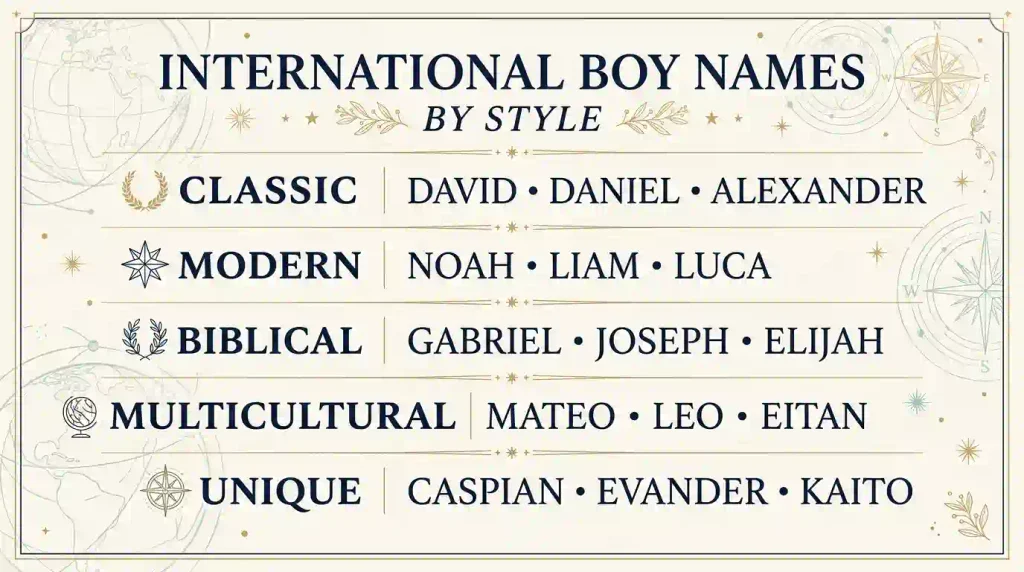
16. Popular International Boy Names by Style and Inspiration
Parents can use naming styles to discover international alternatives beyond the highest-ranked choices.
16.1 Classic and Timeless International Boy Names
David, Daniel, John, Michael, Alexander, Joseph, and Peter are longstanding international names.
They have extensive historical usage across countries.
16.2 Modern and Trending Global Boy Names
Noah, Leo, Luca, Mateo, Liam, Theo, and Oliver appear prominently in recent international comparisons.
They represent several linguistic origins while sharing contemporary appeal.
16.3 Unique and Uncommon International Boy Names
Caspian, Evander, Levente, Kaito, Noam, Eitan, and Birnir may appeal to parents seeking distinctive choices.
Their rarity depends on the country in which they are used.
16.4 Traditional Names With Religious Significance
Muhammad, Ibrahim, David, Daniel, Yusuf, Joseph, Gabriel, and Noah have important religious or historical associations.
16.5 Mythology-Inspired Boy Names From Different Cultures
Names such as Atlas, Orion, Apollo, and Evander are associated with classical mythology.
Other cultures have their own mythological naming traditions.
16.6 Boy Names Inspired by Music and Famous Personalities
Names associated with performers, athletes, and public figures may become more recognizable through popular culture.
Parents should distinguish personal inspiration from statistically documented trends.
16.7 Royal and Title-Inspired Baby Names
Names such as William, Henry, Alexander, and Louis have historical royal associations.
Their popularity also reflects linguistic and family traditions beyond royalty.
16.8 Popular Boy Names That Work Across Multiple Languages
Leo, Luca, Noah, Daniel, Gabriel, and Mateo are recognizable in several languages.
Parents seeking additional ideas can explore Popular & Rare Boy Names and compare name meanings, pronunciation, and international usage.
17. How to Choose an International Baby Boy Name
Choosing an international name involves more than selecting something recognizable in multiple countries.
Parents may also value cultural heritage, meaning, pronunciation, and family traditions.
17.1 How to Choose a Boy Name That Works Across Cultures
Consider how the name is pronounced and understood in the languages your family uses.
A name does not need identical pronunciation everywhere to be a meaningful international choice.
17.2 Choosing a Name Based on Meaning and Origin
Research the linguistic background carefully.
Some names have widely accepted meanings, while others have debated or uncertain origins.
Avoid relying on unsupported translations.
17.3 How to Consider Pronunciation in Different Languages
Say the name aloud in the languages most relevant to your family.
Consider common pronunciation differences and whether they are important to you.
17.4 Choosing Between Popular and Uncommon International Names
Popular names offer familiarity.
Less common choices may provide distinctiveness.
Neither is inherently better.
For additional naming inspiration, browse Boy Names and compare names based on their origins, meanings, and styles.
17.5 How to Honor Family Heritage Through a Baby Name
A name can honor relatives, languages, traditions, or important cultural figures.
Its personal significance may matter more than international rankings.
17.6 Can Cousins or Siblings Share the Same First Name?
Yes, naming customs differ between families and cultures.
Some families commonly repeat names across generations, while others prefer unique names for each child.
17.7 How to Find a Name That Is Recognizable Internationally
Compare name usage across the countries and languages relevant to your family.
Check spelling variations, pronunciation, and cultural associations.
17.8 How to Choose a Meaningful Name for Your Baby Boy
Make a shortlist of names that feel personally important.
Compare their histories and pronunciation.
Choose a name that fits your family’s preferences rather than relying solely on global popularity.
18. Where Do Worldwide Baby Name Rankings Come From, and How Accurate Are They?
Worldwide baby-name rankings are produced from different data sources.
Understanding their limitations is essential for accurate interpretation.
18.1 How Global Baby Name Popularity Is Measured
Global popularity can be measured through national birth counts, standardized percentages, name-family comparisons, or the number of countries where a name appears.
Each method produces different results.
18.2 Nameberry’s International Baby Name Rankings
Nameberry’s September 2026 study compared leading names across 38 countries and selected regional lists.
It grouped related names into families.
Noah ranked first using that methodology.
18.3 NameKun’s International Name Popularity Study
NameKun analyzed top-100 name information from 139 countries.
It ranked names using an international popularity score.
David led that comparison.
18.4 Letter Solver’s Most Popular Baby Names by Country Research
Letter Solver conducted country-by-country research using available local reports.
Its findings highlighted variations of Mohammed and other globally familiar names.
The underlying data was collected through June 2023, so it should not be treated as a current 2026 annual ranking.
18.5 How National Birth Records Are Used in Global Comparisons
National registries provide the strongest foundation for country-level rankings.
However, different countries may count first names, all given names, or spelling variants differently.
Researchers must document these distinctions.
18.6 Latest Available Baby Name Rankings by Country and Year
| Country or region | Verified reporting period | Leading boy name | Source type |
| United States | 2025 | Liam | Government |
| Canada | 2025 | Noah | Government |
| England and Wales | 2025 | Muhammad | Government |
| France | 2025 | Gabriel | Government |
| Germany | 2025 | Noah | National language research organization |
| Netherlands | 2025 | Noah | Government social insurance agency |
| Norway | 2025 | Noah | Government |
| Denmark | 2025 | Oscar | Government |
| Sweden | 2025 | Noah | Government |
| Austria | 2025 | Noah | Government |
| Belgium | 2025 | Noah | Government |
| Ireland | 2025 | Rían | Government |
| Switzerland | 2025 | Noah | Government |
| Finland | 2025, Finnish-speaking families | Eino | Government |
| Iceland | 2025 | Birnir | Government registry |
| Spain | 2024 | Mateo | Government |
| Poland | First half of 2026 | Nikodem | Government |
| Turkey | 2025 | Alparslan | Government |
| Russia | 2025 | Mikhail | National registration analysis |
| Brazil | 2025 | Ravi | Civil registration |
| Argentina | 2025 registration comparison | Benjamín | National registration research |
| Chile | 2025 | Mateo | Civil registration |
| Israel | Hebrew year 5786 | Mohammad | Population authority |
| South Africa | 2024 | Lethabo | Government |
| South Korea | 2025 | Do-yun | Birth-registration analysis |
| New Zealand | 2025 | Noah | Government |
| Australia | 2025, state and territory lists | Varies by jurisdiction | State registries |
This table does not cover every country and should not be interpreted as one standardized worldwide ranking.
18.7 Which Countries Publish Official Annual Baby Name Statistics?
Countries and regions with established public reporting include the United States, Canada, England and Wales, France, Austria, Norway, Denmark, Belgium, the Netherlands, Sweden, New Zealand, and several others.
Some publish downloadable birth counts, while others provide only limited lists.
18.8 Countries Without Reliable Public Baby Name Rankings
A country may not publish comprehensive rankings because of administrative limitations, privacy rules, or differences in civil-registration systems.
India, Pakistan, Bangladesh, Nigeria, and several other countries lack a single easily comparable national annual dataset verified for this article.
In such cases, avoid inventing exact ranks.
18.9 Why Some Worldwide Rankings Use Data From Different Years
National statistics are released on different schedules.
Some countries publish data shortly after the end of a year.
Others require more time to process registrations.
International research therefore often combines the latest available records from different periods.
18.10 Comparing Number of Countries, Total Births, and Population-Weighted Popularity
These are distinct measurements.
A name appearing in many countries may have fewer total births than a name concentrated in one populous country.
Population-weighted comparisons require consistent denominators and name-family definitions.
18.11 Why Worldwide Baby Name Lists Show Different Results
Studies may disagree because they measure different populations, years, spellings, or forms of popularity.
For example, a country-appearance ranking can identify Noah as a leading recent newborn name family, while a broad international usage score can place David first.
18.12 How to Verify International Baby Name Statistics
Check the original source and publication date.
Confirm the birth year, geographic coverage, and counting method.
Avoid treating website search trends as official births.
For an example of a reliable government database, consult the Social Security Administration’s Popular Baby Names records.
18.13 Limitations of International Baby Name Popularity Data
Global rankings face several limitations, including incomplete country coverage, inconsistent spellings, different calendar years, and language-specific registration conventions.
These limitations should be disclosed rather than hidden.
18.14 Research Methodology, Data Sources, and Update Dates
This article combines Nameberry’s 2026 international newborn-name comparison, NameKun’s cross-country research, Letter Solver’s historical country-based work, and verified national statistics available by November 2026.
Country-specific rankings are labeled with their respective reporting periods.
Where current official national data could not be established, examples are presented without unsupported ranking positions.
19. Frequently Asked Questions About the Most Popular Boy Names in the World
19.1 What Is the Number One Boy Name in the World?
Noah leads Nameberry’s 2026 international newborn-name comparison, but no universal official world ranking exists.
19.2 What Are the Top 10 Most Popular Boy Names Worldwide?
Nameberry’s leading name families are Noah, Leo, Luca, Mateo, Liam, Jack, Oliver, Theodore, Jakob, and Aleksander.
19.3 Is Muhammad the Most Common Male Name in the World?
Muhammad and its variants are widely used, but no comprehensive global count confirms a definitive number-one position.
19.4 Is Noah One of the Most Popular International Boy Names?
Yes, Noah appears in leading baby-name rankings across numerous European and English-speaking countries.
19.5 What Are the Most Popular Boy Names in Europe?
Noah, Leo, Luca, Oliver, Mateo, and Gabriel are prominent examples across recent national charts.
19.6 What Are the Most Popular Boy Names in Asia?
Popular choices vary greatly by country and include Muhammad, Alparslan, Do-yun, and culturally specific names from many languages.
19.7 Which Boy Names Are Common Across Different Countries?
David, Daniel, Noah, Leo, Luca, Michael, John, and Alexander-related names are internationally recognizable.
19.8 What Are the Most Popular Religious Boy Names Worldwide?
Muhammad, Noah, David, Daniel, Joseph, John, and Gabriel have extensive religious and cultural histories.
19.9 Which International Boy Names Have the Best Meanings?
Leo, Theodore, Mateo, David, Gabriel, and Alexander offer meaningful historical interpretations.
19.10 What Are Some Unique International Boy Names?
Caspian, Evander, Birnir, Kaito, Levente, and Noam are distinctive options depending on the country.
19.11 Are Global Baby Name Rankings Official?
No, worldwide rankings are research comparisons assembled from different national or regional datasets.
19.12 Why Do Different Countries Have Different Popular Boy Names?
Language, religion, family traditions, culture, and historical preferences influence national naming patterns.
19.13 How Do I Choose an International Name for My Baby Boy?
Compare meaning, pronunciation, family heritage, and cultural significance across the languages relevant to your family.
19.14 Which Boy Name Is Popular in the Most Countries?
David appeared in 113 countries in NameKun’s study, while Noah led Nameberry’s recent top-10 appearance comparison.
19.15 What Is the Most Common Male Name Among Adults Worldwide?
No definitive worldwide living-population ranking is available.
19.16 Do Different Spellings Affect Global Baby Name Rankings?
Yes, variations such as Muhammad, Mohammed, and Mohammad can substantially affect counts and rankings.
19.17 Which Countries Have the Most Diverse Baby Boy Names?
A reliable worldwide comparison requires standardized diversity measures rather than raw counts alone.
19.18 What Are the Fastest-Rising International Boy Names?
There is no verified universal ranking; names must be compared using country-specific historical data.
19.19 Are There Boy Names That Are Gender-Neutral in Other Countries?
Yes, names such as Andrea, Robin, Alex, and Jordan can have different gender associations across cultures.
19.20 Where Can I Find the Latest Official Baby Name Rankings by Country?
Consult the relevant country’s government statistics office or civil-registration agency and check its latest reporting year.
20. Final Thoughts: Most Popular Boy Names in the World
The most popular boy names in the world reveal how naming traditions connect families across countries, languages, and generations. Noah leads Nameberry’s recent international newborn-name comparison, while David ranks first in NameKun’s broader cross-country popularity analysis. Other internationally recognizable choices include Leo, Luca, Mateo, Liam, Muhammad, Daniel, and Alexander.
However, global popularity does not have one universal definition. Rankings differ by country, birth year, spelling conventions, and research methodology.
Whether you prefer a traditional religious name, a short modern favorite, or something distinctive from your family’s cultural heritage, international rankings can provide inspiration without determining your decision.
Explore name meanings, compare national popularity charts, and shortlist names that reflect your family’s language, traditions, and values. The ideal boy name is one that carries personal meaning and feels right throughout your child’s life.