

How Common Is a Name? Check Name Popularity, Frequency, and Rarity in the USA
Summary
How common is a name, and how many people share yours? Whether your name is Liam, Noah, James, Alexander, or something unusual, understanding its popularity can reveal fascinating details about its history, frequency, and uniqueness. In the United States, name popularity is measured using birth records, population statistics, and historical naming trends. The Social Security Administration (SSA) tracks baby names dating back to 1880, while the U.S. Census Bureau provides information about names found among the broader population.
To find out how popular your name is, you can check its national ranking, compare birth-year statistics, explore state-level trends, and estimate how many people share your first or last name. You can also discover when your name was most popular, whether its usage is increasing or decreasing, and how spelling variations influence its frequency.
This guide explains how name popularity works, how to calculate name rarity, and where to find reliable statistics. It also explores popular American boy names, generational naming trends, and practical ways to determine whether your name is genuinely unique.
Table of Contents
- How Common Is a Name? Quick Overview
- How to Check How Common Your Name Is
- Where Does Name Popularity Data Come From?
- How to Calculate and Estimate Name Frequency
- What Are the Most Common Names in America?
- How Common Is Your Name Among People Your Age?
- How Has Name Popularity Changed Over Time?
- How Does Name Popularity Vary by Location?
- How Do Spelling Variations and Nicknames Affect Name Popularity?
- How Accurate Are Name Popularity Checkers and Calculators?
- What Are the Odds of Meeting Someone With Your Name?
- Are American Names Becoming More Unique Over Time?
- How Popular Is Too Popular for a Baby Name?
- What Does Your Name Mean and Where Does It Come From?
- Does Having a Common Name Affect Your Online Identity?
- What If Many People Share Your Name?
- Frequently Asked Questions
- Final Thoughts
1. How Common Is a Name? Quick Overview
The popularity of a name depends on how frequently it appears within a particular population, location, or time period. A name can be extremely common among American adults but relatively uncommon among babies born today.
For example, James and John have been used extensively for generations, while Liam and Noah are particularly prominent in recent U.S. birth records. Comparing those names requires more than checking a single popularity ranking.
Understanding name frequency begins with distinguishing between the number of people who already have a name and the number of newborns receiving it.
1.1 What Makes a Name Common, Rare, or Unique?
A common name is used by a relatively large number of people within a defined population. A rare name appears less frequently, while a unique name may belong to just one person within a particular dataset.
However, there is no universally accepted statistical boundary separating common and rare names.
A name’s classification depends on factors such as population size, birth year, location, and spelling.
For instance, Michael is familiar across several American generations, whereas a recently invented name might appear only a handful of times in available records. That does not necessarily mean the newer name belongs to only one individual worldwide.
For practical comparisons, name rarity can be described using illustrative categories:
| Name category | General interpretation |
| Extremely common | Used by a large share of the relevant population |
| Common | Frequently appears in official name statistics |
| Moderately common | Recognizable but less frequent than leading names |
| Uncommon | Appears relatively infrequently |
| Rare | Has a very small recorded frequency |
| Unique or nearly unique | Has few or no matches in the available dataset |
These categories are descriptive, not official classifications issued by the SSA or Census Bureau.
1.2 How Many People Have the Same Name as You?
The number of people sharing your name depends on whether you are examining your first name, surname, or complete name.
Someone named James may share that first name with millions of Americans. Someone named James Smith belongs to a smaller group, while adding a distinctive middle name could narrow the possibilities further.
You can obtain population-level first-name and surname counts from the Census Bureau, but publicly released Census name tables do not provide exact counts of individual full-name combinations.
That distinction matters when a website claims to know precisely how many people share your complete name.
1.3 What Does Name Popularity Actually Mean?
Name popularity measures how frequently a name appears relative to other names.
In baby-name statistics, popularity usually refers to how often parents selected a particular given name during a specific birth year.
The SSA ranks names separately for boys and girls according to their recorded birth counts.
A name ranked first has the highest recorded frequency within that year’s applicable dataset. However, its position does not tell you how many living Americans currently have that name.
Popularity therefore has several meanings:
| Measurement | What it tells you |
| Birth-year ranking | How frequently a name was given to newborns in a particular year |
| Population frequency | How many recorded people have the name |
| Historical popularity | How usage changed across decades |
| Regional popularity | How frequently a name appears in a particular location |
| Full-name estimate | An approximate number of people sharing a complete name |
1.4 What Can Name Frequency Tell You About Your Name?
Name frequency can reveal whether your name is widespread, concentrated within certain age groups, or associated with a particular historical period.
For example, finding that your name peaked in the 1980s might explain why you meet more adults than children with that name.
Historical data can also reveal cultural changes. Traditional names sometimes decline and return decades later, while modern names may experience rapid growth following exposure through popular culture.
For parents choosing a baby boy’s name, frequency statistics help distinguish a fashionable choice from a long-established favorite.
1.5 Name Popularity vs. Name Rarity: What’s the Difference?
Popularity and rarity describe opposite aspects of the same underlying distribution.
A highly popular name generally has low rarity because many people use it. A rare name has low recorded frequency within the chosen dataset.
However, popularity rankings and rarity scores are not always directly interchangeable.
For instance, a name ranked 900th among newborn boys may be uncommon within that birth year but could still have thousands of living bearers across earlier generations.
Always check which population and time period a rarity checker uses.
1.6 How Common Is Your Name? Quick Reference Guide
| Your question | Best starting point |
| How common is my first name in America? | 2020 U.S. Census first-name tables |
| How popular is my name among babies? | SSA annual birth-name rankings |
| When was my name most popular? | SSA historical name search |
| How common is my surname? | Census surname frequency tables |
| Is my name popular in my state? | SSA state-level birth-name statistics |
| How many people share my full name? | Statistical estimate or carefully interpreted public-record search |
| How unique is my name worldwide? | Country-specific databases and cautious estimates |
The most reliable answer usually comes from comparing multiple appropriate sources rather than relying on a single popularity score.
2. How to Check How Common Your Name Is
Finding out how common your name is starts with identifying exactly what you want to measure. You might be interested in the popularity of your first name among babies, the number of people with your surname, or the historical frequency of your complete name.
Different resources answer different questions, so choosing the correct lookup method is essential.
2.1 How to Find Out How Many People Have Your First Name
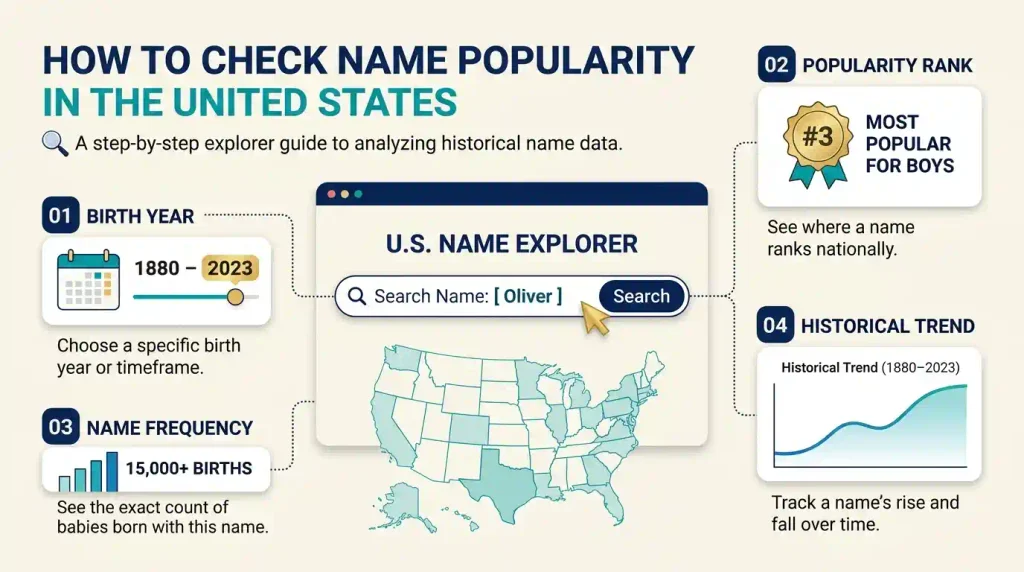
The 2020 U.S. Census first-name tables are a useful starting point for identifying how frequently a given name appeared among people counted in that Census.
Search for your exact first name and examine its reported frequency, ranking, and relevant population details.
For example, someone named Alexander could investigate how frequently Alexander appears among the wider U.S. population rather than looking only at recent baby-name rankings.
If your main interest is selecting a name for a newborn, birth-year rankings are more relevant.
Parents exploring meaningful Boy Names can use these statistics to understand whether a favorite choice is currently fashionable, historically established, or relatively unusual.
2.2 How to Check How Many People Share Your Last Name
To research a surname, use the U.S. Census Bureau’s published surname frequency tables.
These datasets provide counts for qualifying surnames and show how surname distributions change across census years.
Names such as Smith, Johnson, Williams, Brown, and Jones have remained among the most familiar American surnames for generations.
When examining surname statistics, consider capitalization, punctuation, cultural spelling differences, and name changes.
A common surname does not necessarily indicate that two people are related, even when their family names are identical.
2.3 How to Find People With Your Exact Full Name
Checking a complete name is more complicated than checking a first name.
Official Census name-frequency datasets publish first-name and last-name information separately, rather than identifying specific individuals through combined names.
You can search public directories or genealogy resources for matching full names, but these services may contain duplicate records, outdated addresses, and historical listings.
A statistical full-name estimate can suggest how common a combination might be. It cannot reliably establish the exact number of living people sharing that combination.
For better accuracy, compare surname prevalence, first-name frequency, and relevant geographic or cultural patterns.
2.4 How to Use a Name Popularity or Rarity Calculator
A name popularity calculator typically accepts a first name and searches a database for its frequency or ranking.
Depending on the tool, the results may include birth counts, historical trends, population percentages, or an estimated rarity category.
Before relying on the result, check whether the underlying dataset represents newborns, the entire population, or a third-party collection of records.
2.4.1 Interactive U.S. Name Frequency Checker
A useful U.S. name frequency checker should allow users to enter a given name and select their preferred comparison.
For example, a properly designed tool could offer:
| Input | Available result |
| First name | Recorded frequency and ranking |
| Birth year | Popularity during that year |
| Sex category | Corresponding SSA name statistics |
| State | State-level birth-name popularity |
| Multiple names | Side-by-side popularity comparison |
| Historical period | Change in ranking across years |
A trustworthy checker should also display the source year, relevant population, and any limitations.
Not every website provides all these functions, and a tool should never present estimated full-name matches as exact government counts.
2.4.2 How to Interpret Your Name Frequency Results
Suppose a name checker reports that a name ranked 25th among American boys born in a particular year.
That result means 24 names ranked ahead of it under the source’s ranking method. It does not mean the name belongs to 25% of boys or that only 25 people have it.
If the checker also reports a birth count, you can compare that number with the total number of eligible births.
This gives a clearer picture of the name’s actual prevalence.
2.5 How to Look Up Your Name in Official U.S. Databases
One of the best resources for historical American baby-name research is the Social Security Administration’s Popular Baby Names database.
The database allows you to investigate names by birth year, historical period, and location.
To research a name, enter its spelling, select the relevant sex category when required, and review the resulting popularity information.
You can also consult the Census Bureau’s name-frequency datasets for a broader population-based perspective.
The two sources complement one another because they measure different populations.
2.6 How to Compare the Popularity of Two or More Names
If you are wondering which name is more popular, compare names using the same data source, birth year, and geographic area.
For instance, comparing Liam and Oliver in the 2025 SSA rankings is meaningful because both names are measured using the same national birth-name data.
However, comparing Liam’s 2025 birth ranking with Oliver’s lifetime frequency would produce a misleading conclusion.
A name comparison table should ideally contain:
| Comparison factor | Name A | Name B |
| National rank | Recorded rank | Recorded rank |
| Birth count | Number of births | Number of births |
| Historical peak | Peak year or period | Peak year or period |
| Recent direction | Rising, falling, or stable | Rising, falling, or stable |
| Regional popularity | Relevant state data | Relevant state data |
2.7 How to Check Name Popularity by Birth Year
Birth-year analysis helps answer questions such as “What year was my name most popular?” and “When was my name popular?”
Search your name across the SSA’s historical records and examine its annual rankings or birth counts.
A name might achieve its highest ranking in one year while reaching its highest number of recorded births in another.
For this reason, distinguish between its peak ranking and peak birth count.
If you want to know how familiar your name was among people born around the same time as you, compare a period of several years rather than a single date.
2.8 How Many Different First Names Are There?
There is no single universal count of all possible first names.
The number depends on the country, language, spelling conventions, population, and rules used to normalize names.
The edited 2020 U.S. Census data contained approximately 5.2 million different first-name entries across the population. Most appeared fewer than 100 times, and the public frequency tables identify 53,615 first names meeting the threshold of at least 100 occurrences.
This enormous variety includes uncommon spellings, multilingual names, invented names, and other distinct name forms.
The figure reflects the Census Bureau’s processed dataset, not a dictionary of 5.2 million established baby names.
3. Where Does Name Popularity Data Come From?
Name popularity statistics are created from administrative records, population data, and demographic research.
Two particularly important sources for American names are the Social Security Administration and the U.S. Census Bureau.
Understanding how these organizations collect information is necessary for interpreting name rankings accurately.
3.1 Social Security Administration (SSA) Baby Name Records
The SSA publishes historical given-name statistics using information from Social Security card applications.
Its baby-name series extends back to births in 1880, making it especially useful for studying long-term American naming trends.
The dataset records names by birth year and sex category, with national and state-level files available.
The SSA’s published records have limitations. Some people born in earlier periods never obtained Social Security numbers, and certain low-frequency names are excluded from public data to protect privacy.
3.1.1 What Does the 2025 SSA Baby Name Data Reveal?
The latest completed annual SSA rankings, released in May 2026 for births in 2025, show that Liam and Olivia remained the most popular names for American boys and girls, respectively.
Among boys, Noah, Oliver, Theodore, and Henry completed the top five.
These results illustrate the popularity of relatively short, familiar names alongside traditional names experiencing renewed interest.
The rankings describe naming choices for babies born in 2025, not the most common names among all living Americans.
3.1.2 How to Access Historical SSA Name Rankings
The SSA provides annual popularity records, decade-level summaries, and historical comparison tools.
Choose a name and examine its position across multiple birth years to identify increases, declines, and periods of stability.
For deeper research, downloadable national and state-specific datasets contain additional name records beyond the standard top-1,000 website display.
These datasets are useful for studying uncommon names, historical changes, and naming patterns across generations.
3.2 U.S. Census Bureau First and Last Name Statistics
The Census Bureau publishes statistical tables showing the frequency of names reported by the U.S. population.
Its surname data enables researchers to study familiar family names, while the 2020 Census release also includes extensive first-name information.
Unlike SSA annual birth statistics, Census counts reflect people included in a population enumeration.
These sources should not be treated as interchangeable.
3.2.1 What Does the 2020 U.S. Census Reveal About Name Frequency?
In April 2026, the Census Bureau released first-name and last-name statistics from the 2020 Census.
After data processing, first names were recorded for approximately 302 million people, covering about 91.1% of the enumerated population.
The most frequently reported first names were Michael, John, James, David, and Robert.
The release also provides information about surnames and broad demographic patterns while protecting individual confidentiality.
One important limitation is that these tables do not publish exact first-and-last-name combinations.
3.2.2 What Is the Difference Between Census Name Counts and SSA Birth Records?
| Feature | U.S. Census | SSA baby-name records |
| Main population | People included in a census | Recorded births by year |
| Primary purpose | Population name frequency | Baby-name popularity |
| First names | Available in 2020 release | Historical annual series |
| Last names | Available | Not included in popular baby-name tables |
| Historical trends | Census-to-census comparisons where available | Annual and decade-level comparisons |
| Exact full names | Not publicly provided | Not provided |
| Best for | Population-level name frequency | Birth-year and baby-name trends |
The SSA tells you how frequently a name was given to newborns. The Census helps establish how widespread a name was among a broader population at a particular point in time.
3.3 Public Records and People Search Databases
Public-record directories may include information derived from property records, historical address listings, court records, or other legally accessible sources.
Such services can sometimes identify multiple records associated with the same name.
However, directory entries are not equivalent to unique people.
A single individual may appear under several addresses or name variations. Some records may refer to deceased individuals or contain outdated information.
Public-record searches are therefore better suited to carefully defined identification or genealogy tasks than precise population-frequency calculations.
3.4 Why Records and Actual People Are Not the Same
A collection containing 100 records associated with a particular name does not necessarily represent 100 different living individuals.
Duplicate records, name changes, old addresses, and incomplete identifiers can inflate apparent frequencies.
Conversely, people with limited public records may be missing entirely.
This is why a website’s record count should not automatically be interpreted as a population count.
A reliable name-frequency calculation requires a clearly defined unit, such as people, births, records, or households.
3.5 How Name Frequency Data Is Collected and Analyzed
Official name statistics generally involve collecting name information, standardizing selected fields, counting occurrences, and applying privacy protections.
Researchers may perform spelling normalization, remove invalid entries, or use disclosure-avoidance methods to protect confidentiality.
The exact treatment differs between datasets.
For example, SSA records generally distinguish different spellings of a given name, while some punctuation and spacing differences are normalized.
Understanding these methodological decisions helps explain why two credible sources may produce different results.
3.6 Which Name Popularity Data Source Is Most Reliable?
The best source depends on the question.
For a boy’s birth-year popularity ranking, SSA data is generally the most appropriate American source.
For a surname’s frequency in the wider U.S. population, Census tables are more relevant.
For historical research involving family relationships, carefully verified genealogical records may be necessary.
A trustworthy name calculator should identify its source, collection year, geographic coverage, and limitations rather than simply displaying a popularity score without explanation.
4. How to Calculate and Estimate Name Frequency
Understanding how name frequency is calculated helps you interpret statistics and recognize misleading results.
The most common measurements include rank, birth count, population percentage, and frequency per 100,000 people.
Full-name calculations require additional assumptions because official datasets typically report first names and surnames separately.
4.1 Understanding Name Popularity Rankings vs. Actual Counts
A name’s rank describes its position relative to other names.
Its count describes how many eligible births or people were recorded with that name.
For example, a name ranked 10th in two different years may have different birth counts because the total number of births and the distribution of names changed.
A ranking is useful for comparison, but counts reveal the actual scale of usage.
Whenever possible, examine both figures together.
4.2 How to Interpret Name Frequency Ratios and Percentages
Name frequency can be expressed as a percentage of a defined population.
The basic calculation is:
Name frequency percentage = (Number of people with the name ÷ Total relevant population) × 100
For example, imagine a fictional dataset containing 2,000 people, of whom 40 have the same first name.
The name’s frequency would be:
40 ÷ 2,000 × 100 = 2%
This means 2% of the people in that particular dataset share the name.
4.2.1 What Does 1 in 71 People Mean?
A frequency of 1 in 71 means that approximately one person out of every 71 in the specified population has the name.
Expressed as a percentage:
1 ÷ 71 × 100 = approximately 1.41%
However, the ratio only makes sense when the underlying population is clearly identified.
One in 71 recorded male births is very different from one in 71 residents of the United States.
4.2.2 How to Calculate Name Frequency per 100,000 People
Researchers often standardize frequencies per 100,000 people.
The calculation is:
Frequency per 100,000 = (Name count ÷ Population count) × 100,000
Suppose a name appears 250 times among 500,000 people.
Its standardized frequency is:
250 ÷ 500,000 × 100,000 = 50 per 100,000 people
Standardized rates help compare populations of different sizes without confusing large population totals with genuinely high name prevalence.
4.3 How to Calculate Your Name’s Percentile Among Americans
A percentile requires a defined distribution and comparison method.
For example, researchers might compare a name’s frequency with the frequencies of every other name in a dataset.
If a name is more frequent than 90% of the distinct names considered, it could be described as being above the 90th percentile of those names by frequency.
This does not mean 90% of Americans have less common names, because names vary greatly in the number of people who carry them.
Likewise, a rank among the top 1,000 baby names is not automatically a percentile among all American names.
For personal name research, a clear frequency percentage or birth-year rank is often easier to interpret.
4.4 How to Estimate the Number of People With Your Full Name
A rough full-name estimate can be calculated from first-name and surname frequencies.
One simplified approach assumes that first names and surnames occur independently.
Under this assumption:
Estimated full-name count = (First-name count × Surname count) ÷ Population count
This model is useful for illustrating how combined-name probabilities work, but it does not produce a verified count of real individuals.
4.4.1 The First-Name and Last-Name Independence Method
Imagine a hypothetical population of 10 million people.
Suppose 100,000 have the first name Alex and 50,000 have the surname Carter.
The independence estimate would be:
(100,000 × 50,000) ÷ 10,000,000 = 500 people
This result represents a mathematical expectation under the assumed distribution.
It does not establish that exactly 500 people named Alex Carter exist.
4.4.2 When the Independence Estimate Fails
The independence assumption becomes less reliable when first names and surnames are associated with cultural, ethnic, linguistic, or regional naming traditions.
Certain first names occur more frequently in communities where particular surnames are also common.
Migration patterns and differences between age groups can further affect the relationship.
Consequently, multiplying national frequencies may overestimate or underestimate the number of people sharing a full name.
4.4.3 Why Certain Full-Name Combinations Occur More Often Than Expected
Name combinations are influenced by family background, language, and geography.
A given name associated with one naming tradition may appear disproportionately often alongside surnames from the same tradition.
For example, two names could have identical national frequencies but very different probabilities of appearing with a specific surname.
A more sophisticated full-name estimate would use joint name-frequency data or demographic modeling, rather than assuming complete independence.
4.5 Worked Example: How Many People Are Named John Smith?
John Smith is often used as an example of a common American full name because both components are widespread.
However, official Census name-frequency tables do not supply an exact verified count of living Americans named John Smith.
To illustrate the mathematical method, suppose a fictional population contains:
| Variable | Hypothetical value |
| Total population | 330,000,000 |
| People named John | 4,000,000 |
| People surnamed Smith | 2,000,000 |
The independence estimate is:
(4,000,000 × 2,000,000) ÷ 330,000,000 = approximately 24,242
This is an illustrative calculation using hypothetical inputs, not an actual John Smith population estimate.
4.5.1 John Smith Name Frequency Across U.S. States
Estimating the frequency of John Smith in individual states requires appropriate state-level information about both components of the name.
National name counts cannot reliably establish the distribution of a full name across states.
An estimate would ideally account for local age distributions, surnames, population size, and naming patterns.
Without those inputs, any precise state-level John Smith count would be speculative.
4.5.2 States With the Highest and Lowest John Smith Frequency
There are two different ways to compare how common John Smith might be across states.
Total count refers to the number of residents sharing the name.
Per-capita frequency refers to the share of the state’s population that has the name.
A populous state might have more John Smiths overall but a smaller percentage of residents with that name than a less populous state.
Reliable rankings require actual state-level combined-name evidence or an explicitly labeled statistical model.
4.5.3 Why Texas, Florida, and California Have Large John Smith Record Counts
Texas, Florida, and California have large populations, which can produce large numbers of records associated with familiar names.
However, the number of directory records should not be confused with the number of unique living residents sharing a name.
Population size, duplicate listings, address history, and differences between data providers can all influence apparent counts.
This is particularly important when comparing records collected from commercial people-search services.
4.6 Additional Name Frequency Calculation Examples
Consider three fictional names recorded within a population of 100,000 people.
| Example name | Recorded count | Population frequency |
| James | 2,500 | 2.5% |
| Oliver | 600 | 0.6% |
| Cassian | 40 | 0.04% |
In this imaginary dataset, James is the most common, followed by Oliver and Cassian.
However, the results would change if the dataset represented newborn boys rather than adults of all ages.
This illustrates why the population definition matters as much as the name count itself.
4.7 How to Compare Multiple Names Using a Popularity Table
A meaningful name comparison should keep the year, geography, source, and population consistent.
For example, compare Noah, Oliver, Theodore, and Henry using their SSA rankings for the same birth year.
You can then examine historical trends separately to determine whether each name is traditionally established or currently fashionable.
For parents choosing between several boy names, this approach provides a more balanced assessment than relying only on a single ranking number.

5. What Are the Most Common Names in America?
The most common American names depend on whether you are studying newborns, the living population, or historical birth records.
Traditional names such as James, Michael, and John have accumulated substantial usage over multiple generations.
Meanwhile, Liam and Noah dominate recent American baby-boy rankings.
5.1 Top 10 Most Common Names in U.S. History
For a consistent long-term comparison, the SSA provides rankings covering the 100-year period from 1926 through 2025.
The following are the most frequently recorded boy names across that period:
| Rank | Boy name | Recorded births, 1926–2025 |
| 1 | James | 4,505,076 |
| 2 | Michael | 4,359,450 |
| 3 | John | 4,204,996 |
| 4 | Robert | 4,191,413 |
| 5 | David | 3,560,303 |
| 6 | William | 3,358,163 |
| 7 | Richard | 2,365,369 |
| 8 | Joseph | 2,246,662 |
| 9 | Thomas | 2,105,675 |
| 10 | Christopher | 2,063,964 |
These are cumulative recorded births across the specified 100-year period, not counts of people currently alive.
The results highlight the long-term strength of traditional American male names.
5.2 Most Common First Names in America Today
Current baby-name popularity and overall population frequency tell different stories.
Among people counted in the 2020 Census, Michael, John, James, David, and Robert were the five most frequently reported first names.
However, the most popular names given to babies in 2025 were substantially different.
This contrast reflects decades of changing naming preferences.
5.2.1 Most Common Male First Names
The SSA’s top 10 American boy names for births in 2025 were:
| Rank | Boy name |
| 1 | Liam |
| 2 | Noah |
| 3 | Oliver |
| 4 | Theodore |
| 5 | Henry |
| 6 | James |
| 7 | Elijah |
| 8 | Mateo |
| 9 | William |
| 10 | Lucas |
These rankings show the popularity of short names, biblical names, and traditional choices.
James and William demonstrate the lasting appeal of established names, while Liam and Oliver reflect strong contemporary naming preferences.
5.2.2 Most Common Female First Names
For comparison, the top five girl names among babies born in 2025 were Olivia, Charlotte, Emma, Amelia, and Sophia.
Female names historically display substantial variety, and the 2020 Census reported that the five most common first names across the whole population were predominantly male.
Studying both categories helps reveal broader differences in how naming preferences are distributed.
However, official name rankings are based on the sex categories recorded in the underlying data and do not determine an individual’s gender identity.
5.3 Most Common Last Names in the United States
Several surnames have remained extremely common throughout American history.
The Census Bureau reports that Smith, Johnson, Williams, Brown, and Jones occupied the same top-five surname positions in 2000, 2010, and 2020.
Other familiar surnames include Garcia, Miller, Davis, Rodriguez, and Martinez.
Surname frequencies change through population growth, immigration, marriage, family formation, and demographic shifts.
Their stability across generations makes surnames valuable for studying American population history.
5.4 Most Common Full-Name Combinations in America
A full name combines a first name with a family name, producing many possible combinations.
Names such as James Smith, John Johnson, Michael Williams, and David Brown may appear familiar because their individual components are common.
However, their actual combined frequencies cannot be determined by simply multiplying rankings.
No official Census table provides a verified national ranking of every complete name.
Commercial directories and mathematical estimates may offer clues, but results should be labeled according to their methodology.
5.5 How Have America’s Most Common Names Changed Between the 2010 and 2020 Censuses?
The 2010 and 2020 Census surname datasets allow meaningful comparisons of family-name frequency.
The Census Bureau found considerable long-term stability among leading surnames, alongside changes associated with immigration and demographic growth.
For example, several predominantly Hispanic surnames became increasingly prominent among the country’s most common family names.
The 2020 release also expanded public first-name analysis. It was the first Census release since 1990 to provide comparable national first-name data.
Therefore, a direct 2010-to-2020 comparison of first names should not be presented as though the same comprehensive public first-name tables existed for both years.
5.6 What Popular Name Lists Do Not Reveal
A top-10 or top-100 list cannot tell you everything about a name.
Rankings do not automatically show how people are distributed across age groups, how many individuals are currently alive, or how frequently a name occurs within your community.
They also do not combine different spellings or nicknames.
A name may rank highly nationally yet remain relatively uncommon in a particular school or neighborhood.
For accurate interpretation, combine ranking information with counts, time periods, and geographic context.
6. How Common Is Your Name Among People Your Age?
Age is one of the most important factors affecting name popularity.
A name that seems common among middle-aged adults may be unfamiliar to younger children, while a name popular in nurseries may be relatively rare among older generations.
Historical birth records can help explain these differences.
6.1 Is Your Name More Common Among Babies or Adults?
To determine whether your name is more common among babies or adults, compare recent SSA birth rankings with historical data and broader population statistics.
For example, Michael was exceptionally prominent in American naming history, whereas Liam has become a leading choice for recent newborn boys.
This does not mean Michael is now rare.
Rather, it demonstrates how a name’s prominence can differ between the existing population and a newly born generation.
6.2 Name Popularity by Generation
Generational naming patterns reflect the culture, traditions, and preferences prevailing when children were born.
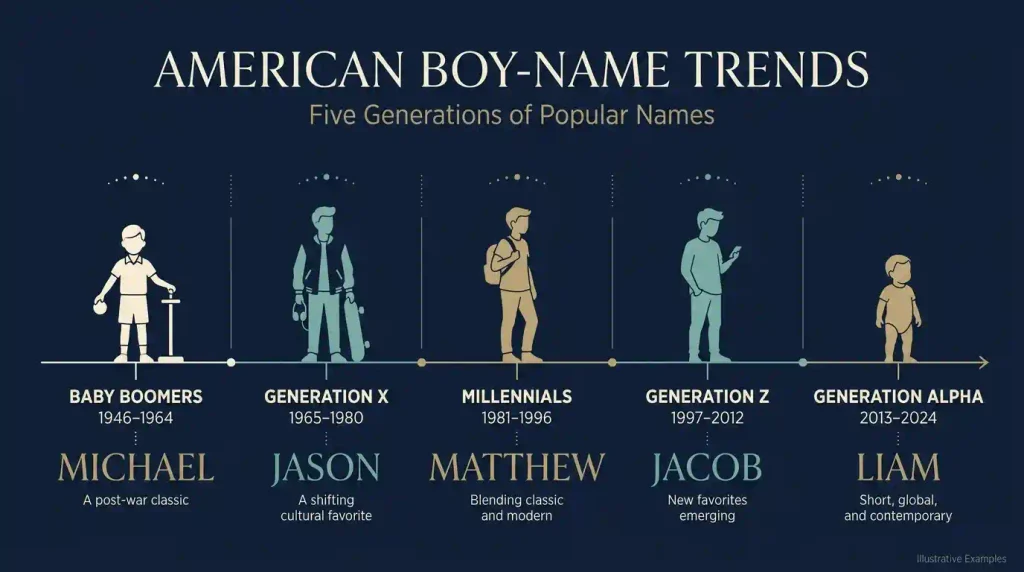
The following generational divisions are commonly used as approximate reference points, although boundaries can vary.
| Generation | Approximate birth years | Illustrative boy-name trends |
| Baby Boomers | 1946–1964 | Michael, James, John, Robert |
| Generation X | 1965–1980 | Michael, David, Jason, Christopher |
| Millennials | 1981–1996 | Michael, Matthew, Joshua, Daniel |
| Generation Z | 1997–2012 | Jacob, Ethan, Noah, Aiden |
| Generation Alpha | Approximately 2013 onward | Liam, Noah, Oliver, Theodore |
These names illustrate prominent trends within broad periods; they are not complete or exclusive generation-specific rankings.
6.2.1 Baby Boomer Generation Name Trends
Baby Boomers were born during an era when traditional biblical and established European-origin names occupied prominent positions in American birth records.
Michael, James, John, and Robert were especially familiar choices.
Many of these names remained popular for decades, contributing to their strong representation among the wider population.
Their longevity also explains why they are often perceived as timeless rather than belonging to only one generation.
6.2.2 Generation X Name Trends
Generation X birth years saw continued use of established names alongside rising choices such as Jason and Christopher.
Names associated with this period often became especially familiar among adults entering school, university, and employment during the late 20th century.
However, their historical frequency does not necessarily reflect how popular they are among babies today.
6.2.3 Millennial Generation Name Trends
Among Millennials, names such as Michael, Matthew, Joshua, Daniel, and Jacob were prominent during different parts of the period.
Biblical naming traditions remained influential, but changing preferences also introduced greater variety.
A Millennial named Matthew may therefore find more people sharing his name within his age group than among children born in the mid-2020s.
6.2.4 Generation Z Name Trends
Generation Z naming patterns included strong interest in names such as Jacob, Ethan, Noah, and Aiden.
Shorter names and modern-sounding variations became increasingly visible.
Spelling differences also became important, with similar-sounding names sometimes appearing as separate entries in official rankings.
This makes it useful to compare name families rather than relying exclusively on one spelling.
6.2.5 Generation Alpha Name Trends
Generation Alpha includes children born in the 2010s and 2020s, depending on the definition used.
Liam, Noah, Oliver, and Theodore are prominent examples from recent U.S. boy-name rankings.
Traditional names have remained influential, but parents also explore nature-inspired, international, and less frequently used names.
The generation is still young, so its overall naming patterns will continue developing.
6.3 How to Find Your Name’s Popularity in Your Birth Year
Start by identifying your birth year and searching the SSA’s corresponding popularity records.
Review your name’s rank and recorded birth count.
Then compare nearby years to determine whether the name was rising, falling, or remaining stable when you were born.
For example, someone born in 1995 should examine the mid-1990s rather than assuming today’s rankings reflect the popularity of their name at birth.
6.4 Why a Popular Baby Name May Be Rare Among Older Adults
Names often become fashionable during a particular period.
A name that gained widespread popularity only recently may have relatively few older bearers.
Conversely, a name that dominated earlier decades may continue appearing frequently among adults despite receiving fewer new births.
This difference is especially relevant when interpreting the rarity of modern boy names.
A recent top-ranked baby name can still be less common among the entire population than a traditional name with decades of accumulated usage.
6.5 How Age Distribution Affects Overall Name Frequency
Overall name frequency reflects the names of people across different ages.
A name’s present-day population count is affected by historical births, mortality, immigration, and other demographic changes.
Therefore, the cumulative number of recorded births with a name is not equivalent to the number of living individuals carrying it.
Accurate adult name-frequency estimates require information about the population, not just historical baby-name rankings.
7. How Has Name Popularity Changed Over Time?
American naming trends have changed substantially since the 19th century.
Some names have remained familiar across generations, while others have experienced dramatic rises, declines, or revivals.
Historical name statistics help explain when names were popular and how cultural preferences have evolved.
7.1 Popular Names in the 19th Century
Many American names popular in the 19th century reflected religious traditions, family customs, and names passed between generations.
John, William, James, George, and Charles were prominent examples among boys.
Names often remained popular for extended periods because naming traditions changed more gradually within some communities.
7.1.1 Popular Names in the United States
SSA records from the 1880s show John, William, James, George, and Charles among the leading boy names.
These names later became familiar across multiple generations, contributing to their enduring presence in American naming history.
Some traditional choices remain popular today, including James, William, and Henry.
Others have moved in and out of fashion while maintaining historical significance.
7.1.2 Popular Names in England and Wales
Historical English and Welsh naming records also demonstrate the influence of traditional names such as William, John, George, and Thomas.
British naming patterns influenced many American naming traditions, especially during earlier periods.
However, the two regions have developed distinct naming preferences over time.
Historical comparisons should use equivalent periods and recognize differences between birth-registration and American administrative datasets.
7.2 Popular Names in the 20th Century
The 20th century saw significant changes in American naming preferences.
Traditional names continued to dominate many periods, but new favorites emerged through cultural influence, generational change, and increased naming diversity.
Names such as Michael, Christopher, Jason, Matthew, and Joshua became prominent during different decades.
7.2.1 Popular Names in the United States
Michael became particularly influential in American baby-name history.
According to SSA historical rankings, it occupied the top position among boys repeatedly across the late 20th century.
Other prominent names included James, John, Robert, David, Christopher, and Matthew.
Studying decade-by-decade records shows that popularity can remain stable for years before shifting as new generations favor different styles.
7.2.2 Popular Names in England and Wales
England and Wales also experienced shifts from traditional names toward a broader range of modern choices.
Names such as David, Michael, James, and Daniel have appeared prominently during different historical periods.
The UK Office for National Statistics maintains historical baby-name records that support comparisons across decades.
Because the UK and United States use different data systems, researchers should compare proportions and appropriately defined periods rather than assuming rankings are directly equivalent.
7.3 Modern Names and Future Naming Trends
Modern baby-name trends combine traditional favorites with international influences, shorter names, and distinctive spelling choices.
Liam, Noah, Oliver, Theodore, and Mateo illustrate the diversity of contemporary American boy-name preferences.
Media, entertainment, family heritage, and popular culture can influence how frequently parents choose particular names.
However, predicting future name popularity is uncertain.
A rapid increase in ranking may continue, stabilize, or reverse as preferences change.
7.4 How to Tell Whether Your Name Is Rising or Falling in Popularity
To identify a trend, compare rankings and birth counts across several consecutive years.
If a name moves from rank 200 to rank 100, it has increased in relative popularity.
If it moves from rank 100 to rank 200, its ranking has declined.
However, movement in ranking does not always correspond to an increase or decrease in absolute birth count.
A reliable trend assessment considers both measures.
7.5 How to Read Name Popularity Trend Graphs
A name popularity graph usually displays time on the horizontal axis and popularity on the vertical axis.
Before interpreting the graph, identify whether the vertical axis represents rank, number of births, or percentage of births.
Ranking graphs can be particularly confusing because a smaller rank number represents greater popularity.
For example, moving from rank 50 to rank 10 indicates improvement even though the numerical value decreases.
Birth-count graphs have a more straightforward interpretation because larger values indicate more recorded births.
7.6 Why a Single Birth Year’s Ranking Can Be Misleading
Names can experience temporary popularity changes.
A celebrity, television character, sports figure, or other cultural influence may increase a name’s visibility during a particular year.
However, the name may return to its previous popularity afterward.
Examining at least five to ten years of data gives a better understanding of sustained trends.
A name that fluctuates slightly around rank 100 is different from one that rises rapidly from rank 900 to rank 100.
7.7 How to Compare Name Popularity Across Multiple Decades
Decade-level comparisons help identify long-term changes.
For example, compare John, Michael, Jacob, and Liam across the 1950s, 1980s, 2000s, and 2020s.
These names represent different periods of strong popularity, making them useful for historical comparisons.
An effective analysis should examine their rankings, recorded births, and shares of total births.
That approach helps distinguish genuinely widespread names from names that simply ranked highly during periods with different birth totals.

8. How Does Name Popularity Vary by Location?
A name’s popularity can change significantly depending on where people live.
National name rankings summarize an entire country, but they may not reflect local naming traditions or the preferences of particular communities.
Geography, language, migration, and cultural heritage influence name distribution.
8.1 National vs. State vs. Local Name Popularity
A name may rank highly across the United States while appearing less frequently within a particular state.
Similarly, a name that is relatively uncommon nationally may be familiar in a specific region.
The SSA provides state-level baby-name data that can reveal such differences.
However, state birth rankings describe names given to babies, not necessarily the complete population of people living within that state.
8.2 Most Common First Names in Each U.S. State
State-level popularity lists show which names were most frequently assigned to newborns in each state during a selected year.
To compare states properly, use the same birth year and equivalent ranking data.
A national favorite such as Liam may appear near the top in many states, but the exact rankings and birth counts can differ.
For state-by-state comparisons, examine both relative rank and the name’s share of recorded births whenever available.
8.3 Why Some Names Are More Common in Certain Regions
Regional name popularity can reflect linguistic traditions, family heritage, religious customs, and community demographics.
Names popular in one cultural community may be less familiar in another.
Migration also changes the distribution of names over time.
However, a person’s name does not reliably identify their ethnicity, religion, nationality, or background.
Name-frequency statistics describe population patterns, not the personal identity of a particular individual.
8.4 How to Compare Name Popularity Across Countries
To compare names internationally, use official statistical sources from each country.
For example, compare American SSA data with birth-registration statistics from England and Wales.
When performing comparisons, make sure the same name spelling, sex category, and birth period are being examined.
A name can be highly popular in one country but relatively uncommon in another.
8.4.1 Why the Same Name Rank Can Mean Different Things in Different Countries
A name ranked 10th in the United States does not necessarily represent the same number or percentage of births as a name ranked 10th in England.
Countries have different population sizes, naming diversity, and reporting systems.
Therefore, percentages are often more meaningful than raw rankings for international comparisons.
The relevant denominator should be the number of recorded births within the same category.
8.4.2 Where to Find Official Name Data Outside the United States
Several countries publish official name statistics.
England and Wales use birth-registration data published by the Office for National Statistics.
Other countries maintain national statistical agencies or civil-registration systems with their own reporting rules.
Before comparing international records, check the data year, population coverage, privacy thresholds, and treatment of spelling variations.
8.5 Why Calculating Worldwide Name Frequency Is Difficult
There is no single comprehensive, publicly accessible global register containing every living person’s first name.
Countries differ in data collection practices, privacy laws, spelling systems, and statistical reporting.
Some publish detailed name-frequency datasets, while others provide only limited historical or regional information.
This makes exact worldwide name counts extremely difficult to establish.
Any service claiming a precise global total should explain how it assembled its data and handled missing countries.
8.6 How to Estimate How Many People Have Your Name Worldwide
A worldwide estimate requires combining information from multiple countries.
Researchers can begin with official name-frequency datasets, calculate relevant population shares, and account for countries with incomplete records.
However, missing data, language differences, and transliteration can introduce substantial uncertainty.
For example, a name written in several alphabets may have multiple English spellings.
A responsible worldwide estimate should report an approximate range and clearly state its assumptions.
9. How Do Spelling Variations and Nicknames Affect Name Popularity?
Names that sound identical are not always counted together.
Spelling, punctuation, nicknames, and naming conventions can influence the way official databases classify a name.
This matters especially when comparing modern boy names with multiple accepted spellings.
9.1 Why Different Spellings of the Same Name Are Counted Separately
SSA records generally treat different spellings as distinct entries.
For example, Aiden, Ayden, and Aidan may have separate rankings despite their similar pronunciation.
Consequently, looking up just one spelling may underestimate the total popularity of the broader name family.
For precise research, distinguish between the exact spelling and the combined popularity of related variants.
9.2 How to Combine Name Variants for Accurate Popularity Estimates
To calculate the combined frequency of related spellings, collect their birth counts from the same dataset and year.
Then add the counts together.
For example, if three fictional spelling variants have counts of 500, 300, and 200, their combined total would be 1,000 births.
This combined figure can be useful for measuring a broader naming trend.
However, it should not be presented as the official rank of any individual spelling.
9.3 How Nicknames and Shortened Names Affect Name Frequency
Nicknames can complicate name searches because a person may be known by a name different from their registered first name.
For example, William may be called Will, Bill, or Billy.
Alexander may be shortened to Alex.
Some shortened forms are also used as independent legal first names.
A popularity lookup based on official birth records generally searches the recorded given name rather than every nickname associated with it.
9.4 How Gender-Neutral Names Appear in Popularity Statistics
Some names are used for babies recorded in different sex categories.
Examples include Jordan, Riley, Quinn, and Emerson.
The SSA publishes popularity rankings separately by recorded sex.
Therefore, a gender-neutral name may have different rankings and birth counts in each category.
For a complete name-frequency analysis, researchers can examine both datasets while clearly identifying the population being measured.
9.5 How Are Middle Names, Initials, and Name Suffixes Counted?
Middle names and initials are usually not part of the SSA’s published first-name popularity rankings.
Someone named James Alexander Smith and another person named James Robert Smith would generally contribute to the same first-name frequency for James.
Suffixes such as Jr., Sr., and III may also be handled differently depending on the database and normalization method.
When estimating complete-name matches, middle names and suffixes can help distinguish individuals, but public first-name statistics do not provide a comprehensive way to count every combination.
9.6 How Do Hyphenated Names, Accents, and Transliteration Affect Name Counts?
Name databases may remove punctuation, normalize spaces, or apply other formatting rules.
The SSA’s first-name methodology removes hyphens and spaces, so certain formatting variations can be combined.
Accents and transliterated names may require additional care.
For example, names converted from Arabic, Cyrillic, or other writing systems may appear with different Latin-alphabet spellings.
Researchers should check the source’s normalization rules before interpreting an unusually low frequency.
10. How Accurate Are Name Popularity Checkers and Calculators?
Name popularity tools can provide useful information, but their accuracy depends on the quality of the underlying data.
Some rely on official birth records, while others use public directories, population estimates, or proprietary databases.
These differences can produce conflicting results.
10.1 Why Different Websites Report Different Name Counts
Two websites may report different frequencies because they use different source years, geographic regions, or population definitions.
One may count American newborns, while another estimates living adults.
A third might count directory listings rather than individuals.
Spelling normalization, incomplete records, and privacy protections can create further differences.
The most useful comparison is between tools that describe exactly what their counts represent.
10.2 Why Name Frequency Estimates Are Not Always Exact
Exact counts are difficult when records are incomplete or the population changes over time.
Birth data may not reflect the current living population, while census records capture a population at a particular date.
Full-name estimates introduce additional uncertainty because first names and surnames are not necessarily independent.
For these reasons, estimated results should be described as approximations rather than exact totals.
10.3 Why a Name Calculator May Show Zero Results
A zero result does not necessarily mean that nobody has the name.
It may indicate that the name falls below a reporting threshold, is absent from the selected period, or uses a spelling not recognized by the tool.
Some calculators only search the 1,000 most popular names.
A rare name may exist in the complete dataset while remaining invisible in a limited search interface.
10.4 Does an Unranked Name Mean It Is Unique?
An unranked name is not automatically unique.
It may simply fall outside the published ranking range.
For example, a name absent from the top 1,000 may still have dozens or hundreds of recorded births.
Similarly, a surname missing from a public Census frequency table could fall below the applicable publication threshold.
Rarity should be interpreted with reference to the dataset’s coverage and reporting rules.
10.5 How Do Privacy Thresholds Affect Rare Name Statistics?
Government agencies use privacy safeguards to prevent individuals from being identified through published statistics.
The SSA excludes certain very low-frequency name records, including cases involving fewer than five occurrences within an applicable geographic area.
The 2020 Census public name tables generally focus on names occurring at least 100 times.
These limits protect privacy but mean that many rare names are not visible in public statistical releases.
10.6 Limitations of Name Rankings, Counts, and Population Estimates
Each measurement has limitations.
Rankings show relative position but not necessarily the share of births.
Counts show scale but require an appropriate denominator.
Population estimates may depend on assumptions about mortality, migration, or the relationship between first names and surnames.
A well-designed name-frequency report should describe these limitations directly rather than presenting every statistic as definitive.
10.7 Can Name Frequency Tools Identify Everyone With Your Name?
No official public name-frequency table identifies every individual sharing a particular name.
The SSA and Census Bureau publish aggregate statistical information rather than personal lists of name bearers.
People-search directories may display matching records, but they do not represent comprehensive or reliably deduplicated population registries.
For privacy and accuracy, a name-popularity calculator should focus on statistical frequency rather than claiming to identify every person with a given name.
11. What Are the Odds of Meeting Someone With Your Name?
Name frequency can also be used to estimate the probability of encountering another person who shares your name.
The calculation depends on the frequency of the name, the number of people encountered, and whether the sample resembles the population used to obtain that frequency.
These probability estimates are most useful as illustrations, not predictions of particular social encounters.
11.1 What Is the Probability of Two People Having the Same First Name?
Suppose a fictional population contains a first name used by 2% of people.
If you already have that name and randomly meet another person from the same population, the probability that the second person shares it is 2%.
If you randomly select two people without specifying their names, the probability that both have that particular name is:
0.02 × 0.02 = 0.0004, or 0.04%
To calculate the chance that two random people share any first name, a researcher must combine the squared frequencies of all names in the population.
11.2 How Likely Are You to Meet Someone With Your Exact Full Name?
The probability of encountering someone with your complete name is usually lower than the probability of sharing your first name alone.
However, the exact difference depends on the joint distribution of first names and surnames.
If a full name occurs in one out of every 10,000 people in a hypothetical population, one randomly selected person has a 0.01% chance of sharing it.
Real-world encounters are not perfectly random because people interact within particular regions, age groups, and communities.
11.3 What Are the Chances of Sharing a Name at School or Work?
Schools and workplaces contain groups of people with varying ages and cultural backgrounds.
A popular name among young children may be more likely to repeat in a nursery than in an office with older employees.
Similarly, the chance of finding two people with the same name increases as the group becomes larger.
However, a national frequency does not guarantee any particular number of matches within one classroom.
11.4 How Group Size Affects the Probability of Name Matches
For a person whose name has population frequency p, the probability of encountering at least one additional person with the same name among n other independent, randomly selected people is:
Probability = 1 − (1 − p)ⁿ
For example, suppose your first name has a hypothetical frequency of 1%.
Among 30 other randomly selected people:
1 − (0.99)³⁰ = approximately 26%
This is a theoretical estimate under independent random sampling.
Actual results will differ when the group does not reflect the same name distribution.
11.5 How to Use a Name Match Probability Calculator
A name match probability calculator should ask for the relevant name frequency and the number of other people in the group.
It can then estimate the likelihood of encountering at least one additional match.
For example, a parent could enter an estimated birth-year name frequency and a classroom size.
The result should explain its statistical assumptions, particularly that pupils are not necessarily independent random samples from the entire national birth population.
11.6 Example: What Are the Chances of Finding Another Person Named John Smith?
Suppose a hypothetical calculation estimates that one out of every 20,000 people has the full name John Smith.
The probability that one randomly selected person has that name would be 0.005%.
Among 1,000 other independently sampled people, the probability of at least one match would be approximately 4.88%.
This example is mathematical rather than a verified estimate of John Smith’s real-world frequency.
Accurate predictions would require a defensible estimate of the full-name distribution within the relevant population.
12. Are American Names Becoming More Unique Over Time?
American naming preferences have become increasingly diverse in many respects.
While traditional favorites remain influential, parents also choose a wider range of spellings, cultural names, revived historical names, and modern inventions.
Understanding name diversity requires looking beyond the most popular names.
12.1 Are Common Names Becoming Less Dominant in the United States?
One way to measure the dominance of common names is to calculate the share of births represented by the most popular names.
The SSA reports that the top 1,000 names accounted for approximately 71.51% of recorded U.S. births in 2025.
For boys specifically, the top 1,000 accounted for approximately 75.59%.
These figures show that many babies receive names outside the leading 1,000, indicating substantial variation in modern naming choices.
12.2 How Has the Diversity of American First Names Changed?
Name diversity can be examined through the number of distinct names, the concentration of births within top-ranked names, and the distribution of less common names.
The 2020 Census’s extensive first-name dataset demonstrates the enormous variety of name spellings and forms present within the population.
However, comparing diversity across periods requires consistent data definitions.
Changes in record coverage, population size, and spelling practices can affect the number of distinct names observed.
12.3 Why the Number of Rare Names Is Increasing or Decreasing
Rare-name frequency can change because of cultural exchange, migration, new naming styles, and alternative spellings.
Parents may adapt traditional names, create combinations, or choose names associated with specific languages and family histories.
Digital media can also expose parents to names from beyond their immediate communities.
At the same time, trends can rapidly turn previously uncommon names into popular choices.
Rarity is therefore dynamic rather than permanent.
12.4 How Population Growth Changes the Meaning of a Common Name
Population growth affects absolute name counts.
A name used by 10,000 people in a small population may be proportionally more common than a name used by 20,000 people in a much larger population.
This is why name percentages are often more informative than raw totals.
When comparing the popularity of a name across decades, examine its share of births or population rather than relying exclusively on the number of people recorded.
12.5 Are Parents Choosing More Unique Baby Names Than Previous Generations?
Modern parents have access to far more naming inspiration than earlier generations, including international name databases and online communities.
This makes it easier to discover less familiar options.
However, choosing an uncommon name does not necessarily mean choosing a completely new name.
Some parents select rare historical names, while others revive names that were once popular.
A useful way to study the trend is to compare the share of births assigned to leading names across consistent historical datasets.
13. How Popular Is Too Popular for a Baby Name?
There is no universally correct level of popularity for a baby’s name.
Some parents appreciate familiar names because they are easy to recognize and have established histories.
Others prefer uncommon choices because they want their child to have a more distinctive name.
The best decision depends on personal preference, cultural meaning, and practical considerations.
13.1 What Name Popularity Rank Is Considered Too Common?
A name in the national top 10 is among the most frequently selected choices for that birth year.
A name ranked between 100 and 500 is generally less popular than the national leaders, while names beyond the top 1,000 may appeal to parents looking for less widely used options.
However, rank alone cannot determine whether a name is too common for your family.
Parents exploring Popular & Rare Boy Names can compare familiar favorites with more distinctive alternatives before making a decision.
13.2 Why Do Certain Baby Names Become So Popular?
Names gain popularity for many reasons.
A name may be easy to pronounce, carry a positive meaning, fit a familiar naming tradition, or resemble other fashionable names.
Celebrities, fictional characters, athletes, and cultural events can also increase public attention.
However, not every popularity increase has a single identifiable cause.
Some trends emerge gradually through overlapping cultural influences and family preferences.
13.3 How to Set Your Personal Name Popularity Limit
Start by deciding what level of name repetition would bother you.
Some parents are comfortable choosing a top-10 name, while others prefer names outside the top 100 or top 500.
Use official rankings to understand your options, but avoid treating a particular cutoff as a guarantee of uniqueness.
A name ranked 300th nationally could still be especially familiar within your local community.
13.4 How to Perform a Five-Minute Baby Name Popularity Check
A quick popularity review can help parents narrow their shortlist without becoming overwhelmed by statistics.
Begin with a few preferred names, compare their current rankings, and consider how frequently you encounter them in everyday life.
13.4.1 Define What Level of Popularity Would Bother You
Think about whether you would mind your child sharing a name with classmates, neighbors, or relatives.
If repetition would be frustrating, a less frequently selected name might be appropriate.
If familiarity is important, a widely recognized name may be an advantage.
Establishing your preference first makes the statistical information easier to use.
13.4.2 Compare Official Data With Your Preferred Popularity Range
Look up each shortlisted name using the same recent SSA birth-year dataset.
Compare its rank, number of births, and recent historical direction.
If two names are close in ranking, consider their spelling variants and local popularity.
This provides a better comparison than simply labeling one common and the other rare.
13.4.3 Decide Whether Popularity Should Influence Your Final Choice
Popularity is one factor among many.
A name’s sound, meaning, family connections, cultural importance, and compatibility with a surname may matter more.
If you genuinely love a name, its ranking does not automatically make it unsuitable.
Likewise, an extremely rare name is not necessarily a better choice simply because fewer people use it.
13.5 Does a Top-10 Name Mean Several Children in Every Classroom Will Share It?
Not necessarily.
A top-10 national ranking identifies a leading name relative to other names, but it does not guarantee that multiple children in every classroom will share it.
The likelihood depends on the name’s actual birth frequency, classroom size, and local demographic characteristics.
Even a highly popular name may appear only once or not at all in a particular classroom.
13.6 How to Balance Name Uniqueness With Personal Preference
A balanced approach considers both distinctiveness and long-term usability.
Think about whether the name is easy to spell and pronounce, whether it has meaningful family associations, and how it sounds with the child’s surname.
You might also consider potential nicknames and alternative spellings.
A successful name choice does not have to be statistically rare.
It should be a name your family values and feels comfortable using.
14. What Does Your Name Mean and Where Does It Come From?
Name popularity tells only part of a name’s story.
Understanding its meaning, linguistic history, and cultural development can add depth to your research.
Some widely used American names have histories extending across languages and centuries.
14.1 How to Find the Meaning of Your First and Last Name
Start by researching the established linguistic origin of your name.
For example, Noah is traditionally associated with Hebrew origins, while Alexander comes from Greek and is commonly interpreted as meaning “defender of men.”
A surname may originate from an occupation, place, family relationship, or descriptive characteristic.
However, name meanings found online are not always historically reliable.
Different sources may offer competing interpretations, particularly for ancient names or names used across multiple languages.
14.2 How to Discover the Geographic and Historical Origins of Your Surname
Surnames can reveal information about historical naming conventions and family migration.
Some are occupational, such as Smith or Baker.
Others relate to places, personal characteristics, or ancestors.
Genealogy records, historical documents, and linguistic references may help explain how a surname developed.
However, sharing a surname does not automatically establish common ancestry, and the same surname can have multiple independent origins.
14.3 Why Your Name Matters Beyond Its Popularity
Names can express family traditions, cultural connections, personal identity, and emotional significance.
A name inherited from a grandparent may carry meaning that no popularity ranking can capture.
Similarly, a name chosen because of its sound, history, or symbolism can remain meaningful whether it is common or rare.
Statistics can help explain a name’s distribution, but they cannot measure its personal value.
15. Does Having a Common Name Affect Your Online Identity?
A common name can create practical challenges when establishing an online identity.
People with familiar names may find that many search results, social accounts, and website profiles belong to others.
A distinctive name may be easier to search, but uniqueness does not automatically guarantee an available username or strong online visibility.
15.1 Why Common Names Are Harder to Find in Google Search
Search engines may return results for many individuals who share the same name.
For instance, someone with a widely used first name and surname may compete with numerous unrelated profiles in search results.
Adding relevant details, such as a profession, city, or organization, can help distinguish one person from another.
Search visibility depends on many factors beyond name rarity, including website quality, relevance, and public information.
15.2 How Name Popularity Affects Social Media Username Availability
Popular names are more likely to have been used previously in usernames or account handles.
Someone with a common name may need to add an initial, profession, or another distinguishing element.
However, username availability also depends on platform rules, inactive accounts, and earlier registrations.
An uncommon name may offer more options, but no name guarantees availability across every platform.
15.3 Common Names vs. Unique Names for Personal Branding
A distinctive name can sometimes be easier for audiences to associate with one individual.
However, successful personal branding depends on consistent identity, recognizable content, and professional credibility.
Someone with a common name can establish a strong online presence through a consistent presentation and clear professional positioning.
Name uniqueness is helpful in some circumstances, but it is not a requirement for visibility or success.
15.4 How to Distinguish Yourself From People Sharing Your Name Online
Use a consistent version of your name across relevant profiles.
Where appropriate, include a professional title, middle initial, or other distinguishing information.
A personal website or portfolio can also help establish a clear connection between your name and your work.
Avoid publishing sensitive personal information merely to distinguish yourself from someone with a similar name.
16. What If Many People Share Your Name?
Sharing a name with other people is normal, especially when your first name or surname has a long history of widespread use.
The implications depend on context.
In everyday life, a common name may create occasional confusion, while in genealogical research it may require additional evidence to distinguish individuals.
16.1 What Sharing a Common Name Means for Personal Identification
A name alone is rarely sufficient to identify a specific person reliably.
Schools, employers, and other organizations often use additional authorized identifiers to distinguish people with matching names.
This is important because two people can share both a first name and surname without having any family connection.
Accurate identification should rely on appropriate records rather than assumptions based on name similarity.
16.2 How to Use Name Frequency Data in Genealogy and Family History Research
Name-frequency statistics can provide context when researching family history.
A common surname may require examining additional records to distinguish between unrelated families.
Birth dates, historical locations, family relationships, and documented events can help establish connections.
Name popularity may also explain why certain names appear repeatedly within family trees.
However, statistical frequency should supplement genealogical evidence rather than replace it.
16.3 How to Make Name Popularity Statistics Useful in Real Life
Name popularity data can help parents select baby names, support genealogical research, and satisfy personal curiosity.
It can also explain why certain names are associated with particular generations or regions.
For the most useful results, focus on the statistic that answers your specific question.
If you are choosing a baby name, examine recent birth-year rankings. If you want to understand your own first name’s prevalence, consider population-based frequency data.
Ultimately, the value of name statistics comes from interpreting them in the correct context.
Frequently Asked Questions
How common is a name in the United States?
A name’s frequency depends on its recorded usage in U.S. population or birth-name datasets.
How popular is my name?
Check its SSA birth-year ranking or Census population frequency to understand its popularity.
How can I check how common this name is?
Search the exact spelling in official name-frequency data and compare its recorded count or ranking.
How common is my first name in the world?
Worldwide frequency requires combining available country-specific records, so exact global totals are rarely known.
How unique is my name in the world?
You can estimate its rarity from available datasets, but proving worldwide uniqueness is generally impossible.
How many people have my name?
Official data can report first-name or surname counts, while complete-name totals usually require estimates.
What is the most common boy name in America?
Liam ranked first among boys born in the United States in 2025.
What is the most common first name among American adults?
The 2020 Census found Michael to be the most frequently reported first name across the enumerated population.
What year was my name most popular?
Search historical SSA records and compare peak birth counts or rankings to identify the relevant year.
When was my name most popular?
Its peak depends on whether you measure the highest ranking, most births, or overall population frequency.
Which name is more popular?
Compare both names using the same birth year, geographic area, and official dataset.
Is a name ranked outside the top 1,000 rare?
It is outside that published ranking range, but it may still have many recorded users.
Are rare names becoming more popular?
Some previously rare names rise in popularity, while others remain uncommon across generations.
Why do names become popular?
Family traditions, culture, language, historical influences, and changing preferences can all affect name popularity.
Can two people have exactly the same full name?
Yes, unrelated individuals can share identical first names, middle names, and surnames.
Does a common name mean someone is related to me?
No, sharing a name does not establish a family relationship.
Can a name calculator tell me how many people share my full name?
It may provide an estimate, but exact full-name counts are generally unavailable from public government datasets.
Does name popularity differ by state?
Yes, regional naming traditions and population characteristics can produce different state-level rankings.
Are name popularity calculators accurate?
They can be useful when based on credible datasets, but accuracy depends on their methodology and coverage.
How do I find unique boy names?
Compare recent popularity rankings, explore less frequently used names, and consider historical or culturally meaningful options.
Final Thoughts
Understanding how common is a name involves more than looking up a popularity ranking. A name’s true frequency depends on birth year, geographic location, spelling, historical usage, and the population being measured. Official statistics from the Social Security Administration and U.S. Census Bureau provide valuable ways to explore these differences.
Whether you want to know how many people share your first name, discover when your name peaked, or compare popular and rare boy names, the most reliable approach is to examine appropriate records and interpret their limitations.
For parents, these insights can make choosing a baby boy’s name more informed and enjoyable. Explore historical favorites, compare modern naming trends, and consider what makes a name meaningful to your family.
Discover the history behind your favorite names, compare their popularity, and choose a name that feels right for the next generation.