
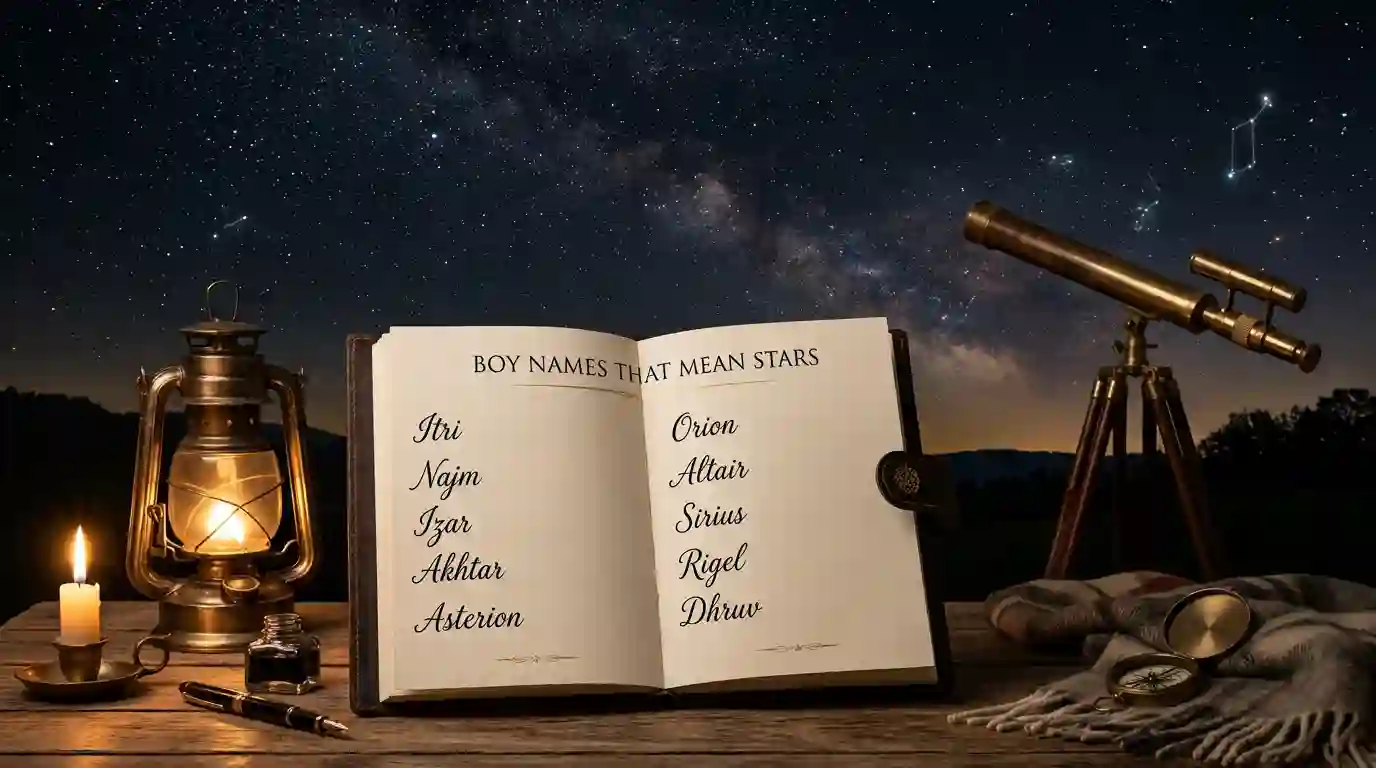
Boy Names That Mean Star
Stars have guided travelers, inspired mythology, marked seasons, shaped calendars, and symbolized hope, protection, dreams, brilliance, and light for thousands of years. That makes boy names that mean stars especially meaningful for parents who want a celestial name with more depth than simply sounding space-inspired. Some names genuinely contain the word or linguistic idea of a star: Itri means “star” in Tamazight, Najm means “star” in Arabic, Izar means “star” in Basque, and Akhtar comes from a Persian word meaning “star.” Others are more specific: Shihab means “shooting star, meteor,” Asterion means “of the stars,” and Astrophel was created to mean “star lover.” Names such as Altair, Rigel, Sirius, Arcturus, Orion, Leo, and Draco have strong astronomical connections but different literal meanings. This guide separates those categories, explains pronunciations and cultural origins, identifies questionable online meanings, compares current U.S. popularity where reliable data exists, and helps you choose a star-inspired boy name whose story is both beautiful and accurate.
Table of Contents
- What Counts as a Star Name?
- Boy Names That Mean Star
- Boy Names Inspired by Named Stars
- Boy Names Inspired by Constellations
- Boy Names Connected to the Sun
- How We Checked Each Name’s Meaning
- Pronunciation and U.S. Popularity
- Compare Star Names at a Glance
- How to Choose a Star-Inspired Boy Name
- Frequently Asked Questions
- Final Thoughts
What Counts as a Star Name?
The phrase “star name” can describe several very different kinds of names.
A parent asking what name means star may want the literal word “star” translated into another language.
Another parent may want the name of an actual star visible in the night sky.
Someone else may prefer a constellation such as Orion or Leo.
And some families are more interested in symbolic concepts such as guidance, brightness, the morning star, a shooting star, or the sun.
All of these fit the broader category of celestial names, but their meanings should not be presented as though they are identical.
Names That Literally Mean “Star”
The most direct choices come from languages in which the name itself contains or equals a word meaning star.
Examples include:
Itri — star in Tamazight
Najm — star in Arabic
Izar — star in Basque
Akhtar — star from Persian
Asterion — of the stars from Greek
Asterius — starry from Greek
Shihab — shooting star or meteor in Arabic
Ahtahkakoop — star blanket in Cree
Astrophel — star lover, coined from Greek elements
Lucero — bright star or morning star in Spanish
These are much stronger answers to what names mean star than names such as Orion or Sirius, which are connected with stars astronomically but do not literally translate as “star.”
Names Linked to Stars Through Astronomy or Mythology
A second category includes the actual names of stars, constellations, mythological figures placed among the stars, and names connected with planets historically described as stars.
Examples include:
Altair — a bright named star in Aquila
Rigel — a bright star in Orion
Sirius — the brightest star in the night sky
Arcturus — one of the brightest stars visible from Earth
Procyon — a bright star in Canis Minor
Castor — a named star in Gemini
Pollux — another prominent star in Gemini
Vega — a bright star in Lyra
Rasalas — a named star in Leo
Orion — a constellation and mythological hunter
Leo — a zodiac constellation
Draco — a constellation named for a dragon
Phoenix — a southern constellation
Caelum — a southern constellation
These are star-inspired names, but their literal meanings often have nothing to do with stars.
Star-Inspired Names With a Different Literal Meaning
This distinction becomes particularly important with astronomical names.
Altair means “the flyer,” not star.
Rigel ultimately comes from an Arabic word meaning “foot,” referring to its position at Orion’s foot.
Sirius comes from a Greek word meaning “burning.”
Arcturus means “guardian of the bear.”
Procyon means “before the dog,” referring to its rising before Sirius, the Dog Star.
Draco means “dragon” or “serpent.”
Leo means “lion.”
Caelum, as the constellation name, means “chisel” in Latin.
All are authentic celestial names.
None should be falsely translated as “star.”
That same rule applies throughout this guide: astronomical connection and literal name meaning are two separate facts.
Parents who like the wider night-sky theme rather than stars alone may also enjoy boy names that mean moon and moonlight.
Boy Names That Mean Star
The strongest part of any star-name list should be the names whose real linguistic meaning actually includes “star.”
Boy Names With a Literal Meaning of “Star”
Itri
Origin: Tamazight / Berber
Meaning: Star
Gender: Masculine
Pronunciation: approximately EE-tree
Itri is one of the clearest and most useful answers to what name means star.
It directly means star in Tamazight and is traditionally masculine.
That gives it an advantage over several famous star words from other languages that are primarily feminine as personal names.
Itri is short, visually simple, and highly unusual in the United States.
Its origin belongs to the Indigenous Amazigh cultures of North Africa, so parents should recognize that cultural context rather than treating Itri merely as an exotic celestial word.
For families seeking a compact rare name with a direct star meaning, Itri deserves a place near the top of the list.
Najm
Origin: Arabic
Meaning: Star
Gender: Masculine
Pronunciation: approximately NAJM, with the consonant cluster pronounced more distinctly in Arabic than many English speakers may initially expect
Najm directly means star in Arabic.
It is an established masculine Arabic name and also appears as a surname.
Unlike symbolic celestial names, the star meaning does not require mythology or interpretation.
The plural and related Arabic vocabulary have deep cultural and literary associations with the night sky.
A longer traditional form is Najm ad-Din, meaning “star of the faith.”
Najm is especially suitable for parents who want a name whose celestial meaning is simple, strong, and direct.
Izar
Origin: Basque
Meaning: Star
Gender: Masculine and feminine
Pronunciation: approximately ee-SAR, though Basque pronunciation should be preferred
Izar means star in Basque.
It is used across genders, making it a genuine gender-neutral celestial option.
Its four-letter spelling is easy for English speakers to read, though authentic pronunciation may differ from what Americans first guess.
Izar works particularly well for parents who like short names such as Kai, Leo, or Ari but want something far rarer.
Because the meaning itself is the direct Basque word for star, no symbolic explanation is needed.
Akhtar
Origin: Persian through Urdu and Bengali usage
Meaning: Star
Gender: Masculine and feminine
Pronunciation: approximately AKH-tar
Akhtar comes from the Persian word meaning star and is used in Urdu and Bengali naming traditions.
In South Asia, it is also extremely familiar as a surname.
For a boy, Akhtar has the advantage of being culturally established rather than invented from astronomical vocabulary.
The first consonant may be pronounced differently depending on language and community, so native pronunciation is worth hearing before use.
The name’s direct star meaning makes it one of the strongest South Asian choices in this guide.
Asterion
Origin: Greek mythology
Meaning: Of the stars
Gender: Masculine
Pronunciation: approximately as-TEER-ee-on
Asterion comes from Greek aster, meaning star, and means “of the stars.”
The name appears on several figures in Greek mythology, including a river god and a figure associated with the Minotaur tradition.
That mythological background gives Asterion a much more dramatic identity than simple word names such as Star.
The name is rare enough to feel highly distinctive, yet its star-rooted etymology is strong.
It would suit parents drawn to ancient Greek names, mythology, and astronomy.
Asterius
Origin: Ancient Greek, Latinized
Meaning: Starry
Gender: Masculine
Pronunciation: approximately as-TEER-ee-us
Asterius is the Latinized form of Greek Asterios.
It means “starry”, derived from the Greek word for star.
Asterius was used for several figures in Greek mythology and by early Christian saints.
That makes it a particularly interesting bridge between classical mythology and historical religious naming.
It is much rarer than names such as Orion but has a more direct star meaning.
Asterios
Origin: Greek
Meaning: Starry
Gender: Masculine
Asterios is the Greek form corresponding to Asterius.
For families of Greek heritage, it may feel more culturally appropriate than the Latinized Asterius.
Both belong to the same Greek aster “star” family.
Aster
Origin: English, ultimately Greek
Meaning: Star-rooted; also the aster flower
Gender: Masculine and feminine
Pronunciation: AS-ter
Aster is more complicated than Itri or Najm.
The modern English given name comes from the aster flower, whose name derives from Greek aster, meaning star, because of the flower’s star-shaped form.
So Aster is genuinely star-rooted, but its immediate English naming route is botanical.
That gives it two themes at once:
- stars
- flowers and nature
Parents who enjoy this crossover may also like boy names that mean nature.
Aster is rare for American boys but not unheard of.
Astrophel
Origin: Literary, coined from Greek elements
Meaning: Star lover
Gender: Masculine
Pronunciation: approximately AS-troh-fel
Astrophel was created by the English poet Sir Philip Sidney for his 16th-century sonnet sequence Astrophel and Stella.
The name was probably intended from Greek elements meaning star + lover/friend, producing the beautiful meaning “star lover.”
This makes Astrophel an unusually exact choice for parents who love astronomy itself rather than merely the visual image of a star.
It is extremely rare in real-life naming and feels highly literary.
For some parents that will make it perfect as a middle name.
Ahtahkakoop
Origin: Cree
Meaning: Star blanket
Gender: Masculine
Pronunciation: Requires Cree-language guidance for accuracy
Ahtahkakoop comes from Cree elements meaning star and blanket.
The result is commonly translated as “star blanket.”
It was the name of a prominent Plains Cree chief.
This is not a name to reduce to an aesthetic phrase for a baby-name mood board.
It belongs to a living Indigenous cultural and linguistic tradition.
Parents without Cree heritage should take particular care to understand its history, pronunciation, and cultural significance before considering it.
The meaning itself is beautiful and strongly celestial.
Kisecawchuck
Origin: Cree, Anglicized
Meaning: Day star
Gender: Masculine
Kisecawchuck comes from Cree elements meaning day and star.
It was borne by a 19th-century Plains Cree chief.
Like Ahtahkakoop, it deserves cultural context and accurate pronunciation rather than being treated simply as a rare English-language celestial option.
Shihab
Origin: Arabic
Meaning: Shooting star, meteor
Gender: Masculine
Pronunciation: approximately shee-HAAB
Shihab is one of the most vivid names in this article.
It means “shooting star” or “meteor” in Arabic.
Technically, a meteor is not a star, but “shooting star” is the familiar visual expression used for a meteor streaking through the atmosphere.
That gives Shihab a direct celestial meaning without relying on symbolism.
It may appeal to parents who want something more dynamic than a static star name.
Lucero
Origin: Spanish
Meaning: Light source, bright star, morning star
Gender: Masculine and feminine
Pronunciation: loo-SEH-ro in most Latin American Spanish
Lucero derives from Spanish luz, meaning light, and can refer to a bright star or the morning star.
It is particularly familiar in Latin American Spanish, with notable usage in Mexico and Colombia.
Lucero is used across genders.
Its meaning combines light, brightness, and celestial imagery, which makes it more poetic than a direct vocabulary name such as Najm.
Bintang
Origin: Indonesian word and modern personal-name usage
Meaning: Star
Gender: Used across genders
Pronunciation: approximately BIN-tang
Bintang means star in Indonesian.
It also appears as a personal name.
However, its documentation as a given name is less robust in specialist historical name references than names such as Itri or Najm.
It is therefore best described as an Indonesian star word used in naming rather than presented as a centuries-old traditional masculine name.
Lintang
Origin: Javanese
Meaning: Star
Gender: Used for males and females
Pronunciation: approximately LIN-tang
Lintang is the Javanese form corresponding to Bintang.
Like Bintang, it provides a genuine Southeast Asian linguistic connection with the star concept.
Its personal-name use is real but less internationally documented than more common names.
Hōkū
Origin: Hawaiian
Meaning: Star
Gender: Modern usage can vary
Pronunciation: HOH-koo
The Hawaiian word hōkū means star.
It also has important traditional uses connected with the lunar calendar.
Hawaiian language requires attention to the long-vowel mark, the kahakō, because diacritics are part of correct spelling.
Generic baby-name sites often remove such marks and cultural context.
If Hōkū is chosen specifically as a personal name, Hawaiian usage and pronunciation should be researched carefully rather than assuming English naming conventions.
Stelo
Origin: Esperanto vocabulary
Meaning: Star
Gender: Word-inspired use rather than strongly established traditional naming
Stelo is the Esperanto word for star.
Because Esperanto is a constructed international language, Stelo is interesting for parents who like global or linguistic names.
However, a genuine vocabulary word does not automatically equal an established personal name.
Stelo therefore works best in the modern word-inspired category.
Tarak
Origin: Sanskrit-derived Indian usage
Star connection: Related Sanskrit tāraka can mean star; the word has other meanings too
Gender: Masculine in modern Indian usage
Tarak needs more nuance than lists usually give it.
Sanskrit tāraka has several meanings and grammatical forms. One established sense is star, while other senses relate to carrying across, rescuing, or named mythological figures.
The modern masculine name Tarak therefore has a legitimate star-related linguistic connection, but “Tarak simply means star” is an oversimplification.
This is exactly why cultural and grammatical context matters in name research.

Boy Names Inspired by Named Stars
Sometimes the most compelling celestial name is not a name meaning star but the actual traditional name of a star.
Astronomers identify stars using catalogs and scientific designations, but many prominent stars also have officially recognized proper names.
For authoritative astronomical naming, the International Astronomical Union maintains the modern framework for recognized star names. International Astronomical Union star-name information
Altair
Origin: Arabic astronomical name
Literal meaning: The flyer
Star connection: Brightest star in Aquila
Pronunciation: commonly al-TAIR in American English
Altair is one of the most wearable named-star choices for a boy.
The name comes from an Arabic expression referring to the flying eagle or flyer and belongs to the brightest star in the constellation Aquila, the Eagle.
It does not mean star.
Its appeal comes from actually being a famous star name.
Altair also has limited given-name usage, including masculine use in Brazil and modern international naming.
It feels futuristic without being invented.
Sirius
Origin: Greek through Latin astronomical tradition
Literal meaning: Burning
Star connection: Brightest star in the night sky
Pronunciation: SEER-ee-us
Sirius is one of the most famous stars visible from Earth.
It belongs to the constellation Canis Major and is commonly known as the Dog Star.
Its name comes from a Greek word meaning burning, likely reflecting its striking brightness.
As a baby name, Sirius carries a very strong astronomical identity.
Modern readers may also associate it with Sirius Black from the Harry Potter series.
That literary association is significant enough that parents should consider whether they welcome it.
Rigel
Origin: Arabic astronomical name
Literal meaning: Foot
Star connection: Bright star marking Orion’s foot
Pronunciation: RYE-jel in common English astronomical usage
Rigel is a major blue-white star in Orion.
Its name derives from Arabic terminology referring to the foot, matching its position in the constellation.
Rigel feels compact and modern even though the astronomical name has deep historical roots.
It is far rarer as a personal name than Orion.
For parents wanting an unmistakable astronomy connection without choosing a highly popular celestial name, Rigel is compelling.
Arcturus
Origin: Ancient Greek
Literal meaning: Guardian of the bear
Star connection: Bright star in Boötes
Pronunciation: ark-TYOOR-us
Arcturus derives from Greek elements meaning bear and guardian.
The meaning refers to the star’s location near Ursa Major and Ursa Minor, the Great and Little Bears.
Arcturus is among the brightest stars in the night sky.
The name’s literal meaning adds an unexpected protective quality.
Parents who like the “guardian” aspect may also appreciate boy names that mean hero and other defender-related names.
Procyon
Origin: Ancient Greek
Literal meaning: Before the dog
Star connection: Brightest star in Canis Minor
Pronunciation: PROH-see-on or PROH-see-un
Procyon means “before the dog.”
The name describes how the star historically rose before Sirius, the Dog Star, at certain latitudes.
As a personal name, Procyon is extremely unusual and strongly astronomical.
It may work better as a bold middle name for many families.
Vega
Origin: Arabic astronomical name transmitted through European languages
Star connection: Brightest star in Lyra
Gender: Modern naming usage varies
Vega is one of the brightest stars in the night sky and a major point in the Summer Triangle.
The astronomical name comes ultimately from an Arabic expression referring to a falling or swooping eagle.
In contemporary naming, Vega may be used across genders.
For an American boy, it would feel rare but recognizable.
Castor
Origin: Greek mythology
Literal meaning: Uncertain; possibly related to shining or possibly beaver
Star connection: Star in Gemini
Gender: Masculine
Pronunciation: KAS-ter
Castor was one of the mythological twins Castor and Pollux.
The constellation Gemini represents the pair, and two prominent stars bear their names.
Castor’s etymology is uncertain.
One theory connects it with a Greek form meaning to excel or shine.
Another links it to the word for beaver.
The safest description is therefore:
Castor is a mythological masculine name that also belongs to a prominent star in Gemini; its original meaning is uncertain.
Pollux
Origin: Greek mythology, Latinized
Star connection: Bright star in Gemini
Gender: Masculine
Pollux is the other famous twin of Gemini.
Like Castor, its celestial importance comes from mythology and astronomy rather than a literal translation meaning star.
The name is extremely rare in modern American personal naming.
Rasalas
Origin: Arabic astronomical expression
Star connection: Named star in Leo
Meaning: Connected with the northern part of the lion’s head
Pronunciation: approximately RAZ-uh-las
Rasalas is much less familiar than Sirius or Altair.
It is a named star in the constellation Leo and comes from Arabic terminology describing part of the lion’s head.
As a first name it would be exceptionally rare.
Its advantage is exclusivity: it sounds name-like while preserving a direct astronomical identity.
Regulus
Origin: Latin
Meaning: Little king, prince
Star connection: Bright star in Leo
Pronunciation: REG-yoo-lus
Regulus comes from Latin and means little king or prince.
It is the brightest star in the constellation Leo.
The combination of royal meaning and astronomical identity gives Regulus a very different tone from soft celestial names.
Parents drawn to leadership or prosperity themes may also find relevant ideas among boy names that mean wealth.
Abhijit
Origin: Sanskrit / Indian
Literal meaning: Victorious
Star connection: Traditional Sanskrit name for Vega
Gender: Masculine
Abhijit means victorious and is also the Sanskrit name for Vega.
This makes it an excellent example of a traditional personal name with an independent star identity.
The literal meaning is not star.
Its celestial connection is historical astronomy.
For families wanting a name that blends victory with the night sky, Abhijit is unusually rich.
Suhail
Origin: Arabic / Urdu
Literal meaning: Connected with an Arabic root meaning smooth, level, or easy
Star connection: Traditional Arabic name associated with Canopus and also used as an official star name elsewhere
Gender: Masculine
Suhail has deep Arabic astronomical history.
The name is associated with the brilliant southern star Canopus in Arabic tradition.
It is also used in modern official star nomenclature.
Suhail is far more established as an everyday masculine personal name than Rigel or Sirius, making it a practical option for families who want astronomy without choosing a name invented from astronomy.
Boy Names Inspired by Constellations
Constellation names occupy a middle ground between mythology and astronomy.
Some began as ancient personal names.
Others were ordinary vocabulary words or mythological labels before becoming constellation names.
Orion
Origin: Greek mythology
Literal meaning: Uncertain
Star connection: One of the most recognizable constellations
Pronunciation: oh-RYE-en
Orion is probably the most familiar star-inspired boy name in the United States.
In Greek mythology, Orion was a great hunter.
The constellation bearing his name contains famous stars including Betelgeuse, Bellatrix, and Rigel, along with Orion’s Belt.
Despite many baby-name claims, the etymology of Orion is not securely understood.
It should not be translated as “rising star,” “son of fire,” or “light of heaven” without strong evidence.
Orion’s power comes from the constellation itself.
Leo
Origin: Latin
Meaning: Lion
Star connection: Zodiac constellation
Pronunciation: LEE-oh
Leo is one of the easiest celestial names to use in everyday American life.
It directly means lion in Latin.
Leo is also a zodiac constellation and contains Regulus, one of the sky’s brighter named stars.
Unlike Orion, Leo is already a highly popular traditional boy name.
The astronomy connection is therefore subtle rather than dominant.
Parents attracted to the lion’s bold symbolism may also like boy names that mean brave.
Draco
Origin: Ancient Greek, Latinized
Meaning: Dragon, serpent
Star connection: Northern constellation
Pronunciation: DRAY-koh
Draco is the constellation of the Dragon.
The ancient Greek name literally means dragon or serpent.
Its astronomical identity is strong, but its modern cultural associations also include fantasy fiction.
Draco is much more intense stylistically than Leo or Orion.
Phoenix
Origin: Greek
Literal meaning: Connected historically with a dark red or crimson color; also the mythical phoenix
Star connection: Southern constellation
Gender: Masculine and feminine
Pronunciation: FEE-niks
Phoenix is both a mythological creature and a constellation.
Its most famous symbolism is rebirth, because the mythical bird rises again after destruction.
The name does not literally mean star or rebirth.
Still, the combination of mythology and constellation status makes it one of the strongest modern celestial choices.
If the renewal symbolism matters more than the astronomy, see boy names that mean new beginning.
Caelum
Origin: Rare English given-name form / Latin constellation vocabulary
Constellation meaning: Chisel
Pronunciation: KAY-lum as a modern personal name; astronomical Latin may differ
Caelum creates an unusual complication.
As a rare English personal name, it can be treated as a variant of Calum.
Separately, Caelum is the name of a southern constellation, and in that astronomical context the Latin word means chisel.
So Caelum is genuinely constellation-inspired but should not be translated as “heavenly star.”
Its sound may suggest Latin caelum, sky or heaven, but the specific constellation was named for a chisel.
Castor and Pollux
Castor and Pollux belong both in the named-star section and the constellation discussion because Gemini represents the mythological twins and its two most famous stars bear their names.
For twin boys, Castor and Pollux would be an unusually literal astronomical pairing—though perhaps too themed for some families.
Asterion
Asterion is not a modern constellation name, but its meaning “of the stars” and Greek mythology place it naturally beside constellation-inspired choices.
Zodiac Names
Several zodiac constellation names can inspire boys’ names even when they are not conventional personal names.
Leo is by far the most usable.
Aries is used as a modern masculine and gender-neutral name and comes from Latin for ram.
Gemini appears occasionally as a modern word name but is rare.
Sagittarius is generally too long and literal for mainstream personal-name use.
Aquarius also appears occasionally but functions more as a zodiac word than a traditional boy name.
If the astronomy theme becomes broader than stars, comparing these with boy names that mean nature can help you decide whether you prefer celestial imagery or more grounded elements.

Boy Names Connected to the Sun
The sun is technically a star.
That makes solar names completely relevant to a broader list of boy names that mean stars, even though everyday language often treats “the sun” and “the stars” as separate categories.
Ravi
Origin: Sanskrit / Indian
Meaning: Sun
Gender: Masculine
Pronunciation: RAH-vee or language-specific variants
Ravi directly means sun in Sanskrit.
It is also the name of a Hindu solar deity, sometimes identified with Surya.
Ravi has the advantage of being short, familiar across South Asian communities, and relatively easy for English speakers.
If you want a star name in the scientific sense but do not want something that sounds like astronomy vocabulary, Ravi is an excellent option.
Helios
Origin: Ancient Greek
Meaning: Sun
Gender: Masculine
Pronunciation: HEE-lee-os
Helios is the Greek word and mythological name for the sun.
In Greek mythology, Helios drives his chariot across the sky.
The name is much rarer than Apollo, though Apollo is not literally the sun and should not be treated as equivalent.
Helios is direct, mythological, and unmistakably solar.
Elio
Origin: Italian and Spanish
Sun connection: Related to Helios in one established name tradition
Gender: Masculine
Pronunciation: EH-lee-oh
Elio offers a softer, more modern-feeling alternative to Helios.
Its solar connection makes it especially attractive for parents who like bright names without wanting something overtly mythological.
Bhaskara
Origin: Sanskrit / Hinduism
Meaning: Shining, light maker
Gender: Masculine
Bhaskara combines Sanskrit elements for light and maker.
It is also a name of the Hindu sun god Surya.
The name was borne by famous Indian mathematicians and astronomers, adding an intellectual connection to its solar meaning.
Bhaskar
Bhaskar is the modern form used in several Indian languages.
It carries the same basic sense of light maker and solar association.
Areg
Origin: Armenian
Meaning: Sun, bright
Gender: Masculine
Pronunciation: approximately ah-REG
Areg is an Armenian masculine name meaning sun or bright.
It is a strong choice for families wanting a direct solar meaning from a language not frequently represented on English-language celestial-name lists.
Shams
Origin: Arabic, Persian, Urdu
Meaning: Sun
Gender: Masculine and feminine depending on cultural context
Shams means sun in Arabic.
It has long literary, religious, and historical usage.
Like Qamar for the moon and Najm for a star, Shams offers direct Arabic celestial vocabulary.
Sol
Origin: Latin / Romance-language word association
Meaning: Sun
Gender: Usage varies
Sol means sun in Latin and in modern Spanish.
It is also associated with the Roman sun personification.
Modern gender use differs by country and language, so parents should check the tradition they intend.
Azhar
Origin: Arabic / Urdu / Malay
Meaning: Shining, brilliant, bright
Gender: Masculine
Azhar does not mean star or sun.
Its meaning—shining, brilliant, bright—makes it a good symbolic celestial choice.
Brightness is one of the most obvious qualities humans associate with stars.
Azhar belongs in the star-inspired category rather than the direct star category.
Albus
Origin: Ancient Roman
Meaning: White, bright
Gender: Masculine
Albus means white, bright in Latin.
It is not celestial by etymology.
Its inclusion comes from brightness symbolism rather than astronomy.
Modern readers may strongly associate it with Albus Dumbledore.
Parents who want light symbolism rather than celestial objects may find Albus or Azhar more usable than Sirius or Rigel.
Star Meanings Beyond the Literal Word
The idea of a star can symbolize many qualities beyond astronomy.
Stars as Guidance
Before GPS and modern navigation, stars helped travelers and sailors orient themselves.
The pole star, Polaris, became particularly important because of its relatively stable position in the northern sky.
That gives star-inspired names an association with:
- guidance
- direction
- steadiness
- reliability
- finding one’s way
Dhruv
Origin: Hindi / Nepali from Sanskrit Dhruva
Meaning: Fixed, immovable, firm, stable
Star connection: North Star / Polaris
Gender: Masculine
Pronunciation: approximately DHROOV
Dhruv is one of the richest symbolic star names.
It does not literally mean star.
Its deeper Sanskrit meaning is fixed, firm, immovable, stable.
In Hindu tradition, Dhruva becomes the North Star.
That makes Dhruv simultaneously a name of stability and celestial guidance.
A parent who wants a star name representing consistency or inner strength may find Dhruv more meaningful than a name that simply translates as star.
Parents attracted to those qualities may also appreciate boy names that mean strength and power.
Stars as Hope and Dreams
The familiar cultural idea of “wishing upon a star” connects stars with hope, ambition, dreams, and possibility.
A name does not need to literally mean dream in order to carry that symbolism.
Celestial names such as Itri, Izar, Orion, Vega, and Sirius can evoke a sense of aspiration simply because of their night-sky identity.
Estel
Origin: Sindarin, fictional language created by J. R. R. Tolkien
Meaning: Hope
Gender: Literary usage
Estel does not mean star.
It means hope in Tolkien’s Sindarin and was used as a childhood name for Aragorn.
Because Tolkien’s invented languages are deeply associated with star imagery, Estel is sometimes pulled into celestial lists.
Its proper category is literary hope name, not literal star name.
Elrond
Origin: Sindarin literary name
Meaning: Star dome
Gender: Masculine
Elrond is much more directly celestial than Estel.
In Tolkien’s Sindarin, Elrond means “star dome.”
It is, however, an invented literary name strongly attached to a major character in The Lord of the Rings.
Parents considering Elrond should expect the Tolkien association to dominate.
Stars as Protection
Arcturus’s meaning, guardian of the bear, naturally links astronomy with protection.
That symbolic idea can pair well with boy names that mean warrior when parents want a stronger protective theme.
Stars as Brilliance
Names such as Azhar, Albus, Sirius, Bhaskara, and Lucero focus on brightness or brilliance rather than the word star itself.
These can be excellent choices for parents who love what stars represent visually.
Names That Need Extra Caution
Several names frequently appear on “names that mean star” lists even though the evidence is weaker, the gender is different, or the meaning has been simplified.
Hoshi
Hoshi means star when written with the Japanese character 星.
However, established modern Japanese name references classify Hoshi primarily as feminine.
Masculine use or use as a name element can exist, but it should not be casually marketed as a standard Japanese boy name meaning star.
For a boy, the exact Japanese characters and actual name form need to be checked.
Steren
Steren genuinely means star in Cornish.
However, it is traditionally feminine.
It belongs on a broader star-name resource, but not among the strongest traditional boy recommendations.
Stellan
Stellan sounds as if it should be related to Latin stella, star.
It is not securely so.
The Swedish masculine name Stellan has an uncertain meaning, with proposed connections including an Old Norse word associated with calmness or a German origin.
Do not translate Stellan as star.
Sterling
Sterling also looks like a star name.
The traditional English given name comes from a Scottish surname linked with the city of Stirling, whose own meaning is uncertain.
The English word sterling later acquired its own history connected with sterling silver; one proposed historical explanation of that word involves a “little star” emblem on coins.
That is far too indirect to say Sterling means star.
It is better described as a familiar masculine name with a remote star-related word-history association.
Jiemba
Jiemba is frequently advertised online as a Wiradjuri name meaning “laughing star.”
That claim is disputed.
Linguistic discussions have questioned the Wiradjuri attribution, and historical records suggest a similar form may represent a word for star from a different Australian language.
Because Indigenous Australian languages and identities are specific, not interchangeable, Jiemba should not be confidently presented as “Wiradjuri for laughing star.”
This is exactly the kind of claim that deserves caution.
Namid
Namid is often listed online with meanings such as star dancer.
Strong linguistic documentation for that interpretation is difficult to establish.
Without identifying the precise language and confirming the translation with reliable Indigenous-language evidence, the meaning should be treated as uncertain.
Stelo
Stelo genuinely means star in Esperanto.
What requires caution is not the vocabulary definition but the assumption that it is a traditional personal name.
Esperanto word names can certainly be adopted creatively, but this is different from an established cultural given-name history.
Hōkū
Hawaiian hōkū genuinely means star, but Hawaiian naming deserves proper language context, including diacritics and traditional usage.
A Hawaiian vocabulary word should not simply be stripped of its spelling marks and presented as a generic English baby name.
Maru
Maru has several unrelated origins.
In Japanese, it can mean round, circle, whole with certain characters and has long use as an affectionate suffix or ship-name element.
In Tswana, a similarly written form has been reported with a cloud meaning.
Korean Maru has different senses again.
It does not securely mean star.
Byeong-Ho
Korean names depend heavily on the hanja selected.
The romanized form Byeong-Ho alone cannot establish a star meaning.
Different characters with the same pronunciation can change the name entirely.
Chinese Star Names
Chinese personal names require the exact characters.
A romanized syllable may correspond to many different characters.
Therefore, a list that says “X Chinese name means bright star” without providing the characters deserves skepticism.
Japanese Star Names
The same principle applies in Japanese.
星 means star, but its reading changes in names and compounds.
A romanized name must be checked against its actual kanji before assigning a meaning.
How We Checked Each Name’s Meaning
Accurate baby-name research requires separating several layers of evidence.
Verify the Language, Spelling, and Original Meaning
For every name, the first questions should be:
What is the source language?
What is the oldest documented or traditional form?
Is the claimed “star” element really present?
Does the English spelling represent several unrelated names?
Is the name actually used as a personal name?
Is it traditionally masculine?
Those questions immediately separate strong entries such as Itri, Najm, Izar, and Akhtar from questionable internet claims.
Flag Disputed Meanings and Alternate Interpretations
A responsible name guide should sometimes say uncertain.
That is more useful than inventing certainty.
Examples include:
Orion — famous constellation, uncertain etymology
Castor — multiple possible etymologies
Stellan — meaning uncertain
Jiemba — “laughing star in Wiradjuri” claim disputed
Namid — widely repeated star-dancer definition lacks strong verification
Maru — several unrelated cultural forms
Tarak — genuine Sanskrit star-related sense but multiple other meanings and grammatical forms
Accuracy creates more value than a longer list.
Distinguish a Given Name From a Star or Constellation Name
Rigel is a star name.
It has some modern personal-name use.
That does not mean it historically began as a baby name.
Orion is an ancient mythological personal name and a constellation.
Leo is an ancient personal name, animal word, zodiac sign, and constellation.
Aster is a modern given name derived from a flower whose word ultimately means star.
Najm is a personal name and a literal Arabic word meaning star.
These four paths are different even though all four names belong naturally on a celestial list.
Astronomy Verification Matters Too
Traditional star names can vary across languages and history.
Modern astronomy standardizes proper names through the International Astronomical Union.
That helps distinguish official named stars from:
- constellation names
- informal nicknames
- catalog numbers
- historical regional names
- planets mistaken for stars
- fictional astronomical names
The morning star and evening star, for example, historically refer to Venus—not an actual star.
This matters for names such as Hesperos, Lucero, Tariq, and Tāwera.
Morning Star and Evening Star Names
Hesperos
Origin: Ancient Greek
Meaning: Evening
Gender: Masculine
Connection: Personification of the Evening Star, Venus
Hesperos does not mean star.
It means evening.
In Greek mythology, Hesperos personifies the Evening Star, which is the planet Venus when visible after sunset.
Hesperos is rare, ancient, and highly literary.
Lucero
Lucero can mean bright star or morning star in Spanish.
Unlike Hesperos, star language is built directly into its meaning.
Tariq
Origin: Arabic / Urdu
Meaning: Visitor, one who knocks
Connection: Traditional Arabic name for the morning star
Tariq does not literally mean star.
Its root refers to knocking or arriving at night.
The name became associated with the morning star, creating a powerful celestial secondary meaning.
Tariq is far more familiar as a personal name than Rigel or Arcturus.
Tāwera
Origin: Māori
Meaning: Morning star, Venus
Gender: Used across genders
Tāwera is connected with Venus as the morning star in Māori.
This is culturally meaningful astronomical vocabulary rather than a generic word-name invention.
The macron should not be treated as optional decoration; it marks vowel length in te reo Māori.
Hōkū and Navigation
In Hawaiian culture, stars are deeply connected with traditional navigation.
That makes Hawaiian star vocabulary culturally richer than a one-word baby-name translation.
Families interested in Hōkū should learn the navigational and calendrical context as well as the dictionary meaning.
Pronunciation and U.S. Popularity
A star name can be perfect on paper but still feel different once you say it every day.
Pronunciation of Names From Different Languages
| Name | Approximate Pronunciation |
| Itri | EE-tree |
| Najm | NAJM |
| Izar | ee-SAR |
| Akhtar | AKH-tar |
| Aster | AS-ter |
| Asterion | as-TEER-ee-on |
| Asterius | as-TEER-ee-us |
| Astrophel | AS-troh-fel |
| Shihab | shee-HAAB |
| Lucero | loo-SEH-ro |
| Altair | al-TAIR |
| Sirius | SEER-ee-us |
| Rigel | RYE-jel |
| Arcturus | ark-TYOOR-us |
| Procyon | PROH-see-on |
| Orion | oh-RYE-en |
| Leo | LEE-oh |
| Draco | DRAY-koh |
| Phoenix | FEE-niks |
| Dhruv | DHROOV |
| Ravi | RAH-vee |
| Helios | HEE-lee-os |
| Areg | ah-REG |
| Azhar | AZ-har |
| Hesperos | HES-peh-ros |
| Tāwera | TAH-weh-rah |
These are practical English approximations only.
Authentic pronunciation should follow the original language, especially for Arabic, Basque, Tamazight, Sanskrit-derived, Cree, Hawaiian, Māori, and other culturally specific names.
U.S. Popularity Trends, Where Reliable Data Is Available
The latest completed U.S. national baby-name dataset covers 2025 births.
Several star-inspired names are already mainstream.
Leo
2025 U.S. boys’ rank: #19
Leo is by far one of the most popular names in this guide.
Its literal meaning is lion, while its celestial connection comes from the zodiac constellation.
This makes Leo a good option for parents who want a subtle star theme rather than an obvious astronomy name.
Phoenix
2025 U.S. boys’ rank: #329
Phoenix is well established and also used for girls.
Its astronomical connection comes from the constellation, while its dominant cultural meaning is the mythical bird associated with rebirth.
Orion
2025 U.S. boys’ rank: #334
Orion has become an established modern American boy name without losing its strong constellation identity.
It is recognizable but nowhere near as common as Leo.
Sterling
2025 U.S. boys’ rank: #346
Sterling is included here mainly to correct a misconception.
It is a familiar masculine name but should not be classified as literally meaning star.
Its star connection is indirect through one theory about the history of the English word sterling.
Dhruv
2025 U.S. boys’ rank: about #1,100
Dhruv sits just outside the top 1,000 nationally.
It remains culturally familiar in South Asian communities despite being statistically uncommon across all U.S. births.
Aster
Aster remains extremely rare for American boys, ranking well below the national top 1,000.
Its use has increased enough to appear in larger SSA datasets, but it remains a genuinely unusual choice.
Sirius
Sirius also appears in U.S. birth data but remains far outside the top 1,000.
The name’s heavy astronomical and literary associations likely keep it distinctive.
Altair
Altair is extremely rare as a U.S. first name.
For families wanting a star name that few classmates are likely to share, it is much rarer than Orion or Phoenix.
What a Popularity Ranking Does and Does Not Tell You
National rankings cannot tell you:
- whether a name is common within a particular cultural community;
- whether two identical English spellings represent different languages;
- which kanji or Chinese characters were used;
- whether accents or diacritics were omitted;
- why parents chose the name.
Exact spellings are also counted separately.
That means variant forms may divide a name family’s apparent popularity.
A rare rank should never be interpreted as evidence that a name is invented.
Itri may be rare in the United States while remaining linguistically authentic.
The same is true of Najm, Akhtar, Areg, and many culturally specific names.
Compare Star Names at a Glance
| Name | Origin | Literal Meaning | Star Connection | Gender | U.S. Familiarity |
| Itri | Tamazight | Star | Direct | Masculine | Very rare |
| Najm | Arabic | Star | Direct | Masculine | Rare |
| Izar | Basque | Star | Direct | Unisex | Rare |
| Akhtar | Persian/Urdu/Bengali | Star | Direct | Unisex | Rare as first name |
| Asterion | Greek | Of the stars | Direct | Masculine | Very rare |
| Asterius | Greek | Starry | Direct | Masculine | Very rare |
| Aster | Greek-rooted English | Flower name from “star” | Star-rooted | Unisex | Very rare |
| Astrophel | Literary/Greek roots | Star lover | Direct compound | Masculine | Extremely rare |
| Ahtahkakoop | Cree | Star blanket | Direct compound | Masculine | Culturally specific |
| Kisecawchuck | Cree | Day star | Direct compound | Masculine | Culturally specific |
| Shihab | Arabic | Shooting star, meteor | Direct celestial | Masculine | Rare |
| Lucero | Spanish | Bright star, morning star | Direct | Unisex | Rare |
| Bintang | Indonesian | Star | Direct word/name | Unisex | Rare |
| Lintang | Javanese | Star | Direct | Unisex | Rare |
| Hōkū | Hawaiian | Star | Direct word | Usage varies | Rare |
| Tarak | Sanskrit-derived | Includes a star sense | Direct/complex | Masculine | Rare |
| Altair | Arabic astronomy | The flyer | Named star | Masculine | Very rare |
| Sirius | Greek/Latin astronomy | Burning | Named star | Masculine | Very rare |
| Rigel | Arabic astronomy | Foot | Named star | Masculine | Very rare |
| Arcturus | Greek | Guardian of the bear | Named star | Masculine | Very rare |
| Procyon | Greek | Before the dog | Named star | Masculine | Extremely rare |
| Vega | Arabic-rooted astronomy | Swooping/falling eagle root | Named star | Unisex modern use | Rare |
| Castor | Greek mythology | Uncertain | Gemini star | Masculine | Rare |
| Pollux | Greek mythology | Uncertain | Gemini star | Masculine | Very rare |
| Rasalas | Arabic astronomy | Northern lion-head reference | Named star | Masculine-style astronomy name | Extremely rare |
| Regulus | Latin | Little king, prince | Named star in Leo | Masculine | Very rare |
| Abhijit | Sanskrit | Victorious | Traditional name for Vega | Masculine | Rare |
| Suhail | Arabic | Smooth/even-rooted | Star-name tradition | Masculine | Established internationally |
| Orion | Greek mythology | Uncertain | Constellation | Masculine | #334 boys, 2025 |
| Leo | Latin | Lion | Zodiac constellation | Masculine | #19 boys, 2025 |
| Draco | Greek | Dragon, serpent | Constellation | Masculine | Rare |
| Phoenix | Greek | Mythical bird/color-rooted | Constellation | Unisex | #329 boys, 2025 |
| Caelum | Latin/English | Chisel as constellation | Constellation | Masculine | Very rare |
| Dhruv | Sanskrit-derived | Fixed, stable | North Star | Masculine | Rare |
| Ravi | Sanskrit | Sun | The Sun is a star | Masculine | Familiar internationally |
| Helios | Greek | Sun | The Sun is a star | Masculine | Rare |
| Elio | Italian/Spanish | Solar connection | Sun-inspired | Masculine | Increasing familiarity |
| Bhaskara | Sanskrit | Shining, light maker | Solar deity | Masculine | Rare |
| Areg | Armenian | Sun, bright | Solar | Masculine | Rare |
| Shams | Arabic | Sun | Solar | Varies | Rare |
| Azhar | Arabic | Shining, brilliant, bright | Brightness symbolism | Masculine | Established |
| Hesperos | Greek | Evening | Evening Star/Venus | Masculine | Extremely rare |
| Tāwera | Māori | Morning Star/Venus | Planetary “star” | Unisex | Rare |
| Elrond | Sindarin/Literature | Star dome | Fictional celestial | Masculine | Very rare |
| Estel | Sindarin/Literature | Hope | Symbolic/literary | Literary | Rare |
| Stellan | Swedish | Uncertain | Often misclassified | Masculine | Established |
| Sterling | English | Surname; “excellent” word association | Indirect star-word history | Masculine | #346 boys, 2025 |
How to Choose a Star-Inspired Boy Name
Choosing a celestial name is easier once you decide what kind of star connection you actually want.
Consider Spelling, Pronunciation, and Nicknames
Short literal names are often easiest.
Itri
Najm
Izar
Leo
Ravi
Longer names have more room for nicknames.
Asterion → Aster, Asteri
Asterius → Aster
Astrophel → Astro
Arcturus → Arc, Art
Lucero → Luce, Luc
Orion → Ori, Rion
Phoenix → Nix
Sirius → Siri, though the technology association may make this less practical
Nicknames do not need to preserve the original meaning.
They simply need to work naturally for your family.
Say the Name With the Middle and Last Name
Try each name in full.
Itri Alexander Bennett
Najm Elias Rahman
Izar James Martin
Akhtar Daniel Khan
Asterion James Carter
Altair Thomas Reed
Orion Alexander Hayes
Leo Sirius Morgan
Rigel James Cole
Dhruv Alexander Patel
Areg Thomas Sarkisian
Ravi Orion Mehta
Suhail James Ahmed
Strong celestial names often benefit from a traditional middle name.
For example:
Sirius James
may feel more balanced than:
Sirius Orion Starling
There is nothing wrong with a heavily themed combination, but consider how it will sound in adulthood as well as infancy.
Consider Cultural Context and Family Connections
An international star name is more than an English translation.
Itri belongs to Tamazight-speaking Amazigh culture.
Najm belongs to Arabic naming.
Akhtar has Persian roots and strong Urdu and Bengali usage.
Ahtahkakoop belongs to Cree history and culture.
Hōkū belongs to Hawaiian language and culture.
Tāwera belongs to Māori tradition.
Dhruv carries Hindu mythology and Sanskrit linguistic history.
Areg is Armenian.
Before choosing a culturally specific name, understand:
- the native pronunciation;
- traditional gender usage;
- whether diacritics matter;
- whether the name has religious significance;
- whether it is ordinary, ceremonial, historical, or sacred;
- whether your intended meaning matches actual community usage.
That context makes the name more meaningful, not less.
Decide Whether You Want a Literal or Symbolic Meaning
For literal star meanings, start with:
Itri
Najm
Izar
Akhtar
Asterion
Asterius
Shihab
Lucero
For actual star names:
Altair
Rigel
Sirius
Arcturus
Procyon
Vega
Castor
Pollux
For constellations:
Orion
Leo
Draco
Phoenix
Caelum
For guidance and the pole star:
Dhruv
For sun names:
Ravi
Helios
Areg
Bhaskara
Shams
For literary celestial names:
Astrophel
Elrond
Estel
This distinction can dramatically shorten your shortlist.
Consider the Personality of the Name
Not every star name feels soft or dreamy.
Rigel feels sharp and modern.
Sirius feels dramatic.
Arcturus feels grand and ancient.
Leo feels friendly and familiar.
Najm feels compact and strong.
Itri feels light and rare.
Astrophel feels romantic and literary.
Dhruv feels grounded despite being celestial.
Phoenix feels bold and symbolic.
If you prefer softer emotional qualities, you may find useful pairings among boy names that mean gentle, while boy names that mean sweet explores another warm naming direction.
Balance Rarity With Everyday Practicality
A rare name can be meaningful, but ask yourself how much explanation you are comfortable giving.
Leo requires almost none.
Orion is widely recognized.
Phoenix is familiar.
Altair may require occasional pronunciation guidance.
Itri will likely require explanation.
Astrophel will require frequent explanation.
Ahtahkakoop requires both linguistic and cultural knowledge.
No level of rarity is automatically better.
The best balance depends on your family.
If rarity itself is a major goal, explore boy names that mean unique.
Star Names and Other Meaning Themes
Star imagery overlaps naturally with many other naming concepts.
Star Names and Courage
The night sky was historically important to sailors, explorers, travelers, and cultures navigating large distances.
That naturally connects celestial imagery with bravery.
Parents who like the adventurous side of star names may also enjoy boy names that mean brave.
Star Names and Heroism
Many stars and constellations preserve mythological heroes.
Orion was a hunter.
Perseus is a constellation named for a Greek hero.
Hercules is another constellation carrying a heroic mythological name.
Castor and Pollux belong to heroic Greek tradition.
If the story matters more than astronomy itself, boy names that mean hero may provide better alternatives.
Stars and Warriors
Ancient astronomy frequently overlaps with myths of warriors, hunters, gods, and monsters.
That makes boy names that mean warrior another natural neighboring topic.
Stars and Survival
The pole star’s reliability and stars’ historical importance in navigation can symbolize finding a path through difficulty.
If resilience is your central idea, boy names that mean survivor focuses more directly on endurance.
Stars and New Beginnings
The morning star appears before or around dawn, linking celestial imagery with the beginning of a new day.
Names such as Lucero, Tāwera, and Tariq can therefore carry fresh-start symbolism.
Parents who want the renewal idea itself should compare boy names that mean new beginning.
Stars and Love
Stargazing is deeply associated with romance, and Astrophel literally evokes a “star lover.”
For names whose meanings focus on affection rather than the sky, boy names that mean beauty and love provides a complementary direction.
Stars and Good Character
Stars are often symbols of hope, guidance, excellence, and aspiration.
Those are symbolic qualities, not etymological meanings.
If moral qualities matter most, boy names that mean goodness focuses on kindness, honesty, generosity, compassion, and virtue.
Stars and Seasons
The night sky changes with the seasons.
Certain constellations become especially prominent in winter or summer.
That creates natural connections with boy names that mean snow, ice and winter and boy names that mean summer.
The sky may be the same category, but the emotional atmosphere is very different.
Frequently Asked Questions
Which boy names literally mean star?
Itri means “star” in Tamazight, Najm means “star” in Arabic, Izar means “star” in Basque, and Akhtar comes from Persian meaning “star.”
What name means star for a boy?
Itri and Najm are among the strongest traditionally masculine choices with a direct meaning of “star.”
What names mean stars?
Asterion means “of the stars,” Asterius means “starry,” and Astrophel was created to mean “star lover.”
What are some names that mean star?
Itri, Najm, Izar, Akhtar, Asterion, Asterius, Shihab, Lucero, Bintang, Lintang, and star-rooted Aster are strong examples.
What Arabic boy name means star?
Najm directly means “star” in Arabic.
What Arabic name means shooting star?
Shihab means “shooting star” or “meteor” in Arabic.
What Persian name means star?
Akhtar comes from the Persian word meaning “star” and is used in Urdu and Bengali naming.
What Basque name means star?
Izar means “star” in Basque and is used for both males and females.
What Tamazight boy name means star?
Itri means “star” and is traditionally masculine in Tamazight.
What Greek boy name means star?
Asterion means “of the stars,” while Asterius/Asterios means “starry”; all derive from Greek aster, “star.”
What boy name means star lover?
Astrophel was coined from Greek elements and was probably intended to mean “star lover” or “star friend.”
What boy name means shooting star?
Shihab is the clearest established masculine example, meaning “shooting star, meteor” in Arabic.
What boy name means bright star?
Lucero can mean “light source, bright star, morning star” in Spanish and is used across genders.
What boy name means pole star?
Dhruv is associated with Polaris, the North Star; its literal Sanskrit meaning is “fixed, immovable, firm, stable.”
Does Dhruv mean star?
Not literally; Dhruv means fixed or stable and is associated with the North Star through Hindu tradition.
Does Orion mean star?
No; Orion is the name of a mythological hunter and a constellation, while its deeper etymology is uncertain.
Does Sirius mean star?
No; Sirius is the name of a famous star and comes from Greek meaning “burning.”
Does Altair mean star?
No; Altair is the name of a bright star in Aquila and comes from Arabic meaning “the flyer.”
Does Rigel mean star?
No; Rigel is a bright star in Orion, and its name comes from an Arabic word meaning “foot.”
Does Arcturus mean star?
No; Arcturus is a bright star whose Greek name means “guardian of the bear.”
Does Leo mean star?
No; Leo means “lion” in Latin and is also the name of a zodiac constellation.
Does Phoenix mean star?
No; Phoenix is the mythical bird’s name and also a constellation, but the word does not literally mean star.
Does Stellan mean star?
No; Stellan’s meaning is uncertain, and a direct connection with the word “star” is not established.
Does Sterling mean star?
No; Sterling is primarily a surname-derived name, though one theory about the history of the English word “sterling” involves a little-star emblem.
Does Hoshi mean star?
Yes, Japanese 星 (hoshi) means “star,” but Hoshi is primarily documented as feminine, so it should not automatically be presented as a traditional boy name.
Does Steren mean star?
Yes; Steren means “star” in Cornish, but it is traditionally feminine.
Is Vega a boy name?
Vega is primarily an astronomical and surname/place-style name and may be used across genders; its star connection comes from the bright star in Lyra.
Is Altair a boy name?
Yes, Altair has limited masculine given-name usage and is also the name of the brightest star in Aquila.
Is Sirius a real boy name?
Yes, Sirius has rare masculine given-name use, although its astronomical and Harry Potter associations are extremely strong.
Which boy names are inspired by constellations?
Orion, Leo, Draco, Phoenix, Caelum, Castor, and Pollux all have strong constellation connections.
What boy names are inspired by actual stars?
Altair, Sirius, Rigel, Arcturus, Procyon, Vega, Castor, Pollux, Regulus, Rasalas, and Suhail are examples.
What is a rare boy name meaning star?
Itri, Najm, Asterion, Asterius, and Astrophel are distinctive options with direct or strongly star-rooted meanings.
What is the easiest star name to pronounce in English?
Leo, Aster, Orion, Ravi, and Izar are relatively straightforward, while Najm, Itri, and culturally specific names may need pronunciation guidance.
What boy name means morning star?
Lucero can mean “morning star,” while Tāwera refers to Venus as the morning star in Māori tradition and Tariq has a traditional morning-star association in Arabic.
What boy name means evening star?
Hesperos means “evening” and was the ancient Greek personification of the Evening Star, Venus.
Is the morning star actually a star?
No; the traditional Morning Star usually refers to Venus when it appears prominently before sunrise.
Is the sun a star?
Yes; the sun is a star, so Ravi, Helios, Areg, Shams, Bhaskara, and other solar names belong naturally in a broader star-name guide.
How can I verify whether a name really means star?
Check the original language, historical spelling, traditional gender usage, and whether “star” is the literal meaning, an astronomical association, or later symbolism.
Final Thoughts
The strongest boy names that mean stars depend on how literal you want the celestial connection to be. Itri, Najm, Izar, and Akhtar give you direct star meanings, while Asterion, Asterius, Astrophel, Shihab, and Lucero expand the theme into “of the stars,” “starry,” “star lover,” “shooting star,” and “bright star.” Altair, Rigel, Sirius, Arcturus, Vega, and Procyon are actual named stars, while Orion, Leo, Draco, and Phoenix draw inspiration from constellations. Dhruv adds the symbolism of the steady North Star, while Ravi, Helios, Areg, and Shams connect your son’s name with our own star, the sun.
Shortlist the names whose real stories appeal to you, check cultural pronunciation and everyday usability, and then say each with your surname. A great celestial name should shine because its meaning is true, not because an internet list made it sound more magical than it really is.