

Boy Names That Mean Snow, Ice, and Winter
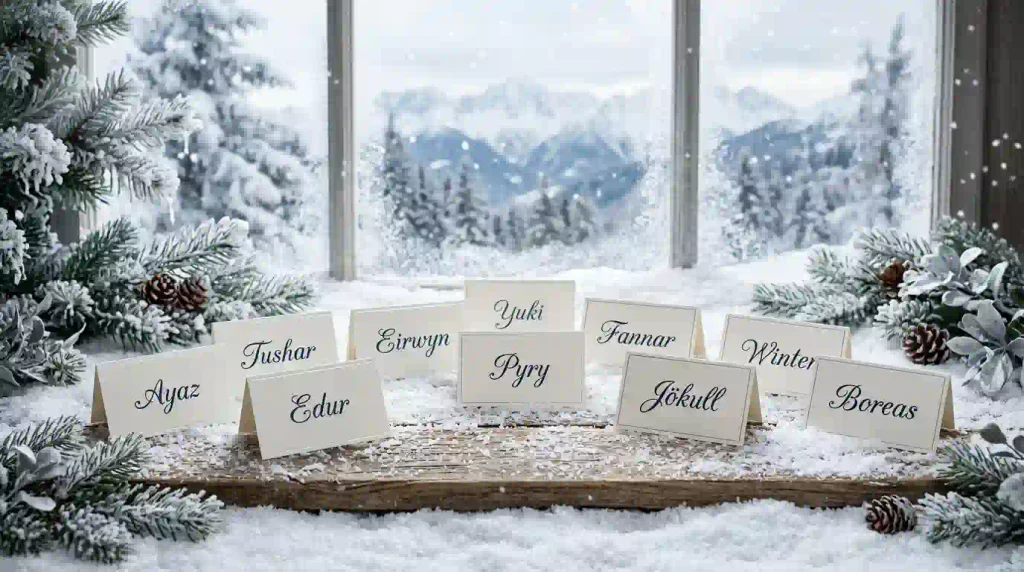
Choosing a winter-inspired name can bring together some of the most striking images in nature: fresh snow, clear ice, silver frost, frozen lakes, mountain glaciers, cold winds, quiet forests, and landscapes transformed by white. The best boy names that mean snow, ice and winter range from direct linguistic choices such as Ayaz, meaning “frost” or “dry cold air,” Tushar, meaning “cold, frost, snow,” Edur, a rare Basque masculine snow name, and Pyry, meaning “snowstorm” or “blizzard,” to names connected with glaciers, winter winds, mythology, Christmas, and cold-weather nature. Others, such as Aspen, Winter, Frost, Boreas, Yule, Nevada, and Douglas, are winter-inspired through English vocabulary, geography, mythology, or seasonal associations rather than a literal translation. This guide separates direct meanings from symbolic links, explains origins and pronunciation, identifies masculine, feminine, and gender-neutral usage, compares familiar and unusual choices, and highlights misleading definitions so you can choose a winter name whose story is as accurate as it is memorable.
Table of Contents
- About This List
- What Counts as a Snow, Ice, or Winter Name?
- Boy Names That Mean Snow, Ice, or Winter
- How Name Meanings and Origins Are Verified
- Popularity and Gender Usage in the United States
- Compare Winter-Inspired Boy Names
- How to Choose a Winter-Inspired Boy Name
- Related Winter Baby Names
- Cold Names, Warm Feelings
- Frequently Asked Questions
- Beyond Winter Baby Names
- Final Thoughts
About This List
Winter-name lists can be surprisingly unreliable.
A name may appear on dozens of baby-name websites as “snow,” “ice,” “cold,” or “winter” even when its original language says something entirely different.
Sometimes a real foreign word for snow is incorrectly presented as though it were a traditional masculine personal name.
Sometimes a feminine name is quietly moved onto a boys’ list.
Sometimes a name only resembles an English winter word.
Sometimes the association comes from mythology, a place, a ski resort, Christmas, a fictional character, or even a species of tree rather than the name’s literal meaning.
This guide uses several labels to keep those differences clear.
A direct meaning is a name whose original linguistic meaning actually refers to snow, frost, ice, winter, a snowstorm, or another specific cold-weather phenomenon.
A winter nature association may refer to a glacier, mountain, evergreen tree, north wind, snowy place, or winter landscape.
A mythological association may come from a god or figure associated with winter.
A seasonal or cultural association may come from Christmas, Yule, the winter solstice, or a famous cold-weather character such as Jack Frost.
A modern word name may simply use an English winter word such as Frost or Winter.
These categories are all useful, but they are not interchangeable.
That distinction is especially important if your goal is not merely finding a cool winter-themed name but specifically asking what name means snow, what name means ice, or what names mean winter.
What Counts as a Snow, Ice, or Winter Name?
A winter-inspired baby name can qualify in several ways.
Names With a Direct Seasonal Meaning
The clearest choices come directly from the original language.
Examples include:
Ayaz — frost or dry cold air
Tushar — cold, frost, snow
Pyry — snowstorm, blizzard
Yuki — can mean snow with the kanji 雪
Edur — rare masculine Basque snow name
Eirwyn — built from Welsh elements for snow and white/blessed
Bylur — Icelandic snowstorm
Jökull — Icelandic glacier
Winter — the English season word
These names answer the literal search intent better than something such as Douglas or Aspen, which merely feels wintry.
Names Linked to Winter Through Nature, Symbolism, or Popular Culture
Other names belong because they evoke winter strongly.
Aspen refers to the aspen tree and also immediately brings to mind the famous Colorado ski destination.
Boreas is the Greek god and personification of the cold north wind.
Yule refers to the Christmas or midwinter season.
Nevada comes from Spanish meaning snowy or snow-covered.
Douglas is associated with the Douglas fir, one of the classic Christmas-tree species, even though the personal name Douglas actually means “dark river.”
Frost is a direct English cold-weather word and surname.
Winter is a direct seasonal word name.
Bora means storm or strong wind in Turkish and is also the name of a famously cold regional wind around the Adriatic.
These names may not all translate to “snow,” but their winter connections are meaningful and defensible.
Names That Only Sound Wintry
Some names repeatedly appear in winter-name lists despite weak or nonexistent cold-weather roots.
That does not make them bad names.
It simply means they should not be falsely translated.
Zane
Zane is a familiar masculine name, but its deeper surname origin is uncertain.
It does not securely mean snow, frost, winter, or cold.
Its sharp sound may feel icy to some people, but that is stylistic rather than etymological.
Nevin
Nevin is sometimes assigned winter meanings online, but established Gaelic-related explanations point elsewhere.
It should not be treated as a dependable snow name.
Douglas
Douglas does not mean Douglas fir, evergreen, snow, or Christmas.
The Scottish name means dark river.
The Douglas fir was named after botanist David Douglas, which created a later botanical association.
It can still work wonderfully on a winter-themed list because Douglas firs are iconic evergreens and Christmas trees, but the distinction matters.
Aspen
Aspen genuinely refers to the tree, not snow.
Its wintry image comes from snowy mountains, ski culture, and the Colorado resort.
Isolde
Isolde is sometimes placed on “ice names” lists because of the opening sound “Is-.”
Its actual origin is much more complex and does not simply mean ice.
Zane, Chan, Nas, Yas, and Similar Short Names
Short names are especially vulnerable to invented meanings because they resemble words or syllables in multiple languages.
A winter connection should always be tied to a specific language, spelling, and documented name history.
Boy Names That Mean Snow, Ice, or Winter
Boy Names That Mean Snow
Edur
Origin: Basque
Meaning: Snow-related; masculine form of Edurne
Gender: Masculine
Pronunciation: approximately eh-DOOR
Edur is one of the best verified masculine choices if you specifically want a name that means snow.
The Basque word edur is a variant of elur, meaning snow, and Edur developed as a rare masculine form related to Edurne.
It is highly unusual in the United States, but its linguistic connection is direct.
Parents who want a rare European snow name without using an English word name may find Edur especially appealing.
Eirwyn
Origin: Welsh
Meaning: White/blessed snow
Gender: Masculine
Pronunciation: AIR-win or EYE-rwin depending on regional Welsh pronunciation
Eirwyn is a rare Welsh masculine name built from eira, meaning snow, and gwyn, meaning white, fair, or blessed.
The related Eirwen is traditionally feminine.
Eirwyn therefore gives parents a genuinely masculine Welsh snow option rather than borrowing the better-known feminine form.
Its meaning can be interpreted as white snow, fair snow, or blessed snow, depending on how the second element is rendered.
Tushar
Origin: Sanskrit; used in Hindi, Marathi, Bengali, and Gujarati
Meaning: Cold, frost, snow
Gender: Masculine
Pronunciation: too-SHAAR, with pronunciation varying by Indian language
Tushar comes from Sanskrit tuṣāra, meaning cold, frost, or snow.
It is one of the strongest choices on this page because all three central concepts—cold, frost, and snow—are built into its established meaning.
Tushar feels familiar within South Asian naming communities but remains uncommon nationally in the United States.
For families who want both wintry imagery and a culturally established masculine name, it is an excellent candidate.
Tuhin
Origin: Sanskrit-derived Indian usage
Meaning: Snow, frost, cold-related
Gender: Masculine
Pronunciation: TOO-hin or too-HIN depending on language
Tuhin is another South Asian masculine name connected with Sanskrit vocabulary for snow, frost, and cold.
It has a softer sound than Tushar while retaining a similarly strong winter meaning.
Tuhin and Tushar work particularly well for parents who want a winter meaning without using a modern English word such as Snow or Frost.
Yuki
Origin: Japanese
Meaning: Can mean “snow” when written 雪
Gender: Masculine and feminine
Pronunciation: YOO-kee, approximately
Yuki is a good example of why Japanese names require the exact kanji.
When written 雪, Yuki means snow.
However, Yuki can also be written with characters meaning happiness or with combinations expressing entirely different ideas.
That means it is correct to say:
Yuki can mean snow.
It is not correct to say:
Every Yuki means snow.
Yuki is used for both males and females in Japanese.
For parents looking specifically for a boy name, its legitimate masculine usage makes it one of the strongest East Asian winter choices.
Yukio
Origin: Japanese
Meaning: Meaning depends on kanji; can include snow + male/man
Gender: Masculine
Pronunciation: yoo-kee-OH
Yukio is an established Japanese masculine name with many possible kanji spellings.
One possible form uses 雪, snow, combined with a masculine character such as 雄, creating a meaning that includes the snow element.
Other Yukio spellings may mean happiness + man, journey + man, reason + chronicle + man, or other combinations.
Yukio should therefore be described as a male name that can contain a snow meaning, not a name that universally translates as “snow boy.”
Eira
Origin: Welsh
Meaning: Snow
Gender: Traditionally feminine in modern Welsh naming
Eira genuinely means snow in Welsh.
However, it is generally treated as a feminine name.
It belongs in this article because it is frequently placed incorrectly on boy-name lists.
If you want the Welsh snow meaning in a more clearly masculine form, Eirwyn is a better fit.
Lumi
Origin: Finnish
Meaning: Snow
Gender: Feminine in established Finnish usage
Lumi literally means snow in Finnish.
It has become popular on international winter-name lists because it is short and easy to pronounce.
But it is traditionally feminine in Finnish naming.
Parents may still encounter modern cross-cultural use, yet it should not be presented as a traditional Finnish boy name simply because the word itself is gender-neutral in English.
Snow
Origin: Modern English
Meaning: Snow
Gender: Gender-neutral word-name potential
Snow is the most literal English option.
It is extremely rare as a masculine first name but straightforward in meaning.
For many families, Snow may work better as a middle name:
Rowan Snow
Alexander Snow
Leo Snow
River Snow
This keeps the winter imagery while giving the child a more conventional everyday first name.
If nature vocabulary names appeal to you, boy names that mean nature offers many more options in the same style.
Boy Names That Mean Ice or Frost
Ayaz
Origin: Turkish, Azerbaijani, Urdu usage
Meaning: Frost; dry and cold air
Gender: Masculine
Pronunciation: eye-YAZ or ah-YAZ depending on language
Ayaz is one of the strongest answers to what name means ice or frost.
More precisely, the Turkish and Azerbaijani word refers to frost or very dry, cold air.
The name has long historical usage and is not simply a modern weather word converted into a baby name.
Its compact sound also makes it relatively easy to use internationally.
For parents wanting a verified masculine cold-weather name, Ayaz belongs near the top of the shortlist.
Frost
Origin: English
Meaning: Frost
Gender: Predominantly masculine in rare modern first-name use
Pronunciation: FROST
Frost is both an English weather word and a long-established surname.
As a first name, it remains very rare, but its meaning is impossible to misunderstand.
Frost feels crisp, minimalist, and modern.
It may appeal particularly to parents who like other short nature names such as:
Ash
Flint
Wolf
Fox
Oak
Reed
If you like short word names but want something less seasonal, boy names that mean unique can provide alternatives.
Tushar
Tushar belongs here as well because its Sanskrit meaning includes frost in addition to snow and cold.
Ayaz Versus Frost
Ayaz gives you an established traditional masculine name from Turkish and Azerbaijani culture.
Frost gives you a transparent English word name.
Both fit the theme strongly, but their styles are completely different.
Isbrand
Origin: Old Germanic
Meaning: Historical compound containing an element associated with ice
Gender: Masculine
Isbrand is an old Germanic masculine name.
Its first element is associated with an old word for ice, though Germanic compound-name interpretation can be complicated.
The second element is related to brand, historically connected with burning, fire, or sword imagery.
That creates an unusually dramatic cold-and-fire contrast.
Isbrand is historically interesting but extremely rare in modern American use.
Isbert
Isbert is another rare historical Germanic form sometimes interpreted with an ice first element and a bright second element.
Documentation is less straightforward than for Ayaz or Tushar, so it should be treated as a historical ice-root possibility rather than a simple vocabulary translation.
Isfrid
Isfrid has been interpreted as combining an ice-related Germanic element with a peace-related element.
Like Isbert, this is a specialist historical choice and should not be ranked with the better-documented mainstream entries.
Izotz
Origin: Basque word
Meaning: Ice
The Basque word izotz means ice.
It sometimes appears in online baby-name collections.
The important question, however, is whether it functions traditionally as a masculine personal name or is simply an appealing foreign vocabulary word.
For that reason, Izotz is best described as an ice word that has inspired modern naming, not one of the strongest established Basque boy names.
Bylur
Origin: Icelandic
Meaning: Snowstorm
Gender: Masculine
Pronunciation: difficult to reproduce precisely in English; native Icelandic pronunciation recommended
Bylur is an Icelandic masculine name derived from the Icelandic word meaning snowstorm.
Its Old Norse background is related to a squall or gust of wind.
That makes Bylur one of the most literal answers to what are good ice names if you want something powerful rather than delicate.
The biggest practical issue in the United States would be pronunciation.
For families with Icelandic or Nordic connections, however, that unfamiliarity may be part of its appeal.
Pyry
Origin: Finnish
Meaning: Snowstorm, blizzard
Gender: Masculine
Pronunciation: approximately PUE-rue, though the Finnish y sound has no exact English equivalent
Pyry directly means snowstorm or blizzard in Finnish.
Unlike Lumi, which is traditionally feminine, Pyry is masculine.
That makes it one of the strongest Finnish choices on a boys’ winter-name list.
Its meaning suggests movement and force rather than quiet snow.
Bora
Origin: Turkish
Meaning: Storm; strong wind associated with rain
Gender: Masculine
Pronunciation: BO-ra
Bora does not literally mean frost or snow.
It means a storm or strong wind.
The name also shares an association with the bora, a famous cold, gusty regional wind around the Adriatic.
That gives Bora an undeniable winter-weather feel while keeping the linguistic meaning accurate.
Boy Names That Mean Winter
Winter
Origin: English
Meaning: Winter season
Gender: Gender-neutral, currently more common for girls
Pronunciation: WIN-ter
Winter is the clearest English answer to what names mean winter.
It refers directly to the coldest season of the year.
The name has been used for both boys and girls, although modern U.S. usage leans more feminine.
For a boy, Winter feels modern, atmospheric, and distinctive without being hard to spell.
Possible nickname:
Win
That gives the name a very practical everyday form.
Talvi
Origin: Finnish vocabulary
Meaning: Winter
Gender: Usage as a personal name varies and is limited
Talvi is the Finnish word for winter.
It appears on baby-name lists as a winter name, but it is much more secure as a Finnish vocabulary word than as a common traditional Finnish masculine personal name.
That distinction should remain clear.
Talvi can work as a modern cross-cultural word-inspired name, but parents interested in authentic Finnish masculine usage may find Pyry a better-documented option.
Zima
Origin: Slavic word and surname element
Meaning: Winter
Gender: Not primarily an established masculine given name in most Slavic traditions
Zima means winter across several Slavic languages and occurs as a surname.
It has a beautiful direct seasonal meaning.
However, ordinary vocabulary does not automatically equal traditional first-name usage.
Zima therefore belongs more comfortably in the word-inspired winter name category than in a list of long-established Slavic boys’ names.
Wintan
Wintan appears on some baby-name lists as an Old English winter name.
Documentation as a traditional masculine given name is not as strong as the English vocabulary connection suggests.
Parents wanting the clearest version of the concept are usually better served by Winter itself.
Dong
The Mandarin Chinese word dōng, written 冬, means winter.
However, Chinese personal names depend on exact characters and combinations.
“Dong means winter” is only accurate when the intended written character is 冬.
Dong may also represent different Chinese surnames or syllables written with unrelated characters.
A full Chinese name should always be interpreted from its characters, not from romanization alone.
Japanese Fuyu-Based Names
Japanese 冬, fuyu, means winter.
It appears in Japanese given names, especially in combinations.
Again, the exact kanji matter.
Rather than taking the ordinary word Fuyu and automatically calling it a traditional boy name, parents should verify the actual Japanese name form they are considering.
Boy Names Inspired by Winter Weather, Nature, Mythology, or Holidays
Boreas
Origin: Greek mythology
Meaning: North wind
Gender: Masculine mythological figure
Pronunciation: BOR-ee-us or BO-ree-us in English
Boreas was the Greek god and personification of the north wind.
He was strongly connected with cold winter weather and was portrayed as bringing chilling winds from the north.
Boreas therefore does not mean snow or winter itself.
It means and personifies the north wind.
For parents who enjoy mythological names with dramatic seasonal imagery, Boreas is one of the strongest options.
Its wintry mythology also gives it more historical depth than an invented frost-themed name.
Jack
Jack itself does not mean frost.
Its winter association comes from Jack Frost, the personification of frost, ice, cold, and winter weather in folklore and popular culture.
Jack remains one of the most familiar masculine names in the English-speaking world, so a family can enjoy a subtle winter connection without choosing an obvious word name.
Yule
Origin: English and northern European seasonal vocabulary/surname use
Meaning: Christmastide, Yule season
Gender: Rare masculine usage
Pronunciation: YOOL
Yule refers to the midwinter and Christmas season.
As a personal name, it is rare and has surname history connected with people born around Christmas or associated with the season.
Yule is an appealing choice for a December baby or a family with a strong Christmas connection.
The winter solstice and older northern European midwinter traditions add another layer to its imagery.
Noel
Noel comes from the French word associated with Christmas.
It does not mean winter, snow, or ice.
However, Christmas falls in winter in the Northern Hemisphere and gives Noel an unmistakable seasonal identity for American families.
Noel works especially well if you want a traditional name with a warm holiday association rather than an overtly cold image.
Nicholas
Nicholas itself means roughly victory of the people.
Its winter link comes from Saint Nicholas and the Christmas traditions that developed around him.
This makes Nicholas a seasonal-association name rather than a literal winter name.
Douglas
Origin: Scottish
Meaning: Dark river
Winter connection: Douglas fir and Christmas-tree imagery
Pronunciation: DUG-lus
Douglas is an excellent example of meaning versus association.
The personal name comes from a Scottish place name meaning dark river.
The Douglas fir, however, was named for the Scottish botanist David Douglas.
Today Douglas firs are closely associated with evergreen forests and Christmas trees.
So Douglas can feel distinctly wintry while its actual meaning remains dark river.
Aspen
Origin: Modern English nature and place name
Meaning: Aspen tree
Gender: Masculine and feminine
Pronunciation: AS-pen
Aspen refers directly to the aspen tree.
Its powerful winter association comes from Aspen, Colorado, ski culture, snowy mountains, and alpine landscapes.
Aspen does not mean snow.
It is a tree name and winter-place association.
The distinction actually makes the name more interesting because it connects both forest and mountain imagery.
Nevada
Origin: Spanish place-name word
Meaning: Snowy, snow-covered
Gender: Gender-neutral modern use
Pronunciation: nə-VAD-ə in standard local U.S. usage
Nevada derives from a Spanish word meaning snowy or snow-covered.
The U.S. state took its name in reference to snowy mountains.
That gives Nevada one of the clearest winter-place meanings available.
As a first name, Nevada is uncommon but used across genders.
Fannar
Origin: Icelandic
Meaning: Possibly from an Old Norse word meaning snowdrift
Gender: Masculine
Fannar is an established Icelandic masculine name.
Its etymology is generally connected, though somewhat cautiously, with Old Norse vocabulary referring to a snowdrift.
Because the derivation is often described as possible rather than absolutely certain, Fannar should be labeled accordingly.
Even with that qualification, it is one of the most compelling Nordic winter names.
Jökull
Origin: Icelandic
Meaning: Glacier
Gender: Masculine usage
Pronunciation: native Icelandic pronunciation recommended
Jökull is the Icelandic word for a glacier and is also used as a masculine name.
The meaning is especially dramatic for parents who want something more monumental than snow or frost.
A glacier represents ancient ice, mountains, permanence, and powerful landscapes.
The Icelandic letter ö and pronunciation may require explanation in English-speaking environments, but that is part of the name’s authentic form.
Aspen, Jökull, and Fannar as Landscape Names
These three illustrate very different forms of winter nature:
Aspen — a tree and mountain-resort association
Jökull — glacier
Fannar — possible snowdrift root
For more landscape-based ideas beyond cold weather, boy names that mean nature offers forests, rivers, animals, mountains, sky, and weather themes.
Whittaker
Origin: English surname
Meaning: White field or white cultivated land
Pronunciation: WIT-uh-ker
Whittaker is not specifically a winter name, but its white field meaning can evoke a snow-covered landscape beautifully.
It is a strong example of a name whose literal meaning creates wintry imagery without actually referring to snow.
Possible nickname:
Whit
That makes the longer surname name more practical.
Caldwell
Caldwell is often interpreted as an English or Scottish surname involving a cold well or cold spring.
It can fit winter lists through the cold-water imagery.
However, surname etymologies can vary by location, so Caldwell belongs more comfortably in the subtle cold-association category than alongside direct names such as Ayaz.
Colden
Colden looks like a straightforward “cold” name and is occasionally interpreted through place or surname histories involving cold landscapes.
Its exact surname origin is less transparent than the modern English spelling suggests.
Parents can choose it for its unmistakably chilly sound, but should be careful about assigning a precise ancient translation.
Isbrand, Frost, Ayaz, and Pyry
These names show four very different ways to express a cold theme:
Isbrand — historical Germanic ice element
Frost — modern English weather word
Ayaz — established Turkish/Azerbaijani frost name
Pyry — established Finnish snowstorm name
Choosing between them is as much about cultural style as meaning.
How Name Meanings and Origins Are Verified
Winter baby-name content often mixes linguistics, weather words, mythology, geography, and aesthetic impressions.
Keeping them separate is the key to accuracy.
Check the Original Language and Spelling
The first question should always be:
What is the original language?
Ayaz can be verified in Turkish and Azerbaijani.
Tushar can be traced to Sanskrit.
Pyry comes from Finnish.
Eirwyn contains Welsh linguistic elements.
Yuki requires Japanese kanji.
Jökull belongs to Icelandic.
Once the language is clear, check the original spelling.
That is especially important with:
- Japanese kanji
- Chinese characters
- Icelandic letters
- Welsh spelling
- Turkish characters
- Sanskrit-derived names
- Greenlandic names
The English spelling alone may hide important information.
Distinguish Traditional Given Names From Ordinary Words
A foreign language word can sound like a beautiful baby name to an English speaker.
But ordinary vocabulary and established personal-name usage are not the same thing.
Consider:
Lumi — a Finnish word meaning snow and an established feminine Finnish name.
Talvi — Finnish word for winter, but much less securely established as a traditional masculine given name.
Zima — Slavic word meaning winter and a surname element, but not automatically a standard masculine first name.
Izotz — Basque word meaning ice, yet traditional personal-name usage requires separate verification.
Tsuki would present the same issue in a moon-name article: a genuine foreign vocabulary word is not automatically a conventional first name.
This does not mean parents cannot use vocabulary-inspired names.
It simply means the description should be accurate.
Note When a Name Has More Than One Interpretation
Japanese names are the clearest example.
Yuki can mean snow with 雪.
It can also mean happiness with 幸.
Other character combinations create additional meanings.
Yukio also varies according to kanji.
Chinese names work similarly.
The romanization Dong may represent the character 冬, winter, but it can also represent completely different characters or a surname.
Germanic names can have another type of ambiguity because very old compound elements sometimes have multiple proposed interpretations.
Surname names also create uncertainty.
Names From the Supplied List That Need Caution
A long winter list becomes more useful when questionable entries are explained rather than quietly repeated.
Aisi
Aisi is sometimes presented as an ice name, but documentation of it as a clearly established masculine personal name with that meaning is inconsistent.
It should be researched within the intended language before use.
Agdluak
Greenlandic and Inuit names deserve careful treatment because spelling standards, dialects, and older colonial transliterations can vary.
Claims that Agdluak simply means snow or ice should be verified with a Greenlandic linguistic source before being repeated.
Eryi
Eryi appears on some baby-name lists with cold or snow definitions, but strong etymological documentation is limited.
It is safer not to place it among the top verified choices.
Jaki
Jaki has multiple possible linguistic contexts and should not automatically be translated as ice or snow.
Kari
Kári is an Old Norse mythological figure connected with wind.
However, Kari is also used in several unrelated naming traditions.
If the intended reference is the Norse wind figure, preserve the cultural form and mythology instead of saying Kari universally means “winter wind.”
Lixue
Chinese names require their exact characters.
A romanized form such as Lixue can be constructed using characters relating to snow, but it can also represent different combinations.
Without the written Chinese characters, the meaning is incomplete.
Moroz
Moroz means frost in several Slavic languages and occurs as a surname.
It is culturally famous through Ded Moroz, “Grandfather Frost,” the East Slavic winter gift-bringer.
That does not automatically make Moroz a conventional masculine first name in the same way as Ayaz.
It works best as a Slavic frost word and surname-inspired possibility.
Nas
Nas has several unrelated linguistic uses and should not be labeled winter without a specific verified origin.
Nevin
Nevin should not be sold as “snow.”
Its established Gaelic-related history points in other directions.
Nieva
Spanish nieva is a verb form connected with snowing, while nieve is snow.
Nieva also exists as a surname/place-related form.
It is not one of the strongest traditional masculine Spanish snow names.
Tivar
Documentation for a direct winter meaning is weak.
Warrin
Multiple naming traditions and variant spellings exist; do not assume a winter meaning without identifying the origin.
Yas
Too ambiguous to assign a winter meaning without language context.
Zane
The English surname-derived name has uncertain deeper meaning and no reliable snow or winter definition.
These names can still appear in brainstorming tools or baby-name generators, but they should not be given false certainty.
Popularity and Gender Usage in the United States
Winter names cover the entire popularity spectrum.
Some are familiar mainstream names with indirect seasonal associations.
Others are so rare that many Americans will never have met someone with the name.
Names Used for Boys, Girls, or All Genders
Traditionally or Predominantly Masculine
Strong masculine choices include:
- Ayaz
- Tushar
- Tuhin
- Edur
- Eirwyn
- Pyry
- Fannar
- Jökull
- Bora
- Boreas
- Douglas
- Yule
- Tushar
- Yukio
- Isbrand
- Whittaker
- Zane
Some are extremely rare but culturally masculine.
Gender-Neutral or Cross-Gender
These include:
- Winter
- Aspen
- Nevada
- Yuki
- Frost in modern word-name usage
- Snow
- Storm
- Noel in some cultures and languages
Actual U.S. usage may lean strongly toward one gender.
Traditionally Feminine Names Frequently Misplaced on Boys’ Lists
These include:
Eira — Welsh snow name, usually feminine
Lumi — Finnish snow name, feminine
Eirwen — feminine Welsh form
Isolde — traditionally feminine
Lixue — gender depends on Chinese characters and usage, but cannot simply be assumed masculine
The existence of a beautiful winter meaning does not erase traditional gender usage.
Familiar Choices Versus Rare or Unfamiliar Names
The most familiar American choices include:
Zane — familiar, though not actually winter-meaning
Douglas — traditional masculine name with Christmas-tree association
Phoenix — not a snow name, but winter/fire imagery may appeal
Aspen — familiar modern nature and place name
Winter — recognizable seasonal word name
Noel — Christmas connection
Jack — Jack Frost association
Less familiar but accessible:
Ayaz
Bora
Tushar
Yuki
Whittaker
Nevada
Rare and distinctive:
Eirwyn
Edur
Pyry
Fannar
Jökull
Bylur
Isbrand
Boreas
A rare name does not necessarily mean an invented name.
Pyry is rare in America but established in Finland.
Fannar and Jökull are rare in America but culturally meaningful in Iceland.
U.S. Popularity Trends, Where Reliable Data Is Available
The most authoritative national source is the U.S. Social Security Administration baby names database.
SSA counts babies by exact recorded spelling.
This matters greatly for international and word names.
A few useful 2025 examples:
Zane ranked #324 for boys.
It is therefore quite familiar, though its meaning is unrelated to winter.
Phoenix ranked #534 among boys in 2025.
Phoenix is not a literal winter name, but its fire-and-rebirth symbolism often appears in seasonal name collections.
Douglas ranked #807.
The traditional Scottish name is far less common than it was during the twentieth century, but most Americans still recognize it immediately.
Aspen ranked #920 among boys in 2025, while being substantially more popular for girls.
This makes Aspen a real example of a gender-neutral nature name whose gender balance is not equal.
Names such as Ayaz, Tushar, Pyry, Fannar, Eirwyn, Edur, Jökull, and Bylur are much rarer nationally.
Rarity should not be confused with authenticity.
Why Exact Spelling Matters
SSA does not combine:
Winter and Wynter
Yuki and Yukio
Frost and Frosty
Nevada and Neva
Eirwyn and Eirwen
Douglas and Douglass
This means a spelling variant can appear much rarer than the broader name family.
For Japanese names, one English spelling can also hide multiple kanji meanings, which popularity data cannot distinguish.
Compare Winter-Inspired Boy Names
| Name | Pronunciation | Origin | Meaning | Winter Connection | Gender Usage |
| Ayaz | eye-YAZ / ah-YAZ | Turkish/Azerbaijani | Frost; dry cold air | Direct frost | Masculine |
| Tushar | too-SHAAR | Sanskrit/Indian | Cold, frost, snow | Direct | Masculine |
| Tuhin | TOO-hin | Sanskrit-derived | Snow/frost/cold | Direct | Masculine |
| Edur | eh-DOOR | Basque | Snow-related masculine form | Direct snow | Masculine |
| Eirwyn | AIR-win / EYE-rwin | Welsh | White/blessed snow | Direct snow | Masculine |
| Yuki | YOO-kee | Japanese | Snow with 雪; other meanings possible | Direct with specific kanji | Unisex |
| Yukio | yoo-kee-OH | Japanese | Can contain snow + male/man | Direct with specific kanji | Masculine |
| Pyry | Finnish pronunciation | Finnish | Snowstorm, blizzard | Direct | Masculine |
| Bylur | Icelandic pronunciation | Icelandic | Snowstorm | Direct | Masculine |
| Fannar | FAN-ar approx. | Icelandic | Possibly snowdrift | Direct/possible | Masculine |
| Jökull | Icelandic pronunciation | Icelandic | Glacier | Direct icy landscape | Masculine |
| Frost | FROST | English | Frost | Direct | Mostly masculine modern use |
| Isbrand | IS-brand approx. | Germanic | Contains possible ice element | Historical ice root | Masculine |
| Winter | WIN-ter | English | Winter | Direct season | Unisex, female-leaning |
| Talvi | TAL-vee | Finnish word | Winter | Direct word | Limited given-name use |
| Zima | ZEE-ma | Slavic word | Winter | Direct word | Mainly word/surname |
| Bora | BO-ra | Turkish | Storm, strong wind | Cold-wind association | Masculine |
| Boreas | BOR-ee-us | Greek | North wind | Winter deity | Masculine mythological |
| Yule | YOOL | English/Northern European | Christmastide | Holiday/winter | Rare masculine |
| Noel | NO-el | French | Christmas | Winter holiday | Masculine/unisex by culture |
| Douglas | DUG-lus | Scottish | Dark river | Douglas fir/Christmas | Masculine |
| Aspen | AS-pen | English | Aspen tree | Ski/snow landscape | Unisex |
| Nevada | nə-VAD-ə | Spanish place name | Snowy, snow-covered | Direct snowy place | Unisex |
| Whittaker | WIT-uh-ker | English | White field | Snow-field imagery | Masculine surname name |
| Caldwell | KAWLD-wel | English/Scottish surname | Cold-well association | Cold water/landscape | Masculine |
| Jack | JAK | English | Traditional name | Jack Frost | Masculine |
| Nicholas | NIK-uh-lus | Greek | Victory of the people | Saint Nicholas/Christmas | Masculine |
| Phoenix | FEE-niks | Greek/English | Mythical bird | Fire, rebirth, winter contrast | Unisex |
| Zane | ZAYN | English surname | Uncertain | Wintry sound only | Masculine |
How to Choose a Winter-Inspired Boy Name
Choosing a winter name involves more than selecting the coldest-sounding word.
The best choice should work as both a meaningful symbol and an everyday name.
Compare Pronunciation, Spelling, and Nicknames
Try saying the name naturally.
Ayaz
Tushar
Pyry
Eirwyn
Jökull
Some require more pronunciation explanation than others.
That is not automatically negative.
The question is whether you are comfortable teaching people how to say the name correctly.
Possible nickname options include:
Eirwyn → Eir, Wyn
Whittaker → Whit
Douglas → Doug, Dougie
Winter → Win
Nicholas → Nick, Nico
Tushar → Tush, depending on family preference
Yukio → Yuki, though the meanings may differ according to kanji
A formal name with an intuitive nickname may be easier to use in an English-speaking environment.
Say the Name With the Middle and Last Name
Test the full combination.
Ayaz Alexander Khan
Tushar James Patel
Eirwyn Thomas Davies
Pyry Alexander Niemi
Jökull Erik Jónsson
Winter James Carter
Aspen Nicholas Reed
Frost Alexander Hayes
Douglas Yule Bennett
Nevada James Cole
Short names such as Frost and Yule often work best with longer traditional middles.
Longer surname-style names such as Whittaker may benefit from a short middle.
Consider Cultural Context and Family Connections
A winter meaning does not exist separately from culture.
Ayaz has Turkish, Azerbaijani, and Urdu usage.
Tushar and Tuhin belong to South Asian naming traditions.
Pyry is Finnish.
Fannar, Jökull, and Bylur are Icelandic.
Eirwyn is Welsh.
Edur is Basque.
Yuki and Yukio require Japanese kanji context.
Using an international name is possible, but learn enough to explain:
- its real pronunciation
- its traditional gender usage
- its native spelling
- whether it has religious or mythological significance
- whether it is commonly used as a name
- whether alternate spellings change the meaning
Meaning is most valuable when the story behind it is understood.
Match the Name to the Type of Winter Image You Love
If you picture fresh white snow, consider:
- Edur
- Eirwyn
- Tushar
- Tuhin
- Yuki
For frost and ice:
- Ayaz
- Frost
- Jökull
- Isbrand
For a snowstorm:
- Pyry
- Bylur
For a winter season:
- Winter
- Yule
- Noel
For winter winds:
- Boreas
- Bora
For mountains and snowy landscapes:
- Nevada
- Aspen
- Whittaker
- Jökull
For Christmas:
- Yule
- Noel
- Nicholas
- Douglas
This approach is often more useful than searching only for the literal word “snow.”
Related Winter Baby Names
Girl Names That Mean Snow, Ice, or Winter
Several of the clearest winter names are traditionally feminine.
Eira
Welsh for snow.
Eira is one of the most direct and attractive feminine snow names.
Lumi
Finnish for snow.
Short, modern-sounding, and strongly established as feminine in Finnish usage.
Eirwen
A Welsh feminine name combining snow with a white, fair, or blessed element.
It is the feminine counterpart most closely related to Eirwyn.
Nevada
Although used across genders, Nevada can work beautifully for a girl and means snowy or snow-covered through Spanish.
Winter
Winter is gender-neutral but currently more common for girls in the United States.
Neve
Neve may have different origins depending on spelling and cultural tradition.
It is often associated visually with Italian neve, “snow,” but established personal-name histories may be different.
Check the exact intended origin.
Khione / Chione
Khione is the Greek mythological goddess associated with snow.
The name is feminine and heavily mythological rather than an ordinary word name.
Holly
Holly does not mean snow.
Its winter association comes from the evergreen plant and Christmas tradition.
Gender-Neutral Names That Mean Snow, Ice, or Winter
Winter
The clearest direct seasonal unisex choice.
Yuki
Used for both males and females in Japanese and can mean snow with the correct kanji.
Aspen
A tree and place name used across genders.
Nevada
A snowy place-name choice used for boys and girls.
Frost
Rare enough that gender conventions are flexible, though masculine surname-style use feels natural.
Snow
Extremely rare but linguistically gender-neutral in English.
Storm
Storm does not mean winter specifically but works across genders as a direct weather name.
Phoenix
Not literally winter-related, but a unisex nature/mythology option that pairs well with cold-and-fire themes.
Cold Names, Warm Feelings
Winter imagery may seem severe, but cold-weather names can carry surprisingly warm emotional meanings.
Snow can represent peace.
A snow-covered landscape can feel silent and untouched.
Frost may suggest clarity.
The winter solstice represents the turning point after the darkest days begin to shorten.
Christmas connects winter with family, generosity, celebration, lights, evergreens, and home.
A glacier can symbolize ancient strength.
A snowstorm can symbolize power.
A snowflake can suggest individuality.
Winter itself may symbolize rest before renewal.
That last idea makes winter names especially meaningful for parents who see the season as part of a cycle rather than an ending.
After winter comes spring.
Dormant plants return.
Frozen water begins moving.
Long nights shorten.
The entire season can therefore represent resilience and transition.
For names built specifically around renewal and starting again, see boy names that mean new beginning.
Likewise, winter survival naturally connects with boy names that mean survivor.
A child does not need to be born in December, January, or February for a winter name to feel meaningful.
Perhaps you:
- met your partner in winter;
- married during a snowstorm;
- love skiing;
- grew up near mountains;
- have Scandinavian or northern European heritage;
- associate snow with childhood;
- welcomed your child after a difficult season;
- simply love cold weather.
A winter name can preserve any of those memories.

Frequently Asked Questions
What name means snow?
Edur is a rare masculine Basque snow name, while Tushar and Tuhin have Sanskrit-derived meanings connected with snow, frost, and cold.
What boy name means snow in Welsh?
Eirwyn is a masculine Welsh name built from the snow element eira and gwyn, meaning white, fair, or blessed.
What Japanese boy name means snow?
Yuki can mean “snow” when written with the kanji 雪, and Yukio can also include the snow character in certain masculine spellings.
What Finnish boy name means snowstorm?
Pyry is a masculine Finnish name meaning “snowstorm” or “blizzard.”
What Icelandic boy name means snowstorm?
Bylur is an Icelandic masculine name meaning “snowstorm.”
What Icelandic boy name is connected with snow?
Fannar is possibly derived from an Old Norse word meaning “snowdrift.”
What boy name means glacier?
Jökull is an Icelandic masculine name and word meaning “glacier.”
What name means ice?
Ayaz is closely related, meaning “frost” or “dry cold air,” while Basque izotz literally means ice but is less securely established as a traditional masculine given name.
What name means frost?
Ayaz directly means “frost” or dry cold air in Turkish and Azerbaijani, while Frost is the direct English word name.
What names mean cold?
Tushar includes the meanings cold, frost, and snow, while Ayaz refers to frost and dry cold air.
What names mean winter?
Winter directly names the season in English; Talvi means winter in Finnish and Zima means winter in Slavic languages, though both have more limited traditional masculine given-name usage.
Is Winter a boy name?
Yes; Winter is a gender-neutral English given name, although current U.S. usage is more common for girls.
Is Aspen a winter name?
Aspen means the aspen tree, but the Colorado ski destination and snowy mountain imagery give it a strong winter association.
Does Douglas mean winter or Christmas tree?
No; Douglas means “dark river,” while its Christmas association comes from the Douglas fir, named after botanist David Douglas.
Does Nevada mean snow?
Nevada comes from Spanish meaning “snowy” or “snow-covered,” making it a genuine snowy place-name choice.
Does Boreas mean winter?
Boreas means or personifies the north wind in Greek tradition and is strongly associated with cold and winter rather than literally meaning “winter.”
What is the Greek name for the north wind?
Boreas is the Greek god and personification of the cold north wind.
Is Yule a boy name?
Yule has rare masculine given-name and surname usage and refers to the Christmas or midwinter season.
Is Noel a winter name?
Noel means Christmas rather than winter itself, but its holiday meaning gives it a strong Northern Hemisphere winter association.
Is Lumi a boy name?
Lumi means “snow” in Finnish but is traditionally a feminine Finnish name.
Is Eira a boy name?
Eira means “snow” in Welsh but is generally feminine; Eirwyn provides a rarer masculine Welsh alternative.
What are good ice names for boys?
Ayaz, Frost, Jökull, Tushar, Isbrand, Pyry, and Bylur provide direct or closely related ice, frost, glacier, and frozen-weather meanings.
What is a strong winter boy name?
Ayaz, Tushar, Jökull, Pyry, Boreas, Frost, and Winter all carry strong cold-weather imagery.
What is a soft-sounding snow name for a boy?
Eirwyn, Yuki, Tuhin, Fannar, and Edur have softer sounds while maintaining genuine winter connections.
What are rare winter boy names?
Edur, Eirwyn, Pyry, Bylur, Jökull, Fannar, Isbrand, and Boreas are highly distinctive in the United States.
What are familiar winter-inspired boy names?
Douglas, Jack, Nicholas, Noel, Aspen, Winter, Phoenix, and Zane are more familiar to American readers, though not all literally mean something wintry.
Does Zane mean snow?
No; Zane’s deeper surname origin is uncertain and it does not have a verified literal meaning of snow, ice, or winter.
Does Whittaker mean snow?
No; Whittaker means “white field,” which can evoke a snow-covered landscape but does not literally mean snow.
What boy name means blizzard?
Pyry means “snowstorm, blizzard” in Finnish, while Bylur means snowstorm in Icelandic.
Which name is better, Winter or Frost?
Winter refers to the whole season and is gender-neutral, while Frost is rarer, sharper in sound, and specifically names frozen moisture.
Can I use a winter name if my baby is born in summer?
Yes; a winter name can honor family memories, heritage, landscapes, symbolism, or personal preference regardless of birth season.
Winter-Themed Baby Names Infographic
A useful winter baby-name infographic can organize the strongest names by theme rather than presenting one long list.
Snow
Edur — Basque — snow-related masculine form
Eirwyn — Welsh — white/blessed snow
Tushar — Sanskrit — cold, frost, snow
Tuhin — Sanskrit-derived — snow/frost
Yuki — Japanese — snow with 雪
Frost and Ice
Ayaz — Turkish/Azerbaijani — frost, dry cold air
Frost — English — frost
Jökull — Icelandic — glacier
Isbrand — Germanic — historical ice element
Snowstorm and Wind
Pyry — Finnish — snowstorm, blizzard
Bylur — Icelandic — snowstorm
Bora — Turkish — storm/strong wind
Boreas — Greek — north wind
Winter and Holidays
Winter — English — winter
Yule — Christmastide/midwinter
Noel — Christmas
Nicholas — Saint Nicholas association
Winter Landscapes
Nevada — Spanish-derived — snowy, snow-covered
Aspen — aspen tree and ski-resort association
Whittaker — white field
Fannar — possibly snowdrift

Beyond Winter Baby Names
A winter theme can lead naturally into many other semantic naming ideas.
Parents who like Boreas, Frost, Ayaz, Pyry, or Jökull may also enjoy names centered on power and toughness. The boy names that mean strength and power collection explores that more directly.
If you associate surviving winter with courage, boy names that mean brave may offer stronger virtue meanings.
For something more martial, boy names that mean warrior provides names connected with battle and fighters, while boy names that mean hero focuses on heroism, champions, defenders, and legendary figures.
Winter also has a softer side.
Fresh snow, quiet forests, and pale morning light can feel peaceful rather than harsh. For that mood, explore boy names that mean gentle and boy names that mean sweet.
If the part you love most is white landscapes, forests, glaciers, mountains, wind, and wildlife, boy names that mean nature expands the theme beyond a single season.
Winter skies create another natural path.
Long clear nights are ideal for stargazing, so boy names that mean stars pair naturally with a winter naming theme.
Likewise, snowy moonlit landscapes make boy names that mean moon and moonlight a closely related category.
If winter represents an ending that eventually becomes spring, boy names that mean new beginning captures renewal and fresh starts.
Names connected with positive character can provide a warm contrast to cold imagery. The boy names that mean goodness guide covers kindness, generosity, virtue, honesty, and compassion.
For warmer emotional meanings, boy names that mean beauty and love moves away from weather toward affection and attractiveness.
Parents who prefer abundance and prosperity may enjoy boy names that mean wealth.
And if you love seasonal naming but winter feels too cold, boy names that mean summer provides the opposite atmosphere: warmth, sunshine, growth, and long days.
The contrast between seasonal themes can be useful even when you already think you know what you want.
Comparing Frost with a summer name may confirm that you truly prefer sharp, cool imagery.
Comparing Eirwyn with a love name may show that softness matters more than the season.
Comparing Jökull with a warrior name may reveal that what you actually love is strength.
That is why semantic name research works best when neighboring themes are explored instead of treating every keyword as an isolated list.
Final Thoughts
The strongest boy names that mean snow, ice and winter are the ones whose meanings are both memorable and accurate. Ayaz offers frost and cold air, Tushar combines cold, frost, and snow, Edur and Eirwyn provide rare European snow connections, Pyry and Bylur capture the force of a snowstorm, Yuki can literally mean snow with the right kanji, and Jökull gives you the dramatic image of a glacier. Winter, Frost, Boreas, Aspen, Nevada, Yule, and Douglas offer different paths through seasons, mythology, landscapes, holidays, and evergreen imagery.
Choose a few favorites, check their cultural pronunciation and traditional gender usage, and say each with the middle and last name. The best winter name should feel meaningful beyond the season—and tell a story you will still enjoy explaining years from now.