
Find Boy Names You’ll Love for a Lifetime
Explore baby boy names by letter, meaning, origin, style and popularity. Whether you are drawn to classic boy names, modern choices, unique boy names, strong male names or something soft and distinctive, this guide helps you move from an endless list to a thoughtful shortlist.

Browse Boy Names Your Way
There is no single right route to a good boy name. Some parents start with a letter, others with cultural heritage, a favorite meaning, a family tradition or a particular naming style. These guides give you different ways to explore the same organized boy-name library.
Boy Names by Letter
Explore names for boys from A to Z, including familiar choices, uncommon finds and spelling variations.
Browse by letter →Boy Names by Meaning
Find boy names connected with strength, courage, light, nature, peace, leadership, faith and other meaningful ideas.
Browse by meaning →Boy Names by Origin
Explore Hebrew, Irish, English, Greek, Latin, Arabic and other cultural naming traditions.
Browse by origin →Boy Names by Style
Discover classic, modern, vintage, cute, cool, strong, nature-inspired, cowboy and royal boy names.
Browse by style →Popular & Rare Boy Names
Compare popular boy names with rare and unique choices and understand how naming trends change.
Explore popularity →Individual Boy Name Guides
Explore individual names with meaning, origin, pronunciation, popularity, variants and nicknames.
Open name guides →Middle Names for Boys
Find middle names that pair naturally with first names while balancing rhythm, syllables and family traditions.
Find middle names →Boy Nicknames
Explore short forms, diminutives and friendly nicknames connected with established male names.
Explore nicknames →Naming Guides
Learn how to choose a baby boy name, compare options, evaluate initials and create a confident shortlist.
Read naming guides →
What Makes a Boy Name Feel Right?
Choosing among thousands of baby names becomes easier when you stop asking only, “Do I like this name?” and start testing how the name works in real life. A good boy name should feel comfortable when spoken, written and paired with the rest of a child’s name.
Begin with the first name, then say it naturally with the planned middle name and surname. Listen to the rhythm. Count the syllables. Notice repeated vowel sounds, abrupt consonants and accidental alliteration.
A short surname may pair beautifully with a longer first name, while a longer surname may feel more balanced with a compact boy name such as Leo, Jack, Luke, Kai or Miles.
- Say the complete name aloud. Test normal conversation and formal introductions.
- Check meaning and origin. Cultural heritage can make a name more personally meaningful.
- Consider nicknames. Alexander may become Alex, and Theodore may become Theo or Teddy.
- Check the initials. Look at how the first, middle and surname initials appear together.
- Build a small shortlist. Five strong choices are easier to compare than hundreds of names.
Explore Boy Name Styles, Stories and Traditions
Naming styles can help reveal patterns in the names you naturally prefer, even when those names come from different cultures or periods.
Classic boy names such as James, William, John, Thomas, Michael, Daniel and Joseph have long histories of use. Many carry biblical, royal or family associations and remain recognizable across generations.
Modern boy names may come from surnames, places, occupations or ordinary words. Hudson, Carter, Parker, Cooper, Maverick, Sawyer and Brooks are examples of names that can feel contemporary while still being easy to recognize.
Other parents prefer vintage boy names such as Arthur or August. A name with a long history can sometimes feel fresh again after being less common for several generations.
Style can also come from imagery. Nature-inspired names may suggest rivers, forests, seasons or landscapes. Mythological names may draw from Greek mythology and other ancient traditions. Biblical boy names can connect families with faith, the Old Testament and cultural heritage.
Cowboy names, fantasy-inspired names, romantic boy names, royal names and space-themed names each create a different feeling. The goal is not to fit a child into a category. The categories simply make it easier to discover the patterns behind the names you like.
Explore by Style
Start with a naming mood, then compare meaning, origin, pronunciation and popularity before creating your shortlist.
Popular Boy Names, Unique Choices and Naming Trends
Name popularity is useful information, but it should not make the decision for you. Some families prefer popular boy names because they are recognizable, familiar and generally easy for other people to pronounce.
Other parents intentionally search for unique boy names because they want a name their child may be less likely to share with several classmates.
Popularity can also vary by region. A boy name that is common nationally may be less frequent in one state, while another name outside the national top rankings may be especially popular within a particular community.
Cultural heritage, family traditions, historical figures, sports, music, literature and pop culture can all influence naming trends. That is one reason name popularity changes over time.
For U.S. data, an important reference is the Social Security Administration baby-name database . Its data is based on Social Security card applications and can help families understand historical name popularity.
Popularity rankings are useful context, but rank alone cannot tell you whether a name belongs in your family. Meaning, origin, sound, spelling, family connection and nickname options matter too.
Familiar Boy Names to Explore
Use these as inspiration while comparing different sounds, origins and naming styles.
Understand Where a Boy Name Comes From
A name’s origin can add important context to a shortlist. Hebrew names, Greek names, Latin names, Irish names, English names, German names, French names, Italian names, Arabic names, Japanese names, Scottish names, Welsh names, Scandinavian names, Sanskrit names and Portuguese names developed within different linguistic and cultural traditions.
Origin is not always simple. A name may travel between languages, develop different spelling variations or become widely used far beyond its earliest cultural setting.
Some boy names have biblical associations. Others are connected with Greek mythology, saints, rulers, literature, historical figures, occupations, surnames or places.
That is why a useful individual boy name guide should go beyond a one-line definition. It should distinguish name meaning from name origin, explain pronunciation where necessary, identify useful variants and short forms, and provide context about how the name is used.
Family traditions can shape naming decisions too. A namesake may honor a grandparent, parent, friend or respected figure. Patronymics, generational suffixes and middle names may create connections between generations.
Explore Boy Names by Origin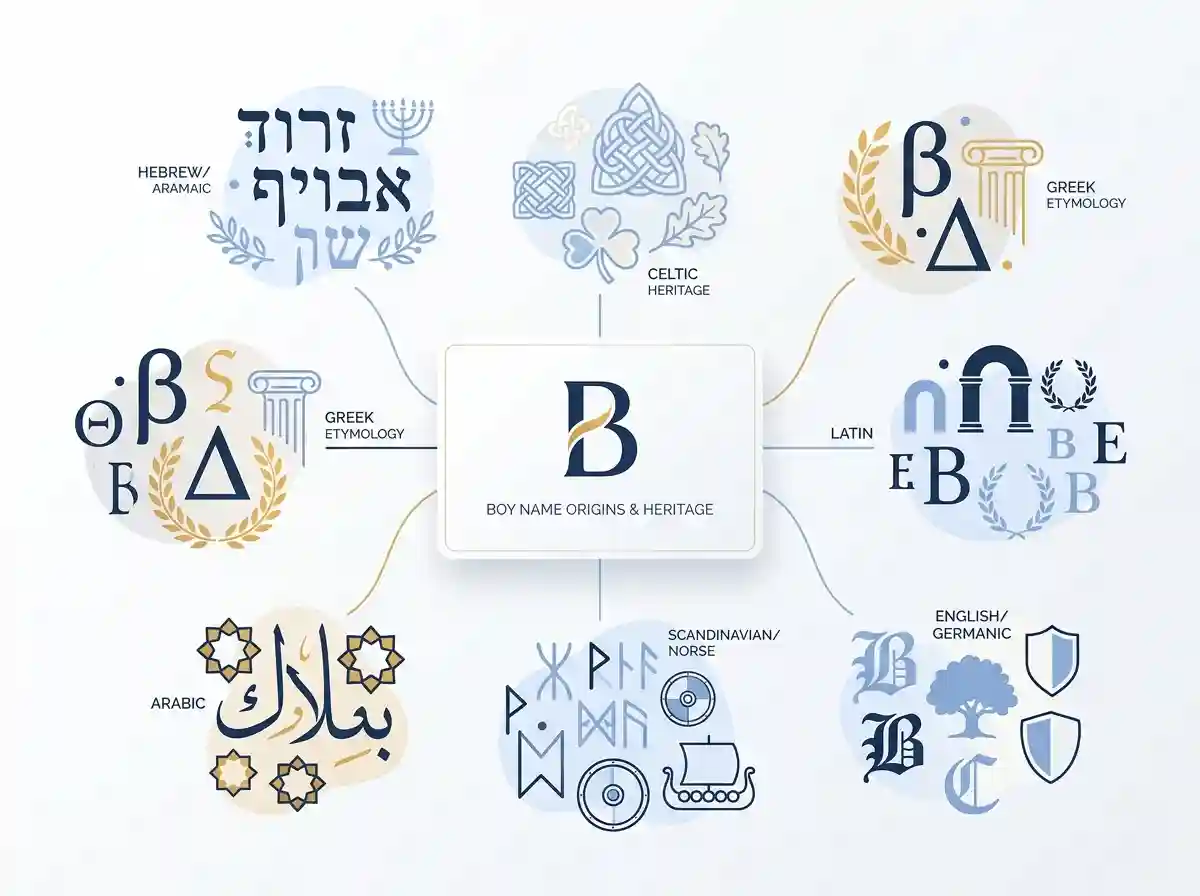
What to Check Before You Choose a Boy Name
A list can introduce you to a name. A closer look helps you decide whether that name truly deserves a place on your shortlist.
Meaning & Origin
Check the linguistic background and meaning rather than relying on a one-line interpretation without context.
Pronunciation
Learn the common pronunciation and whether multiple accepted pronunciations exist.
Spelling & Variants
Compare spelling variations, related forms and diminutives before choosing the version you prefer.
Popularity
Review historical rankings and remember that regional popularity may differ from national popularity.
Middle Name Flow
Say the first name, middle name and surname together and listen for natural syllable balance and rhythm.
Initials & Nicknames
Check initials, likely short forms and possible nicknames before making your final decision.
Boy Name Ideas to Start Exploring
Some parents want familiar names that have remained strong over time. Others want something distinctive without choosing a name that feels difficult to spell, pronounce or use. A helpful approach is to compare different kinds of boy names and notice which qualities repeatedly appeal to you.
For established choices, explore names such as Liam, Noah, Oliver, Theodore, Henry, James, Elijah, Mateo, William, Lucas, Benjamin, Levi, Jack, Sebastian, Samuel, Leo, Ezra, Michael, Daniel, John, Ethan, Julian, Joseph, Alexander, Owen, Matthew, Luke, Thomas, David and Gabriel.
These boy names come from different linguistic and cultural traditions, but they are recognizable choices with established histories. Their meanings, origins, spelling variations and popularity patterns can all be explored before adding them to your shortlist.
If you like contemporary or surname-style choices, consider Hudson, Cooper, Carter, Jackson, Mason, Grayson, Parker, Sawyer, Bennett, Lincoln, Logan, Nolan, Wesley and Weston.
If shorter names appeal to you, Kai, Leo, Luca, Milo, Ezra, Beau and Jack show how much personality a short boy name can carry. Short names may also pair naturally with longer middle names or surnames.
For a bolder shortlist, names such as Atlas, August, Maverick, Roman, Silas, Rowan, River, Brooks, Everett and Enzo offer different combinations of history, mythology, nature, surname usage and modern naming style.
A unique boy name does not need an unusual spelling or an invented sound. A name can feel distinctive because of its history, origin, rhythm, meaning or relative rarity.
Keep a simple name shortlist while browsing. For each favorite, record its meaning, origin, pronunciation, possible nickname, popularity level and one or two middle-name combinations. Comparing the same factors across several names can make your strongest choices much easier to recognize.
Boy Names FAQ
Common questions parents ask while comparing baby boy names.
Start with names you genuinely like, then compare meaning, origin, pronunciation, popularity, nicknames, initials and how the first name flows with the planned middle name and surname. Reduce your shortlist gradually instead of trying to identify one perfect name immediately.
Neither is automatically better. Popular boy names can feel familiar and recognizable, while rare or unique boy names may feel more distinctive. Popularity is best treated as one factor among many.
Meaning can add personal significance, especially when it connects with culture, faith, family traditions or values. It does not need to be the only deciding factor, but the linguistic history behind a claimed meaning is worth checking.
Say the full name naturally several times. Listen for syllable balance, repeated endings, alliteration and awkward sound transitions. A combination that looks good in writing can feel different when spoken.
The Social Security Administration maintains baby-name data based on Social Security card applications. The database can be used to compare name popularity and historical trends in the United States.
Yes. Name usage changes across regions, cultures and generations. Some names remain strongly associated with boys while others become commonly used across genders.
Start With One Direction, Then Follow the Names You Love
You do not need to search every possible male name in one sitting. Begin with a letter, meaning, origin or style that interests you. Open several individual boy name guides, compare meaning, popularity, pronunciation and sound, then add only the strongest choices to your shortlist. The right boy name is not simply the one with the highest ranking or rarest spelling. It is a name that feels meaningful, usable and lasting for your family.