
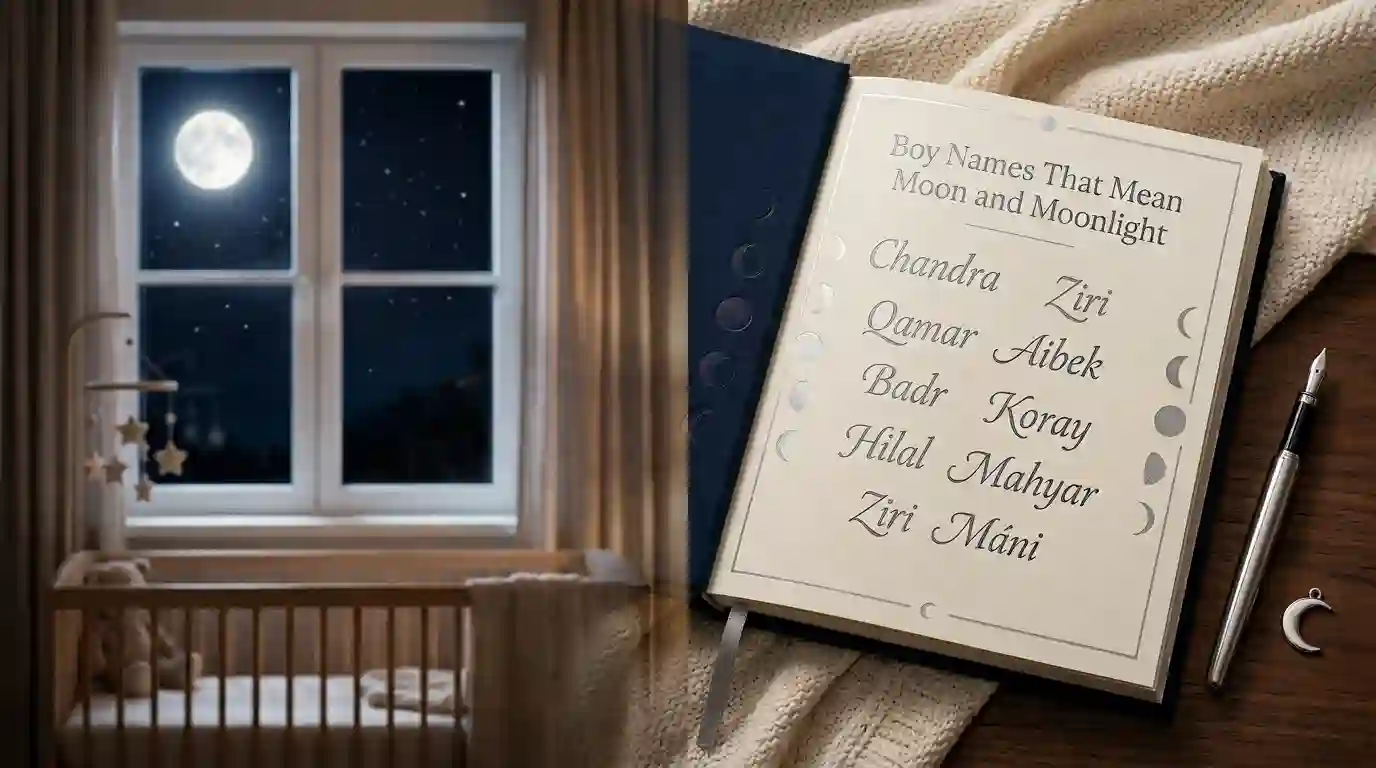
Boy Names That Mean Moon and Moonlight: Meanings, Origins, and Pronunciation
The moon has inspired names for thousands of years, representing light in darkness, changing seasons, time, renewal, beauty, mystery, and the night sky. Boy names that mean moon and moonlight come from an unusually wide range of cultures, from Sanskrit Chandra, meaning “moon,” and Arabic Qamar, also meaning “moon,” to Badr, meaning “full moon,” Hilal, meaning “crescent moon,” and Tamazight Ziri, meaning “moonlight.” Other choices combine the moon with strength, leadership, luck, friendship, or mythology: Aibek joins “moon” with “chieftain,” Koray means “ember moon,” Rakesh means “lord of the full moon,” and Old Norse Máni is both the word for the moon and its male personification in Norse mythology. This guide separates literal meanings from lunar mythology, astronomical moon names, disputed etymologies, and names that merely sound celestial, giving you verified origins, pronunciations, gender usage, spelling variants, and U.S. popularity before you choose a meaningful moon-inspired name for your son.
Table of Contents
- How to Tell What a Moon-Inspired Name Really Means
- Boy Names by Moon-Related Meaning
- Moon Names From Different Languages and Cultures
- Boy Names Inspired by Lunar Gods and Mythology
- Boy Names Inspired by Moons in Our Solar System
- Boy Moon Names by Style and U.S. Popularity
- Gender and Usage: Which Moon Names Work for Boys?
- Moon Name Pronunciation, Spelling, and Variants
- Compare Boy Names That Mean Moon and Moonlight
- Tips for Choosing a Moon-Inspired Boy Name
- Frequently Asked Questions About Boy Names That Mean Moon
- Final Thoughts on Boy Names That Mean Moon and Moonlight
How to Tell What a Moon-Inspired Name Really Means
Searching what name means moon sounds straightforward until you begin comparing baby-name lists.
Some names genuinely translate as “moon.”
Some refer to a particular lunar phase, such as the full moon, crescent moon, or new moon.
Others combine the moon with another concept such as friendship, strength, kingship, fortune, or light.
Then there are mythological names belonging to moon gods and astronomical names taken from natural satellites orbiting other planets.
All are legitimate forms of lunar inspiration, but they should not be presented as though they have identical meanings.
Names That Literally Mean “Moon”
The clearest answers to what is a name that means moon have linguistic roots directly referring to the moon itself.
Chandra
Origin: Sanskrit / Indian
Meaning: Moon
Gender: Traditionally masculine in its lunar-deity form; also used across genders
Pronunciation: CHUN-druh is a common English approximation; pronunciation varies by Indian language
Chandra comes from Sanskrit candra, meaning moon and connected with a root relating to shining.
In Hindu tradition, Chandra is also the male deity who personifies the moon.
This gives Chandra two unusually strong lunar connections: the word itself means moon, and the name belongs to a major lunar deity.
That makes it one of the clearest and most culturally established choices in this article.
Qamar
Origin: Arabic
Meaning: Moon
Gender: Masculine and feminine
Pronunciation: QAH-mar; the original Arabic consonant is not perfectly represented by English q
Qamar directly means moon in Arabic.
It is also used in Urdu and other Muslim naming communities.
Unlike names that simply evoke nighttime or brightness, Qamar has a literal lunar meaning.
For parents asking which name means moon, Qamar is therefore one of the strongest answers, although gender usage can vary by community.
Máni
Origin: Old Norse
Meaning: Moon
Gender: Masculine
Pronunciation: approximately MAH-nee in an Anglicized approximation; historical and modern Nordic pronunciation differs
Máni literally means moon in Old Norse.
In Norse mythology, Máni is also the male personification of the moon, making the name both linguistic and mythological.
This is particularly interesting because many cultures personify the moon as female, while the Norse tradition represents Máni as male and his sister Sól as the sun.
Arma
Origin: Hittite and Luwian mythology
Meaning: Moon, month
Gender: Masculine mythological usage
Arma means moon or month in ancient Hittite and Luwian contexts and was the name of a male lunar deity.
It is extremely rare as a modern U.S. boy name, but historically it offers a direct moon meaning.
Names That Literally Mean “Moonlight,” “Moon Glow,” or “Bright Moon”
Finding masculine names meaning moonlight is more difficult than finding names meaning moon.
Many popular moonlight names are traditionally feminine.
For example, Persian Mahtab genuinely means “moonlight,” but it is traditionally feminine in Persian naming. Turkish Aynur also means “moonlight” but is traditionally feminine.
Fortunately, there are verified masculine alternatives.
Ziri
Origin: Tamazight / Berber
Meaning: Moonlight
Gender: Masculine
Pronunciation: approximately ZEE-ree
Ziri is one of the strongest answers to what names mean moonlight.
The name means moonlight in Tamazight and is traditionally masculine.
It is especially associated with North African Amazigh naming traditions.
Unlike names that merely symbolize light at night, Ziri provides a direct linguistic moonlight meaning.
Ajnur
Origin: Bosnian, ultimately Turkic and Arabic elements
Meaning: Moonlight
Gender: Masculine
Pronunciation: approximately EYE-noor
Ajnur is the Bosnian masculine form of Aynur.
Aynur combines Turkic ay, meaning moon, with Arabic nur, meaning light.
The resulting meaning is therefore moonlight.
This is a useful choice for parents who want a masculine name with a direct light-and-moon construction rather than a mythological association.
Getsumei
Origin: Japanese
Possible meaning: Moonlight, with 月明
Gender: Reported as masculine in user-contributed naming references
Confidence: Lower
Getsumei can be written with Japanese characters 月明, combining the character for moon with one associated with brightness or clarity.
The compound can mean moonlight.
However, documentation of Getsumei as an established Japanese masculine personal name is substantially weaker than the evidence for names such as Chandra, Ziri, Qamar, or Aibek.
It is therefore better treated as an uncommon, character-dependent Japanese possibility that requires native-language verification, rather than a top recommendation.
Names Associated With Lunar Gods, Mythology, or Astronomy
A name does not have to translate as moon to have an unmistakable lunar connection.
Khonsu was an Egyptian moon god.
Tsukuyomi is the Japanese moon deity.
Chandra is the Hindu moon god as well as a word meaning moon.
Máni personifies the moon in Norse mythology.
Then there are astronomical names.
Triton is Neptune’s largest moon.
Oberon is a major moon of Uranus.
Callisto is one of Jupiter’s four large Galilean moons.
Phobos and Deimos orbit Mars.
Charon is Pluto’s largest moon.
These names are inspired by moons, but they do not literally mean “moon.”
That distinction is especially important in semantic name research.
Parents who love the broader night sky rather than only lunar meanings may also enjoy boy names that mean stars.
How to Verify a Name’s Meaning and Origin
A trustworthy moon-name meaning should ideally answer several questions.
What language does the name come from? Is the “moon” element actually present in that language? Is the word really used as a personal name? Is it traditionally masculine? Does its meaning depend on a particular character, spelling, or transliteration? Is the lunar connection literal, mythological, astronomical, or merely symbolic?
Consider Ay.
Ay means “moon” in Turkish and several related Turkic languages.
That does not automatically mean every name beginning or ending in Ay is simply translated as “moon.”
Aibek combines moon with chieftain or master.
Ayhan combines moon with khan or ruler.
Aykut combines moon with good fortune.
Koray combines ember with moon.
The complete name matters.
Meanings That Vary by Language, Spelling, or Source
Some moon-name claims are much less secure.
Jericho
Jericho is a modern masculine given name derived from the ancient city.
One theory connects the place name with a Hebrew word for moon. Another connects it with a word for fragrance.
The etymology remains uncertain.
That means descriptions such as “Jericho means moon” or “city of the moon” are too confident.
A more accurate description is:
Jericho may have an ancient etymological connection with the Hebrew word for moon, but another origin has also been proposed.
Luan
Luan is frequently included on internet moon-name lists.
That needs qualification.
The established Albanian masculine name Luan means “lion.”
In Brazilian usage, Luan is sometimes interpreted as a masculine form related to Portuguese lua, meaning moon, but this explanation is not as firmly documented as the Albanian etymology.
Parents choosing Luan specifically for a literal moon meaning should therefore investigate the cultural form they intend.
Mani
There are several unrelated names written Mani.
Old Norse Máni means moon and is the lunar personification.
Persian Mani, however, is a different name of uncertain meaning associated historically with the founder of Manichaeism.
Sanskrit maṇi means jewel.
Removing the accent and cultural context can therefore collapse three different histories into one spelling.
Mahtab
Mahtab genuinely means moonlight in Persian.
However, it is traditionally feminine.
It belongs in a discussion of moonlight meanings, but it should not be silently converted into a traditional Persian boy name.
Aylun
Aylun sometimes appears on online moon-name lists, yet strong documentation for it as an established masculine name with a clear lunar etymology is limited.
Until the specific language and traditional usage can be established, it is better not to present Aylun as a verified boy name meaning moon.
That type of caution makes a name guide more useful than simply producing the longest possible list.
Boy Names by Moon-Related Meaning
Different parents are searching for different lunar ideas.
Some want the word moon itself.
Others prefer moonlight, a full moon, the crescent, or a name referring to the beginning of a lunar cycle.
Boy Names That Mean “Moon”
Chandra — Moon
Chandra is the strongest Sanskrit choice and carries both linguistic and religious lunar significance.
The name also fits parents looking for a natural celestial concept rather than a modern invented name.
If natural meanings are central to your search, compare it with boy names that mean nature.
Qamar — Moon
Qamar is one of the clearest Arabic options.
It is short, international, and literal.
Its gender usage is mixed, so parents should look at family and regional naming conventions.
Máni — Moon
Máni gives parents a rare Old Norse masculine lunar name with a mythological story.
It is especially appealing for families interested in Norse languages or mythology.
Arma — Moon, Month
Arma comes from ancient Anatolian religious tradition.
Its historical authenticity is strong, but modern personal-name usage is uncommon.
Mahyar — Moon Friend
Origin: Persian
Meaning: Moon + friend/companion
Pronunciation: approximately mah-YAAR
Mahyar does not mean simply “moon.”
It combines Persian māh, moon, with yār, friend or companion.
The result can be understood as moon friend or companion of the moon.
It is a verified masculine Persian name and an excellent option for parents who want a poetic lunar meaning.
Aidos — Moon Friend
Origin: Kazakh
Meaning: Moon + friend
Gender: Masculine
Aidos combines Kazakh ai, moon, with dos, friend.
It offers a Central Asian parallel to Persian Mahyar.
Aibek — Moon Chieftain
Origin: Kazakh and Kyrgyz
Meaning: Moon + chieftain/master
Pronunciation: approximately eye-BEK
Aibek combines moon with the Turkic title beg/bek, meaning chieftain, master, or leader.
The name therefore combines celestial imagery with leadership.
Parents attracted to that stronger tone may also like boy names that mean strength and power.
Aisultan — Moon Sultan
Origin: Kazakh
Meaning: Moon + sultan/king
Gender: Masculine
Aisultan joins the moon element with a title meaning ruler or king.
It is a particularly regal lunar construction.
Aitöre — Moon Nobleman
Origin: Kazakh
Meaning: Moon + nobleman/lord
Gender: Masculine
Aitöre is another example of the productive Turkic lunar element ai/ay.
It combines moon imagery with nobility.
Boy Names That Mean “Moonlight” or “Moon Glow”
Ziri — Moonlight
Ziri is the standout masculine choice for a direct moonlight translation.
Its Tamazight heritage also makes it distinctive in U.S. naming.
Ajnur — Moonlight
Ajnur provides a verified masculine Balkan form of a name built from moon + light.
Chantrea — Moonlight
Origin: Khmer
Meaning: Moonlight
Gender: Masculine and feminine
Chantrea means moonlight in Khmer and is used across genders.
Its sound and meaning make it a strong cross-cultural option, though U.S. speakers may need pronunciation guidance.
Getsumei — Moonlight
Getsumei can represent moonlight through particular Japanese kanji, but it should remain in a lower-confidence tier because documented personal-name usage is limited.
Parents who mainly want a soft luminous image rather than a direct moon translation may also find inspiration among boy names that mean gentle.
Mahtab — Moonlight, but Traditionally Feminine
Persian Mahtab is worth knowing because its etymology is excellent.
It combines Persian elements for moon and shine/light.
Its traditional gender usage, however, is feminine.
A Persian masculine alternative with a lunar meaning is Mahyar, “moon friend.”
Boy Names Connected With the Full, Crescent, or New Moon
Badr — Full Moon
Origin: Arabic
Meaning: Full moon
Pronunciation: BADR, with a final consonant cluster
Badr is among the clearest lunar-phase names.
It directly means full moon in Arabic.
The full moon often carries cultural associations with brightness, completeness, beauty, and visibility, but those symbolic ideas should not replace the literal translation.
Badr itself is used for both males and females in Arabic, with strong masculine usage.
Badru — Full Moon / Born at the Full Moon
Origin: Swahili usage influenced by Arabic Badr
Meaning: Commonly interpreted as full moon or born at the full moon
Gender: Masculine
Badru is used as a masculine name in African and Swahili contexts and is closely connected with Arabic Badr.
Sources vary between simply “full moon” and the more specific “born at the full moon.”
Because Badr is the clearer Arabic root, Badru is best described as an Arabic-influenced Swahili lunar form rather than an entirely independent moon word.
Rakesh — Lord of the Full Moon
Origin: Sanskrit / Indian
Meaning: Lord of the full moon
Pronunciation: rah-KESH
Rakesh combines Sanskrit rākā, full moon, with īśa, lord or ruler.
This gives the name one of the richest verified full-moon meanings in the article.
Rakesh is well established across several Indian languages.
Hilal — Crescent Moon
Origin: Arabic; also used in Turkish
Meaning: Crescent moon
Pronunciation: hee-LAAL
Hilal means crescent moon in Arabic.
It also refers to the new lunar crescent used in the traditional Islamic calendar.
Its gender usage changes by culture: Hilal is typically masculine in Arabic but feminine in Turkish.
This makes cultural context essential.
İlkay — New Moon
Origin: Turkish
Meaning: New moon / first moon
Gender: Masculine and feminine
Pronunciation: approximately eel-KYE
İlkay combines Turkish ilk, first, with ay, moon.
It therefore means new moon or first moon.
The new moon naturally suggests cycles, beginnings, and renewal.
Parents drawn to that symbolism may also want to explore boy names that mean new beginning.
Aytaç — Moon Crown
Origin: Turkish
Meaning: Moon + crown
Gender: Masculine and feminine
Aytaç combines Turkish ay, moon, with taç, crown.
The literal structure is closer to moon crown than a lunar phase, but the image can evoke a crescent surrounding the head.
Koray — Ember Moon
Origin: Turkish
Meaning: Ember moon
Pronunciation: approximately koh-RYE
Koray combines kor, ember, with ay, moon.
The result, ember moon, is one of the most vivid lunar compounds available for boys.
Ayberk — Mighty Moon
Origin: Turkish
Meaning: Moon + mighty/firm/solid
Gender: Masculine
Ayberk combines lunar imagery with solidity and strength.
It is a useful alternative for parents who want a moon name that still sounds powerful rather than delicate.
Berkay — Mighty Moon
Berkay reverses the order of similar elements, combining mighty, firm, solid with moon.
Aykut — Moon + Good Fortune
Origin: Turkish
Meaning: Moon + luck/good fortune
Pronunciation: approximately EYE-koot
Aykut combines ay, moon, with kut, luck or good fortune.
Its positivity may also appeal to parents researching boy names that mean goodness or boy names that mean wealth.
Kutay — Lucky Moon
Origin: Turkish
Meaning: Lucky moon
Kutay contains the same two Turkic elements as Aykut in the opposite order.
Tuncay — Bronze Moon
Origin: Turkish and Azerbaijani
Meaning: Bronze moon
Pronunciation: approximately toon-JYE in Turkish
Tuncay combines a word for bronze with ay, moon.
The metallic imagery creates a warm copper-colored lunar impression.
Ayhan — Moon Ruler
Origin: Turkish
Meaning: Moon + khan/ruler
Gender: Masculine and feminine
Ayhan combines moon with a leadership title.
Its meaning can be interpreted literally from those components rather than simply “king of the moon.”
Moon Names From Different Languages and Cultures
Lunar naming traditions become especially interesting when compared across languages.
The moon is grammatically feminine in some languages, masculine in others, and culturally personified in many different ways.
Arabic and Persian Names
Arabic provides some of the clearest direct lunar meanings.
Qamar
Qamar simply means moon.
It is used across genders and also appears in Urdu naming.
Badr
Badr means full moon.
It is one of the strongest male-usable Arabic lunar names for parents who want a specific moon phase.
Hilal
Hilal means crescent moon.
The word has particular cultural importance because the sighting of the lunar crescent helps mark months in the Islamic calendar.
Badru
Badru is strongly connected with Badr in Swahili and African Muslim naming traditions.
It is usually interpreted through the full-moon concept.
Mahyar
Persian Mahyar means moon friend or moon companion.
It is one of the strongest Persian masculine choices.
Mahtab
Persian Mahtab means moonlight, but traditionally belongs to feminine naming.
This distinction matters because English-language baby-name lists sometimes categorize foreign names by meaning without checking gender usage in the source culture.
Nima
Persian Nima has an uncertain meaning.
One proposed interpretation is half moon, while another gives a completely different meaning connected with fairness or justice.
It should therefore not be presented as a secure moon name.
If you prefer romantic lunar imagery rather than a literal translation, some of these names pair naturally with boy names that mean beauty and love.
Sanskrit and Indian Names
Sanskrit has one of the richest lunar vocabularies represented in established masculine names.
Chandra
Moon.
It is both a word and the male lunar deity.
Rakesh
Lord of the full moon.
Chandrakant
Origin: Sanskrit / Hindi / Marathi
Meaning: Beloved by the moon
Pronunciation: CHUN-druh-kahnt
Chandrakant combines Chandra, moon, with an element meaning beloved or desired.
It is also associated with the moonstone.
This is an excellent longer traditional choice for parents who want an unmistakable Sanskrit lunar construction.
Ramachandra
Ramachandra combines the name Rama with Chandra, moon.
It is also an important name or epithet of the Hindu deity Rama.
That means it carries substantial religious context beyond its literal components.
Soma
Soma is the name of the ritual drink described in the Vedas and the deity personifying it.
In later tradition, Soma is sometimes identified with the moon god Chandra.
The name therefore has a genuine lunar mythological association, though it should not simply be translated as “moon” in every context.
Chander
Chander is a Hindi form or variant connected with Chandra and therefore shares the moon root.
Arjuna and Lunar Dynasty Associations
Some Indian names belong to stories, dynasties, or traditions associated with lunar ancestry without literally meaning moon.
Those connections belong to mythology rather than direct translation.
That distinction is the same principle used throughout this article.
Turkish and Kazakh Names
Turkic languages produce some of the most creative masculine moon compounds.
The element ay/ai means moon and appears in many names.
Aibek / Aybek
Moon + chieftain or master.
Aibek is used in Kazakh and Kyrgyz, while Aybek is an alternate transcription.
Aidos
Moon + friend.
Aisultan
Moon + sultan/king.
Aitöre
Moon + nobleman/lord.
Ayberk
Moon + mighty/firm.
Ayhan
Moon + ruler/khan.
Aykut
Moon + good fortune.
Aytaç
Moon + crown.
Berkay
Mighty/firm + moon.
Günay
Origin: Turkish and Azerbaijani
Meaning: Sun + moon
Gender: Masculine and feminine
Günay combines two major celestial bodies: the sun and moon.
İlkay
First moon/new moon.
Koray
Ember moon.
Kutay
Lucky moon.
Tuncay
Bronze moon.
The variety shows how productive lunar vocabulary can be in Turkish and Central Asian naming.
Instead of simply translating “moon,” the name can describe the moon as powerful, lucky, royal, glowing, crowned, or companionable.
Japanese and Other East Asian Names
East Asian names require more caution than many alphabetic-language names because their meanings often depend on written characters.
Tsuki
The Japanese word 月, read tsuki in ordinary vocabulary, means moon or month.
However, recognizing a Japanese word does not automatically make it a common traditional personal name.
Tsuki does appear in modern naming references, but it is more commonly presented as feminine.
It should not be treated as one of the strongest verified Japanese boy names meaning moon.
Getsumei
With 月明, Getsumei can convey moonlight or a bright moon.
Personal-name evidence is limited, however, and other kanji can alter the interpretation.
It belongs in an exploratory rather than high-confidence category.
Tsukuyomi
Tsukuyomi is the male moon deity of Japanese mythology and Shinto tradition.
The name is commonly analyzed using an old word for moon combined with an element connected with counting or reading.
It is much more naturally understood as a mythological deity name than a conventional modern Japanese baby name.
Japanese Kanji and Moon Meanings
The character 月 means moon or month.
It may appear in compounds inside Japanese names, but the reading of 月 can change depending on the name and combination.
Other characters may share the same pronunciation.
That means a romanized spelling alone cannot establish the meaning.
For example, two names spelled similarly in English may use completely different kanji.
Chinese Names
The Chinese character 月, pronounced yuè in Mandarin, means moon or month.
It can appear within Chinese given names.
But “Yue means moon” is incomplete as a baby-name statement because the romanization Yue can correspond to multiple Chinese characters and tones.
The exact written character must be checked.
Korean Names
The Korean word for moon is dal, but Korean personal-name meanings commonly depend on Hangul and sometimes hanja combinations rather than simple translation from an English baby-name list.
A Korean name should therefore be verified in its written form rather than assigned a generic lunar definition based on romanization alone.
Norse, Celtic, and Other Cultural Names
Máni — Old Norse
Máni is one of the most historically compelling male moon names.
The name literally means moon and belongs to the male lunar personification of Norse mythology.
Ziri — Tamazight
Ziri means moonlight.
It offers a verified North African masculine option that is both compact and distinctive.
Chantrea — Khmer
Chantrea means moonlight and is used across genders.
Arma — Hittite and Luwian
Arma means moon or month and belongs to an ancient male moon god.
Jericho — Ancient Hebrew Place-Name Association
Jericho may derive from a Hebrew moon word, but fragrance is another proposed etymology.
The moon meaning therefore remains possible, not certain.
Celtic Moon Names: Be Careful With Internet Lists
Verified traditional Celtic masculine names that literally mean moon are much harder to find than online lists suggest.
Many supposed “Celtic moon names” actually have meanings involving animals, brightness, whiteness, mythology, or completely unrelated roots.
Rather than forcing weak associations, parents specifically wanting Celtic heritage may be better served by choosing an authentic Celtic name with a night, nature, or mythological connection.
For broader seasonal imagery, you can explore boy names that mean summer or boy names that mean snow, ice and winter.

Boy Names Inspired by Lunar Gods and Mythology
Moon mythology offers another route for parents who want a celestial name without requiring the literal definition “moon.”
Names of Male Moon Deities
Chandra
Tradition: Hindu
Connection: Male god and personification of the moon
Literal meaning: Moon
Chandra is unusually strong because it belongs in both the direct-meaning and mythology categories.
Máni
Tradition: Norse
Connection: Male personification of the moon
Literal meaning: Moon
Máni travels through the sky in Norse myth and is pursued by the wolf Hati.
Khonsu
Tradition: Ancient Egyptian
Connection: Moon god
Meaning of name: Traditionally associated with “traveller”
Pronunciation: approximately KHON-soo
Khonsu was an important Egyptian deity connected with the moon, time, movement across the night sky, and healing.
His name does not literally mean moon.
Instead, it is associated with the idea of traveling, matching the moon’s perceived movement across the heavens.
Iah
Tradition: Ancient Egyptian
Connection: Lunar deity and personification of the moon
Iah was an Egyptian lunar god whose name is closely connected with the Egyptian term for moon.
Over time, aspects of the lunar cult were also associated with larger deities such as Khonsu and Thoth.
Tsukuyomi
Tradition: Japanese / Shinto
Connection: Male deity of the moon and night
Tsukuyomi is among the best-known male lunar deities outside South Asian and European mythology.
Its cultural and religious context should be understood before treating it simply as an exotic baby name.
Arma
Tradition: Hittite and Luwian
Connection: Male moon deity
Literal meaning: Moon, month
Arma provides another rare example where deity and literal lunar meaning overlap.
Names Connected With Lunar Myths and Legends
Soma
Soma’s relationship with Chandra connects the name with lunar mythology in Hindu tradition.
Nanna / Sin
The ancient Mesopotamian moon god was known as Nanna in Sumerian tradition and Sîn in Akkadian tradition.
Nanna is male in this mythological context despite being perceived as feminine by many modern English speakers.
Neither is an obvious modern American boy-name recommendation, but they are important examples of male moon deities.
Thoth
The Egyptian god Thoth had many domains, including wisdom, writing, reckoning, and lunar associations.
His name does not mean moon, so he belongs only in the mythological inspiration category.
Moon gods demonstrate how widely cultures connected the moon with time, healing, calendars, wisdom, fertility, travel, vegetation, and cycles.
Parents who enjoy mythological courage as much as celestial symbolism may also like boy names that mean hero or boy names that mean brave.

Boy Names Inspired by Moons in Our Solar System
A moon-inspired boy name does not have to come from a word meaning moon.
Our solar system contains hundreds of natural satellites with names drawn from Greek mythology, Roman mythology, Shakespeare, literature, and other traditions.
Some work surprisingly well as masculine given names.
Names of Moons Orbiting Jupiter, Saturn, Uranus, and Neptune
Ganymede — Jupiter
Ganymede is Jupiter’s largest moon and the largest moon in the solar system.
The astronomical name comes from Ganymede of Greek mythology, a beautiful Trojan youth.
As a modern first name, Ganymede would be extremely unusual, but it provides an unmistakable astronomical connection.
Callisto — Jupiter
Callisto is another of Jupiter’s four large Galilean moons.
The original mythological Callisto is female.
That means Callisto is better described as an astronomical moon name than as a traditionally masculine Greek personal name.
Modern parents may still perceive the -o ending as masculine in English or Romance-language contexts, but the historical gender should not be ignored.
Atlas — Saturn
Atlas is the name of a small moon of Saturn as well as the famous Titan of Greek mythology.
As an American baby name, Atlas already functions independently of the astronomical connection.
Its moon status adds another celestial layer.
Pan — Saturn
Pan is a small moon of Saturn named for the Greek god.
It is extraordinarily short, mythological, and unusual as a modern English given name.
Janus — Saturn
Janus is a moon of Saturn and the name of the Roman god associated with doorways, transitions, beginnings, and looking both backward and forward.
This makes Janus especially interesting for parents drawn to lunar cycles and transition symbolism.
Hyperion — Saturn
Hyperion is one of Saturn’s irregularly shaped moons and also a Titan from Greek mythology.
The name feels grand and literary but would be highly distinctive in everyday American use.
Oberon — Uranus
Oberon is one of Uranus’s major moons.
Its name comes from Oberon, king of the fairies, best known through Shakespeare’s A Midsummer Night’s Dream.
Oberon is traditionally masculine in literature and is one of the more usable planetary-moon names for a boy.
Ariel — Uranus
Ariel is another major moon of Uranus.
The name has Hebrew roots and modern unisex usage.
Its astronomical connection provides an additional meaning layer rather than defining the name itself.
Triton — Neptune
Triton is Neptune’s largest moon.
Its astronomical name comes from Triton, the son of Poseidon in Greek mythology.
Triton is masculine in mythology, making it a more straightforward boy-name inspiration than Callisto.
Its literal Greek etymology is uncertain.
Names Inspired by the Moons of Mars and Pluto
Phobos — Mars
Phobos is one of Mars’s two small moons.
The name comes from the Greek personification of fear and means fear or panic.
Phobos has a fascinating astronomical identity but a meaning that many parents may find less appealing for a child.
Deimos — Mars
Deimos is Mars’s other moon.
The Greek name means terror.
Like Phobos, it works much better as astronomy inspiration than as a conventional virtue-rich baby name.
Charon — Pluto
Charon is Pluto’s largest moon.
It was named after the mythological ferryman who carried souls across the river to the underworld.
The name has a strong classical and astronomical identity but also a dark mythological context.
Nix, Hydra, Kerberos, and Styx — Pluto
Pluto has four additional small moons named for mythological figures or concepts associated with the underworld.
Of these, none is as naturally usable as a mainstream boy name as Charon.
Why Planetary Moon Names Are Different
Triton does not mean moon.
Oberon does not mean moon.
Phobos does not mean moon.
They are the names of moons.
That may sound like a minor distinction, but it changes search intent.
If you are asking what are some names that mean moon, planetary satellites do not belong in the literal answer.
If you are asking for creative lunar baby names, they absolutely belong.
The cold landscapes of Triton, Enceladus, and other icy moons may also appeal to readers exploring boy names that mean snow, ice and winter.

Boy Moon Names by Style and U.S. Popularity
The meaning may attract you to a name, but style often determines whether it reaches your final shortlist.
Popular and Familiar Names
Direct moon names are generally uncommon in mainstream U.S. naming.
The most familiar choices tend to be names whose lunar connection is indirect.
Jericho is familiar as a biblical place-name and modern masculine name, although its moon etymology is uncertain.
Atlas is increasingly recognizable as a modern mythological name and also happens to be a moon of Saturn.
Ariel is well established across genders and is also a moon of Uranus.
Orion, although a constellation rather than a moon, often appears beside lunar names because of its unmistakable night-sky identity.
Among names with genuinely direct lunar meanings, Chandra, Badr, Qamar, Hilal, Rakesh, and Veer-like international naming styles are more culturally specific and generally less common nationwide.
Short and Easy-to-Pronounce Names
Badr
Four letters and one compact Arabic syllable.
The consonant ending may take practice for English speakers, but the name itself is concise.
Ziri
Two syllables, easy visual spelling, and a direct “moonlight” meaning.
Qamar
Five letters and two syllables.
English speakers may approximate the initial Arabic consonant differently from native pronunciation.
Máni
Two syllables and a direct moon meaning.
The accent may be omitted in English contexts, but doing so creates potential confusion with unrelated Mani names.
Ziri, Badr, and Máni
These are among the strongest options if you want a lunar meaning without a long formal name.
If short, warm names appeal to you more generally, boy names that mean sweet may provide another useful style cluster.
Rare and Distinctive Names
For something unusual in the United States, consider:
Ziri — moonlight
Ajnur — moonlight
Aibek — moon chieftain
Aidos — moon friend
Mahyar — moon companion
Koray — ember moon
Kutay — lucky moon
Tuncay — bronze moon
Máni — moon
Arma — moon/month and ancient moon god
Khonsu — Egyptian moon god
Triton — moon of Neptune
Oberon — moon of Uranus
These are not equally rare in their cultures of origin.
Aibek, for example, is a perfectly established Central Asian masculine name even though it is unusual in America.
“Rare in the United States” should never be mistaken for “invented.”
Classic Moon-Inspired Names
Moon meanings are often culturally specific, so there are fewer conventional English classics than in categories such as strength or biblical names.
However, a few options feel established because of history or literature.
Jericho has ancient place-name history.
Chandra has ancient Sanskrit and religious history.
Badr has centuries of Arabic usage.
Rakesh is an established Indian masculine name.
Máni comes from Old Norse tradition.
Oberon has centuries of literary history.
A classic name does not need to be common in the United States; it can be classic within its own language or cultural tradition.
U.S. Popularity and Social Security Administration Data
The most authoritative public source for American baby-name rankings is the U.S. Social Security Administration baby names database.
SSA’s latest completed national dataset covers 2025 births.
One important limitation is that the convenient public ranking tool emphasizes the top 1,000 names for each sex.
Most literal masculine moon names are outside that top group.
Jericho ranked #886 among boys in 2025, making it one of the few names in this article with a moon-related theory that appears in the current national top 1,000.
By contrast, names such as Badr, Hilal, Máni/Mani, Chandra, Aibek, Koray, Ziri, Qamar, Mahyar, and Rakesh are much rarer nationally under those exact spellings.
That does not mean nobody uses them.
SSA’s underlying national files contain names beyond the top 1,000 as long as they meet privacy thresholds, and exact spellings are counted separately.
A family that uses Mani instead of Máni, for example, may also be representing a completely different cultural name.
Popularity therefore needs to be interpreted together with origin.
Gender and Usage: Which Moon Names Work for Boys?
Moon imagery crosses gender boundaries in many cultures.
A name meaning moon may be masculine in one language, feminine in another, or used for both.
Traditionally Masculine Names
Strong masculine choices include:
| Name | Cultural Usage |
| Rakesh | Masculine Indian |
| Aibek | Masculine Kazakh/Kyrgyz |
| Aidos | Masculine Kazakh |
| Aisultan | Masculine Kazakh |
| Aitöre | Masculine Kazakh |
| Ayberk | Masculine Turkish |
| Aykut | Masculine Turkish |
| Berkay | Masculine Turkish |
| Koray | Masculine Turkish |
| Kutay | Masculine Turkish |
| Tuncay | Masculine Turkish/Azerbaijani |
| Mahyar | Masculine Persian |
| Ziri | Masculine Tamazight |
| Ajnur | Masculine Bosnian |
| Máni | Masculine Norse/Icelandic |
| Khonsu | Male Egyptian deity |
| Tsukuyomi | Male Japanese deity |
These provide the safest choices if traditional masculine usage matters to you.
Gender-Neutral Names Used for Boys
Chandra
Chandra appears in masculine and feminine usage, but the Sanskrit moon deity is male.
Qamar
Qamar is used across genders in Arabic and Urdu traditions.
Badr
Badr is masculine and feminine in Arabic.
Hilal
Hilal is particularly interesting because it is generally masculine in Arabic but feminine in Turkish.
Ayhan
Ayhan is used across genders in Turkish, though masculine usage is familiar.
Aytaç
Aytaç can also be masculine or feminine.
Günay
Günay is used across genders.
Chantrea
Chantrea can be masculine or feminine in Khmer.
Cultural Usage and Context
Gender should never be assigned based only on how a name “sounds” to English speakers.
An American reader might assume Mahtab works for a boy because the ending does not resemble a familiar English feminine suffix.
In Persian, however, Mahtab is a feminine name.
An English speaker may assume Hilal is consistently masculine because it appears on Arabic boy-name lists.
In Turkish, it is typically feminine.
Callisto may sound masculine to Americans because of the -o ending, yet the mythological Callisto is female.
Máni may look identical to the unaccented Sanskrit-derived Mani, but they are unrelated names.
A culturally accurate naming decision considers traditional usage as well as meaning.
Moon Name Pronunciation, Spelling, and Variants
International names deserve pronunciation guidance, but English approximations can only go so far.
Simple Pronunciation Guide
| Name | Approximate English Pronunciation |
| Chandra | CHUN-druh |
| Qamar | QAH-mar |
| Badr | BADR |
| Badru | BAD-roo |
| Hilal | hee-LAAL |
| Rakesh | rah-KESH |
| Aibek | eye-BEK |
| Aidos | eye-DOHS |
| Ayberk | eye-BERK |
| Ayhan | eye-HAHN |
| Aykut | eye-KOOT |
| Koray | koh-RYE |
| Kutay | koo-TIE |
| Tuncay | toon-JYE |
| Mahyar | mah-YAAR |
| Ziri | ZEE-ree |
| Ajnur | EYE-noor |
| Máni | roughly MAH-nee |
| Khonsu | KHON-soo |
| Tsukuyomi | tsoo-koo-YOH-mee |
| Jericho | JER-ih-koh |
| Oberon | OH-buh-ron |
| Triton | TRY-ton |
| Phobos | FOH-bus |
| Charon | KAIR-on or language/context-dependent |
These are practical approximations rather than replacements for native pronunciation.
Alternate Spellings and Transliterations
Aibek / Aybek
Both are used for the Kazakh/Kyrgyz name.
Transliteration conventions explain the difference.
Vir / Veer-Type Transliteration Principle
Although not a moon name, the Vir/Veer example illustrates how South Asian long vowels may be represented differently in English.
Moon names can vary in the same way.
Máni / Mani
The accent is meaningful for distinguishing the Old Norse/Icelandic form visually.
Writing Mani is common in English environments, but it can also refer to completely unrelated Persian or Sanskrit names.
Badr / Badru / Badar
Badr is the standard direct Arabic full-moon form.
Badar can represent a transliteration or regional form.
Badru appears in African and Swahili Muslim naming and is strongly connected with Badr.
They should not automatically be assumed to have identical histories.
Chandra / Chander
Chander is a Hindi-related form connected with Chandra.
Ay Names
Aibek, Aybek, Ayhan, Ayberk, Aytaç, Aykut, Kutay, Koray, and Tuncay all contain or relate to the Turkic moon element ay.
The placement of the element does not change its basic lunar contribution, but the other component changes the whole meaning.
Names With Uncertain or Disputed Pronunciations
Ancient mythology names are especially difficult to reduce to one “correct” pronunciation.
Arma comes from languages no longer spoken in their ancient form.
Khonsu is an English transliteration of an Egyptian name whose historical vocalization cannot be reproduced with complete certainty.
Greek names such as Triton and Phobos have classical Greek pronunciations and different modern English conventions.
Japanese romanization can hide sound distinctions.
If cultural authenticity matters, use pronunciation from native-language speakers rather than relying only on an Americanized baby-name pronunciation.
Compare Boy Names That Mean Moon and Moonlight
| Name | Meaning / Lunar Connection | Origin | Gender Usage | Pronunciation | U.S. Popularity |
| Chandra | Moon | Sanskrit/Indian | Masculine & feminine | CHUN-druh | Rare / outside top 1,000 |
| Qamar | Moon | Arabic | Masculine & feminine | QAH-mar | Rare |
| Máni | Moon; Norse moon personification | Old Norse | Masculine | MAH-nee approx. | Very rare |
| Arma | Moon, month; moon god | Hittite/Luwian | Masculine mythological | AR-ma approx. | Very rare |
| Badr | Full moon | Arabic | Masculine & feminine | BADR | Rare |
| Badru | Full moon / born at full moon | Swahili/Arabic-influenced | Masculine | BAD-roo | Very rare |
| Rakesh | Lord of the full moon | Sanskrit/Indian | Masculine | rah-KESH | Rare nationally |
| Hilal | Crescent moon | Arabic/Turkish | Masculine in Arabic; feminine in Turkish | hee-LAAL | Very rare |
| İlkay | New moon / first moon | Turkish | Unisex | eel-KYE approx. | Very rare |
| Ziri | Moonlight | Tamazight | Masculine | ZEE-ree | Very rare |
| Ajnur | Moonlight | Bosnian | Masculine | EYE-noor | Very rare |
| Chantrea | Moonlight | Khmer | Unisex | varies | Very rare |
| Getsumei | Moonlight with specific kanji | Japanese | Reported masculine | gets-MAY / varies | Very rare; lower confidence |
| Aibek | Moon + chieftain/master | Kazakh/Kyrgyz | Masculine | eye-BEK | Very rare |
| Aidos | Moon + friend | Kazakh | Masculine | eye-DOHS | Very rare |
| Aisultan | Moon + sultan/king | Kazakh | Masculine | varies | Very rare |
| Aitöre | Moon + nobleman/lord | Kazakh | Masculine | varies | Very rare |
| Ayberk | Moon + mighty/firm | Turkish | Masculine | eye-BERK | Very rare |
| Ayhan | Moon + ruler/khan | Turkish | Unisex | eye-HAHN | Very rare |
| Aykut | Moon + good fortune | Turkish | Masculine | eye-KOOT | Very rare |
| Aytaç | Moon + crown | Turkish | Unisex | eye-TAHCH | Very rare |
| Berkay | Mighty/firm + moon | Turkish | Masculine | ber-KYE | Very rare |
| Günay | Sun + moon | Turkish/Azerbaijani | Unisex | goo-NYE approx. | Very rare |
| Koray | Ember moon | Turkish | Masculine | koh-RYE | Very rare |
| Kutay | Lucky moon | Turkish | Masculine | koo-TIE | Very rare |
| Tuncay | Bronze moon | Turkish/Azerbaijani | Masculine | toon-JYE | Very rare |
| Mahyar | Moon + friend/companion | Persian | Masculine | mah-YAAR | Very rare |
| Chandrakant | Beloved by the moon | Sanskrit/Indian | Masculine | CHUN-druh-kahnt | Very rare |
| Ramachandra | Rama + moon | Sanskrit/Indian | Masculine | varies | Very rare |
| Soma | Lunar deity association | Sanskrit/Hindu tradition | Masculine & feminine | SO-mah | Rare |
| Khonsu | Egyptian moon god | Ancient Egyptian | Masculine deity | KHON-soo | Extremely rare |
| Tsukuyomi | Japanese moon god | Japanese mythology | Masculine deity | tsoo-koo-YOH-mee | Extremely rare |
| Jericho | Possibly linked with “moon”; disputed | Biblical place-name | Masculine modern use | JER-ih-koh | #886 boys, 2025 |
| Triton | Neptune’s largest moon | Greek mythology/Astronomy | Masculine | TRY-ton | Very rare |
| Oberon | Moon of Uranus | Literature/Astronomy | Masculine | OH-buh-ron | Very rare |
| Atlas | Moon of Saturn; mythological Titan | Greek/Astronomy | Masculine modern use | AT-lus | Established modern use |
| Phobos | Moon of Mars; “fear, panic” | Greek mythology | Masculine mythological | FOH-bus | Extremely rare |
| Deimos | Moon of Mars; “terror” | Greek mythology | Masculine mythological | varies | Extremely rare |
| Charon | Pluto’s largest moon | Greek mythology/Astronomy | Masculine mythological | KAIR-on approx. | Very rare |
This comparison shows why the question what names mean moon needs more than a flat list.
Chandra, Qamar, and Máni directly answer it.
Badr specifies the full moon.
Hilal specifies the crescent.
Ziri and Ajnur answer the moonlight search.
Aibek, Koray, Rakesh, and Mahyar combine the moon with another idea.
Triton and Oberon are moons rather than names meaning moon.
Jericho remains uncertain.
That level of labeling makes the final choice much easier.
Tips for Choosing a Moon-Inspired Boy Name
A lunar meaning can be beautiful, but the strongest baby name is one that works beyond its definition.
Consider the Name’s Cultural Meaning and Context
Start by deciding what kind of lunar connection you actually want.
If the literal word moon matters most, consider Chandra, Qamar, or Máni.
If moonlight is your priority, Ziri or Ajnur provide clearer masculine choices.
For the full moon, Badr and Rakesh are excellent.
For a crescent, Hilal is unusually direct.
For a new moon, İlkay provides a meaningful Turkish option.
If you want a compound name, Aibek, Ayberk, Koray, Kutay, Tuncay, Aidos, and Mahyar allow you to combine the moon with leadership, strength, fire, luck, metal, or friendship.
For mythology, Chandra, Máni, Khonsu, Tsukuyomi, and Arma provide dramatically different cultural stories.
For astronomy, Triton, Oberon, Atlas, and Charon offer modern celestial inspiration.
Do not choose only from the English translation.
Learn the cultural background too.
Check How It Sounds With Middle and Last Names
Try the full combination in normal speech.
Badr Alexander Khan
Ziri Adam Bennett
Aibek Daniel Karimov
Rakesh Arjun Patel
Mahyar Cyrus Rahimi
Koray James Demir
Chandra Dev Sharma
Jericho Miles Carter
Triton James Cole
A short lunar first name can pair especially well with a longer middle or surname.
Longer names such as Chandrakant may flow better with compact family names.
If you want the middle name to balance celestial softness with resilience, compare boy names that mean survivor.
Think About Spelling, Nicknames, and Everyday Use
Ask whether you are comfortable explaining pronunciation.
Chandra and Rakesh are relatively straightforward once heard.
Aibek may be pronounced incorrectly as “AY-beck” rather than closer to “eye-BEK.”
Tuncay uses Turkish spelling rules unfamiliar to many Americans.
Máni may lose its accent in U.S. databases and become Mani.
Qamar contains an Arabic sound English does not reproduce exactly.
Tsukuyomi is strongly mythological and substantially longer.
There is no reason to avoid a name because people may need to learn it.
The important question is whether you personally value authenticity enough to correct pronunciation when necessary.
Balance the Meaning With the Child’s Everyday Identity
A name does not need to describe a child’s personality.
Naming a son Badr does not require him to become calm or luminous.
Naming him Aibek does not determine leadership.
Máni does not make someone mystical.
The meaning is a story and symbol, not a prediction.
That can be useful when comparing celestial names with character-based categories such as boy names that mean warrior, where the symbolism is much more forceful.
You may discover that you love moon names precisely because they leave more room for interpretation.
Frequently Asked Questions About Boy Names That Mean Moon
What boy names literally mean moon?
Chandra means “moon” in Sanskrit, Qamar means “moon” in Arabic, and Old Norse Máni means “moon.”
What boy names mean moonlight?
Ziri means “moonlight” in Tamazight, while Bosnian masculine Ajnur comes from a name meaning “moonlight.”
What boy name means full moon?
Badr directly means “full moon” in Arabic, while Rakesh means “lord of the full moon.”
What boy names mean crescent moon?
Hilal means “crescent moon” in Arabic and is traditionally masculine in Arabic usage.
What boy name means new moon?
Turkish İlkay means “new moon” or “first moon.”
What boy name means moon and ruler?
Ayhan combines Turkish “moon” with a khan/ruler element, while Aisultan combines moon with sultan or king.
What boy name means moon and strength?
Ayberk combines Turkish “moon” with an element meaning mighty, firm, or solid.
What boy name means moon and friend?
Persian Mahyar means moon + friend/companion, while Kazakh Aidos combines moon with friend.
What boy name means moonlight in Arabic?
A direct masculine Arabic moonlight equivalent is less straightforward; Ajnur derives from Turkic “moon” plus Arabic nur, “light,” while Qamar itself means “moon.”
Is Chandra a boy name?
Yes; Chandra is traditionally masculine as the Sanskrit name of the male moon deity, though it is also used across genders.
Is Qamar a boy name?
Yes; Qamar is used for both males and females and directly means “moon” in Arabic.
Is Badr a boy name?
Yes; Badr is used for boys and girls in Arabic and literally means “full moon.”
Is Hilal a boy name?
Yes in Arabic usage, where Hilal is typically masculine; in Turkish usage it is typically feminine.
Does Mahtab mean moonlight?
Yes; Mahtab means “moonlight” in Persian, but it is traditionally a feminine Persian name.
Does Jericho mean moon?
Possibly, but not certainly; one proposed etymology connects Jericho with a Hebrew word for moon, while another connects it with fragrance.
Does Luan mean moon?
The established Albanian masculine Luan means “lion”; a Brazilian moon-related interpretation exists but is less securely documented.
Does Mani mean moon?
Old Norse Máni means “moon,” but Persian Mani and Sanskrit maṇi are unrelated names with different meanings.
Does Tsuki mean moon?
Yes, Japanese tsuki means “moon,” but a vocabulary word is not automatically a traditional masculine personal name.
Does Getsumei mean moonlight?
The Japanese compound 月明 can convey “moonlight,” but Getsumei’s status as an established masculine given name is less securely documented.
What moon name is easiest to pronounce in English?
Ziri, Badr, Chandra, Rakesh, Qamar, and Koray are relatively compact, though authentic pronunciation still varies by language.
What are rare boy names that mean moon?
Aibek, Mahyar, Ziri, Ajnur, Koray, Kutay, Tuncay, Aidos, Máni, and Arma are distinctive options in the United States.
Which male names come from moon gods?
Chandra, Máni, Khonsu, Tsukuyomi, Arma, and Iah are connected with male lunar deities or personifications.
Which boy names come from moons of other planets?
Triton, Oberon, Atlas, Phobos, Deimos, Charon, Ganymede, and other satellite names provide astronomical inspiration.
How can I tell whether a name literally means moon?
Check the original language and root rather than relying on symbolism, mythology, or the fact that an astronomical moon carries the name.
Are moon-inspired names used for boys and girls?
Yes; Chandra, Qamar, Badr, Hilal, Ayhan, Aytaç, Günay, and Chantrea have gender usage that varies by culture.
How do I check a name’s popularity in the United States?
Use the U.S. Social Security Administration baby-name database and remember that alternate spellings are counted separately.
Final Thoughts on Boy Names That Mean Moon and Moonlight
The best boy names that mean moon and moonlight depend on how literal you want the lunar connection to be. Chandra, Qamar, and Máni directly mean moon; Badr represents the full moon, Hilal the crescent, and İlkay the new moon. Ziri and Ajnur are particularly strong choices for moonlight, while Aibek, Koray, Mahyar, Aykut, Ayberk, and Tuncay combine the moon with leadership, fire, friendship, fortune, strength, and color. Mythological names such as Khonsu and Tsukuyomi add cultural stories, while Triton, Oberon, Atlas, and Charon connect the name directly with our solar system.
Shortlist the names whose meanings genuinely appeal to you, verify their cultural pronunciation and gender usage, and then test each one with your surname. A meaningful lunar name should not only look beautiful on a list—it should carry a story you will enjoy telling for years.