
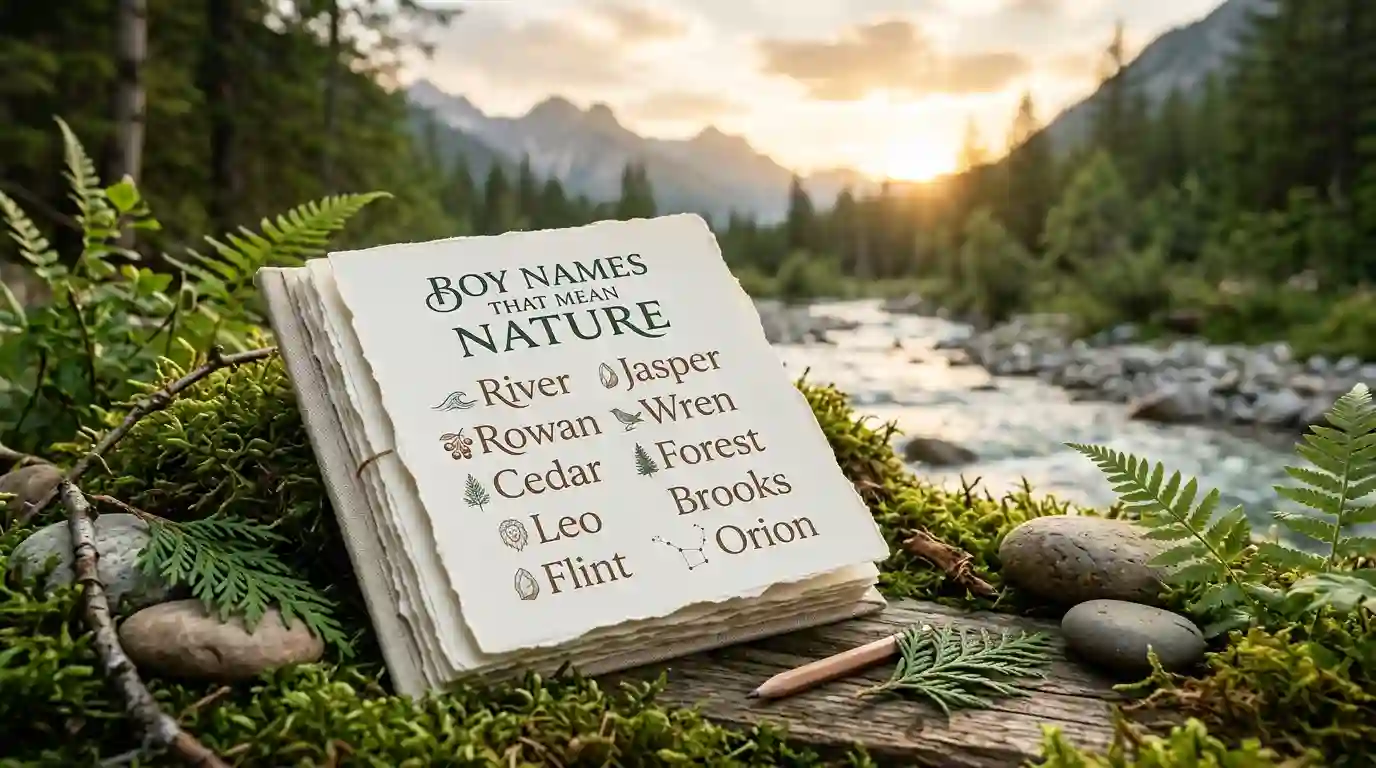
Boy Names That Mean Nature: Meanings, Origins, and Styles
Nature can inspire a boy’s name through forests, rivers, mountains, animals, stones, weather, seasons, flowers, stars, and even the colors of the landscape. The best boy names that mean nature range from unmistakable English word names such as River, Forest, Cedar, Flint, Ocean, Wolf, and Sky to traditional names with less obvious natural roots, including Peter, meaning “stone,” Dylan, built from Welsh elements associated with the tide or flow, Leo, meaning “lion,” and Linden, connected with the linden tree. Other popular choices, such as Rowan, Jasper, Oliver, Kai, Phoenix, and Caspian, need more explanation because their nature connections can depend on surname history, symbolic usage, alternative etymologies, or modern word-name associations. This guide separates direct nature meanings from subtler connections, explains origins and pronunciation, compares popular and rare choices, covers trees, water, wildlife, weather, celestial themes, seasons, colors, and landscapes, and shows how to choose a nature-inspired name that feels meaningful without relying on inaccurate baby-name definitions.
Table of Contents
- Why Choose a Nature-Inspired Name for a Boy?
- What Counts as a Nature Name for a Boy?
- Nature Boy Names by Theme
- Nature-Inspired Boy Names by Style
- How We Verified Nature Name Meanings
- Nature Names From Different Cultures
- Nature Names for Boys in the United States
- Compare Nature Names for Boys
- How to Choose a Nature Name for Your Boy
- Nature Name Pairings
- Frequently Asked Questions About Nature Names for Boys
- Final Thoughts
- References
Why Choose a Nature-Inspired Name for a Boy?
Nature names have an unusual advantage: they can feel modern without depending entirely on trends.
Trees, oceans, mountains, stones, birds, stars, rain, and seasons existed long before modern baby-name rankings, so even newly fashionable nature-inspired baby names can carry imagery that feels timeless.
Parents may choose a nature name because it reminds them of:
- a favorite landscape
- a childhood home
- a meaningful trip
- the ocean or mountains
- a particular tree or flower
- wildlife
- an outdoor lifestyle
- environmental values
- a season of birth
- resilience and growth
- freedom and adventure
- peace and tranquility
- strength and permanence
- family heritage
A name such as River may suggest movement and freedom.
Oak can symbolize stability.
Cedar may suggest longevity and woodland strength.
Flint feels hard and elemental.
Wren brings a small songbird to mind.
Wolf is wild and powerful.
Sky feels open and expansive.
Those associations are symbolic rather than predictions about personality. Naming a child River will not make him adventurous, just as naming him Wolf will not determine his temperament.
A name is better understood as a story, image, or family value.
Nature themes also overlap naturally with other naming styles. Parents who like powerful outdoorsy choices may enjoy boy names that mean strength and power, while those who prefer softer imagery may be drawn to boy names that mean gentle.
What Counts as a Nature Name for a Boy?
Not every nature-inspired name works in exactly the same way.
Some are literal vocabulary words.
Some derive historically from trees, animals, stones, geographical features, or natural phenomena.
Others became nature names only in modern usage.
Names That Literally Refer to Something in Nature
These are the easiest to identify.
River refers directly to a flowing body of water.
Ocean refers to the ocean.
Cedar refers directly to a tree.
Oak refers to the oak tree.
Sky refers to the sky.
Storm refers to weather.
Wolf refers to the animal.
Bear refers to the animal.
Fox refers to the animal.
Wren refers to the bird.
Flint refers to the hard stone.
These are direct nature names because an English speaker can recognize the natural object immediately.
Some began as ordinary vocabulary and only later developed as personal names.
That does not make them less legitimate. Word names have existed in English naming traditions for centuries, and modern naming has expanded the range considerably.
Names With a Symbolic or Less Obvious Nature Connection
Other names require more explanation.
Peter
Peter does not sound like a modern earthy word name.
Its Greek root, however, means stone.
That makes Peter one of the oldest widely used boy names with an elemental nature meaning.
Leo
Leo comes from Latin and means lion.
Although most parents probably think of Leo primarily as a classic personal name, its linguistic meaning is an animal.
It is also the name of a zodiac constellation, giving it a second celestial association.
Dylan
Dylan comes from Welsh elements associated with tide or flow.
Its mythological namesake is strongly connected with the sea.
Dylan therefore offers a water connection without functioning as an obvious English word name such as River or Ocean.
Heath
Heath comes from an English surname originally describing someone who lived on a heath, an open area of uncultivated land.
It feels botanical because heath is also used for certain shrubs, but the given name historically arrived through the landscape surname.
Linden
Linden comes from a German or Dutch surname derived from a word meaning linden tree.
It is therefore a genuine tree-related name even though it does not look like a modern English vocabulary invention.
Jasper
The traditional personal name Jasper probably comes through Gaspar and may ultimately be related to a word meaning treasurer.
However, Jasper is also the English word for the gemstone.
A modern parent may therefore choose Jasper specifically for the stone reference even though the older personal name did not necessarily originate from the gemstone.
That is a legitimate modern nature association, but it should be labeled correctly.
How a Name’s Meaning Can Vary by Language or Source
Names frequently become inaccurate when several unrelated origins are collapsed into one definition.
Kai
Kai is one of the best examples.
The familiar European masculine Kai has an uncertain origin and may be a diminutive of several names.
There are also unrelated names spelled Kai in other languages.
In some traditions or submitted forms, Kai has been connected with natural concepts including sea, willow, or other meanings.
That does not mean every boy named Kai has a personal name that literally means ocean.
If you choose Kai specifically for a nature meaning, identify the cultural origin you intend rather than borrowing whichever definition appears most attractive.
Rowan
Rowan is another multilayered name.
Its Irish personal-name origin comes through Ruadhán, connected with an Irish root meaning “red.”
Modern English Rowan can also be given directly in reference to the rowan tree.
Therefore it is reasonable to call Rowan a tree-inspired modern nature name—but not to pretend that its only or original meaning is “rowan tree.”
Oliver
Oliver is often advertised as meaning olive tree.
The Old French name Olivier may indeed have been influenced by or derived from Latin oliva, “olive tree.”
However, Germanic and Old Norse derivations have also been proposed.
So “possibly associated with the olive tree” is more accurate than presenting “olive tree” as completely settled.
Silas
Silas is frequently placed on forest-name lists because of its possible relationship with Silvanus.
Silvanus itself is associated with Latin silva, “wood, forest.”
Silas, however, has a more complicated biblical linguistic history and may represent a different form altogether.
Calling Silas simply “forest” is therefore too confident.
Asher
Asher is sometimes pulled into tree-name lists because it begins with Ash.
That is misleading.
The Hebrew given name Asher means happy, blessed.
The English surname Asher can separately refer to someone living near an ash tree, but the familiar biblical masculine given name does not mean “ash tree.”
This distinction between spelling and etymology is one of the most important rules in name research.
Nature Boy Names by Theme
One benefit of the nature category is its range.
You can choose a name that feels woodland, coastal, mountainous, celestial, wild, colorful, botanical, or adventurous without leaving the overall theme.
Tree, Woodland, and Botanical Names
Oak
Origin: Modern English word name
Meaning: Oak tree
Pronunciation: OHK
Style: Short, strong, earthy
Oak is about as direct as tree names get.
The oak has long symbolized endurance, strength, longevity, and permanence in European cultural traditions.
As a first name, Oak remains much rarer than Oakley or similar elaborations, giving it a minimalist feel.
Ash
Origin: English nature word / also a short form of other names
Meaning: Ash tree when used as a word name
Pronunciation: ASH
Ash works as both a direct nature word and a nickname.
It can be chosen independently for the ash tree, or it may shorten names such as Ashton or Ashley.
Do not confuse the English nature word with Asher, whose Hebrew meaning is “happy, blessed.”
Forest
Origin: English
Meaning: Forest
Pronunciation: FOR-ist
Forest can come directly from the English vocabulary word.
It can also be regarded as a variant of Forrest.
The spelling Forest makes the nature connection particularly transparent.
Forrest
Origin: English surname
Meaning: Forest; originally someone living near a forest
Pronunciation: FOR-ist
Forrest has a stronger surname history than Forest.
It works well for parents who like woodland imagery but prefer a traditional surname-style spelling.
Cedar
Origin: Modern English
Meaning: Cedar tree
Pronunciation: SEE-der
Cedar is an established but rare modern English given name used across genders.
The cedar evokes evergreen woodland, aromatic wood, longevity, and mountain landscapes.
It is more unusual than Rowan but easier to interpret than many international botanical names.
Rowan
Origin: Irish and modern English
Nature connection: Rowan tree
Pronunciation: ROH-en
Gender: Masculine and feminine
Rowan has become one of the most usable tree-inspired names for boys.
Its established Irish history prevents it from feeling like a newly invented word name, while the rowan tree gives modern parents a clear botanical association.
Linden
Origin: German/Dutch surname into English usage
Meaning: Linden tree
Pronunciation: LIN-den
Linden feels softer than Oak or Cedar.
Its two syllables and familiar -den ending also make it accessible in contemporary U.S. naming.
Erez
Origin: Hebrew
Meaning: Cedar
Pronunciation: EH-rez
Erez directly means cedar in Hebrew.
It is an excellent option for parents who want a tree meaning in an established masculine cultural name rather than an English vocabulary word.
Brin
Origin: Slovene
Meaning: Juniper
Pronunciation: BREEN
Brin is a Slovene masculine name meaning juniper.
It offers a particularly compact botanical option.
Junípero
Origin: Spanish/rare religious-historical usage
Nature root: Juniper
Junípero is associated with the Latin word for juniper and is historically known through Junípero Serra.
It is culturally and historically specific rather than simply a Spanish translation of modern English Juniper.
Juniper
Origin: Modern English
Meaning: Juniper tree/shrub
Gender: Primarily feminine in current established English usage
Juniper is a genuine botanical word name, but in current U.S. naming it is much more strongly associated with girls than boys.
Parents looking for a traditionally masculine juniper name may prefer Brin.
Sage
Origin: Modern English
Nature meaning: Aromatic herb
Additional meaning: Wise person
Gender: Gender-neutral
Sage works on two levels.
It is a herb name and an English word for a wise person.
That double meaning helps explain its popularity among parents drawn to healing nature names, spirituality, herbal imagery, or wisdom.
Basil
Basil requires the same careful treatment as Jasper.
The traditional English masculine name Basil comes from Greek and means royal, kingly.
The herb basil is a separate English word with the same spelling.
Modern parents can choose Basil because they like the plant association, but it is inaccurate to say the historical given name itself means “herb.”
Heath
Heath comes through a surname for someone who lived on a heath.
The landscape word also describes open shrubland and is connected with heath plants.
The result is a subtle botanical and landscape name rather than an obvious tree word.
Silvanus and Sylvan
Silvanus is derived from Latin silva, “wood, forest,” and was also the name of a Roman god associated with forests.
Sylvan, influenced by the same Latin root, means woodland or forest-like in English.
For parents wanting a more traditional alternative to Forest, Sylvan is particularly attractive.
Bosco
Bosco derives from an Italian surname meaning wood or forest.
It is known especially through Saint John Bosco.
The name therefore combines European religious history with woodland imagery.
Codrin
Codrin is Romanian and comes from codru, meaning forest.
It is rare in the United States but linguistically direct.

Water, River, Sea, and Rain Names
River
Origin: Modern English
Meaning: River
Gender: Gender-neutral
Pronunciation: RIV-er
River has become one of the defining modern nature names.
It feels outdoorsy without being obscure and works across genders, though boys have substantial usage in the United States.
Symbolically, a river can suggest movement, persistence, change, life, and journey.
Brooks
Origin: English surname
Nature connection: Brook, stream
Pronunciation: BROOKS
Gender: Predominantly masculine
Brooks derives from the surname Brooks, which is related to Brook.
It provides water imagery while still sounding like a traditional surname name.
This combination has helped Brooks feel far more mainstream than many direct nature words.
Brook
Brook is the direct English word for a small stream and is also used as a surname and given name.
In current American naming, Brooke is strongly feminine, while Brooks is much more masculine.
Ocean
Origin: Modern English
Meaning: Ocean
Gender: Masculine and feminine
Pronunciation: OH-shun
Ocean is one of the broadest and most dramatic direct water names.
Its English word ultimately comes through Latin and Greek traditions related to Okeanos, the mythical great water surrounding the world.
Ocean feels modern, expansive, and unconventional.
Dylan
Origin: Welsh
Meaning: Built from elements relating to tide/flow
Pronunciation: DIL-en in English
Dylan provides a less obvious sea connection.
The Welsh mythological Dylan is closely tied to the sea, and the name’s linguistic construction includes llanw, meaning tide or flow.
It is therefore one of the best choices for parents who want a mainstream personal name with authentic water roots.
Caspian
Origin: Modern literary/geographical usage
Nature connection: Caspian Sea
Pronunciation: KAS-pee-en
Caspian is most naturally understood as a geographical name associated with the Caspian Sea.
The sea itself takes its name from the ancient Caspi people.
Claims that Caspian literally means “sea,” “white,” or “treasure of the sea” are less reliable than the simple geographical explanation.
The modern given name became especially familiar through Prince Caspian in C. S. Lewis’s Chronicles of Narnia.
Kai
Kai is attractive to nature-name parents because various unrelated names and words spelled Kai have sea or plant meanings in some languages.
However, the mainstream European masculine Kai has an uncertain origin.
If you choose Kai because of an ocean meaning, identify the exact cultural tradition rather than assuming “Kai universally means sea.”
Rain
Rain is a direct weather and water word.
The spelling Raine also appears as a surname-style form, but it may have different surname origins.
Rain itself works as a modern gender-neutral nature name.
Rainier
Rainier may look like “rain,” but its historical Germanic name roots are unrelated to weather.
This is exactly the kind of visual coincidence that should not be mistaken for etymology.
Wade
Wade can evoke water because the English verb means to walk through shallow water.
However, the traditional personal name has Germanic roots and a history independent of the modern vocabulary association.
It fits best as a symbolic or modern water association, not as a name literally translating as river or sea.
Calder
Calder appears in several British river and place names.
Its exact linguistic origins vary by location, but the geographical river association makes it appealing to parents who like less obvious water names.
Water themes can also pair beautifully with celestial ones. If you prefer the quiet light of the night sky, see boy names that mean moon and moonlight.
Mountain, Stone, and Earth Names
Flint
Origin: English
Meaning: Flint stone
Pronunciation: FLINT
Flint is one of the strongest earthy names for boys.
The hard fine-grained stone was historically important for tools and fire-making.
As a modern name it suggests durability, spark, and ruggedness without requiring a metaphorical translation.
Clay
Origin: English surname
Meaning: Associated with someone living near or working with clay
Pronunciation: KLAY
Clay is both an ordinary earth material and an established masculine given name.
Historically it came through a surname rather than simply being invented from the word.
That gives it a traditional foundation while keeping the nature connection obvious.
Peter
Origin: Greek
Meaning: Stone
Pronunciation: PEE-ter
Peter is one of the oldest and most internationally recognized stone names.
Its Greek root petros means stone.
This makes Peter an excellent option for parents who want a direct nature meaning without a modern word-name style.
Jasper
Origin: Traditional personal name with separate gemstone association
Nature connection: Jasper gemstone
Jasper is one of the most popular earthy-sounding names, but accuracy matters.
The old personal name likely developed through Gaspar and may ultimately connect with a word meaning treasurer.
Separately, jasper is the name of a gemstone.
Modern parents may absolutely choose Jasper for the stone image, but its historical personal-name etymology is not simply “gemstone.”
Stone
Stone is a direct modern English word name.
It feels harder and more minimalist than Peter.
Slate
Slate refers to the metamorphic rock and has modern surname/word-name appeal.
It is far less traditional as a first name than Flint or Clay.
Onyx
Onyx is the name of a gemstone and mineral variety.
It is bold, dark, and increasingly recognizable as a modern given name.
The Greek root of the gemstone word originally referred to a fingernail or claw because of the mineral’s appearance.
Summit
Summit refers to the highest point of a mountain or hill.
It is an outdoor-adventure name rather than a traditional personal name.
The imagery suggests height, achievement, wilderness, and climbing.
Ridge
Ridge refers to a long narrow elevated landform.
It has a rugged American outdoor character and is more familiar as a surname or geographical word than as a traditional personal name.
Cliff
Cliff is traditionally a short form of Clifford or Clifton but also functions naturally as an English landscape word.
It offers subtler nature imagery than Summit or Ridge.
Everest
Everest comes from Mount Everest, which was named in English after surveyor George Everest.
Therefore Everest is mountain-inspired, but the personal surname itself did not originally mean mountain.
This difference between geographical association and literal meaning matters.
Zion
Zion has biblical, religious, and geographical significance.
It can evoke Mount Zion and mountain imagery, but it should not be reduced to an ordinary nature word because its religious meaning is central to its history.
Earthy Names and Strength
Stone, Flint, Oak, Clay, Ridge, and Summit naturally feel solid.
If this grounded quality is what you like most, boy names that mean brave may provide complementary choices for a middle name.
Sky, Weather, Light, and Celestial Names
Sky
Origin: Modern English
Meaning: Sky
Gender: Gender-neutral
Pronunciation: SKYE
Sky comes directly from the English word.
The word itself ultimately developed from an Old Norse word meaning cloud.
Sky is one of the shortest and clearest celestial nature names available.
Skye
Skye is commonly used as a spelling variant of Sky in modern English naming.
However, Skye is also the name of the Isle of Skye in Scotland, whose place-name etymology is more complicated.
Parents choosing Skye may therefore be invoking either the sky or the Scottish island.
Storm
Storm is a direct weather word.
It feels stronger and more dramatic than Sky and works as a modern gender-neutral name.
Storm symbolizes energy, change, power, and unpredictability.
Zephyr
Origin: Greek
Meaning: West wind
Pronunciation: ZEF-er
Zephyr comes through Greek mythology and the word for the west wind.
Zephyrus was the Greek god or personification of the west wind.
Among unusual weather names, Zephyr has one of the strongest historical foundations.
Orion
Orion is the name of a figure from Greek mythology and one of the most recognizable constellations in the night sky.
The personal name does not literally mean star or constellation; its etymology is uncertain.
Its nature connection is astronomical and mythological.
Parents who enjoy this theme can explore boy names that mean stars.
Phoenix
Phoenix comes from the mythical immortal bird that is reborn from its ashes.
The Greek word behind the creature is associated with a dark red color.
Phoenix therefore overlaps several nature themes:
- mythical wildlife
- fire
- color
- rebirth
It does not literally mean rebirth, even though rebirth is its strongest cultural symbolism.
For names centered specifically on renewal, compare boy names that mean new beginning.
Sol
Sol means sun in Latin and several Romance-language contexts.
It is also the Roman personification of the sun.
Gender and traditional usage vary by culture, so the intended origin matters.
Elio
Elio is an Italian and Spanish masculine name connected with Helios, the Greek sun god, depending on the form and tradition.
Its warm sound gives it natural appeal for parents wanting a solar rather than lunar name.
Akash
Origin: Sanskrit / Indian
Meaning: Open space, sky
Pronunciation: ah-KAASH
Akash is a direct and established masculine sky name in Hindi, Marathi, Bengali, and related usage.
It offers a traditional cultural alternative to English Sky.
Celestial Nature Names
Celestial choices can include:
- Orion
- Atlas
- Leo
- Sky
- Sol
- Elio
- Akash
- Phoenix
Not every one literally means a celestial body, but each has a genuine sky or astronomy connection.
Animal, Bird, and Wildlife Names
Wolf
Wolf is a direct English animal word but also relates to a long tradition of Germanic names using the wolf element.
It feels fierce, compact, and unmistakably wild.
Bear
Bear is another direct English animal name.
Unlike Bernard—which includes an older Germanic bear element—Bear makes the wildlife reference obvious.
Fox
Fox comes from the animal word and also has surname history.
It feels quick, bright, and contemporary.
Hawk
Hawk directly names the bird of prey.
It is much rarer as a given name than Falcon or traditional bird surnames.
Wren
Origin: Modern English
Meaning: Wren, the small songbird
Gender: Masculine and feminine
Wren is a verified direct bird name.
It is currently more associated with girls in American naming, but masculine usage exists.
Leo
Leo means lion in Latin.
It provides a traditional masculine option for parents who like animal names but do not want a modern word name such as Wolf or Bear.
Ari
Ari can have several unrelated origins.
In Hebrew it means lion.
In other traditions the same spelling has different histories.
When choosing Ari for the lion meaning, the Hebrew origin should be specified.
Ronan
Ronan comes from Irish Rónán, traditionally interpreted as little seal.
It provides a gentle wildlife connection without sounding like an English animal word.
Björn
Björn directly means bear in Old Norse and modern Scandinavian languages.
It is a culturally established masculine name rather than a modern nature invention.
Arthur and the Bear Theory
Arthur is sometimes described as meaning bear.
That theory is possible but not certain.
The origin of Arthur remains disputed, so it is safer to call the bear connection one proposed etymology, not an established translation.
Hunter
Hunter comes from the English occupational surname referring to someone who hunted.
It is outdoors-related rather than an animal name itself.
Hunter works especially well in the outdoor-adventure category.
Falcon
Falcon is a direct bird word and surname-style modern name.
It is uncommon but immediately understandable.
Wildlife names naturally overlap with themes of courage and protection. Parents drawn to Wolf, Hawk, Bear, or Falcon may also like boy names that mean warrior or boy names that mean hero.

Season and Outdoor-Adventure Names
Summer
Summer is used predominantly for girls in current English naming, but word names do not have inherent grammatical gender in English.
Parents specifically looking for masculine seasonal choices may prefer names that refer to summer in other languages or subtler warm-weather imagery.
For a complete seasonal list, see boy names that mean summer.
Winter
Winter is increasingly gender-neutral in modern English naming, though female usage is stronger.
It carries a clear seasonal meaning.
More culturally specific winter ideas are covered in boy names that mean snow, ice and winter.
August
August does not mean the summer season.
It comes from Latin Augustus, meaning great, venerable, majestic.
However, because August is a summer month in the Northern Hemisphere, it has a strong seasonal association for American parents.
That makes it a season-inspired association, not a literal nature meaning.
Hunter
Hunter reflects outdoor activity through its occupational meaning.
It evokes forests, wildlife, and traditional wilderness skills.
Wilder
Wilder comes from an English surname associated with wild, untamed, uncontrolled.
It is one of the clearest modern adventure names and feels especially suited to parents who want wilderness rather than a specific plant or landscape.
Ranger
Ranger is a modern occupational/adventure word name associated with people who protect or patrol forests, parks, and wild land.
The U.S. National Park Service gives the word especially strong outdoor associations in American culture.
Scout
Scout refers to someone who explores or gathers information.
It is gender-neutral and carries outdoors, camping, and adventure imagery.
Trek
Trek is an extremely modern adventure word name.
It refers to a long journey, often one undertaken on foot.
Its first-name usage remains rare.
Summit
Summit combines mountain imagery with a goal-oriented metaphor.
Canyon
Canyon is a direct landscape word name with a distinctly American-Western feel.
Canyon, Ranger, Wilder, and Hunter
These names belong more to outdoor-adventure names than strict literal “nature meanings,” but they fit the broader nature-name intent extremely well.
Colorful Nature Names
Nature provides many color terms through stones, plants, animals, landscapes, and light.
Jasper
Jasper can function as a gemstone-inspired name, with varieties appearing in red, brown, green, yellow, and other earth tones.
Onyx
Onyx is strongly associated with black stone, though the mineral occurs in different banded colors.
Gray / Grey
Gray is a direct color name and surname.
Both Gray and Grey appear as given names.
Sterling
Sterling suggests silver color through sterling silver, though the surname and personal-name etymology are more complex.
Phoenix
Phoenix connects with dark red through the Greek word behind the mythical creature.
Rowan
The Irish root behind Ruadhán relates to red, providing Rowan with a color connection separate from its tree association.
Ash
Ash can suggest the gray color of ash as well as the tree.
Cedar
Cedar may evoke warm reddish-brown wood even though the name itself refers to the tree, not a color.
These layered meanings are one reason nature naming can be so rich: one name may connect simultaneously with trees, colors, animals, seasons, mythology, or place.
Healing and Eco-Inspired Names
“Healing nature names” and “eco-inspired names” are more symbolic categories.
Very few established masculine names literally mean “eco-friendly.”
Instead, parents choose plants, herbs, forests, rivers, and wilderness words because of the values they associate with the natural world.
Sage
Sage has perhaps the strongest healing-herb association.
The plant has a long history in food and traditional herbal practices.
The unrelated English meaning “wise person” gives the name another positive dimension.
Cedar
Cedar’s aromatic wood and evergreen character create a clean, restorative woodland image.
Linden
Linden trees have longstanding cultural and herbal associations in parts of Europe.
The given name itself simply traces to the tree.
Forest
Forest represents an entire ecosystem rather than one plant.
It works naturally for environmentally minded families without requiring a newly coined “eco” name.
River
River symbolizes natural systems, movement, water, and interconnected landscapes.
Grove
Grove means a small group of trees.
It is rare as a first name but familiar as an English landscape word and surname element.
Green
Green is both a color and an environmental symbol.
As a personal name it is much rarer than Sage, Forest, or River.
Eco-Inspired Does Not Mean a Name Predicts Values
A child named Forest is not automatically an environmentalist.
A name can honor the natural world without creating expectations about identity.
That makes nature names appealing: they can express parental values while remaining open-ended.
Nature-Inspired Boy Names by Style
Popular and Familiar Names
Some nature names are already deeply integrated into U.S. naming.
Oliver
Oliver is currently one of the most popular boys’ names in the United States.
Its possible connection with the olive tree gives it a subtle nature angle, though the etymology is not completely settled.
Leo
Leo is familiar, international, short, and directly connected with the lion.
Asher
Asher is extremely popular but should not be classified as a literal tree name.
Its Hebrew meaning is happy or blessed.
It may sound nature-adjacent because of “ash,” but that is not the correct biblical etymology.
Kai
Kai is widely used in the United States and has several possible cultural origins.
Its nature meanings depend on which Kai you mean.
Brooks
Brooks combines surname familiarity with stream imagery.
Rowan
Rowan works particularly well because it is both an established personal name and a modern tree reference.
Silas
Silas sounds woodland-like and may be historically connected with Silvanus, but “forest” is not a secure one-word translation of Silas.
River
River has moved from unusual word name to a well-established modern gender-neutral choice.
Jasper
Jasper feels established as a personal name while also carrying a gemstone association.
Dylan
Dylan gives parents genuine water-related roots without sounding like a contemporary word name.
Hunter
Hunter is outdoorsy rather than literally a natural object.
It remains highly familiar in American naming.
Unique and Uncommon Names
Parents wanting something more distinctive might consider:
- Cedar
- Flint
- Ziri-like nature names from other cultures
- Sylvan
- Codrin
- Brin
- Erez
- Ocean
- Zephyr
- Wolf
- Hawk
- Ridge
- Summit
- Canyon
- Grove
- Akash
- Bosco
- Tuncay-style international nature compounds if celestial meanings appeal
Rare does not mean invented.
Erez, Codrin, Brin, and Akash are culturally established names that simply happen to be less common in U.S. national statistics.
If distinctiveness is your main criterion, see boy names that mean unique.
Short, Strong, and Earthy Names
One-syllable names often make nature imagery feel especially grounded.
Strong options include:
Oak — oak tree
Ash — ash tree as an English word name
Wolf — wolf
Bear — bear
Fox — fox
Hawk — hawk
Flint — flint stone
Clay — clay
Sky — sky
Storm — storm
Reed — modern plant association, though the surname origin is usually different
Wren — small songbird
Reed Needs a Note
Reed is often treated as a direct reed-plant name.
The traditional English surname Reed, however, usually comes from Old English meaning red, referring to red hair or a ruddy complexion.
The identical English word reed for the marsh plant is historically separate.
Modern parents can still choose Reed for the botanical association, but the older personal-name route is not necessarily plant-derived.
Soft and Gentle Names
Nature names do not need to sound rugged.
Softer options include:
- Rowan
- River
- Wren
- Linden
- Ocean
- Kai
- Dylan
- Silas
- Sage
- Elio
- Leo
- Caspian
- Oliver
Open vowels, flowing consonants, and two-syllable patterns often give these names a gentler sound.
For a full meaning-based list rather than a sound-based one, see boy names that mean gentle.
How We Verified Nature Name Meanings
Nature-name content is especially vulnerable to attractive but incorrect definitions.
A name may look like an English word, resemble another name, or acquire a modern symbolic meaning completely unrelated to its historical etymology.
Check the Name’s Original Language and Literal Meaning
The first question should always be:
Where did this name actually come from?
For example:
- Peter → Greek → stone
- Leo → Latin → lion
- Dylan → Welsh → tide/flow elements
- Erez → Hebrew → cedar
- Akash → Sanskrit → sky/open space
- Brin → Slovene → juniper
- Asher → Hebrew → happy/blessed
That prevents visual coincidences from becoming false meanings.
Distinguish Established Meanings From Symbolic Associations
There are at least four useful categories.
Direct Nature Meaning
Examples:
- River
- Cedar
- Erez
- Wolf
- Leo
- Wren
- Peter
- Akash
- Flint
Nature-Derived Surname or Place Name
Examples:
- Brooks
- Heath
- Forest
- Forrest
- Clay
- Linden
- Hunter
- Caspian
Modern Nature Association
Examples:
- Jasper as gemstone
- Reed as marsh plant
- Basil as herb
- Skye as sky spelling
- Phoenix as fire/rebirth creature
Symbolic or Mythological Nature Connection
Examples:
- Orion
- Phoenix
- Atlas
- Soma
- Zephyr
These groups should not be flattened into identical one-word “meanings.”
Note Alternate Spellings and Disputed Meanings
Important examples include:
Forest / Forrest — related but with different word/surname emphasis.
Sky / Skye — Sky is the direct English vocabulary name; Skye can also reference the Scottish island.
Rowan / Rowen — Rowan is established; alternate spellings may have different histories or simply be modern variants.
Kai — multiple unrelated origins.
Oliver — olive-tree etymology plausible but not certain.
Silas — forest association indirect and debated.
Arthur — bear meaning is only one theory.
Caspian — geographical reference is stronger than fanciful literal definitions.
Sources Used to Verify Meanings, Origins, and Pronunciations
For this guide, meaning checks prioritize established language roots and specialist onomastic resources rather than simply repeating baby-name descriptions.
Useful reference types include:
- historical name dictionaries
- etymological dictionaries
- Behind the Name for documented name histories
- dictionaries of original languages
- the U.S. Social Security Administration for popularity
- NASA for astronomical names
- National Park Service resources for geographic and outdoor terminology where relevant
Sites such as Nameberry and other baby-name platforms are useful for observing naming style and trends, but attractive marketing descriptions should still be checked against stronger etymological evidence.
Popularity and meaning also require different sources.
A linguistic source can tell you that Peter means stone.
It cannot tell you how popular Peter was among U.S. births last year.
Likewise, the Social Security Administration can count Peter registrations but cannot determine the name’s Ancient Greek etymology.
Nature Names From Different Cultures
Nature naming is not a modern American invention.
Cultures around the world have long used names connected with trees, animals, water, landscape, sky, stones, seasons, and celestial bodies.
Cultural Meanings and Traditional Usage
Hebrew
Erez — cedar
Ari — lion
Peter is not Hebrew, despite its biblical use; its underlying form here is Greek.
Names should follow the language where the meaning originated, not simply the religious tradition in which they later became famous.
Welsh
Dylan — built from tide/flow elements and tied to sea mythology.
Welsh pronunciation differs somewhat from mainstream American English pronunciation.
Irish
Rowan in its Irish given-name history comes through Ruadhán.
Ronan means little seal.
Irish personal-name history often becomes mixed online with modern English nature-word associations, so the two should be distinguished.
Scandinavian and Old Norse
Björn — bear
Máni — moon
Leif — heir/descendant, not leaf
Leif is another classic warning.
It looks almost identical to English leaf, but its Old Norse meaning is heir or descendant.
A nature list can include Leif for its leaf-like sound if clearly labeled as symbolic, but it should not claim Leif means leaf.
Sanskrit and Indian Languages
Akash — sky/open space
Chandra — moon
Kiran — ray, sunbeam, and related senses
These provide verified nature meanings without needing to borrow English vocabulary words.
Japanese
Japanese nature names require the exact kanji.
A romanized spelling can represent several possible character combinations and meanings.
For example, a name pronounced Kai might be written with a character meaning sea in one case and completely different characters in another.
A generic English spelling alone is not enough to establish meaning.
Chinese
Chinese names likewise depend on written characters.
Lin, for example, can be written 林, meaning forest, but other characters pronounced Lin have different meanings.
The exact character must be known.
Romanian
Codrin derives from a Romanian word meaning forest.
This is a particularly useful rare masculine woodland name.
Slovene
Brin means juniper.
Short, direct, and masculine.
Māori, Hawaiian, and Indigenous Names
Extra care is appropriate when choosing culturally specific or Indigenous names.
A meaning found on a generic baby-name website may omit:
- pronunciation
- genealogy
- sacred or ceremonial context
- regional use
- gender conventions
- spelling marks
- community-specific meaning
A name should not be reduced to an aesthetic label such as “earthy” when it has a living cultural context.
Pronunciation and Transliteration
Transliteration can create several spellings for the same name.
It can also create identical spellings for completely unrelated names.
Before choosing an international nature name:
- identify the original language;
- find the native spelling or characters;
- listen to native pronunciation;
- check traditional gender usage;
- check whether the word is actually used as a name;
- distinguish translation from symbolism.
This is particularly important for Arabic, Sanskrit-derived, Japanese, Chinese, Korean, Māori, and Indigenous names.
Considerations for Culturally Specific and Indigenous Names
Using a name outside your own heritage is not automatically inappropriate.
Context matters.
Ask whether the name is:
- an ordinary personal name;
- sacred or ceremonial;
- strongly connected with a specific ancestry;
- commonly used internationally;
- easy to explain respectfully;
- being chosen because of genuine appreciation rather than because it merely “sounds exotic.”
Accuracy is the starting point.
Respect comes from learning the story behind the name rather than treating culture as decoration.
Nature Names for Boys in the United States
Nature naming has moved well beyond niche “hippie” or cottagecore aesthetics.
Some of the most widely used modern U.S. boys’ names now have direct or indirect natural associations.
Names Traditionally Used for Boys
Predominantly masculine choices include:
- Leo
- Brooks
- Hunter
- Silas
- Jasper
- Peter
- Heath
- Flint
- Clay
- Dylan
- Forest
- Forrest
- Wilder
- Caspian
- Ronan
- Erez
- Akash
- Björn
- Codrin
Gender-Neutral Names and Usage by Gender
Nature word names often cross traditional gender lines because ordinary English nouns have no grammatical gender.
Gender-neutral or cross-gender options include:
- River
- Rowan
- Cedar
- Sky
- Skye
- Ocean
- Sage
- Wren
- Storm
- Phoenix
- Linden
- Juniper
- Winter
- Scout
Actual usage may lean strongly toward one sex.
For example, Wren and Juniper currently lean feminine in U.S. naming even though masculine use exists or is linguistically possible.
River has substantial use for both.
Rowan is also firmly established across genders.
U.S. Popularity Trends Using Social Security Administration Data
The latest completed national data is for 2025 births. The U.S. Social Security Administration publishes rankings from Social Security card applications and provides public top-1,000 lists as well as larger research files.
The most striking mainstream example is Oliver, which ranked #3 among U.S. boys in 2025.
Its nature connection is subtle because the olive-tree etymology is plausible but not entirely certain.
Looking across the first six years of the 2020s gives an even clearer picture of nature-style popularity:
- Asher ranks #22 cumulatively for boys from 2020–2025, though its Hebrew meaning is “happy, blessed,” not ash tree.
- Leo ranks #24 and directly means “lion.”
- Dylan ranks #40 and has authentic tide/flow roots.
- Kai ranks #71, though its meaning depends on origin.
- Brooks ranks #72.
- Rowan ranks #81.
- Silas ranks #83, though the common “forest” definition is oversimplified.
- Hunter ranks #99.
- River ranks #116.
- Jasper ranks #132, with a modern gemstone association.
These rankings show that nature-inspired style is not confined to rare names.
Some options are genuinely mainstream.
For current U.S. rankings, parents can use the Social Security Administration baby names database.
One important limitation: SSA counts exact spellings separately.
Forest and Forrest are separate.
Sky and Skye are separate.
Rowan and Rowen are separate.
Kai cannot be separated into cultural origins when the spelling is identical.
The 2025 top 1,000 boy names represent about 75.59% of boys in the SSA dataset, so being outside the top 1,000 does not mean a name is unused.
It simply means the exact spelling is comparatively uncommon nationally.
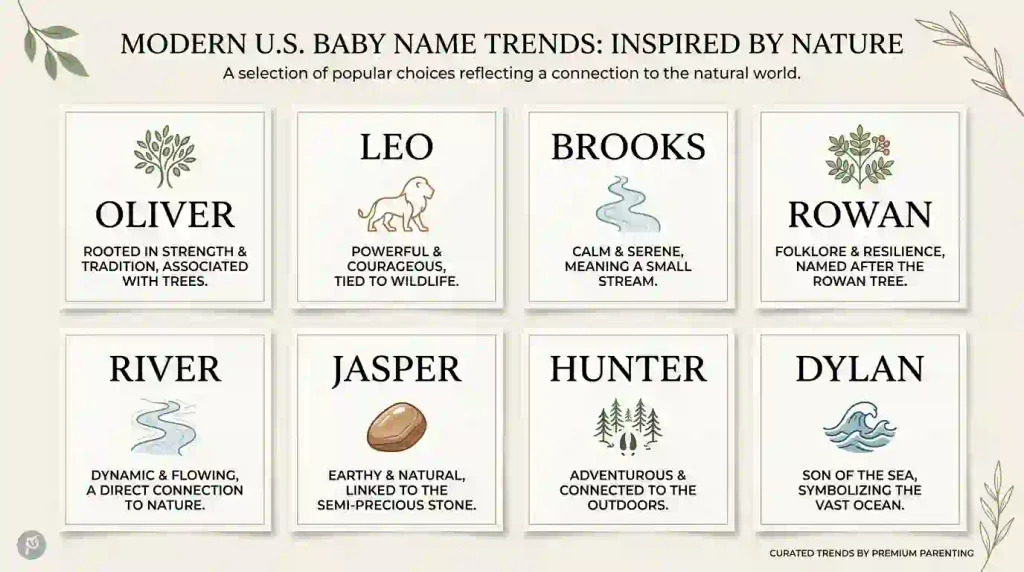
Compare Nature Names for Boys
| Name | Meaning / Nature Connection | Origin | Type | Pronunciation | Gender Usage | U.S. Style |
| Oak | Oak tree | English | Direct tree | OHK | Mostly masculine modern use | Rare |
| Ash | Ash tree when used as word name | English | Direct tree | ASH | Unisex | Uncommon |
| Forest | Forest | English | Direct woodland | FOR-ist | Masculine | Uncommon |
| Forrest | Lived near a forest | English surname | Woodland surname | FOR-ist | Masculine | Familiar |
| Rowan | Irish name; also rowan tree reference | Irish/English | Mixed direct/association | ROH-en | Unisex | Popular |
| Cedar | Cedar tree | English | Direct tree | SEE-der | Unisex | Rare |
| Erez | Cedar | Hebrew | Direct tree | EH-rez | Masculine | Rare |
| Brin | Juniper | Slovene | Direct botanical | BREEN | Masculine | Rare |
| Sage | Herb / wise person | English | Botanical/virtue | SAYJ | Unisex | Established |
| Basil | Historical name means royal; herb association separate | Greek/English | Modern botanical association | BAZ-el | Masculine | Rare |
| Heath | Person from a heath | English | Landscape surname | HEETH | Masculine | Familiar |
| Linden | Linden tree | German/Dutch surname | Tree-derived | LIN-den | Unisex | Uncommon |
| River | River | English | Direct water | RIV-er | Unisex | Popular |
| Brooks | From Brook surname | English | Water/surname | BROOKS | Masculine | Popular |
| Ocean | Ocean | English | Direct water | OH-shun | Unisex | Uncommon |
| Dylan | Tide/flow elements | Welsh | Water-rooted | DIL-en | Mostly masculine | Very familiar |
| Caspian | Caspian Sea association | Geographic/literary | Water/place | KAS-pee-en | Masculine | Established modern |
| Kai | Meaning depends on origin | Multiple | Origin-dependent | KYE | Mostly masculine in U.S. | Popular |
| Flint | Flint stone | English | Direct stone | FLINT | Masculine | Rare |
| Clay | Lived near/worked with clay | English surname | Earth | KLAY | Masculine | Familiar |
| Peter | Stone | Greek | Direct stone | PEE-ter | Masculine | Classic |
| Jasper | Traditional name; gemstone association | English/Dutch | Modern stone association | JAS-per | Masculine | Popular |
| Onyx | Onyx gemstone | English word | Direct stone | ON-iks | Mostly masculine modern use | Uncommon |
| Ridge | Ridge landform | English | Direct landscape | RIJ | Masculine | Modern |
| Summit | Mountain summit | English | Direct landscape | SUM-it | Mostly masculine modern use | Rare |
| Sky | Sky | English | Direct sky | SKYE | Unisex | Uncommon |
| Skye | Sky variant / Scottish island | English/Scottish association | Sky/place | SKYE | Unisex | Established |
| Storm | Storm | English | Direct weather | STORM | Unisex | Rare |
| Zephyr | West wind | Greek | Direct weather/mythology | ZEF-er | Masculine | Rare |
| Akash | Sky, open space | Sanskrit | Direct sky | ah-KAASH | Masculine | Rare nationally |
| Orion | Constellation/mythological hunter | Greek | Celestial association | oh-RYE-en | Masculine | Established |
| Phoenix | Mythical bird; dark-red root | Greek/English | Wildlife/fire/color | FEE-niks | Unisex | Established |
| Wolf | Wolf | English/Germanic association | Direct animal | WULF | Masculine | Rare |
| Bear | Bear | English | Direct animal | BAIR | Masculine | Uncommon |
| Fox | Fox | English | Direct animal | FOKS | Mostly masculine | Uncommon |
| Hawk | Hawk | English | Direct bird | HAWK | Masculine | Rare |
| Wren | Wren songbird | English | Direct bird | REN | Unisex | Feminine-leaning |
| Leo | Lion | Latin | Direct animal | LEE-oh | Masculine | Very popular |
| Ronan | Little seal | Irish | Direct animal | ROH-nan | Masculine | Established |
| Hunter | Hunter | English | Outdoor occupation | HUN-ter | Mostly masculine | Popular |
| Wilder | Wild, untamed | English surname | Wilderness association | WYLE-der | Masculine | Modern |
| August | Great/venerable; month association | Latin | Seasonal association | AW-gust | Masculine | Popular |
| Winter | Winter season | English | Direct season | WIN-ter | Unisex | Feminine-leaning |
| Reed | Surname usually “red”; plant association separate | English | Modern plant association | REED | Masculine | Established |
| Asher | Happy, blessed | Hebrew | Not literal nature | ASH-er | Masculine | Very popular |
| Oliver | Possibly olive tree; alternate origins proposed | Old French | Possible botanical | OL-iv-er | Masculine | #3 in 2025 |
| Silas | Origin uncertain/possibly related to Silvanus | Biblical/Greek/Latin | Indirect woodland theory | SYE-las | Masculine | Popular |
| Leif | Heir, descendant | Old Norse | Not “leaf” | LAYF/LIFE varies | Masculine | Uncommon |
How to Choose a Nature Name for Your Boy
Nature lists can become overwhelming because nearly any natural object could theoretically become a modern word name.
The better question is not “How many nature names exist?”
It is “Which type of nature connection feels right for our family?”
Decide Between a Direct or Subtle Nature Connection
Direct choices include:
- River
- Oak
- Cedar
- Ocean
- Wolf
- Bear
- Sky
- Storm
- Flint
- Wren
Nobody needs to research them to understand the imagery.
Subtle choices include:
- Peter — stone
- Leo — lion
- Dylan — tide/flow
- Linden — linden tree
- Ronan — little seal
- Akash — sky
- Erez — cedar
- Brin — juniper
- Zephyr — west wind
Then there are association-based names:
- Jasper — gemstone
- Caspian — Caspian Sea
- Orion — constellation
- Phoenix — mythical bird/fire/rebirth
- Skye — sky/island
- Oliver — possible olive connection
- Rowan — Irish name plus modern tree reference
Some parents prefer the clarity of River.
Others like discovering that Peter quietly means stone.
Neither is inherently better.
Consider the Name’s Sound, Spelling, and Nicknames
Say the name naturally.
River James
Rowan Alexander
Cedar Thomas
Jasper Miles
Leo Benjamin
Flint Alexander
Dylan Brooks
Caspian Reed
Then consider everyday nicknames.
Rowan may become Ro.
Jasper may become Jas or Jazz.
Oliver almost inevitably invites Ollie.
Forest might become Forry, though many families would use it in full.
Caspian can shorten to Cas.
Linden can become Lindy or Lin.
If you dislike the obvious nickname, think carefully before choosing the formal name.
See How It Works With Middle and Last Names
Nature names can sound especially good when balanced with a conventional middle name.
Compare:
River Alexander Bennett
with:
River Ocean Storm
The first lets River stand out.
The second may feel intentionally themed.
There is nothing wrong with a strongly themed name, but consider how it will sound outside childhood.
A direct nature name often benefits from a traditional middle.
Conversely, a traditional first name can carry a more adventurous nature middle:
James River Carter
Thomas Wolf Bennett
Alexander Cedar Hayes
Peter Fox Morgan
Leo Flint Walker
That approach is especially useful when you love a bold nature name but are unsure about using it as the everyday first name.
Nature Name Pairings
Here are combinations that balance meaning, rhythm, and style.
Woodland Pairings
Rowan James — tree association + classic middle
Cedar Alexander — evergreen tree + traditional strength
Forest Elias — woodland + flowing biblical middle
Linden James — tree-rooted surname name + classic middle
Oak Benjamin — minimal tree name + longer traditional middle
Erez Nathaniel — cedar + traditional biblical middle
Water Pairings
River James — modern nature + classic
Dylan Brooks — tide/flow + stream surname
Ocean Alexander — expansive water imagery + formal middle
Caspian James — sea geography + traditional balance
Brooks Daniel — water surname + classic middle
Earth and Stone Pairings
Flint Alexander — hard stone + classic
Clay Benjamin — earth + traditional middle
Jasper Thomas — gemstone association + classic
Peter Onyx — stone + dark gemstone
Ridge Samuel — landscape + biblical middle
Sky and Weather Pairings
Orion James — constellation + classic
Zephyr Alexander — west wind + formal middle
Sky Benjamin — open sky + traditional middle
Storm Elias — dramatic weather + softer middle
Akash Daniel — sky + cross-cultural classic
Wildlife Pairings
Leo River — lion + water
Ronan James — little seal + classic
Wolf Alexander — direct animal + formal middle
Bear Thomas — direct wildlife + classic
Fox Benjamin — short animal name + longer middle
Wren Alexander — songbird + formal middle
Nature Plus Character Pairings
A nature first name can be paired with another semantic value.
Rowan Felix can combine woodland imagery with good fortune.
River Clement combines water with gentleness.
Flint Conrad pairs stone with bravery.
Leo David combines lion imagery with “beloved.”
Cedar Tobias pairs a tree with a name meaning “Yahweh is good.”
If meaning across both names matters, you may also explore boy names that mean goodness, boy names that mean beauty and love, or boy names that mean wealth.
Frequently Asked Questions About Nature Names for Boys
What are good nature names for boys?
River, Rowan, Leo, Cedar, Forest, Brooks, Jasper, Dylan, Flint, Oak, Ronan, Zephyr, Erez, and Akash are strong nature-inspired choices with different levels of directness.
What is a name that means nature?
Few common masculine names literally mean the broad concept “nature”; most nature names instead mean a specific natural thing such as forest, river, sky, stone, tree, or animal.
What is a boy name that literally means forest?
Codrin comes from Romanian codru, “forest,” while Forest itself can be used directly as an English word name.
What boy name means tree?
Cedar directly names a tree, Erez means “cedar” in Hebrew, Brin means “juniper” in Slovene, and Linden derives from the linden tree.
What boy name means sky?
Akash means “open space, sky” in Sanskrit, while Sky is a direct modern English word name.
What boy name means stone?
Peter comes from Greek petros, meaning “stone.”
What boy name means lion?
Leo directly comes from Latin leo, meaning “lion.”
What boy name means seal?
Ronan comes from Irish Rónán and means “little seal.”
What boy name means cedar?
Erez means “cedar” in Hebrew.
What are strong or earthy names for boys?
Oak, Flint, Clay, Stone, Wolf, Bear, Ridge, Peter, Jasper, Cedar, and Summit all have solid earth or wilderness imagery.
What are good water names for boys?
River, Brooks, Ocean, Dylan, Caspian, and Calder all have genuine water or geographic-water associations.
Is Rowan really a tree name?
Rowan has an Irish personal-name origin, but modern English Rowan can also be chosen directly in reference to the rowan tree.
Does Asher mean ash tree?
No; the Hebrew masculine name Asher means “happy, blessed,” though an unrelated English surname Asher can refer to someone who lived near an ash tree.
Does Oliver mean olive tree?
Possibly; an olive-tree derivation is a major theory, but Germanic and Old Norse origins have also been proposed.
Does Silas mean forest?
Not securely; Silas may be related to Silvanus, which has a forest root, but Silas has other possible linguistic explanations.
Does Kai mean ocean?
Some unrelated forms or cultural uses of Kai have sea-related meanings, but the familiar European masculine Kai has an uncertain origin, so the meaning depends on the specific tradition.
Does Leif mean leaf?
No; Old Norse Leif means “heir” or “descendant,” despite its similarity to the English word leaf.
Does Reed mean the plant?
The English word reed names the marsh plant, but the traditional surname Reed usually comes from an Old English word meaning “red.”
Does Basil mean the herb?
The traditional masculine name Basil comes from Greek and means “royal, kingly”; modern parents may separately associate its spelling with the herb.
Does Jasper mean gemstone?
The old personal name probably has a different etymology, but modern Jasper can legitimately be chosen in reference to the gemstone.
Is Caspian a nature name?
Yes as a geographical nature name, because it refers to the Caspian Sea; claims that it literally means “sea” are less accurate.
Are nature names too trendy?
Some are currently fashionable, but many—such as Peter, Leo, Dylan, Heath, and traditional botanical or animal names—have histories much older than current trends.
Can a nature name work as a middle name?
Yes; bold names such as Wolf, Bear, River, Cedar, Flint, Storm, or Fox often work particularly well as distinctive middle names.
Are nature names gender-neutral?
Many modern word names—including River, Rowan, Sky, Ocean, Sage, Cedar, Storm, and Wren—are used across genders, although actual usage may lean one way.
What are rare nature names for boys?
Erez, Brin, Codrin, Sylvan, Zephyr, Cedar, Flint, Bosco, Akash, Summit, and Grove are distinctive options in the United States.
What is a soft nature name for a boy?
Rowan, River, Linden, Dylan, Ronan, Ocean, Kai, Sage, and Caspian have softer sounds than rugged names such as Flint, Wolf, or Ridge.
What is a strong tree name for a boy?
Oak is the most direct strong tree word name, while Cedar and Erez provide evergreen alternatives.
What nature names have celestial meanings?
Sky, Akash, Orion, Leo, Sol, Elio, Phoenix, Chandra, and other lunar or stellar names all connect with the sky or celestial world.
How can I check whether a boy’s name has a verified nature meaning?
Identify the original language, check the historical root, distinguish literal meaning from symbolism, and verify international names in their native spelling or characters.
Final Thoughts
The best boy names that mean nature do more than sound outdoorsy—they have a connection you can explain accurately. River, Ocean, Cedar, Oak, Flint, Sky, Wolf, Wren, and Forest make their natural imagery obvious, while Peter, Leo, Dylan, Ronan, Linden, Akash, Erez, and Brin hide meaningful stone, animal, water, sky, and botanical roots inside established personal names. Rowan, Jasper, Oliver, Kai, Caspian, Phoenix, Reed, Basil, and Silas can also work beautifully, but their nature connections require more nuance.
Start by deciding whether you prefer woodland, water, earth, weather, wildlife, celestial, seasonal, or adventure imagery. Then narrow the list by pronunciation, cultural context, popularity, nickname potential, and how each name sounds with your surname. The strongest nature name is the one whose story feels genuine—not simply the one with the most attractive definition online.
References
Name meanings and origins in this guide were cross-checked using established etymological and onomastic references, including Behind the Name and original-language information where available. U.S. popularity references use the Social Security Administration national baby-name data. Astronomy-related name associations are checked against NASA, while U.S. landscape and outdoor terminology can be cross-checked with National Park Service resources.